Louisiana
Pressed on Ten Commandments displays, Louisiana governor gives bad advice


Gov. Jeff Landry seems to realize that he’s created a controversy by requiring every public school classroom in the state to promote the Protestant version of the Ten Commandments. But the Louisiana Republican told reporters earlier this week, “I don’t see what the whole big fuss is about.”
As NBC News reported, the first-year governor also had some related advice for families who prefer religiously-neutral public education:
Louisiana Gov. Jeff Landry has a suggestion for parents who don’t believe the Ten Commandments should be displayed in public school classrooms throughout the state. “Tell your child not to look at them,” he told reporters Monday.
Whether the Louisiana Republican is aware of this or not, this is a familiar argument with an unfortunate history.
Before U.S. Supreme Court rulings in the middle of the 20th century protecting the separation of church and state, it was common in many parts of the country for public schools to promote religious symbols, practices and prayers. If students and their families weren’t part of the local majority on matters of faith, they heard advice similar instructions to the one Landry offered this week.
You’re part of a Jewish family in a public school that promotes Christianity? Tell your child to go wait in the hall while the rest of the class recites a Christian prayer. You’re a Catholic student in a school promoting the Protestant version of the Ten Commandments? Your parents can simply tell you to avert your eyes as the state government promotes its preferred sacred text.
The far-right governor may be confused about “the whole big fuss,” but in the United States, there’s no reason to turn back the clock to an era in which public officials intervened in children’s religious upbringing, communities fought over whose religion would be favored, and kids from minority traditions were told to tolerate being treated as second-class students.
The underlying principle couldn’t be simpler: It’s not the job of politicians in state government to endorse and promote the tenets of a preferred religion. Schools can and should remain neutral on matters of faith. Why Landry and his cohorts would want government officials to interfere in matters better left to families remains something of a mystery.
When the Republican first created this law in June, requiring Decalogue displays in all public classrooms — from kindergarten to state-funded universities — Landry declared, “If you want to respect the rule of law, you’ve got to start from the original law giver, which was Moses.”
In reality, of course, if Louisiana Republicans want to respect the rule of law, they have to start with their own country’s Constitution, which includes the First Amendment, and to honor U.S. Supreme Court precedent, which GOP officials in the state have decided to ignore.
This post updates our related earlier coverage.


SHREVEPORT, La. (KSLA) – Attack ads aimed at Louisiana Treasurer John Fleming and U.S. Rep. Julia Letlow have been running for weeks as the two Republicans compete in the race for Louisiana’s open U.S. Senate seat.
Fleming said political action committees have been “running dishonest attack ads for two weeks solid,” including ads he said connect him to the Sept. 11 attacks.
“I fully expect at some point they would connect me to the assassination of Lincoln,” Fleming said.
Letlow said she wants negative campaigning to stop.
“I’ve had $15 million dropped on my head in negative ads, and I understand that’s why people won’t run,” Letlow said.
Carbon capture has also been a major issue in the race. Carbon capture is described in the report as a process in which carbon dioxide from industrial installations or natural resources is separated before it is released into the atmosphere and then transported to a long-term storage location.
Fleming said he opposes carbon capture. Letlow said claims about her position have been misrepresented.
What Fleming, Letlow say on carbon capture
“I want a good economy for Louisiana, but there are things we have to do like lowering taxes, reducing insurance rates to get better business — not by a toxic dump of carbon dioxide,” Fleming said, referencing what he called “Julia Letlow and Jeff Landry’s method” of pursuing economic growth.
Letlow said she does not support projects that are not safe or lack community support.
“If the project is not safe, if it does not have community finance, I believe it should not move forward,” Letlow said. She also said she appreciates “the governor’s moratorium on the projects until they can be fully vetted,” and told voters not to believe what they read on social media.
Candidate backgrounds highlighted in the report
The report said Fleming previously served in Congress and was appointed to several positions in the Trump administration. Fleming is described as a Minden native, a Navy veteran, a physician and a businessman.
Fleming said he is mostly funding his own campaign.
“I can’t be bought,” Fleming said. “I stand for the individual people.”
The report said Letlow is a Monroe native. It said she ran in a 2021 special election for a vacant congressional seat previously held by her late husband, Luke Letlow, who died from COVID.
Letlow said her priorities include safe communities, border security and growing the economy.
“I want those safe communities for our kids,” Letlow said. “I will continue working with the president to make sure our border remains secure. I also want to grow our economy.”
Copyright 2026 KSLA. All rights reserved.
Louisiana
Q&A: Louisiana U.S. Senate candidates sound off on important issues ahead of primary runoff

Louisiana heads to the polls again on Saturday, June 27, as both Republicans and Democrats will hold party primary run-offs for Bill Cassidy’s U.S. Senate seat. Polls open at 7 a.m. and close at 8 p.m.
Republican voters will choose between Congresswoman Julia Letlow and state Treasurer John Fleming, while Democratic voters will choose between Jamie Davis, the state party’s endorsed candidate in the race, and Gary Crockett, who faces Davis after Nick Albares ended his campaign in late May.
Below is a list of questions WRKF sent to the four candidates and their responses. The responses have been edited and condensed for clarity.
Louisiana’s primary is this Saturday, May 16. See what’s on the ballot.
Gary Crockett (Democrat)
Photo courtesy of Gary Crockett
On abortion:
I am Moderate/pro-choice. I support legal abortion in some circumstances. I oppose total abortion bans. I absolutely support exceptions for rape, incest, and threats to the mother’s life. I am in favor of preserving access but totally against 3rd trimester abortions unless the woman’s life is in jeopardy.
On the death penalty:
I’m a moderate when it comes to the death penalty, and my view is to “keep it for the worst offenders” and allow for conclusive DNA testing for all who are sentenced to death.
On President Donald Trump:
I have strong opposition to Trump because his policies don’t work for the people who work.
The working-class people are suffering economically because Trump’s policies only benefit billionaires and large corporations.
Trump should spend more time focusing on economic and governance issues rather than filling the pockets of himself and his family.
On ‘The Epstein Files’
I call for the immediate release of non-sensitive records consistent with the law.
I support the investigation of wrongdoing regardless of political affiliation or person, including videos and files implicating the president.
I call for equal justice under the law with no actions or procedures to protect powerful individuals.
On carbon sequestration
I do not support research and deployment of carbon-capture technologies.
I reject the idea and any rhetoric that presents carbon sequestration as the only climate solution.
On DEI (Diversity, Equity, and Inclusion)
America has many mountains to climb in the areas of equal opportunity and anti-discrimination efforts.
Despite emphasizing merit, skills, and fairness, the current Secretary of Defense and this administration have discriminated against members of our own forces for promotions, even after passing several boards in which their counterparts took the same testing and were evaluated equally, but only minorities were refused promotions.
I want mandates ensuring everyone has a fair chance while maintaining standards.
What are your proudest accomplishments?
I am most proud of my 20+ years of military service and being a father of 4 great children.
What will be your top three priorities in office?
The economy, which includes increasing the minimum wage, creating opportunities, both economic and social, for our next generation of young people, and a better and more robust healthcare system for all — especially the rural areas of America.
Jamie Davis (Democrat)

Greg LaRose
/
Louisiana Illuminator
On abortion:
We flattened all of women’s healthcare into one issue, and it made many women less safe.
Politicians and laws shouldn’t be in the room with a woman and her doctor.
Since the Supreme Court struck down Roe, women have died on operating tables because doctors have been afraid to help.
We should restore women’s right to healthcare, trust them as the mothers to make important family and personal decisions, codify Roe, and keep the government out of their business.
On the death penalty:
It is not up to us to decide whether someone lives or dies. There is no moral justification. We are not the most high.
I agree with punishments that fit the crime, but when did we become the judges of whose lives we take vs. who we allow to live?
On President Donald Trump:
He’s the president for two more years, and here’s what I know.
A lot of Louisiana voters believed in him, and I think he’s let them down and left them with empty promises.
On ‘The Epstein Files’
They need to be released, and people should face consequences.
There are too many distractions flying around D.C., but if I’m elected, I’ll be another voice advocating for justice for the survivors.
On carbon sequestration
Decisions about our land, water, and future should not be made solely at the state or federal level without local consent.
Communities deserve the final say when projects threaten their property rights, safety, and quality of life.
I oppose CCS by way of eminent domain to seize private property for carbon pipelines.
No family should be forced to give up their land so corporations can profit from taxpayer-backed projects.
I also support repealing the federal 45Q tax credit, which has subsidized CCS projects while shifting the risks onto local communities.
Instead of spending taxpayer dollars on carbon capture schemes, we should invest in clean energy, infrastructure, and economic development that create good-paying jobs without putting Louisiana communities in harm’s way.
On DEI (Diversity, Equity, and Inclusion)
According to President Trump and the U.S. Supreme Court, DEI is over with.
We need to get serious and focus on ensuring everyone has a fair shot at making a living.
What are your proudest accomplishments?
I was the first person in my immediate family to graduate from high school, something that meant a great deal to my parents and opened doors for me that they never had.
In my early 20s, my father had to undergo back surgery during the farming season. Successfully managing the farm and bringing in the crop while he recovered gave me confidence and taught me the value of responsibility, hard work, and perseverance.
I am also proud of my service to my community. When I was elected to the Tensas Parish Police Jury, I unseated the longest-serving police juror in the State of Louisiana, proving that hard work, determination, and a willingness to listen to people can bring about meaningful change.
Through each of these experiences, my faith, family, and commitment to service have guided me and continue to shape the way I approach leadership today.
Above all, I am proud of my family. Becoming a husband, father, and grandfather has been the greatest blessing of my life.
What will be your top three priorities in office?
My top three priorities are affordability, healthcare, and opportunity.
First, I will work to lower the cost of living by addressing the rising costs of housing, insurance, utilities, and everyday necessities while supporting family farms, small businesses, and good-paying jobs.
Second, I will fight to protect healthcare by defending Medicaid, strengthening rural hospitals at risk of closing, lowering prescription drug costs, and protecting Social Security and Medicare and the subsidies that keep premiums affordable.
I will address opportunity in a few ways:
- First, invest in education, higher federal minimum wages, and workforce development, so that every Louisianan has the opportunity to succeed and build a future here at home.
- I will also push for a national ban on partisan gerrymandering so that we get elected officials away from drawing maps and back to solving problems and working together. Every American deserves fair representation and a voice that matters. They also deserve to know their elected official is accountable to them, not scheming to draw voters they don’t like into another district.
- Lastly, I will fight for a strong Farm Bill that supports family farmers, improves and expands SNAP benefits, strengthens rural communities, improves crop insurance and safety nets, and ensures that those who feed our country can continue to make a living on the land.
My goal is simple: to help create a Louisiana we can all afford and an economy that works for everyone.
State Treasurer John Fleming (Republican)

Photo courtesy of John Fleming
On abortion:
100% opposed to abortion. I have a 100% voting record in opposition to abortion.
On the death penalty:
I support the death penalty, especially in capital cases.
On President Donald Trump:
I fully support President Trump
On ‘The Epstein Files’
I support full release and disclosure
On carbon sequestration
I am totally opposed and never voted for Carbon Sequestration
On DEI (Diversity, Equity, and Inclusion)
Totally opposed and never voted for DEI.
Legislation you are most proud of and why?
- Amtrak Secure Transportation of Firearms Act of 2009. The bill required Amtrak to permit passengers to safely transport unloaded firearms and ammunition in declared, locked, hard-sided containers within checked baggage
- Federal Duck Stamp Act of 2014, which increased the price of the federal Migratory Bird Hunting and Conservation Stamp (Duck Stamp) from $15 to $25 to generate critical funding for wetland conservation
- Passed an amendment to the annual NDAA to prevent atheists from being hired in the military as chaplains.
How do you feel your record is viewed in Congress?
- The most conservative of any congressman in Louisiana, according to voting scorecards.
- One of the nine original founders of the House Freedom Caucus.
- Led the fight against the Affordable Care Act, which has driven healthcare costs to twice the rate of inflation.
What are your proudest accomplishments?
Fighting against abortion and ultimately reducing the rates of abortion as well as getting the right justices to make abortion a state issue, not a federal right.
What will be your top three priorities in office?
- Repeal the 45Q tax credits to end Carbon Sequestration.
- Reform healthcare to bring back competition and price transparency so that costs go down while quality of care improves.
- Serve on the Senate Armed Services Committee to support our national defense and defend our two major military bases in Louisiana.
Congresswoman Julia Letlow (Republican)
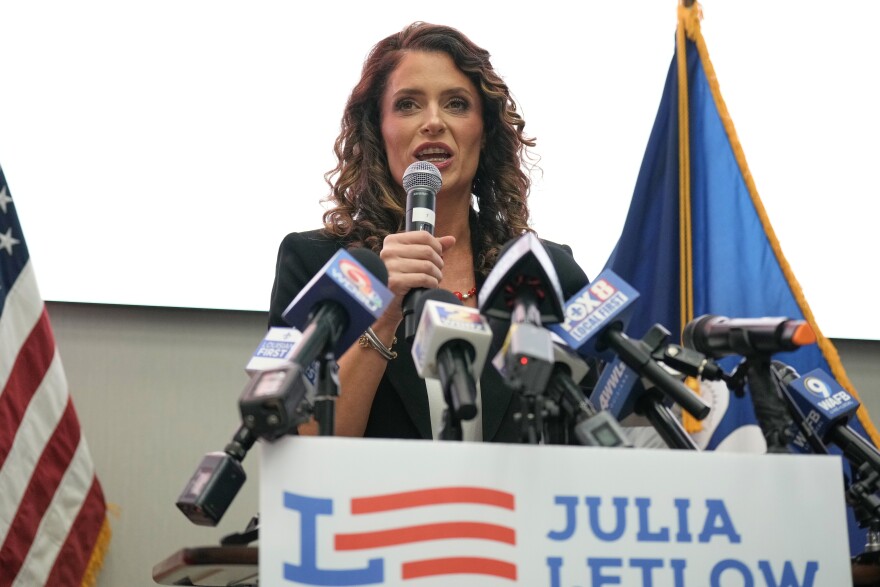
Matthew Hinton
/
AP Photo
On abortion:
I am unapologetically pro-life. As a mother, I believe every life is precious and worth protecting.
In Congress, I have consistently opposed taxpayer funding for abortion and supported legislation that defends the unborn.
In the Senate, I will continue to be a strong, unwavering pro-life voice for Louisiana families.
On the death penalty:
I support the death penalty for the most heinous crimes. There are evil acts so horrific that the ultimate punishment is justified.
I also believe victims and their families deserve justice, and I will always stand with law enforcement and those who work to keep our communities safe.
On President Donald Trump:
President Trump called on me to run for this Senate seat because he knows I’m conservative to my core and will always have his back.
I was honored to earn his complete and total endorsement, and I look forward to being his partner in the Senate to secure the border, unleash American energy, protect our values and finish the America First agenda.
On ‘The Epstein Files’
The American people deserve transparency and accountability. Anyone who committed crimes should be prosecuted to the fullest extent of the law.
The Department of Justice should follow the facts wherever they lead and ensure justice is served.
On carbon sequestration
I support Gov. Landry’s moratorium on new CCS permits.
My position is simple: if a project is not safe, not transparent, and does not have local buy-in, it should not move forward.
This is a state issue, and I trust Gov. Landry and our legislature to put the right protections in place for Louisiana communities.
On DEI (Diversity, Equity, and Inclusion)
Like many Americans, I initially saw DEI being presented as a way for students to achieve the American dream. But the radical left turned it into a system of division, indoctrination, and holding people down.
In Congress, I have fought against it every single day by authoring the Parents’ Bill of Rights to strip DEI from our K-12 programs, supporting the End Woke in Higher Education Act, and voting to remove DEI programs from the military.
I will continue to fight against DEI in the U.S. Senate.
Legislation You Are Most Proud Of and Why?
The legislation I’m most proud of is the Parents’ Bill of Rights.
As a mother and former educator, I believe parents should have a seat at the table when it comes to their children’s education.
The bill gives parents greater transparency into curriculum, school budgets, and what is happening in their children’s classrooms. It puts families back in charge and protects children from political agendas that don’t belong in schools.
How Do You Feel Your Record Is Viewed in Congress?
I think my record is viewed as one of someone who shows up, does the work and delivers results.
I’ve served on the Appropriations Committee, brought hundreds of millions of dollars back to Louisiana communities, fought for parents, supported our farmers and law enforcement officers and stood with President Trump.
I’ve earned a reputation as a conservative who gets things done and listens to the people whom I serve.
What Are Your Proudest Accomplishments?
I’m proud of the Parents’ Bill of Rights.
I’m proud of the work we’ve done to support Louisiana agriculture, including getting legislation I authored included in the Farm Bill.
I’m proud of the resources I’ve helped deliver to Louisiana communities for infrastructure, healthcare, and public safety.
And most importantly, I’m proud to have earned the trust of the people of Louisiana and President Trump.
What Will Be Your Top Three Priorities in Office?
First, border security and public safety. We must make President Trump’s border policies permanent, deport criminal illegal aliens, stop fentanyl and support law enforcement.
Second, growing Louisiana’s economy. That means unleashing American energy, cutting wasteful spending, lowering costs, supporting our farmers and fishermen and creating more good-paying jobs.
Third, education and families. I’ll continue fighting for school choice, parents’ rights, transparency in education and protecting girls’ sports and opportunities for the next generation.
Those three priorities all come back to one goal: making Louisiana safer, stronger, and more prosperous for our children and grandchildren.

MONROE, La. (KNOE) – The Federal Emergency Management Agency (FEMA) announced that federal funding for hazard mitigation projects is available to address flood, earthquake and wildfire threats. This funding will allow states to take proactive steps to protecting their communities from future disasters.
The funding for these projects has been made available through FEMA’s Pre-Disaster Mitigation grant program, with 40 states and one Tribal Nation expected to receive more than $189 million in federal funding for 125 projects.
Identified projects in FEMA Region 6 include:
- $6 million for I-20 South Frontage Road drainage improvements for the Ouachita Parish Police Jury
- $900,000 for the pump station for the town of Lake Arthur
- $1.5 million to the Department of Homeland Security and Emergency Management for portable backup generators and water support
- $750,000 for the Boyd Lining Project in the city of Bloomfield
- $262,000 for emergency siren warning system upgrades for Roosevelt County, Texas
- $1.5 million for a high hazard dam project in the city of Gladewater
- $1.1 million for emergency disaster energy hubs for the city of Austin
- $1.1 million for the Cypress Ditch Improvement Project in the city of Bellaire
- $1.1 million for the Alberta Avenue storm and domestic water improvements project for the El Paso County Hospital District
- $1.1 million for Tributary C116-00-00 conveyance and drainage improvements for the Harris County Flood Control District
- $827,000 for the underpass flooding early warning system improvements in the city of Beaumont
Before funds are awarded, these communities must submit an application by July 22, 2026, by 5 p.m. Eastern time.
Nationwide, FEMA expects to distribute $189M for 125 projects
Applications must be submitted through FEMA Grants Outcomes (FEMA GO), the agency’s grants management system. For more information, review the Notice of Funding Opportunity on Grants.gov.
Copyright 2026 KNOE. All rights reserved.
-

 Oregon53 seconds ago
Oregon Announces $49 Million Payout to Inmates for Handling of Pandemic
-

 Pennsylvania8 minutes ago
Pa. sees growth in over-65 residents, but overall population stagnates
-

 Rhode Island11 minutes ago
GETTING SUPPORT AT THE FORT – Jamestown Press
-

 South-Carolina16 minutes ago
250 years later, Revolutionary War artifacts still tell South Carolina's story
-

 South Dakota23 minutes ago
US Rep. Dusty Johnson looks ahead after primary defeat
-

 Tennessee26 minutes ago
Tennessee Republicans unveil monument honoring unborn children at State Capitol
-

 Texas31 minutes ago
USDA reports screwworm spread in Texas
-
Utah38 minutes ago
Edwin Munk Woolley — Obituary | Larkin Mortuary


