Louisiana
Louisiana environmental activist loses freedom of speech lawsuit against parish officials


NEW ORLEANS (AP) — Louisiana parish officials who threatened to arrest and imprison an environmental activist as she attempted to speak during a public meeting did not violate her right to freedom of speech, a unanimous civil jury ruled Wednesday.
Joy Banner had sought more than $2 million in damages from two St. John the Baptist parish officials — Parish President Jaclyn Hotard and councilmember Michael Wright — who she said blocked her from raising allegations of corruption tied to industrial development at a public meeting. While Banner’s attorneys said the case had important implications for protecting outspoken citizens from government censorship, lawyers representing the parish said they were model officials trying to curtail disruption and keep the meeting on track.
The case is part of a broader series of disputes playing out in courts and public hearings between grassroots community groups and Louisiana officials over industrial expansion in the 85-mile (136-kilometer) chemical corridor between Baton Rouge and New Orleans, often referred to by environmental activists as “Cancer Alley” because of its high pollution levels.
Trusted news and daily delights, right in your inbox
See for yourself — The Yodel is the go-to source for daily news, entertainment and feel-good stories.
Banner, co-founder of the environmental and racial justice organization The Descendants Project, gained a national reputation fighting against an $800 million grain terminal slated for her predominantly Black community in St. John the Baptist parish. The project was later aborted.
In a November 2023 parish council meeting, Banner sought to oppose an agenda item introduced by Hotard to use taxpayer funds for a lawyer to defend parish officials from ethics complaints. The state ethics board had launched an investigation after Banner filed a complaint pointing out that Hotard’s mother-in-law, Darla Gaudet, owned a marine transport company that owned land near the proposed site for the grain terminal.
As Banner began to discuss these concerns during the public comment period, councilmember Michael Wright repeatedly banged his gavel and both he and Hotard told Banner she was not speaking on topic as she made her remarks.
Wright then quoted from an obsolete law under which anyone who publicly shared testimony given to a state ethics board investigation could be subject to one year of imprisonment. A federal judge deemed the law unconstitutional years ago.
“When I heard the words imprisonment and misdemeanor, I thought, ‘That’s it, I’m going to jail, I’ve messed everything up, my business is going to be ruined, my name is going to be ruined.’ I was terrified and shocked,” Banner later testified.
Ike Spears, the parish officials’ attorney, noted that they had also interrupted and instructed to stay on topic other members of the public who spoke during the public comment period. He described Banner as a “disruptive citizen” striving to become a “social media influencer” and garner media attention from the litigation.
“She wants us to reward this conduct with $2 million plus,” Spears told jurors.
Banner’s attorney William Most countered that her intended comments at the public meeting were “vital” to informing the parish about Hotard’s potential conflicts of interest.
“Joy Banner was treated differently than anyone else: She was the only person threatened with arrest and she was also the only one to raise the issue of Hotard’s family business interests,” Most said. “She was directly on topic.”
Hotard also used vitriolic language to describe Banner, including fantasizing about strangling her, in text messages to her mother-in-law that were introduced as evidence. Most said the messages indicated that Hotard had a personal motivation to shut down Banner’s participation in a public meeting.
The state ethics board ruled last year that Hotard had not violated state ethics laws.
Yet Hotard’s mother-in-law later revealed during a deposition for Banner’s lawsuit that Hotard’s husband is a beneficiary of a trust that owned land overlapping with the planned railroad route leading into the proposed grain terminal.
Spears acknowledged that Hotard would “probably” personally benefit from the grain terminal’s approval. But he said increased tax revenue and good-paying jobs were the parish president’s driving motivation in supporting the project.
Hotard, who was not present for the verdict, did not respond to an emailed request for comment.
The jury sent a “strong message against frivolous lawsuits,” Wright said in an emailed statement to The Associated Press. “This is a significant victory for St. John Parish and a promising sign for businesses and industries considering the River Parishes as their home.”
Juror Cam Owen said he was ready to vote in Banner’s favor following closing arguments. He changed his mind — and came to tears during deliberations — after closely reviewing the facts and video footage of the public meeting, which he described as the “deciding factor” for the jury. Owen said jurors calculated the amount of time Banner was able to speak and concluded she was able to express most of her viewpoint.
“At the end of the day, you know, they did try to stop her, but she did actually say what she had to say,” Owen said.
The jury also ruled that the parish had not violated Louisiana’s open meetings law.
Banner said she had no regrets about bringing the lawsuit and said it uncovered the parish president’s hidden financial interests.
“The purpose of this case was for transparency,” Banner said. “I think it’s important to hold people accountable for the things that we feel are wrong.”
“I hope you can heal,” Eastern District of Louisiana Judge Nannette Jolivette Brown told Banner and the parish officials after the verdict. “This is only one part of the process.”
___
Brook is a corps member for The Associated Press/Report for America Statehouse News Initiative. Report for America is a nonprofit national service program that places journalists in local newsrooms to report on undercovered issues. Follow Brook on X: @jack_brook96.



BATON ROUGE, La. (WAFB) – The Louisiana House passed a bill that would hold parents financially responsible when their children threaten schools.
House Bill 137 would allow courts to fine parents up to $5,000 if a child under 14 is convicted of making a school threat. The bill now heads to the Senate.
The convicted children could also face a mental health exam, up to a year of probation or six months in juvenile detention, and mandatory counseling in a back on track youth program.
Supporters say the measure will deter threats, while critics call it a dangerous precedent.
The proposal is making its way through the legislature as part of the 2026 Regular Legislative Session, which must adjourn no later than 6 p.m. on Monday, June 1.
Click here to report a typo. Please include the headline.
Click here to subscribe to our WAFB 9 News daily digest and breaking news alerts delivered straight to your email inbox.
Watch the latest WAFB news and weather now.
Copyright 2026 WAFB. All rights reserved.
Louisiana
Louisiana could get rid of inspection stickers — in most places. Is your parish on the list?

Drivers in most of Louisiana would no longer need to get inspection stickers under a bill advancing in the Legislature with Gov. Jeff Landry’s support.
Instead, personal vehicles would just need a sticker that lists its vehicle identification number.
Drivers in some parts of the state, however, would still have to get inspections.
New Orleans, Kenner and Westwego have their own rules requiring the stickers — which locals famously call “brake tags” — and those would “still be allowed to continue as they are,” Office of Motor Vehicles Commissioner Keith Neal said.
And, emissions testing would still be required for drivers in several Baton Rouge-area parishes because of a federal air quality order under the Clean Air Act. Those parishes are Ascension, East Baton Rouge, Iberville, Livingston and West Baton Rouge.
Commercial vehicles and school buses would still be required to do regular safety inspections.
House Bill 838, sponsored by Rep. Larry Bagley, R-Stonewall, would set a $6 annual cost for the new VIN sticker, and the fee would be assessed and collected by the Office of Motor Vehicles during registrations and registration renewals.
For example, someone who renews a vehicle registration every two years would pay $12 and someone who renews every four years would pay $24.
“The good thing about it is you won’t have to go get a sticker,” Bagley told members of the House transportation committee. “It’ll simplify many things.”
For most parishes, inspection stickers would no longer be required effective January 1. Starting June 30 this year, law enforcement would be prohibited from issuing citations for not having an inspection sticker.
In the five-parish capital region that’s subject to federal emissions testing requirements, the law would take effect once the Environmental Protection Agency approves the change.
The House transportation committee approved the bill Monday without objection.
Valerie Brolin, a spokesperson for the City of Kenner, said Mayor Michael Glaser would consider whether Kenner should end its brake tag program if HB838 becomes law. “Kenner’s not going to independently do it on its own,” she said.
What the new stickers would do
The new stickers would contain a QR code that, when scanned, lists the VIN.
“The only thing that’ll be in that QR code is the VIN,” Evelina Broussard, chief information officer for the state’s Office of Technology Service, told lawmakers on Monday.
Bagley in an interview said having the 17-digit VIN accessible to law enforcement through a QR code allows them to more easily enter it into the systems they use for ticketing or other searches, rather than enter it manually.
Landry called for eliminating inspection stickers in his “State of the State” speech to open the legislative session earlier this month.
“It’s time to eliminate the inspection sticker and stop this major inconvenience for Louisiana drivers!” Landry posted on X Monday after the bill passed out of committee.
Landry previously said the state may eventually use the sticker to display insurance coverage information.
Asked about the plan to display insurance information, Bagley said it is not currently part of the legislation, though it “possibly could” be in the future.
Bagley, who has served as a state representative for 11 years, said he’s been trying to pass the legislation since his second year at the Capitol.
Landry’s support of the measure is what’s made the difference this year, he said.
“He’s saying he’s going to change Louisiana for the better, we’re going to see a lot of changes,” Bagley said of Landry. “This is one of them.”
Bagley said so far this year there’s been no opposition to his bill.
“Why would you want to fight a first-term governor that’s popular when you know there’s probably not much you can do,” he said.
Louisiana
Entergy Louisiana’s claim customers will save thanks to Meta deal greeted with some skepticism

NEW ORLEANS (WVUE) – Meta is building a multi-billion dollar data center in northeast Louisiana and Entergy Louisiana is a huge part of the project’s equation.
“We did reach agreement with Meta to expand or have a new agreement, actually, for the data center at their Richland Parish site,” Phillip May, CEO of Entergy Louisiana told Fox 8 on Monday (March 30).
“This new agreement will require us to build seven new generators. Each of those generators will be about 750 megawatts each. So, about 5,200 megawatts of new, efficient, modern gas-fired generation.”
May pointed to other benefits.
“That generation will come with hydrogen capability and carbon-capture availability as well, as well as additional 2,500 megawatts of solar, three separate battery projects, and up rates on our nuclear plant,” May said.
May said the agreement with Meta ultimately will benefit Entergy Louisiana customers by $2 billion.
“This thing is structured to save our customers over $2 billion, over the life of the 20-year contract,” he said. “And Meta is fully paying for the cost associated with these assets over that 20-year period.”
He was asked how what Entergy plans to generate for Meta, in terms of megawatts, compares to what it is generating now for other customers.
“This amount of generation is about 50% more than is currently deployed by Entergy Louisiana,” May said.
But the deal concerns the utility watchdog Alliance for Affordable Energy.
“We haven’t had nearly enough time to review this most recent application, which, by the way, has a lot of redactions. So there’s an awful lot of information that the public, and certainly we, have not seen yet to really be able to analyze and say, indeed, all of these savings are going to come to fruition,” said Logan Burke, executive director of the Alliance for Affordable Energy.
The group is concerned about what could happen in years to come.
“The way regulation works in the state of Louisiana is, once this infrastructure is approved to be built, is deemed prudent and in the public interest, it means that utilities will be able to recover those costs from whatever customers they have going forward. And if, in fact, Meta winds up no longer being a customer after 15 or 20 years, that’s billions of dollars in costs that ratepayers will be on the hook for,” Burke said.
Fox 8 asked May if Entergy Louisiana customers could end up paying more down the line as a result of the agreement.
“No. In fact, the opposite is true,” May said. “Our Entergy customers will see lower rates than what they otherwise would have been.”
The deal still needs approval from the Louisiana Public Service Commission.
“Well, the next thing that has to happen is a proper investigation,” Burke said. “The proceeding in which Entergy is filed for approval from the commission is underway now. It means that organizations like the Alliance and like the Public Service Commission have a responsibility to look at these books, to look at these agreements, and see if they are stable and what kinds of protections need to be put in place.”
May said he thinks approval could come before year’s end.
“The filing with the PSC has already occurred. I’m sure the LPSC will take it up, hire outside counsel in the things that they do, have a thorough investigation of this proposal,” May said. “We believe this could work through Louisiana Public Service Commission’s lightning initiative, that will allow it to be approved by the end of this year.”
See a spelling or grammar error in our story? Click Here to report it. Please include the headline.
Subscribe to the Fox 8 YouTube channel.
Copyright 2026 WVUE. All rights reserved.

Raiders coach Klint Kubiak favors veteran QB, hesitant to start rookie early in season

10 things to stop paying for to save money now
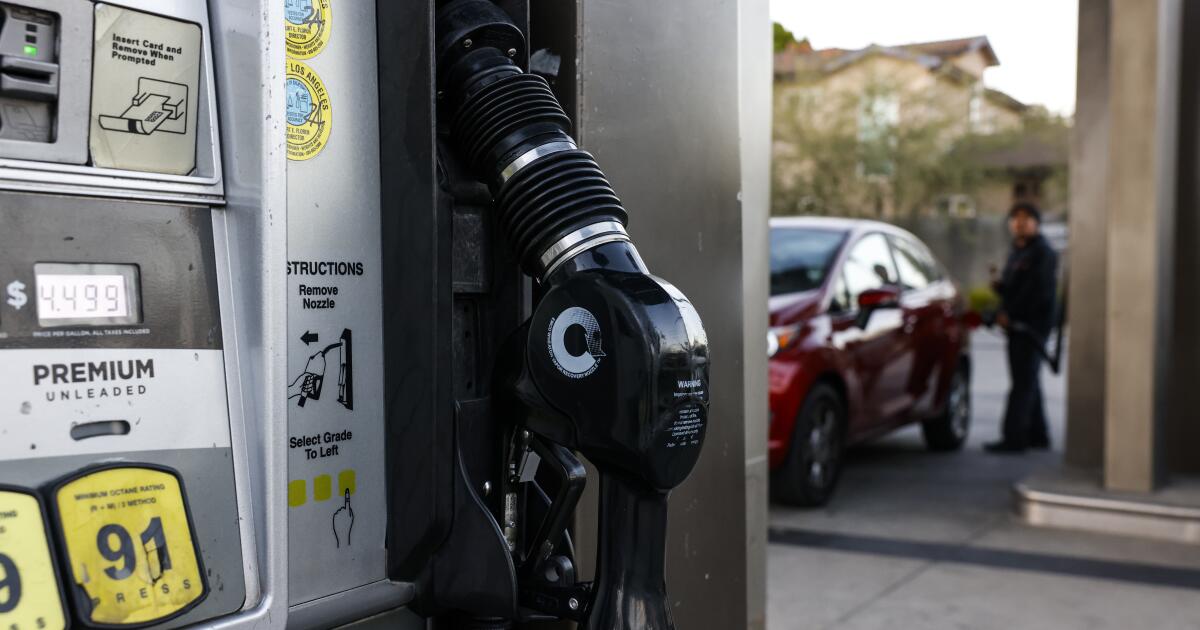
Gas just hit $6 in Los Angeles. Here’s where you can still find it for $5

‘The Super Mario Galaxy Movie’ post-credits scene is justice for a beloved character

How to have the best Sunday in L.A, according to Thundercat

Florida High School Football Rankings: Top 25 teams – Oct. 21

How old is Bo Nix? What to know about Oregon quarterback ahead of 2024 NFL Draft

Cleary's 21 help Le Moyne down Central Connecticut State 69-64 in OT

99th annual Pony Swim held in Virginia

Indiana Members Credit Union announced as new anchor tenant at Bottleworks District

Newsletter: Energy shock has Brussels on edge

Suspension lifted for helicopter pilots who hovered near Kid Rock’s home

Read the Judge’s Decision on the Trump Administration’s Subpoena Against Penn

Man wearing ICE uniform brutally beaten in Honolulu not affiliated with agency, DHS says

Analysis: Hezbollah backs Iran ambassador as conflict deepens Lebanon rifts
-

 South-Carolina3 days ago
South Carolina vs TCU predictions for Elite Eight game in March Madness
-

 Miami, FL6 days ago
Jannik Sinner’s Girlfriend Laila Hasanovic Stuns in Ab-Revealing Post Amid Miami Open
-

 New Mexico1 week ago
Clovis shooting leaves one dead, four injured
-

 Minneapolis, MN6 days ago
Boy who shielded classmate during school shooting receives Medal of Honor
-

 Tennessee1 week ago
Tennessee Police Investigating Alleged Assault Involving ‘Reacher’ Star Alan Ritchson
-

 Culture1 week ago
Do You Know the Comics That Inspired These TV Adventures?
-
 Science1 week ago
As mosquitoes go year-round in L.A., a promising fix hits a snag
-

 Technology1 week ago
YouTube job scam text: How to spot it fast