Louisiana
Louisiana could use more of Sweden’s centuries-old and beloved fika tradition


A friend recently returned from a vacation to Sweden and shared photos from his trip, mentioning a word I hadn’t heard before: fika.
Something about the way he used the word on his social media post pulled me in. The word sounded like something I would appreciate.
Loosely translated, a fika is a Swedish coffee break.
I don’t drink coffee. I’ve never been to Sweden, but I was right about appreciating the word and what it represents.
I decided to contact my friend Erika Sunnegardh. She’s a Swede, an international opera soprano who made her Metropolitan Opera debut in 2006 — and my go-to source for all things Swedish.
I messaged her and learned she was on a boat off the coast of Portugal. Even so, she took the time to send me a voice message with her take on fika.
She said it’s been around for several hundred years, but the word itself took hold around 1910. Cleverly, the word came about by someone rearranging the letters of the Swedish word for coffee, kaffi. She said that it started as something women did, gathering over coffee to meet and talk. She used the word “lighthearted” to describe its origins.
Eventually, fika became a part of everyday Swedish life.
She emphasized that fika is about much more than coffee.
Logistically, sweet treats are mandatory. They call them fika bread — cinnamon rolls, cardamom buns, pastry or the like.
However, cookies are also a part of fika. She shared a detail that struck me as deeply Swedish.
“Tradition has it you should treat seven different kinds of cookies,” she said. “No less, because then you’re stingy, and no more, because then you’re showing off. Seven is the magic number.”
According to the Visit Sweden website, there are seven specific types of cookies that are the most traditional fika cookies: Brussels cookies, chocolate slices, dream cookies (a type of meringue cookie that melts in the mouth), raspberry caves, oat biscuits, nut biscuits and chessboards (two-tone shortbread cookies).
Sunnegardh told me that morning and afternoon fika are a part of daily life in Swedish workplaces. Work stops. Everybody leaves their desk. Someone may stay to cover the office phones, but fika happens, lasting 10 or 15 minutes — never more than 20. People bring their own treats and their personal phones are down. Tea is permitted for the noncoffee drinkers.
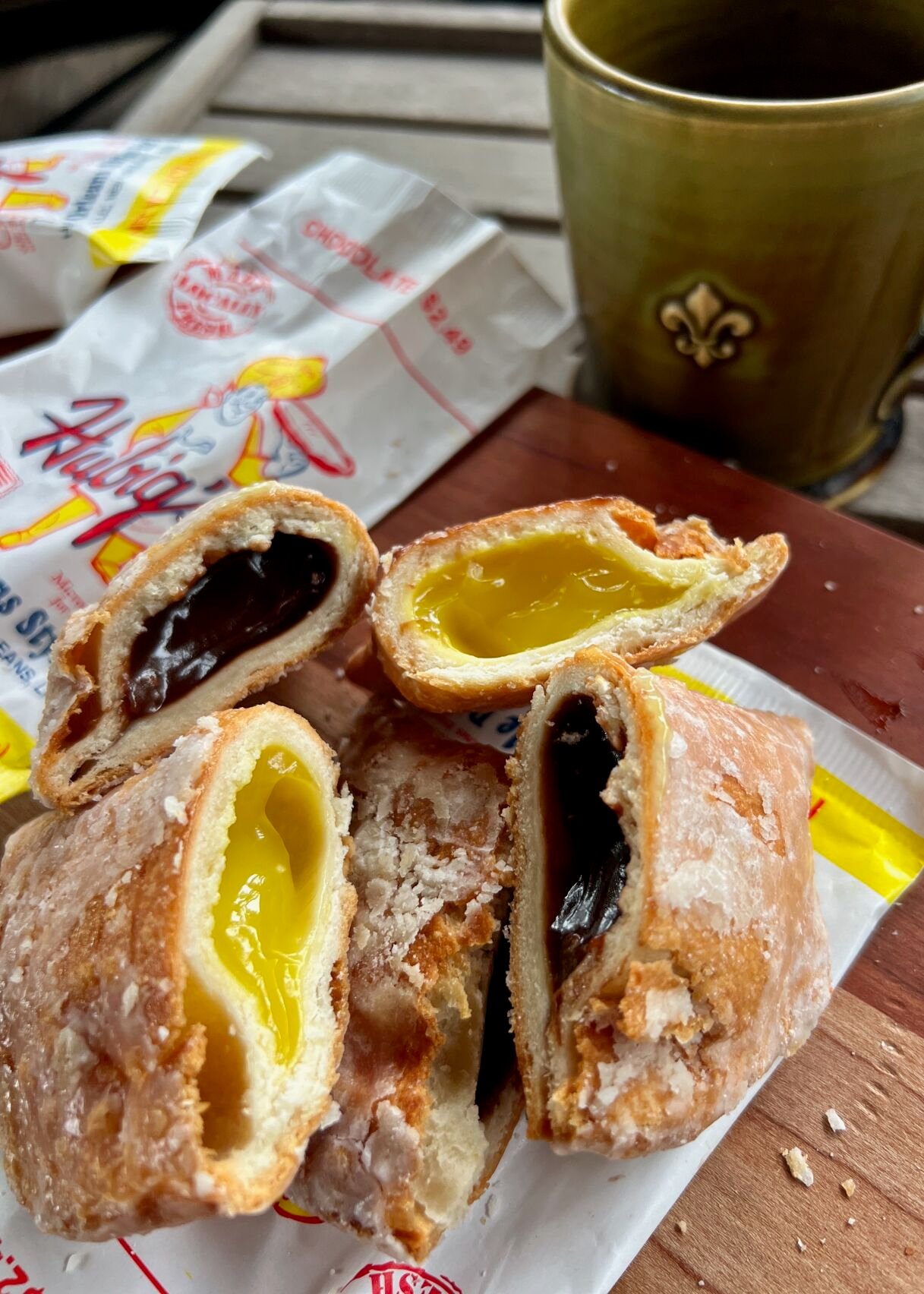
Lemon and chocolate Hubig’s Pies, cut open to show their fillings, make a decadent coffee break snack. Chocolate rejoined the lineup for flavors as the beloved New Orleans hand pie continues its gradual return to the full spectrum of flavors. (Staff photo by Ian McNulty, NOLA.com | The Times-Picayune)
“It simply is what it is,” Erika told me from her boat. “It can’t be degraded or weirded out by any digital thing. I have never heard of anyone skipping fika just because the world has changed.”
I recognized fika from the start.
Not from Sweden, but from Mississippi.
My parents’ home was fika central.
Throughout the day — almost any day — usually mid-morning or mid-afternoon, people knocked on the door and were welcomed in. My mother would put on coffee. Somehow, there was almost always cake.
People sat down and visited, and the day went wherever it went. Now that I think about it, they usually stopped by in the mornings around 10 and in the afternoons around 2, which coincides nicely with the Swedish tradition.
My parents led productive, even busy lives, but I never remember Mom not sitting to visit when guests arrived — and my dad too when he was home.
They didn’t call it fika, of course. They didn’t call it anything. It was just how things were.
Things stayed that way for my parents until my dad died and my mother moved away from our family home to be closer to my youngest brother.
The tradition was not passed to the next generation. Dropping by unannounced is unheard of now. We rarely sit and visit without an agenda. We schedule coffee weeks out.
I do like calling it fika.
Names change things.
What was an interruption becomes a ritual. What felt like lost time becomes the point.
If fika is the word that gets people to put their phones down and sit with each other — really sit, with something sweet nearby and no particular reason to leave — then I am for it.
My mother never needed a word for it. She just opened the door.


MARSHALL, Texas (KETK) – A man is currently wanted after police said he kidnapped his ex-girlfriend in Marshall on Saturday, before fleeing into Louisiana.
The Marshall Police Department reported that their dispatch got a call requesting a welfare check at a property in the 1300 block of East Pinecrest Drive at around 7:29 a.m. on Saturday. Officers who responded to the scene met a woman who said she had just been kidnapped by her ex-boyfriend.
The officers determined that the woman had escaped from her ex-boyfriend and that he fled from the scene before they arrived. Marshall PD identified the ex-boyfriend as Jamichael Brown.
Brown’s vehicle was later found abandoned in Greenwood, La. Then, Marshall PD joined with the Joint
Harrison County Violent Crime and Narcotics Task Force, the Waskom Police Department, the Greenwood Police Department and the Caddo Parish Sheriff’s Office to conduct a joint search of the area near his vehicle but Brown was not found.
He’s currently wanted for prior warrants on charges of violation of bond conditions and assault of a pregnant person, along with a new warrant for aggravated kidnapping, which was secured by Marshall PD on Saturday.
Marshall PD said Brown should be considered armed and dangerous and they’ve asked the public not to approach him. Anyone who sees him is asked to call 911 or local law enforcement.
Anyone with information about this case is also asked to call the the Marshall Police Department Criminal Investigation Division at 903-935-4575.
You can now stream KETK and FOX51 News live 24/7 on your smart TV with KETK+, our brand-new app! No antenna, cable, or satellite needed—watch for free, anytime. Just download it on your Roku, Apple TV, or Fire TV and start streaming.
Louisiana
Louisiana drivers warned not to leave these 10 everyday items in parked cars as June heat builds

LOUISIANA (KNOE) – As June temperatures climb across Louisiana, safety experts are warning drivers to take certain everyday items out of their vehicles every time they park.
NOAA climate normals show typical June highs reach about 90°F in New Orleans, 91°F in Baton Rouge and 93°F in Shreveport. Research from Arizona State University found a car parked in direct sunlight on an 80°F day can reach 120°F inside within an hour. Dashboard temperatures can top 165°F on a 95°F afternoon.
That means a quick stop at a gas station in Monroe, a grocery run in Arkansas or a school pickup in Mississippi can damage belongings, spoil medicine and food, and increase the risk of a fire.
Below are 10 items Louisiana drivers should remove from their cars when they park.
1) Aerosol cans
Products such as hairspray, deodorant, spray sunscreen, dry shampoo and spray paint are pressurized. Many aerosol labels warn against temperatures above 120°F, a level ASU testing shows a vehicle can reach within 60 minutes on an 80°F day.
2) Medication
The U.S. Food and Drug Administration (FDA) says many medicines should be stored between 68°F and 77°F. Insulin products commonly carry guidance to stay below 86°F once in use. A 2024 Journal of Allergy and Clinical Immunology study found EpiPens lost 41.6% of epinephrine potency after three months at 122°F.
Drivers should not leave inhalers, antibiotics, thyroid medication, birth control or emergency allergy injectors in the glovebox.
3) Sunscreen
The FDA warns sunscreen containers should be kept out of excessive heat and direct sun. High heat can break down active ingredients, leaving users with less protection than the SPF label suggests.
4) Food and groceries
The U.S. Department of Agriculture (USDA) says perishable food should not sit in the 40°F to 140°F “danger zone” for more than two hours — or more than one hour when the outside temperature is above 90°F.
That one-hour limit can arrive quickly during Louisiana summers, especially for eggs, dairy, meat and seafood.
5) Eyewear
High heat can damage plastic frames and some lens coatings. Many optical materials become vulnerable once temperatures rise above about 130°F. ASU testing shows dashboards can exceed 165°F on a 95°F day, hot enough to warp frames or harm polarized, photochromic and anti-reflective coatings.
6) Lighters and matches
Disposable butane lighters often carry warnings to keep them away from heat above 50°C (122°F). That is below the dashboard temperatures measured in parked-car heat studies, making a lighter left near a windshield a preventable fire risk.
7) Glasses cases and clear water bottles
Fire services have warned that clear bottles and other magnifying objects can focus sunlight onto upholstery or paper. In demonstrations, focused sunlight has been measured above 200°F, which can scorch vehicle interiors.
8) Important documents
Passports, Social Security cards, laminated IDs, parking tickets and thermal receipts can warp, fade or blacken in extreme heat. Thermal paper commonly reacts around 150°F, a temperature that can be reached on a dashboard on a hot summer afternoon.
9) Pets and children
The National Highway Traffic Safety Administration (NHTSA) says an average of 38 children die in hot cars in the U.S. each year, and KidsAndCars.org has tracked more than 1,170 child hot-car deaths since 1990.
The American Veterinary Medical Association (AVMA) reports that on a 70°F day, a car can reach 89°F within 10 minutes and 104°F within 30 minutes.
Louisiana law allows certain emergency rescue actions for children or animals in distress, but safety groups stress the simplest rule: Never leave children or pets in a parked vehicle, even briefly.
10) Lithium-ion devices (including vapes)
Devices such as vapes, phones, laptops, power banks and e-bike batteries use lithium-ion cells that are generally designed to operate safely up to around 140°F — below the dashboard heat recorded in summer car tests.
The Federal Aviation Administration (FAA) logged 89 lithium-battery incidents on U.S. aircraft in 2024, including 15 involving vapes or e-cigarettes. Anker recalled more than 1.1 million PowerCore 10000 power banks in 2025 over overheating risks.
Shane Margereson of Ecigone, which works with vape and lithium-battery products, said drivers should watch for warning signs such as swelling, a sweet chemical smell, discoloration or a device feeling warm when it has not been used.
“The simplest rule of all: treat it like your phone,” Margereson said. “Never leave it on the dashboard, in the glovebox or in direct sunlight.”
Heat-safety reminder
If you must leave items in a vehicle, move them out of direct sun, keep them low in the cabin, and shorten stop times. When possible, take heat-sensitive products inside with you.
Copyright 2026 KNOE. All rights reserved.

SHREVEPORT, La. (KTAL/KMSS) – There are new statewide standards for sign language interpreters.
The Louisiana Department of Health, through the Louisiana Commission for the Deaf, has established minimum qualification, training, and registration requirements for sign language interpreters.
The new standards outline the education and skill level required for professional interpreters to work in Louisiana, and apply to health care providers, school districts, businesses, and courtrooms where interpreters are legally required.
LDH said these regulations are meant to ensure those who are deaf, deafblind, and hard of hearing have access to the information and services they deserve.
“In Louisiana, public and private service providers have always been required to secure qualified sign language interpreters, but until now, there has never been a clear statewide definition of what ‘qualified’ means,” said Jana Broussard, acting executive director of the Louisiana Commission for the Deaf.
“These regulations provide clarity for both providers and recipients receiving sign language interpreting services and help ensure interpreters are appropriately qualified for the setting they are working in.”
Providers have until January 1, 2027, to comply with the new requirements, which were created in response to ACT 128 of the 2022 Regular Legislative Session.
The Louisiana Commission for the Deaf offers professional development opportunities to help interpreters meet the new qualifications. Along with one-on-one coaching, study groups, job shadowing opportunities, internships, and continuing education units.
You can now stream KTAL 6 and KMSS 33 News live 24/7 on your smart TV with KTAL Now, our brand-new app! No antenna, cable, or satellite needed—watch for free, anytime. Just download it on your Roku, Apple TV, or Fire TV and start streaming.
-

 San Francisco, CA4 minutes ago
San Francisco Burglar Escapes in Driverless Taxi
-

 Dallas, TX6 minutes ago
One-two-three punch of Mavs, Stars and Neiman bruises struggling Downtown Dallas
-

 Miami, FL12 minutes ago
Dolphins OC fuels breakout buzz for underused second-year playmaker
-

 Boston, MA18 minutes ago
Aroldis Chapman Trade Rumors Heating Up for Struggling Red Sox
-

 Denver, CO21 minutes ago
Christ in the Heart of the City: Hundreds Join Corpus Christi Eucharistic Procession in Downtown Denver
-

 Seattle, WA26 minutes ago
WEST SEATTLE SUNDAY: 20 notes, including I-5’s early reopening
-

 San Diego, CA34 minutes ago
Mark Your Mornings: Cloak & Petal is Opening a Japanese-Inspired Café
-

 Milwaukee, WI37 minutes ago
15 Milwaukee-area champions crowned on Day 2 of WIAA state girls track

