Louisiana
Louisiana bears the burden of upstream runoff. Why doesn’t it push for solutions?

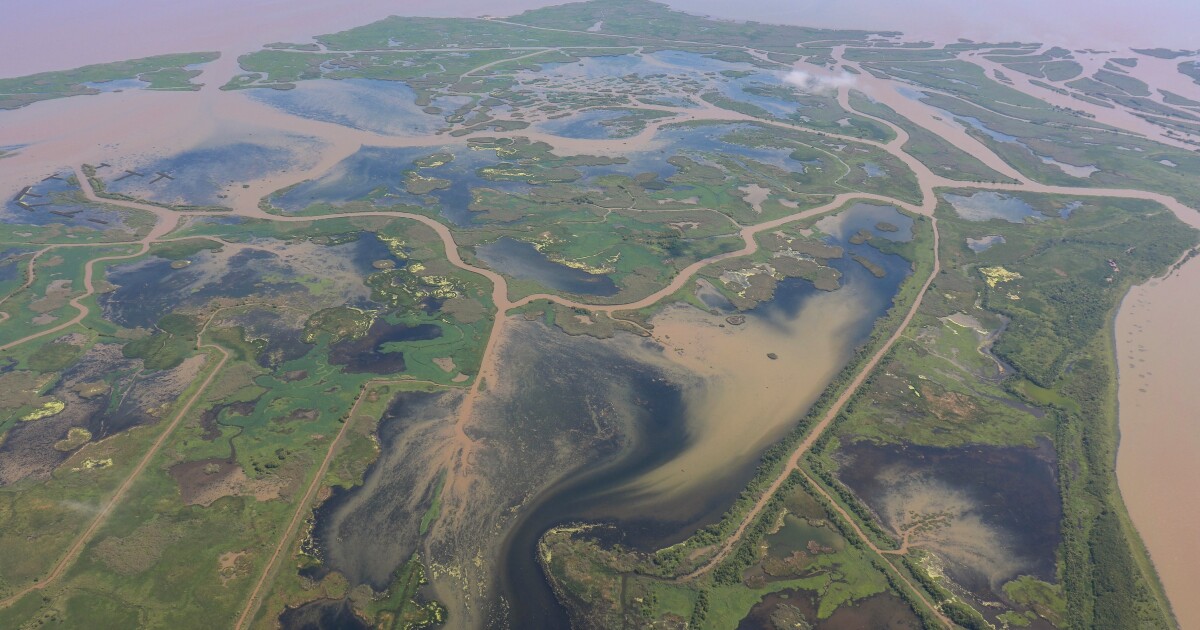
CYPREMORT POINT, La. — Thomas Olander has watched his shrimp catch shrink over the last 15 years. It’s not just the abundance of Louisiana shrimp; Olander said that the average size of the crustacean has also shrunk.
Credit: Darrell Hoemann, Investigate Midwest; ROSCOSMOS/NASA. Graphic: Annie Ropeik, Ag & Water Desk
In the past, shrimpers could expect the crustaceans to grow throughout the spring season, which starts in May in Louisiana waters and generally runs through July. “Since we’ve been dealing with this ‘dead zone,’” said Olander. “We’re not seeing that growth no more.”
The dead zone is a stretch along the shallows of the Gulf of Mexico where algae blooms choke off oxygen in the water.
This month, the National Oceanic and Atmospheric Administration (NOAA) estimated that this summer’s dead zone would reach 5,827 square miles – an area roughly the size of Connecticut. That’s up from approximately 3,058 square miles in 2023.
These massive algae blooms are caused by nutrients that run off of farms up and down the Mississippi River Basin, which stretches from Northern Minnesota to the Gulf of Mexico.
Fertilizer that helps crops grow contains high levels of nitrogen and phosphorus. These nutrients run off the fields during rainstorms at the end of the growing season and end up in waterways leading to the Mississippi River.
In 1996, the dead zone in the Gulf of Mexico came to national attention through local reporting. The Gulf of Mexico Hypoxia Task Force was established in the fall of 1997 – a collaboration of state, federal and tribal agencies – and asked the group to create and implement an action plan.
A preliminary goal is to reduce both nitrogen and phosphorus by 20% by 2025. But despite some progress, the task force has not yet met its goals.
The U.S. Geological Survey showed that in May 2024, while nitrogen loads in the lower Mississippi River were 7% lower than baseline measurements, phosphorus loads increased by 22%.
The 2025 target is simply not a priority for the task force, said Doug Daigle, a research scientist at Louisiana State University and coordinator of the Louisiana Hypoxia Working Group. He added that neither the task force nor Louisiana attempted to raise funds from Congress to implement programs that would reduce nutrient pollution.
“It’s a problem with the task force, not just Louisiana. There has not been an organized attempt to garner more funding for the action plan,” said Daigle.
Where is the Clean Water Act?
The task force’s action plan is hindered by a lack of enforceable limits on nitrogen and phosphorus, according to the Tulane Institute on Water Resources Law and Policy. Instead, it focuses on voluntary state efforts and guidelines.
In a presentation to the Louisiana Governor’s Advisory Commission on Coastal Restoration, Protection and Conservation in early June, Daigle said the state has been a passive and largely silent member of the task force.

David Kovaluk for St. Louis Public Radio
Daigle said the 176-page strategy is not technically a strategy because it doesn’t have any targets or goals. He added that the state has missed years of opportunity to reduce the dead zone.
To address the sheer quantity of nutrient pollution from the upriver basin states, Tulane lawyers suggest that Louisiana could petition the U.S. Environmental Protection Agency for greater enforcement under the Clean Water Act.
One section of the law allows for the government to set specific, maximum amounts of daily pollutants for bodies of water deemed to be impaired. Louisiana could petition the EPA to declare sections of the Mississippi River or the Gulf of Mexico as impaired, which would allow for the creation of an enforceable limit on nutrients entering the river upstream.
Louisiana could also petition the EPA administrator to convene an interstate water management conference to address pollution upriver. While the Gulf Hypoxia Task Force currently acts as a mediary between states, it lacks the enforcement power that the Clean Water Act could provide.
But the state has so far not done any of this. Louisiana Gov. Jeff Landry’s office did not respond when asked if Landry has any plans to petition the EPA or address the growth of the dead zone.
In 2016, the Gulf Restoration Network sued then-EPA administrator Lisa P. Jackson for the agency’s “hands-off approach” to dealing with nitrogen and phosphorus pollution under the Clean Water Act. This lawsuit followed a petition submitted by several environmental non-profits in 2008 that demanded numeric water quality standards be set for the nutrients.
But ultimately, the Eastern District of Louisiana court ruled that the EPA could continue a voluntary approach to nutrient reduction.
In 2019, when the most recent version of Louisiana’s nutrient reduction and management strategy was released, Mark Davis, director of the Tulane Institute on Water Resources Law and Policy, submitted recommendations for improvements to the Louisiana Department of Environmental Quality (LDEQ).
Davis wrote that it has become clear that neither the EPA nor the task force would be implementing numeric targets any time soon. Those specific, enforceable limits would not be forthcoming “until Louisiana makes their development a priority and focuses the issue on upstream states and the federal government,” he wrote.
“They did not make a dent,” Davis said.
‘The solution to pollution is not distribution’
As Louisiana works to review its Nutrient Reduction and Management Strategy, some critics say that the state focuses too heavily on plans to redirect the flow of the Mississippi River.
The Coastal Protection and Restoration Authority (CPRA) highlights the benefits that would come from plans to reconnect the river to land across the coast.
“CPRA is constructing diversions with the main purpose of building and sustaining Louisiana’s coastal wetlands,” said Angelina Freeman, a research scientist at CPRA who was a member of the Louisiana Nutrient Reduction and Management Strategy interagency team.
She explains that by redirecting the river’s flow, nutrients that would have otherwise fueled the dead zone would instead nourish the state’s recovering wetlands.

La’Shance Perry
/
The Lens
A few man-made diversions are already up and running, such as the Caernarvon and Davis Pond Diversions. Davis Pond is restoring wetlands in the upper Barataria Basin on the west side of the Mississippi River near Luling, in St. Charles Parish, Louisiana, while Caernarvon delivers sediments and nutrients to Breton Sound on the river’s east bank in Plaquemines Parish.
The 2023 Louisiana Coastal Master Plan calls for redirecting sediments and nutrients into Barataria Bay on a massive scale through the largest single restoration project in U.S. history. The Mid-Barataria Sediment Diversion would build and nourish up to 27 square miles of coastal wetlands over the next 50 years.
But to Daigle, centering the state’s nutrient reduction and management strategy around sediment diversions such as the yet-to-be-built Mid-Barataria is a mistake.

Cassandra Glaspie
/
Louisiana State University
“Until [the diversions] are built and operating they don’t do anything, good or bad,” he added. “Talking about them doesn’t accomplish anything. Having them in a plan doesn’t accomplish anything.”
“The solution to pollution is not distribution,” said Nancy Rabalais, a professor at Louisiana State University who, for years, led Gulf research cruises to monitor the size of the dead zone.
Rabalais and fellow LSU researcher R. Eugene Turner published a separate June 2024 dead zone forecast that was less dire than the above-average estimate released by NOAA. Their prediction looks at the potential effects of warmer water on oxygen levels.
They emphasize that their reduced forecast is “solely due to ocean warming, not to a decline in nitrate loading from the Mississippi River.”
Cutting down on nutrients within Louisiana
While the vast majority of nutrients that create the dead zone every summer come from agriculture in the states upriver from Louisiana, there is still a significant input of runoff from farmland within the state itself.
In 2022, the LDEQ published a report on long-term nitrogen and phosphorus trends at ambient water quality monitoring stations across the state. They found that nutrient concentrations are decreasing at the majority of testing locations.
Following these trends, Louisiana received a recent influx of funding to further reduce nutrient runoff within the state from the Gulf of Mexico Division of the EPA.
Earlier this year, the Gulf of Mexico Alliance received a grant to help farmers in northeast Louisiana adopt practices to prevent excessive runoff from entering the Bayou Lafourche watershed, and ultimately the Red River and Atchafalaya Basin.
The Atchafalaya River siphons off 30% of the Mississippi River’s flow. The Atchafalaya has a growing delta system, such as at the Wax Lake Outlet, but excess nutrients still escape to the Gulf of Mexico, expanding the dead zone to the west.
In Morehouse Parish, farmers are being taught how to limit their contribution to nutrient runoff that would reach the Gulf through the Mississippi-Atchafalaya Basin. The grant will fund new farming techniques, including the subsidizing of cover crops to reduce runoff, which may also increase soil productivity and cash crop yields.
“We’re doing exactly what we hope and wish everyone north of us would be doing,” said Joey Breaux, assistant commissioner of the Louisiana Department of Agriculture and Forestry. He added that the farmers in Morehouse Parish have been very receptive to the new program.

La’Shance Perry
/
The Lens
The $1.4 million grant will run through 2026 with the specific goal of reducing the Gulf of Mexico’s dead zone.
The funds will go to help farmers plant cover crops in between growing seasons to reduce soil erosion and prevent nutrients from running off into the river. The farmers will also receive instruction in no-till management, which calls for crops to be planted in narrow rows within the untilled seedbeds of previous crops. Keeping the soil intact increases organic matter and productivity while reducing the need for excess fertilizer.
Olander, the shrimper, said that he wishes the Department of Wildlife and Fisheries would support his industry’s losses in the way that they are for farmers. “They are really keeping their farmers going,” he added. “Call me a farmer of the sea; I’ll take that title if they would help us.”
What to expect from the next dead zone tour
On July 21, the R/V Pelican will set sail to take stock of this summer’s dead zone. NOAA will fund a six-day tour of the traditional hypoxic area to the west of the Mississippi River, where the Atchafalaya River also dumps nutrient runoff into the Gulf of Mexico.
This year, the cruise will be extended for four extra days to tour the area east of the Mississippi River. This portion of the cruise will be funded by a grant distributed by the Gulf of Mexico Alliance from the Bipartisan Infrastructure Bill.
And that tour may bring new scientific research to be considered before Louisiana issues its five-year update to the state nutrient reduction strategy.
“This strategy is up for revision,” said Daigle, “I think it needs a total revision, not just tweaking.”
This story is part of the series Farm to Trouble from the Mississippi River Basin Ag & Water Desk, an independent reporting collaborative.



Bill Advances Honoring Shreveport Civil Rights Icons
Louisiana lawmakers move forward with bill honoring Shreveport civil rights icons Reverend Harry Blake Senior and Virginia Green Evans.
(The Center Square) − Louisiana lawmakers have filed more than 20 bills this session touching on artificial intelligence, but only a narrow slice of them has moved so far.
The clearest momentum has come on bills dealing with child exploitation. Senate Bill 42 by Sen. Rick Edmonds, R-Baton Rouge, which prohibits using artificial intelligence to create child sexual abuse materials, passed the Senate 36-0 and was sent to the House the next day.
Senate Bill 110 by Sen. Heather Cloud, R-Turkey Creek, bars using a child’s image to train an artificial intelligence model to produce child sexual abuse materials, also advanced out of the Senate and is now pending in the House Administration of Criminal Justice Committee. But the broader regulatory push has moved far more slowly.
Rep. Josh Carlson, R-Lafayette, told The Center Square the efforts have run into familiar resistance from business groups wary of state-by-state regulation.
“Anything that effects business they say is bad for business,” Carlson told The Center Square.
Carlson has a bill that would create a Louisiana AI Bill of Rights, restrict certain chatbot uses involving minors, create disclosure rules for bots and AI-generated advertising, and bar the state from contracting for AI products tied to foreign countries of concern. Carlson is still working to get his bill added to the Commerce committee’s agenda.Another bill that has managed to make progress is HB190 by Rep. Laurie Schlege, R-Metarie. It passed the House 98-0. Two days after, an op-ed submitted to The Center Square from Citizens for a New Louisiana charged the law as “one that threatens to stifle innovation, burden small businesses and startups.” The op-ed suggested amending the bill, but Schlegel hasn’t budged so far.
Senate Bill 246 by Sen. Jay Luneau, D-Alexandria, was scheduled for Senate floor debate Monday but was postponed twice, first to Tuesday and then to Wednesday. The delay followed Luneau’s promise to the Louisiana Association of Business and Industry that he would amend the bill after the group sent a memo warning it could create “unnecessary compliance burdens for businesses operating across the state.”
“AI systems are inherently interstate and global, making them better suited for a consistent federal framework rather than fragemented state oversight,” the memo continued. “SB246 risks placing Louisiana at a competitive disadvantage while duplicating efforts more appropriately handled by Congress.” The memo mentioned a December executive order from the Trump administration which instructed federal officials to identify “onerous” state AI laws and said states with such laws could be barred from receiving certain remaining BEAD broadband funds, to the maximum extent allowed by federal law.
Louisiana has $800 million in Broadband Equity, Access, and Deployment program funding that could be revoked. Responding to questions about concerns that his bill might violate that order, Edmonds told The Center Square, “I don’t see this as over regulation.” He said that, so far, he has heard no concerns with his bill.
Edmonds acknowledged concerns that overregulation could inhibit the use and development of AI, but said that his bill was specific and would not.

LAKE CHARLES, La. (KPLC) – The Venture Global CP2 construction site in Cameron has been cleared after a bomb threat was made Sunday, according to a spokesperson from Venture Global.
The bomb threat came in around noon on Sunday, according to officials. Louisiana State Police hazmat and bomb squads were called to investigate.
No shelter in place was deemed necessary and no roads were closed, according to the Cameron Parish Sheriff’s Office.
A Venture Global spokesperson released the following statement:
“Venture Global was made aware of a bomb threat at our CP2 site and immediately activated our established emergency response protocols. We are coordinating closely with state and local authorities as they investigate. The safety and security of our employees and the surrounding community remain our highest priority.”
Copyright 2026 KPLC. All rights reserved.

NEW ORLEANS (WGNO) — For the fifth consecutive year, the Louisiana Children’s Museum hosted its annual environmental festival, Mud Fest, on Saturday, March 28.
From 10 a.m.-4 p.m., parents and their little ones had the opportunity to have fun in the sun and enjoy the “highlight” of the museum’s spring season.
This event was inspired by the iconic New Orleans festival culture which includes good food, live music and a nice, high-energy atmosphere. Mud Fest is tailored for the “youngest environmental stewards” to have fun and make all the mess they want with mud.
Due to the Crescent City being surrounded by wetland habitats, we interact with water daily in both our rural and urban communities.
The festival generates positive associations with our region and also builds critical thinking skills for future educators, engineers, fishermen and farmers. According to LCM, engaging with nature, water and plants “builds a child’s confidence and fosters a lifelong connection to the Earth.”
“As the Louisiana Children’s Museum celebrates its 40th anniversary, events like Mud Fest reflect our long-standing commitment to hands-on learning that sparks curiosity and connects children to the world around them,” LCM CEO Tifferney White said.
This year, Mud Fest had performances from young musicians of the School of Rock, the Louisiana Sunspots and more. There were also a storytelling stage and various family-friendly activities for visitors to engage in.
Mud Fest partnered with Pontchartrain Conservancy, STEM NOL, Whimscapes and Sugar Roots to put on the event.
Stay up to date with the latest news, weather and sports by downloading the WGNO app on the Apple or Google Play stores and by subscribing to the WGNO newsletter.
Latest Posts

Governor Ivey proclaims March 30 Doctors Day in Alabama

How Sanctioned Russian Arctic LNG Hardware Could Find a Second Life in Alaska’s ‘Polar LNG’ Project

Japanese grocery store opening 1st Arizona location. What to know

AP Decision Notes: What to expect in Arkansas’ primary runoff elections

A New Homelessness Strategy is Sweeping California – edhat

Florida High School Football Rankings: Top 25 teams – Oct. 21

How old is Bo Nix? What to know about Oregon quarterback ahead of 2024 NFL Draft

Cleary's 21 help Le Moyne down Central Connecticut State 69-64 in OT

99th annual Pony Swim held in Virginia

Indiana Members Credit Union announced as new anchor tenant at Bottleworks District

Video: Iran to Allow More Oil Ships Through Strait of Hormuz, Trump Says

Dem senator warns deportation could let Virginia woman’s illegal immigrant killer ‘escape accountability’

Newsletter: G7 ministers to hold talks on war’s economic fallout

ICE officers could remain at airports after TSA workers are paid

Scathing report claims nation’s oldest labor union ‘betrayed’ MAGA members through ‘shocking’ spending
-

 Sports1 week ago
IOC addresses execution of 19-year-old Iranian wrestler Saleh Mohammadi
-

 Miami, FL4 days ago
Jannik Sinner’s Girlfriend Laila Hasanovic Stuns in Ab-Revealing Post Amid Miami Open
-

 New Mexico1 week ago
Clovis shooting leaves one dead, four injured
-

 Politics1 week ago
Schumer gambit fails as DHS shutdown hits 36 days and airport lines grow
-

 Tennessee7 days ago
Tennessee Police Investigating Alleged Assault Involving ‘Reacher’ Star Alan Ritchson
-

 Minneapolis, MN4 days ago
Boy who shielded classmate during school shooting receives Medal of Honor
-

 Science1 week ago
Record Heat Meets a Major Snow Drought Across the West
-

 Politics1 week ago
Trump gives Iran 48-hour ultimatum to reopen Strait of Hormuz or face strikes on power plants