Louisiana
Here’s how to protect the Baton Rouge bat population, plus how they benefit Louisiana yards.


Bats are all around, but due to their nocturnal nature, Baton Rouge residents do not see them often. Misconceptions about the flying mammals abound, despite their significance to ecological systems.
Aaron Ashbrook, an assistant professor for the LSU Entomology department, specializes in urban entomology. He recently hosted a seminar series at LSU AgCenter’s LaHouse Research and Education Center for state sanitarians who expressed interest in the local bat population. Ashbrook’s lecture focused on correcting misinformation about pollinator support, mosquito management and bat conservation.
After the interest and success of the sanitarian lecture, Ashbrook and Christine Gambino, an extension associate for the entomology department, joined forces to plan a “Bats in Our Ecosystem Day” for the public.
Full lecture hall in the Howe-Russell auditorium to hear Teague O’Mara at the “Bats in Our Ecosystem Day.”
Ashbrook and Gambino planned a two-part event on May 24 that included a lecture on different bat species, their benefits and a demonstration on how to build a bat house.
Initially, the presentations were supposed to take place at LaHouse, but due to the large amount of interest and turnout, the event was moved to LSU’s Howe Russell Auditorium.
Gambino said that 405 people registered and 85 attended. She has noticed an increase in similar events that focus on gardens, pollinators and conservation efforts.
“We had people drive in from all over the state to attend,” she said. “We wanted to get the word out about bats, and we got lots of interest. People who couldn’t attend asked for the presentation to be recorded.”

From left: Teague O’Mara, Christine Gambino, Aaron Ashbrook and Mike Meyers after the bat conservation event.
Ashbrook and Gambino were pleasantly surprised at the registration and the turnout.
Teague O’Mara, director of conservation evidence at Bat Conservation International and adjunct professor of biological sciences at Southeastern Louisiana University, presented the lecture on bat diversity, Louisiana bat species, bat abilities, the benefits of bats for humans, threats to the bat population and solutions to protect bats.
O’Mara shared that there are 12 bat species present in Louisiana, all of which are insectivores and protected by law. Mexican free-tailed bats reside in the state year-round and primarily feed on moths, beetles, flies and ants.
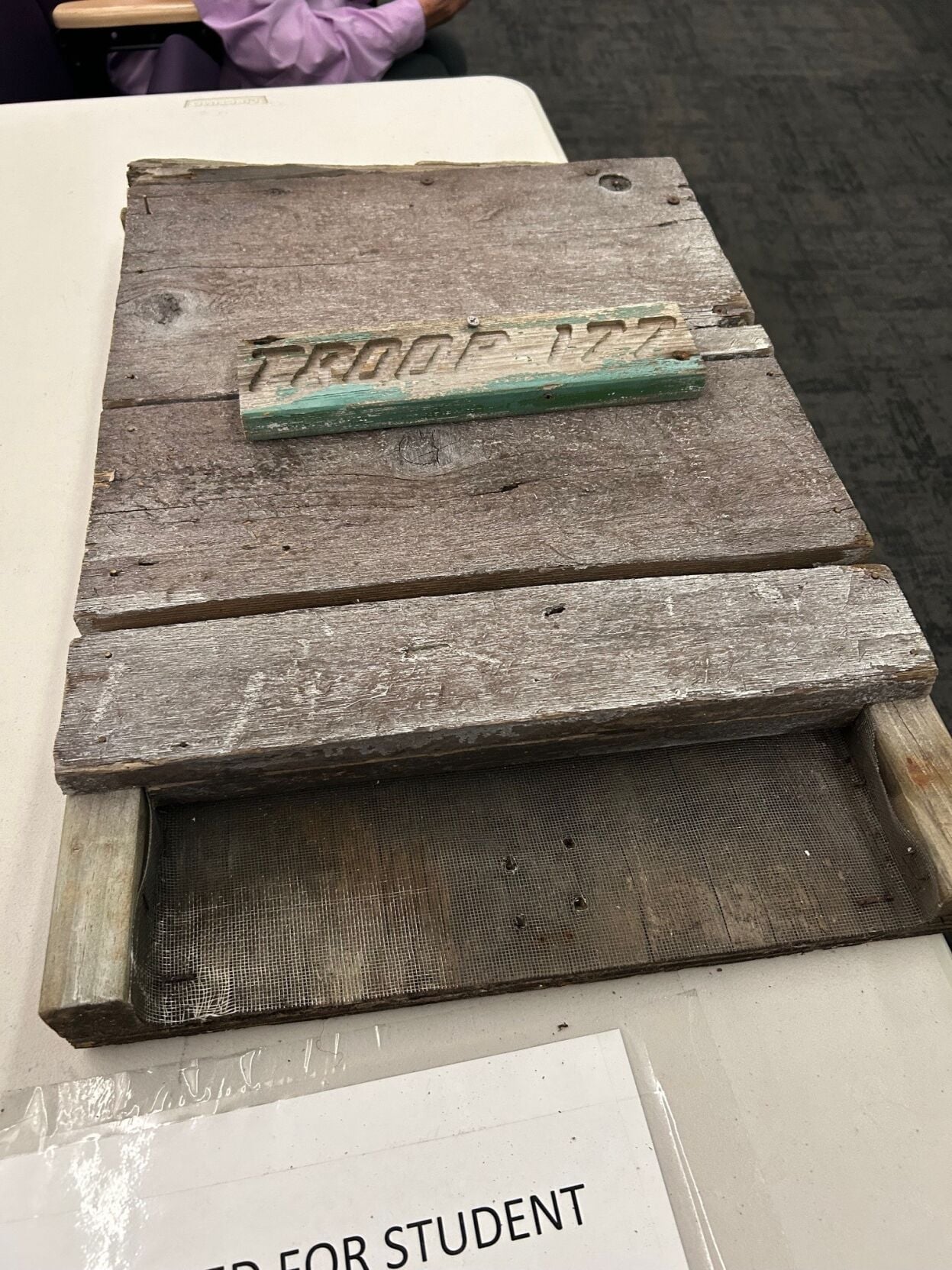
Bat house that Mike Meyers, the Boy Scout Master who demonstrated building a bat house at the bat conservation event.
Beneficially, bats consume agricultural pests and insects, which positively affects farming economies. They also disperse seeds and pollinate commercially and ecologically valuable plants like agave, which flowers at night.
O’Mara included threats to bat populations, which include white-nose syndrome, wind turbines, land use change like deforestation and human diseases. The more natural separation between bats and humans provides a buffer, which means the less chance of viral spillover between the two species.
There are multiple ways Louisianans can help protect the local bat population, including building and setting up a bat house — which Mike Meyers, a Boy Scout Master in Metairie, demonstrated at the “Bats in Our Ecosystem Day.”

Mike Meyers, Boy Scout Master, demonstrates building a bat house at the bat conservation event.
The bat houses must be attached to a structure that could be inhabited by bats and need to be built with specific dimensions, distance from a house and height for the bats, to allow them to find the space comfortable and appealing to live in. Meyers even recommends a specific color, nutmeg, to paint the houses.
Other ways people can protect bats are planting bat-friendly pollinator gardens, using less pesticides and standing up for bat conservation.
For more information, visit batcon.org.



NEWTON COUNTY, Texas. (KPLC) – A DeRidder man reported missing was found dead in the Sabine River Sunday morning, according to the Newton County Sheriff’s Office.
Newton County Sheriff Colton Havard said Jordan Jamal Allen was located around 7:50 a.m. on July 12 with help from Texas Parks and Wildlife game wardens, the Beauregard Parish Sheriff’s Office, and 409 Search and Rescue.
Authorities say the body was recovered not far from where Allen went under Friday night near the U.S. 190 bridge east of Bon Wier at the Texas-Louisiana state line.
The sheriff said that Allen and a woman were said to be wading across the river Friday when the current began pulling the woman.
The sheriff said Allen tried to help her, but went under around 8:45 p.m. and wasn’t seen again. He said the woman made it back to land safely.
We will have more in this story as it develops.
Copyright 2026 KPLC. All rights reserved.

MONDAY
RED STICK FLY FISHERS PROGRAM: 7 p.m., Bluebonnet Regional Library, 9200 Bluebonnet Blvd., Baton Rouge. Open to the public. Email Brian Roberts: roberts.brian84@gmail.com. Website: rsff.org
WEDNESDAY
FLIES & FLIGHTS: 7-9 p.m, Rally Cap Brewing, 11212 Pennywood Ave., Baton Rouge. Casual fly tying. Open to public. Email Chris Williams: thefatfingeredflytyer@gmail.com
THURSDAY
ACADIANA FLY RODDERS PROGRAM: 6 p.m., Pack and Paddle, 601 E. Pinhook, Lafayette. Open to public. Email Darin Lee: at cbrsandcdc@gmail.com. Website: acadianaflyrodders.org
FRIENDS OF NRA/SOUTHWEST LA BANQUET: 6 p.m., Riverside Bar & Grill, 3748 Louisiana 3059, Lake Charles. Call Brack Cole 337-912-1620. Email: jbcoleair@yahoo.com
ONGOING
STATEWIDE TOURNAMENT & ANGLERS RODEO/S.T.A.R.: Through Sept. 7, Coastal Conservation Association’s summer-long fishing event. Tagged redfish, coastal/offshore species categories & youth division. CCA membership required. Website: ccalouisiana.com/star
LOTTERY HUNTS
DOVE/TEAL: July 27 application deadline for dove hunt on Elbow Slough Wildlife Management Area and teal hunt on White Lake Wetlands Conservation Area. Website applications only on Wildlife & Fisheries/Louisiana Outdoors License, Permits and Tags webpage. Fee $8.50. Details: dove hunt, David Hayden at dhayden@wlf.la.gov; teal hunt, Lance Ardoin at lardoin@wlf.la.gov
AROUND THE CORNER
JULY 21 — LAFAYETTE KAYAK FISHING CLUB MEETING: 6 p.m., Pack and Paddle, 601 E. Pinhook, Lafayette. Call 337-232-5854. Website: lafayettekayakfishing.com
JULY 21-22 — GULF COUNCIL SHRIMP COMMITTEE MEETING: Gulf Council office, 4107 W. Spruce St., Tampa, Florida. In conjunction with Scientific and Statistical committees. Website: gulfcouncil.org
JULY 23 — ACADIANA BUGS & BREWS: 6 p.m., Pack and Paddle, 601 E. Pinhook, Lafayette. Casual fly tying and local beers provided. Open to the public. Email Darin Lee: cbrsandcdc@gmail.com. Website: packpaddle.com
JULY 23-25 — International Grand Isle Tarpon Rodeo, Grand Isle Marina & Otto Candies Pavilion, Grand Isle. Website: tarponrodeo.org
JULY 24-25—BASSMASTER JUNIOR CHAMPIONSHIP: Kentucky Lake, Paris, Tennessee. Website: bassmaster.com
JULY 26 — SOUTH LOUISIANA HIGHPOWER CLUB MATCH: 8:30 a.m., Ascension Parish Sheriff’s Range, St. Landry Road, Gonzales. NRA XTC & F-Class match rifle or service rifle, 200-yard/50-rounds match course. Fee $15 members, $20 nonmembers, $5 juniors. $25 annual club (first match free) and Civilian Marksmanship Program membership (allows purchases from CMP). Call Mike Burke, 337-380-8120. Email: SouthLAHighPower@hotmail.com
FISHING/SHRIMPING
SHRIMP: Spring inshore season closed except for Breton/Chandeleur sounds; all outside waters open.
OPEN RECREATIONAL SEASONS: Private recreational red snapper; gray triggerfish; flounder; lane, blackfin, queen and silk snappers and wenchmen among other snapper species; all groupers except closed for goliath and Nassau groupers in state/federal waters.
CLOSED SEASONS: Greater amberjack; bluefin tuna; gag, goliath and Nassau groupers in state/federal waters. Commercial greater amberjack season closed.
LDWF UPDATES
Closed: Roads on Pomme de Terre, Richard Yancey & Bogue Chitto WMAs (flooding)
Drawdowns: Saline Lake (Natchitoches/Winn parishes through Oct. 5); Iatt Lake (Grant Parish through Oct. 5).
-

 Tennessee6 minutes ago
Everything Tennessee Basketball Assistant Coach Gregg Polinsky Said During Summer Practice | Rocky Top Insider
-

 Texas12 minutes ago
Talarico, Paxton campaigning in Texas this week. See events
-

 Utah18 minutes ago
KSL News Daily: The nuclear debate Utah can’t avoid – KSLNewsRadio
-

 Vermont24 minutes ago
The nation is craving protein, but Vermont dairy isn’t cashing in
-

 Virginia30 minutes ago
Study: VA the fourth most ‘retirement-friendly’ state
-

 Washington36 minutes ago
What is the Farmer’s Almanac fall forecast for the Washington DC area?
-

 Wisconsin42 minutes ago
Wisconsin April storm victims get tax relief until Nov. 2, 2026
-

 West Virginia48 minutes ago
Bridgeport named ‘Best Place to Live in West Virginia’ by popular website, Morgantown rounds out top 10

