Plus special access to select articles and other premium content with your account – free of charge.
By entering your email and pushing continue, you are agreeing to Fox News’ Terms of Use and Privacy Policy, which includes our Notice of Financial Incentive.
Please enter a valid email address.
SWANNANOA, N.C. – Nearly a month after Hurricane Helene devastated areas of the Southeast and killed more than 250 people, North Carolina residents are sleeping in tents where their homes once stood, even as temperatures drop to the 30s at night.
Advertisement
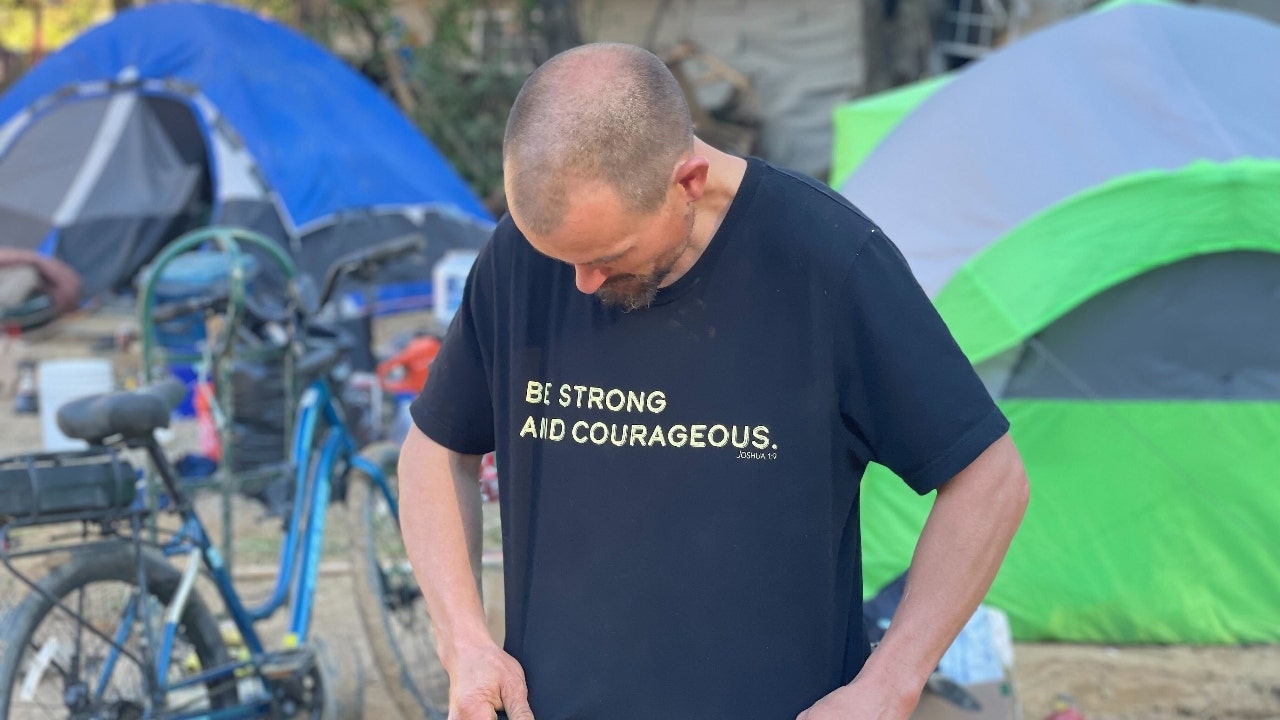
Kris Weil is one of several people in hard-hit Swannanoa sleeping in a tent with his dog outside his home, which was destroyed by intense flooding and winds on Sept. 27. Weil’s story is nothing short of a miracle.
Less than 24 hours before the storm struck the Appalachian Mountains, Weil’s 8-month-pregnant girlfriend was transported to the hospital because she was experiencing chest pain. Weil stayed home to prepare for the baby, at which point he started getting flood warnings on his phone, not knowing he’d soon be left with nothing.
Weil watched as water rapidly flooded his neighborhood and then made its way inside his home.
NC FAMILY THAT LOST 11 IN HURRICANE HELENE MUDSLIDES SAYS COMMUNITY SACRIFICED ‘LIFE AND LIMB’ TO SAVE EACH OTHER
Kris Weil is sleeping in a tent outside his home that was destroyed during Hurricane Helene.(Fox News Digital)
Advertisement
“The house completely got washed off its foundation, and we got sucked out the back window — with me and my friend and three dogs — and managed to survive long enough for a swift water rescue boat to come get us, just by chance, they had just showed up in town from Chicago, Illinois,” Weil told Fox News Digital. “They came and got us out of the tree with a rescue boat. And we’ve been staying in tents.”
The water that flooded Weil’s home forced him out a back window that had broken open. He was able to latch onto a vine attached to a tree in his backyard with one hand and hold onto one of his dogs with the other hand as water rushed through the area.
It wasn’t until nearly six hours later that a rescue boat from Cook County, Illinois, arrived and transported Weil and his friend to safety.
HURRICANE HELENE: ‘BACKBONE OF AMERICA’ HELPING FARMERS ACROSS SOUTHEAST WHO LOST BILLIONS IN CROPS, LAND
The water that flooded Weil’s home forced him out a window that had broken open. He was able to latch onto a vine attached to a tree in his backyard with one hand and hold onto one of his dogs with the other hand as water rushed through the area.(Fox News Digital)
Advertisement
“She would have been in that tree with me,” Weil said of his girlfriend had she not gone to the hospital before the storm hit.
For days, there was no cellphone service or Wi-Fi for Weil to contact his girlfriend, but when he eventually found a way to contact her, he learned she had been transported to UNC Medical Center in Chapel Hill where she delivered a healthy baby several weeks before her due date on Oct. 20.
RETIRED NORTH CAROLINA POLICE OFFICER DELIVERS THOUSANDS OF DOLLARS IN SUPPLIES, FOOD TO HELENE SURVIVORS
The couple named their baby Sage Nevaeh — her middle name being “Heaven” spelled backwards.(Kris Weil)
The couple named their baby Sage Nevaeh — her middle name being “Heaven” spelled backwards. Sage is expected to be released from the NICU soon, Weil said. His girlfriend qualified for a program offering her temporary free housing, and she and the baby are both doing well.
Advertisement
“There’s been some miracles.”
— Kris Weil
“The churches, the community, more than anything, have been some of the people who have helped the most. And it’s been inspiring to know that we’re not forgotten. The people are amazing,” Weil said. “Their willpower and their love for other people is amazing. … They come in here in force and brought us everything we need. And they weren’t going to leave until they knew we were all right.”
Kris Weil and his dog survived flooding during Hurricane Helene by holding onto a vine attached to a tree in his backyard.(Fox News Digital)
Volunteers donated several tents to Weil and his dog, as well as a bike, food, a camping stove and propane. Emerge Ministries was able to find someone to donate a car to Weil so he can visit his girlfriend and newborn.
Less than a mile from Weil, Dara Cody and her neighbor are sleeping in tents where their homes once stood in picturesque yards on the banks of the Swannanoa River.
Advertisement
“For whatever reason, I just couldn’t sleep that night,” Cody said of the night Hurricane Helene came through, adding that she kept “checking and checking” the water level of the river behind her home that she had lived in since 2010.
Less than a mile from Weil, Dara Cody and her neighbor are sleeping in tents where their homes once stood in picturesque yards on the banks of the Swannanoa River.(Fox News Digital)
“Something wouldn’t let me rest. I almost fell asleep several times, but something brought me back awake,” she explained. “But then at about 5 in the morning, I just couldn’t rest till I got up and went and looked. … It had jumped up about 12 feet in 30 minutes … and it was way higher up in my yard and way deeper.”
At that point, Cody woke her partner and told him, “You have to get up right now. We’re not going to make it if you don’t.”
HURRICANE HELENE: MORE THAN 90 REPORTED DEAD IN NORTH CAROLINA, 26 STILL MISSING
Advertisement
Volunteers with Emerge Ministries of North Carolina have been helping Dara Cody sort through debris after Helene.(Emerge Ministries)
They grabbed what personal items they could and fled their home, which is now a patch of dirt beside the river that came far up over its banks that morning, destroying homes, cars and land. The couple found shelter while Helene passed through the area, but when they returned to where their home once stood the next day, it was “completely gone.”
“Like, is this a dream? What is happening here? I just didn’t know how to feel,” Cody recalled.
PUPPIES RESCUED FROM HURRICANE HELENE TO BE REHOMED WITH MILITARY MEMBERS, FIRST RESPONDERS
What Dara Cody’s property looked like before Hurricane Helene.(Dara Cody)
Advertisement
“Our home, my car, everything was just completely gone. And the devastation — not just in my home — of the entire town was just absolutely heartbreaking and just beyond … there are no words,” she said. “It was shock. It was pain. It was hurt. It was just, my heart was broken for my whole town. I’ve lived here my entire life since I was born.”
“It was shock. It was pain. It was hurt. It was just, my heart was broken for my whole town.”
— Dara Cody
In the weeks since, Cody has been working to gather what remnants of her home she can. Volunteers from Emerge Ministries have been helping her clean and sort through debris. At night, Cody, her partner and their neighbor sleep in tents alongside the now-destroyed edges of the Swannanoa.
She added that she is a candidate for a tiny home “if the county will allow it.”
Volunteers from Emerge Ministries have been helping her clean and sort through debris.(Emerge Ministries)
Advertisement
“All the volunteers that have come here have just been beyond what we could ever imagine and have been more generous than we could ever imagine,” Cody said. “They have all done more for us than we ever imagined any people, especially strangers, would ever do for us. The outpouring of love and compassion and generosity and people giving … has just blown our minds. It’s unbelievable.”
“They have all done more for us than we ever imagined any people, especially strangers, would ever do for us.”
— Dara Cody
Shannon Martin Easley of Louisiana and Judy Norris of North Carolina are two volunteers with Emerge Ministries who have been helping Cody and others in the aftermath of Helene. The ministry has anywhere from 50 to 150 volunteers in the western North Carolina region “from all over the country” offering help “every day,” Easley said.
A car crushed between a house and a tree has a yellow “X” spray-painted on it, meaning authorities did not find anyone inside.(Fox News Digital)
“My uncle cleared a driveway for a man a few days ago, and he had not seen a human in 20 days,” Easley said. “How many more are just like him?”
Advertisement
Volunteers from Ohio and Maryland also spoke with Fox News Digital in Swannanoa.
Martha Hershberger and her husband, Roy, of Shekinah Christian Fellowship in Ohio, have been serving hot meals under a tent in a parking lot off the main road in Swannanoa. She estimates that she and other volunteers have been serving between 1,500 and 2,000 meals per day.
Martha Hershberger of Abba’s Heart Ministries International in Ohio has been serving hot meals under a tent in a parking lot off the main road in Swannanoa. She estimates that she and other volunteers have been serving between 1,500 and 2,000 meals per day.(Fox News Digital)
“We’ve dealt with several people who’ve lost their homes, and we’ve talked to some who have watched their neighbors drown and everything washed away,” Hershberger said. “We’ve talked to some who have their home. They lost power for a bit, but they’re all impacted with the trauma of it.”
HURRICANE EFFECTS POSE ‘TREMENDOUS’ HEALTH HAZARDS FOR AMERICANS, DOCTOR WARNS
Advertisement
Hershberger added that the people of western North Carolina will need “help for the long haul.”
Several volunteers from Maryland echoed that sentiment. Barbara Kaufman of A Lady and A Hop Maryland LLC, David Hawkins of Hawkins Landscaping and Michele Payton of Pulling for Veterans all came to Swannanoa from Frederick to deliver supplies and services to those in need. Kaufman said she traveled to the area to help people clean their damaged homes.
WATCH: Volunteers help Hurricane Helene survivors in North Carolina
“We need boots on the ground, hands to the plow,” Kaufman said. “These people here need help.”
CLICK HERE TO GET THE FOX NEWS APP
Advertisement
“Yeah, they shouldn’t be sleeping in tents,” Payton added.
A total of 26 North Carolinians remain missing in the wake of Helene. The storm caused widespread damage across seven states that will take years for some towns to recover from. Locals and volunteers compared Helene’s devastation to a war zone.
Former NBA sixth-man of the year winner Jamal Crawford has been a star for NBC and Peacock on their NBA coverage this season. After spending a season with MSG contributing to their coverage of the New York Knicks, Crawford joined one of the major networks and has shined all season long. It’s been reported that […]
The Republican candidate for the District 1 seat on the Louisiana Public Service Commission will now be determined in a June runoff between a state lawmaker and a past parish president.
State Rep. Stephanie Hilferty and attorney and policy consultant John Young bested three other candidates in Saturday’s Republican primary with 28 percent and 31 percent of the vote, respectively. Since neither got more than 50 percent of the vote, the race to represent the New Orleans suburbs on the PSC advances to a June 27 runoff.
The winner will face Democrat Connie Norris, who was unopposed in her party’s primary, and Chris Justin, an engineer running as an independent, in November’s general election.
Advertisement
Hilferty and Young both vowed to serve as watchdogs against excessive utility spending. They edged out state Rep. Mark Wright, who finished third with 24 percent of the vote.
At least seven of the nine counties that had the so-called 287(g) agreements with Immigration and Customs Enforcement have pulled out of those plans.
Maryland Gov. Wes Moore, center, smiles before signing legislation that prohibits immigration enforcement agreements with the federal government during a bill-signing ceremony Tuesday, Feb. 17, 2026, in Annapolis, Md. He is joined, from left, by Maryland Secretary of State Susan Lee, Lt. Gov. Aruna Miller, House Speaker Peña-Melnyk and Senate President Bill Ferguson. (AP Photo/Brian Witte)(AP/Brian Witte)
Maryland Gov. Wes Moore, center, smiles before signing legislation that prohibits immigration enforcement agreements with the federal government during a bill-signing ceremony Tuesday, Feb. 17, 2026, in Annapolis, Md. He is joined, from left, by Maryland Secretary of State Susan Lee, Lt. Gov. Aruna Miller, House Speaker Peña-Melnyk and Senate President Bill Ferguson. (AP Photo/Brian Witte)(AP/Brian Witte)
Maryland sheriffs vowed to fight legislation, passed early in this year’s legislative session, prohibiting formal agreements between local police agencies and federal immigration officials, and giving sheriff’s departments 90 days to get out of any deal they were in.
But as the 90-day clock expires Monday, it turns out that at least seven of the nine counties that had the so-called 287(g) agreements with Immigration and Customs Enforcement have pulled out of those plans and an eighth said the agreement will not be enforced, even though it’s still on the books.
Most of the local departments dropped the 287(G) agreements either the same day or the day after Gov. Wes Moore (D) signed Senate Bill 245 and House Bill 444 into law Feb. 17. The emergency legislation took effect immediately upon his signature.
Advertisement
While they appear to have given up the 287(g) fight, however, sheriffs are still assessing a challenge to another immigration bill that passed during the waning hours on the last day of this year’s session: the Community Trust Act. It is one of several immigration enforcement bills the governor has yet to sign, with just one more bill signing scheduled for May 26.
The majority Democratic legislature and the supporters of the 287(g) ban argue it eliminates and distrust of police in communities where aggressive immigration tactics have been conducted and enforced by President Donald Trump (R) and his administration.
As of Sunday, according to ICE, the agency had 1,832 law enforcement agencies in 39 states and two U.S. territories signed on to participate in the 287(g) program. Seven of the nine Maryland counties – Allegany, Carroll, Cecil, Frederick, Harford, St. Mary’s and Wicomico – already informed the agency they had to terminate their partnerships due to the passage of the law.
“I thank you for your partnership since 2019 and your efforts to help me keep our communities safer,” wrote Cecil County Sheriff Scott Adams in a Feb. 17 letter addressed to Vernon Liggins, acting field office director in the Baltimore ICE office.
But the agency’s website lists two Maryland counties still participating: Garrett and Washington.
Advertisement
A representative from the Garrett County Sheriff Office didn’t respond to requests for comment Friday.
Washington County Sheriff Brian Albert said that because the 287(g) ban took effect immediately, the agreement “is pretty much null and void. We’re not participating in the 287(g) program. We just don’t have a lot of people with detainers on them that are processing through the jail. There’s not a large immigrant community here in Washington County.”
But Albert and some other sheriffs are assessing legal advice about the Community Trust Act.
Senate Bill 791, sponsored by Sen. Clarence Lam (D-Anne Arundel and Howard), which was made an emergency measure, would prohibit local or state police from holding a person for ICE, except in limited scenarios: If a person was convicted of a felony in the United States; is a registered sex offender; served between 12 to 18 months in a state prison; or committed an offense in another state and served at least five years in prison.
A major part of the bill requires federal officials to present a judicial warrant to hold someone, not just an administrative warrant.
Advertisement
One of the main complaints from Republican lawmakers and some sheriffs is the act will not only decrease cooperation with federal officials, but also force law enforcement agencies to follow both federal and state law they say conflict with each other.
“We’re sworn to uphold the constitution of the United States and the state of Maryland. The Community Trust Act puts us in a very tough predicament,” Albert said.
‘Have some standing’
Harford County Sheriff Jeffrey Gahler posted a video April 15 on social media urging the governor to veto the Community Trust Act.
“This legislation is a direct assault on public safety. It officially bans our law enforcement and correctional officers from communicating with our federal partners at the Department of Homeland Security,” Gahler said in video.
He reiterated that point said in an interview Thursday.
Advertisement
“The governor hasn’t signed it. We’re waiting on [whether] if he vetoes it, or allows it to become law after 30 days if he doesn’t veto it or sign it,” Gahler said. “We have talked with attorneys. We think we might have some standing. I hope we don’t get there. I hope he does the right thing and vetoes this terrible bill.”
But supporters have said the Community Trust Act closes a loophole that lets local law enforcement agencies and jails detain individuals based on their immigration status and administrative requests from ICE. It complements the passage of the 287(g) ban, they argue.
Another immigration-related bill awaiting the governor’s signature is the Data Privacy Act, which seeks to close loopholes in the state’s Public Information Act and prohibit a business from selling personal data of an individual “for the purpose of immigration enforcement.”
“The signing of these bills are going to be career defining for our governor and going to mark his legacy on immigration at a time when our communities are under attack,” said Cathryn Jackson, policy director for We Are CASA.
As for the 287(g) legislation advocates pushed for more than a decade to get, Del. Nicole Williams (D-Prince George’s) said “it’s a big deal.”
Advertisement
“It’s just really unfortunate we are in this political climate we are in today with a federal administration in trying to prevent people from obtaining the American dream,” said Williams, who sponsored the House version of the 287(g) legislation.
“It’s about people who are searching for a better life for their family. When we talk about American exceptionalism, our immigration system is a part of that,” she said.
Maryland Matters is part of States Newsroom, a nonprofit news network supported by grants and a coalition of donors as a 501c(3) public charity. Maryland Matters maintains editorial independence. Contact Editor Steve Crane for questions: editor@marylandmatters.org.