South
Hurricane Helene forces North Carolina residents to sleep in tents where homes once stood

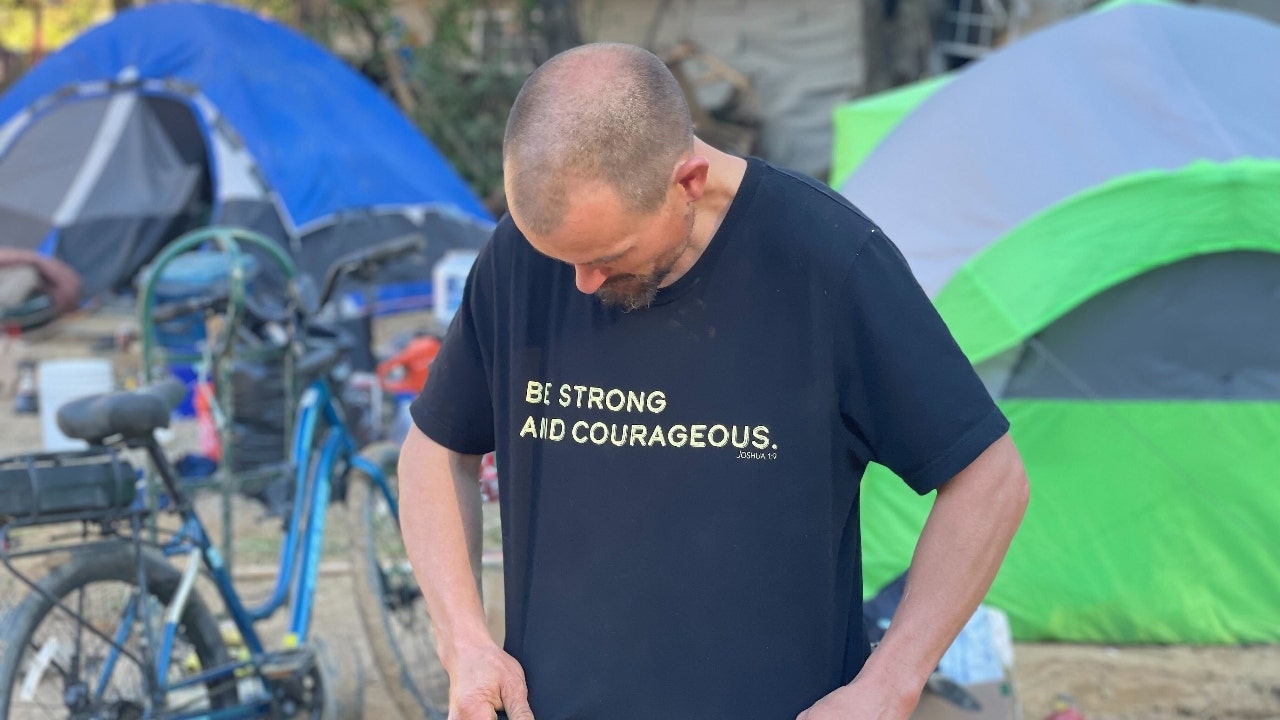
SWANNANOA, N.C. – Nearly a month after Hurricane Helene devastated areas of the Southeast and killed more than 250 people, North Carolina residents are sleeping in tents where their homes once stood, even as temperatures drop to the 30s at night.
Kris Weil is one of several people in hard-hit Swannanoa sleeping in a tent with his dog outside his home, which was destroyed by intense flooding and winds on Sept. 27. Weil’s story is nothing short of a miracle.
Less than 24 hours before the storm struck the Appalachian Mountains, Weil’s 8-month-pregnant girlfriend was transported to the hospital because she was experiencing chest pain. Weil stayed home to prepare for the baby, at which point he started getting flood warnings on his phone, not knowing he’d soon be left with nothing.
Weil watched as water rapidly flooded his neighborhood and then made its way inside his home.
NC FAMILY THAT LOST 11 IN HURRICANE HELENE MUDSLIDES SAYS COMMUNITY SACRIFICED ‘LIFE AND LIMB’ TO SAVE EACH OTHER
Kris Weil is sleeping in a tent outside his home that was destroyed during Hurricane Helene. (Fox News Digital)
“The house completely got washed off its foundation, and we got sucked out the back window — with me and my friend and three dogs — and managed to survive long enough for a swift water rescue boat to come get us, just by chance, they had just showed up in town from Chicago, Illinois,” Weil told Fox News Digital. “They came and got us out of the tree with a rescue boat. And we’ve been staying in tents.”
The water that flooded Weil’s home forced him out a back window that had broken open. He was able to latch onto a vine attached to a tree in his backyard with one hand and hold onto one of his dogs with the other hand as water rushed through the area.
It wasn’t until nearly six hours later that a rescue boat from Cook County, Illinois, arrived and transported Weil and his friend to safety.
HURRICANE HELENE: ‘BACKBONE OF AMERICA’ HELPING FARMERS ACROSS SOUTHEAST WHO LOST BILLIONS IN CROPS, LAND
The water that flooded Weil’s home forced him out a window that had broken open. He was able to latch onto a vine attached to a tree in his backyard with one hand and hold onto one of his dogs with the other hand as water rushed through the area. (Fox News Digital)
“She would have been in that tree with me,” Weil said of his girlfriend had she not gone to the hospital before the storm hit.
For days, there was no cellphone service or Wi-Fi for Weil to contact his girlfriend, but when he eventually found a way to contact her, he learned she had been transported to UNC Medical Center in Chapel Hill where she delivered a healthy baby several weeks before her due date on Oct. 20.
RETIRED NORTH CAROLINA POLICE OFFICER DELIVERS THOUSANDS OF DOLLARS IN SUPPLIES, FOOD TO HELENE SURVIVORS
The couple named their baby Sage Nevaeh — her middle name being “Heaven” spelled backwards. (Kris Weil)
The couple named their baby Sage Nevaeh — her middle name being “Heaven” spelled backwards. Sage is expected to be released from the NICU soon, Weil said. His girlfriend qualified for a program offering her temporary free housing, and she and the baby are both doing well.
“There’s been some miracles.”
“The churches, the community, more than anything, have been some of the people who have helped the most. And it’s been inspiring to know that we’re not forgotten. The people are amazing,” Weil said. “Their willpower and their love for other people is amazing. … They come in here in force and brought us everything we need. And they weren’t going to leave until they knew we were all right.”
Kris Weil and his dog survived flooding during Hurricane Helene by holding onto a vine attached to a tree in his backyard. (Fox News Digital)
Volunteers donated several tents to Weil and his dog, as well as a bike, food, a camping stove and propane. Emerge Ministries was able to find someone to donate a car to Weil so he can visit his girlfriend and newborn.
Less than a mile from Weil, Dara Cody and her neighbor are sleeping in tents where their homes once stood in picturesque yards on the banks of the Swannanoa River.
“For whatever reason, I just couldn’t sleep that night,” Cody said of the night Hurricane Helene came through, adding that she kept “checking and checking” the water level of the river behind her home that she had lived in since 2010.
Less than a mile from Weil, Dara Cody and her neighbor are sleeping in tents where their homes once stood in picturesque yards on the banks of the Swannanoa River. (Fox News Digital)
“Something wouldn’t let me rest. I almost fell asleep several times, but something brought me back awake,” she explained. “But then at about 5 in the morning, I just couldn’t rest till I got up and went and looked. … It had jumped up about 12 feet in 30 minutes … and it was way higher up in my yard and way deeper.”
At that point, Cody woke her partner and told him, “You have to get up right now. We’re not going to make it if you don’t.”
HURRICANE HELENE: MORE THAN 90 REPORTED DEAD IN NORTH CAROLINA, 26 STILL MISSING
Volunteers with Emerge Ministries of North Carolina have been helping Dara Cody sort through debris after Helene. (Emerge Ministries)
They grabbed what personal items they could and fled their home, which is now a patch of dirt beside the river that came far up over its banks that morning, destroying homes, cars and land. The couple found shelter while Helene passed through the area, but when they returned to where their home once stood the next day, it was “completely gone.”
“Like, is this a dream? What is happening here? I just didn’t know how to feel,” Cody recalled.
PUPPIES RESCUED FROM HURRICANE HELENE TO BE REHOMED WITH MILITARY MEMBERS, FIRST RESPONDERS
What Dara Cody’s property looked like before Hurricane Helene. (Dara Cody)
“Our home, my car, everything was just completely gone. And the devastation — not just in my home — of the entire town was just absolutely heartbreaking and just beyond … there are no words,” she said. “It was shock. It was pain. It was hurt. It was just, my heart was broken for my whole town. I’ve lived here my entire life since I was born.”
“It was shock. It was pain. It was hurt. It was just, my heart was broken for my whole town.”
In the weeks since, Cody has been working to gather what remnants of her home she can. Volunteers from Emerge Ministries have been helping her clean and sort through debris. At night, Cody, her partner and their neighbor sleep in tents alongside the now-destroyed edges of the Swannanoa.
She added that she is a candidate for a tiny home “if the county will allow it.”
Volunteers from Emerge Ministries have been helping her clean and sort through debris. (Emerge Ministries)
“All the volunteers that have come here have just been beyond what we could ever imagine and have been more generous than we could ever imagine,” Cody said. “They have all done more for us than we ever imagined any people, especially strangers, would ever do for us. The outpouring of love and compassion and generosity and people giving … has just blown our minds. It’s unbelievable.”
“They have all done more for us than we ever imagined any people, especially strangers, would ever do for us.”
Shannon Martin Easley of Louisiana and Judy Norris of North Carolina are two volunteers with Emerge Ministries who have been helping Cody and others in the aftermath of Helene. The ministry has anywhere from 50 to 150 volunteers in the western North Carolina region “from all over the country” offering help “every day,” Easley said.
A car crushed between a house and a tree has a yellow “X” spray-painted on it, meaning authorities did not find anyone inside. (Fox News Digital)
“My uncle cleared a driveway for a man a few days ago, and he had not seen a human in 20 days,” Easley said. “How many more are just like him?”
Volunteers from Ohio and Maryland also spoke with Fox News Digital in Swannanoa.
Martha Hershberger and her husband, Roy, of Shekinah Christian Fellowship in Ohio, have been serving hot meals under a tent in a parking lot off the main road in Swannanoa. She estimates that she and other volunteers have been serving between 1,500 and 2,000 meals per day.
Martha Hershberger of Abba’s Heart Ministries International in Ohio has been serving hot meals under a tent in a parking lot off the main road in Swannanoa. She estimates that she and other volunteers have been serving between 1,500 and 2,000 meals per day. (Fox News Digital)
“We’ve dealt with several people who’ve lost their homes, and we’ve talked to some who have watched their neighbors drown and everything washed away,” Hershberger said. “We’ve talked to some who have their home. They lost power for a bit, but they’re all impacted with the trauma of it.”
HURRICANE EFFECTS POSE ‘TREMENDOUS’ HEALTH HAZARDS FOR AMERICANS, DOCTOR WARNS
Hershberger added that the people of western North Carolina will need “help for the long haul.”
Several volunteers from Maryland echoed that sentiment. Barbara Kaufman of A Lady and A Hop Maryland LLC, David Hawkins of Hawkins Landscaping and Michele Payton of Pulling for Veterans all came to Swannanoa from Frederick to deliver supplies and services to those in need. Kaufman said she traveled to the area to help people clean their damaged homes.
WATCH: Volunteers help Hurricane Helene survivors in North Carolina
“We need boots on the ground, hands to the plow,” Kaufman said. “These people here need help.”
CLICK HERE TO GET THE FOX NEWS APP
“Yeah, they shouldn’t be sleeping in tents,” Payton added.
A total of 26 North Carolinians remain missing in the wake of Helene. The storm caused widespread damage across seven states that will take years for some towns to recover from. Locals and volunteers compared Helene’s devastation to a war zone.


UPDATE 6-26-2026: Gracie has been found about four miles south of the Cedar Hollow Ranch, according to a Facebook update from Real County Animal Rescue. Ranch manager Vic Jones has assembled a team to safely bring the wandering giraffe home.
—
A giraffe named Gracie is missing in Texas, and the search for her has become a tall order.
Gracie, who is about 3 years old, has been missing for nearly two weeks after escaping her enclosure at Cedar Hollow Ranch in the Texas Hill Country, said Vic Jones, who owns the remote property about 100 miles west of San Antonio. He said Wednesday, June 24 that Gracie had wandered into a part of the privately owned preserve that other giraffes previously avoided.
Jones said he has sent up helicopters to look for Gracie, a few sightings have trickled in, and a $5,000 reward is on the table.
But the giraffe, which stands roughly the height of a tree, hasn’t turned up.
“She wound up going up and feeding in an area on the hillside and the rocky ledges that none of the other giraffes had ever gone on before,” Jones said. “And when she came down off of there, she came down on the wrong side of the gate.”
The ranch is in rural Real County, where its roughly 2,700 residents were put on alert to be on the lookout for a missing giraffe. Jones said the search area is extremely remote, and the likelihood of Gracie encountering any humans is low.
“People are not in danger of her because she’s not around people,” Jones said. ‘She’s out in very, very rough, heavily wooded lands.”
The Texas Hill Country has one of the largest concentrations of exotic captive animals in the country. Real County Sheriff Nathan Johnson said the mild climate and rugged terrain seems to serve as a good stand-in for most of the animals’ native African environments.
He rattled off a list of animals that have gone missing over the years, especially after floods, but said this was his first giraffe.
“I’ve had wildebeests, I’ve had water buffalo, I’ve had monkeys, I’ve had zebras, all go missing,” Johnson said. “Sometimes we recover them, and sometimes we don’t.”
While the middle of Texas is not a giraffe’s native environment, Jones said Gracie should be able to find plenty of leaves and other vegetation to eat. He said other animals were not likely to bother her.
Jones said he initially had helicopters searching an area of about 7,500 acres (3,000 hectares) with no luck. A few days later, there was a report that Gracie was spotted to the south.
But by the time they could search the area, Jones said, she was already gone.
“We’re always two three days late for where the information is coming from, so that makes it tough,” Jones said.

Larger-than-life bug animatronics invade Zoo Miami for a limited-time event.
Families looking for something to do in the city might consider visiting Zoo Miami for their Bugtopia event, which starts on June 27 to October 31.
The zoo will host 13 gigantic animatronics and two photo-op stations.
Starting from the entrance all the way to the Conservation Action Center, guests will find the larger-than-life insects accompanied by colorful comic-style panels with fun facts and sound effects.
The first 250 guests to arrive on June 27 and 28 will receive zoo sunglasses and a free voucher for a kid’s meal from their local Flanigan’s.
Those two opening days will also have a kid-friendly DJ present for extra entertainment.
There will also be “bug-themed tastings” on June 27.
The event will have insect investigation stations as well as microscopic insect explorations called “bug detectives”.
Anyone who completes these activities will earn a junior entomologist certificate.
For families looking for something to do in Miami this summer, you might consider Bugtopia for your next stop.
For more information, click here..

The group stage of the 2026 FIFA Men’s World Cup is nearly over, but not before the Democratic Republic of the Congo takes on Uzbekistan at Atlanta Stadium.
For DR Congo, this last match is extremely important. The team remains in contention for a spot in the knockout round with its one point. Uzbekistan has an extremely slim change of getting to the round of 32 following its loss to Portugal earlier this week, but a massive win could change all that.
This is the second time DR Congo has competed in the World Cup since 1974, when it was called Zaire. The team qualified after winning a playoff tournament in Mexico.
How to watch DR Congo vs. Uzbekistan
- Date: Saturday, June 26
- Kickoff: 7:30 p.m. ET
- Location: Mercedes-Benz Stadium
- TV (English): FS1
- TV (Spanish): Peacock (Telemundo/Universo)
- Streaming: Universo, FOX One, FOX Sports app and website
FIFA Fan Festival Atlanta
What: FIFA Fan Festival™ Atlanta
Where: Centennial Olympic Park
Time: 2 p.m. to Midnight
The free general admission tickets for Saturday have sold out, but guests can purchase tickets to the festival on its website.
-
 Lifestyle2 minutes ago
‘Wait Wait’ for June 27, 2026: With Not My Job guest Stephen Malkmus
-

 Technology12 minutes ago
Margaret Atwood says the problem with AI is ‘garbage in, garbage out’
-

 World17 minutes ago
Gulf countries strongly condemn Iran’s drone attack on Bahrain as rising tensions threaten MOU
-

 Politics24 minutes ago
Jeffries welcomes Democratic Socialists into the fold as critics warn party is revealing ‘exactly who it is’
-

 Health27 minutes ago
These leafy greens could help protect your lungs, study suggests
-

 Sports32 minutes ago
Knicks hand Mamdani-backed candidate cease and desist letter for using team’s logo in campaign: report
-

 Technology39 minutes ago
Empty envelopes in your mailbox? Do not scan that code
-
 Business42 minutes ago
Truck parking lot plans near Port of Los Angeles spark backlash among residents

