South
Historic Illinois home of Paul Powell, the 'Shoebox Scandal' politician, faces sale as trust funds dwindle

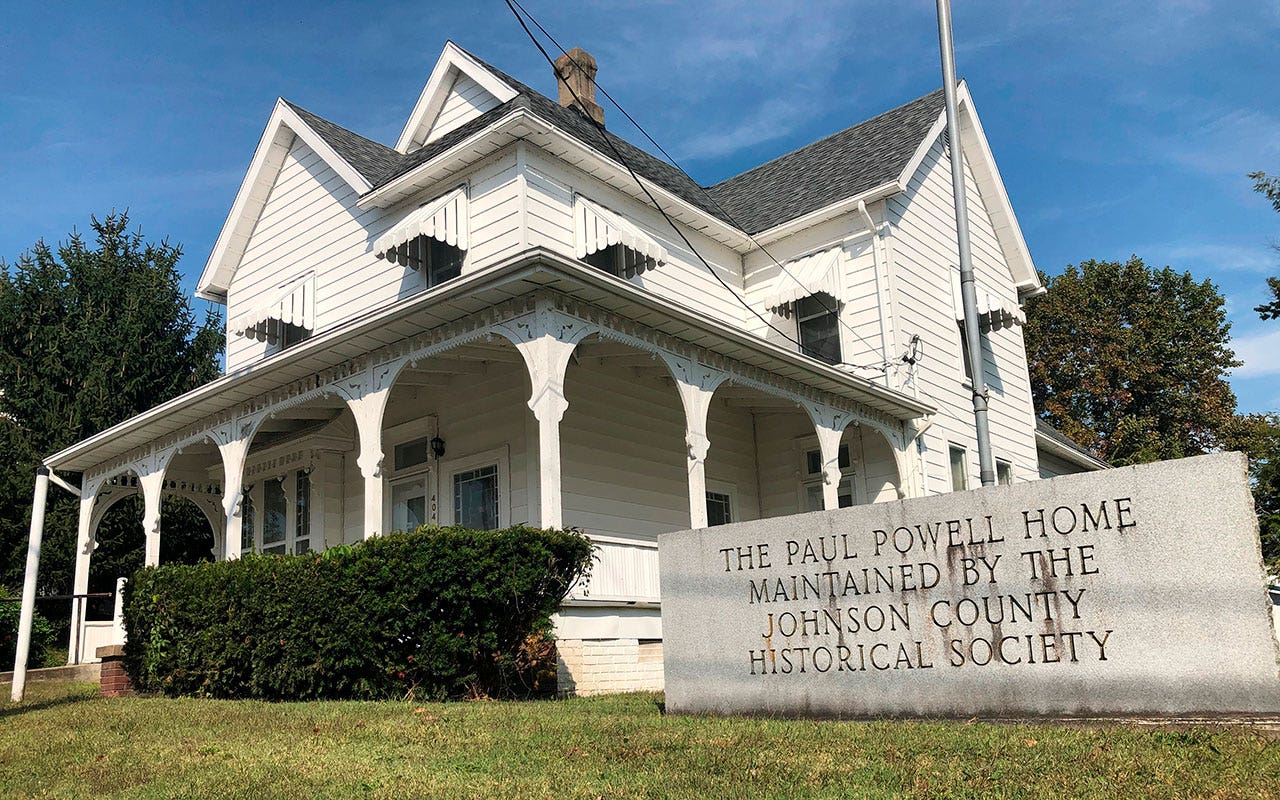
- Paul Powell, a powerful figure in southern Illinois politics, left behind $800,000 in cash in the “Shoebox Scandal.”
- Powell established a $250,000 trust that sustained his legacy for over half a century.
- The trust, which maintains Powell’s birthplace as a museum in Vienna, is running dry, and the home is likely to be sold.
Paul Powell, the southern Illinois political powerhouse who died and left behind $800,000 in cash in the notorious “Shoebox Scandal,” used to say, “The only thing worse than a defeated politician is a broke one.”
For more than half a century, a Powell-established $250,000 trust sustained his legacy, for better or worse. But the account that maintained his birthplace as a museum will soon run dry. The fate of the home in Vienna, a town of 1,300 about 140 miles southeast of St. Louis, is uncertain, but it likely will be sold.
For decades it has been home, according to Powell’s wishes, to the Johnson County Genealogical and Historical Society, which has the home looking as it did during the political giant’s time in office, with memorabilia cluttering the walls.
FORMER ILLINOIS SENATOR HALTS FEDERAL TRIAL AFTER ABRUPTLY ADMITTING TO FRAUD AND MONEY LAUNDERING
The upkeep runs about $5,000 annually, while last year the society’s income was $4,300, said board member Gary Hacker, 85, whose parents were schoolmates of Powell and mowed his lawn as a teenager in the early 1950s.
A sign marks the Paul Powell Home and Museum in Vienna, Ill. The birthplace of Powell, one of Illinois’ more notorious politicians, might soon be up for sale. (AP Photo/John O’Connor, File)
“We’re probably going to be putting it on the market for sale,” Hacker said. “The historical society will relocate.”
Southern Illinois was Powell’s fiefdom for much of the mid-1900s. He brought jobs by expanding the state’s prison infrastructure to the region, pumped money and status into Southern Illinois University and promoted county fairs and pari-mutuel betting on horse racing, which served the dual purpose of enriching Powell, who held racetrack stock.
While in later years Powell spent more time in Springfield and Chicago, when he was at home, favor-seekers streamed to the house. Sunday afternoons were spent in the sunroom he added in the 1950s, where three televisions were tuned to separate networks carrying sports, Hacker said.
“He was pretty adept at watching football, smoking cigars and conducting political business on the telephone or with people who visited him there,” Hacker said.
Winning a House seat in 1934, the Democrat was elected speaker in 1949, 1959 and 1961 — once despite Republicans claiming a one-seat majority. His quid pro quo deals with the boss of Chicago, Mayor Richard J. Daley, ensured projects for both regions and were often punctuated with another Powell aphorism: “I can smell the meat a-cookin’!”
Powell’s leverage only grew with his 1964 election as secretary of state.
“When Paul Powell was a man of influence, people knew where Johnson County was,” said John Rendleman III, a lawyer from Carbondale.
Rendleman’s father, a Powell friend and executor of his estate, uncovered one of the more outlandish political scandals in a state renowned for splashy corruption cases.
After Powell’s sudden death at 68 in October 1970, the elder Rendleman found $750,000 in cash, stuffed mostly in attache cases but also in at least one gift box from Marshall Field & Co., in his suite at Springfield’s St. Nicholas Hotel. Another $50,000 was stashed in his Capitol office about five blocks away.
A federal investigation concluded Powell skimmed much of it by awarding contracts to friends with kickback conditions. His estate, settled in 1978, was worth $4.6 million, the equivalent of $21.8 million today. He had $1 million worth of stock in horse tracks where he determined the most favorable racing dates.
The IRS claimed $1.7 million, and the state of Illinois $230,000. News reports on other politicians with horse racing stock led to federal prison for former Gov. Otto Kerner, at the time a federal appeals judge. Future politicians were required by law to start completing annual statements of economic interest.
FORMER ILLINOIS SENATOR’S WIRE FRAUD AND MONEY LAUNDERING TRIAL DELAYED AGAIN
The number of curiosity-seekers once drawn to the Powell home by the bizarre legend has dwindled, Hacker said. Few remember Powell even in Vienna.
“Memories last about a generation,” Rendelman said.
About $80,000 remains in the trust, Hacker said. Subtracting legal fees and the home’s value, appraised at about $60,000, will empty the account. A court date for closing the trust has not yet been scheduled.
Telephone and email messages seeking comment were left for the trustee at First Mid Bank & Trust in Mattoon.
It’s not beyond possibility that the house will remain open, Hacker said. One potential buyer has suggested making the three-bedroom home of about 1,700 square feet (160 square meters) into a bed-and-breakfast.



Officials in Atlanta, a World Cup host city, threw away tents, medication, identification, and other items belonging to homeless people without any warning, according to a report.
The items were collected from a public park not far from where many soccer fans have been gathering to watch the soccer tournament, The Guardian reports.
Some of the items taken by city workers reportedly include blood pressure pills, an insulin kit, and hormones.
In response to the accusations, the city’s senior advisor on homelessness, Chatiqua Ellison, told the paper that the area that the affected area of Freedom Park was “not an encampment” and that the item removals were part of “routine park maintenance.”
She reportedly said that because the site was not an encampment and the action was not considered a “sweep,” the city was not obligated to give a warning before officials moved in to seize the items.

One person who lost belongings, named Kai, told The Guardian that she lost a bag filled with her possessions, including a flash light.
“Our whole lives was thrown away,” she said.
Kai said the site was effectively an encampment as it was used for that purpose, regardless of the city’s official definition.
Kelsea Bond, an Atlanta city council member whose district includes the park, told the newspaper that she was disappointed with the city’s handling of the situation.
“It’s disappointing that the city is more concerned about the strict, and perhaps arbitrary, definition of ‘encampment’ here rather than the impact these kinds of clearings have on the houseless community,” she said, adding that the city should be more focused on “the impact of a policy, not the intention on paper.”
Bond shared an email with the outlet from Major Peter Ries of the Atlanta Police Department in which he stated that the area in question was not an encampment, and the seized “property was considered abandoned, [and] park maintenance disposed of … unclaimed items.”
The Independent has requested comment from the city of Atlanta.
People from around the world have descended on Atlanta this summer to watch the eight planned soccer matches at Mercedez Benz stadium. But homeless advocates have argued that the city’s efforts to present a good face to visitors has been at the expense of some of the community’s most vulnerable members.

In the months leading up to the World Cup, Atlanta Mayor Andre Dickens made clear in a statement that he did not want the city’s homeless population anywhere near places where they might run into visitors.
“We want to make sure those unsheltered individuals don’t come anywhere downtown, and throughout the city of Atlanta, not just during the World Cup, but now,” he said.
Advocates told The Guardian that at least two of Atlanta’s downtown parks — often used by the homeless as gathering places — were fenced off in the weeks prior to the World Cup, forcing them to disperse into other parts of the city.
They said that disruption breaks up homeless individuals’ routines, access to healthcare services, and disrupts their social connections.
Allen Hall, who was homeless for decades and who now is active in street outreach for the American Friends Service Committee, told the paper that the city’s actions have forced homeless individuals to sleep on the streets and sidewalks because they have limited options outside of shelters.

AUGUSTA, Ga. (WRDW/WAGT) – Launch Augusta hosted its ninth annual Launch Camp at Augusta University on Saturday, welcoming students from 13 Georgia counties to explore careers in health care.
Organizers said the event aims to inspire the next generation of medical professionals by connecting students with experts across more than 25 health-related fields.
Students rotated through clinic simulations, demonstrations and other hands-on, interactive learning experiences. Former Launch Camp participants also returned to volunteer.
“It’s so important to have this exposure at a young age because if you don’t know it exists, there’s things you may not even open your mind to,” said Dr. Kendra Broussard, president and founder, Launch Augusta. “We serve as low as kindergarten students, and they are getting real hands-on medical procedures.”
Organizers said the camp was free to attend thanks to donors and sponsors.
Copyright 2026 WRDW/WAGT. All rights reserved.
Washington, D.C
Sen. Graham’s death shocked Washington. What will be his legacy? : Consider This from NPR

Republican Senator Lindsey Graham of South Carolina at a hearing to examine the 2027 budget for the Department of Defense on Capitol Hill in Washington, DC, on May 12, 2026.
Jim Watson/AFP via Getty Images
hide caption
toggle caption
Jim Watson/AFP via Getty Images
The nation continues to react to the unexpected death of South Carolina Republican Senator Lindsey Graham. Graham was a veteran politician, a dealmaker and military hawk. He was also one of President Trump’s staunchest critics before his election, only to become one of Trump’s close allies on Capitol Hill after his victory.
Former Republican Senator Jeff Flake served alongside Graham from 2013-2019, and said he and Graham were “friends to the end,” despite moments of tension and disagreement. Flake weighs in on what will be Sen. Graham’s legacy.
For sponsor-free episodes of Consider This, sign up for Consider This+ via Apple Podcasts or at plus.npr.org.
Email us at considerthis@npr.org.
This episode was produced by Henry Larson, with audio engineering by Peter Ellena.
It was edited by Michael Levitt.
Our interim executive producer is Courtney Dorning.
-

 Denver, CO3 minutes ago
Nuggets sign former Denver West basketball player Alpha Diallo out of EuroLeague
-

 Seattle, WA9 minutes ago
Portland aims to top Seattle’s 405 e-bikes with 2-mile Guinness record ride and party
-

 San Diego, CA15 minutes ago
Top-ranked Jannik Sinner beats Alexander Zverev to win Wimbledon again
-

 Milwaukee, WI21 minutes ago
MLB Draft 2026: Milwaukee Brewers Draft Signing Tracker
-
Atlanta, GA27 minutes ago
Atlanta officials ‘throw out homeless tents and medicine’ near World Cup spot
-

 Minneapolis, MN33 minutes ago
Minneapolis City Council halts new data center developments until November
-

 Indianapolis, IN39 minutes ago
Quiet and comfortable tonight with the heat gradually returning this week | July 12, 2026
-

 Pittsburg, PA45 minutes ago
Pittsburgh Pirates Select Incoming Tennessee Baseball Transfer Outfielder In MLB Draft | Rocky Top Insider

