Georgia
Georgians voting absentee urged by election officials to drop ballots off at county drop boxes

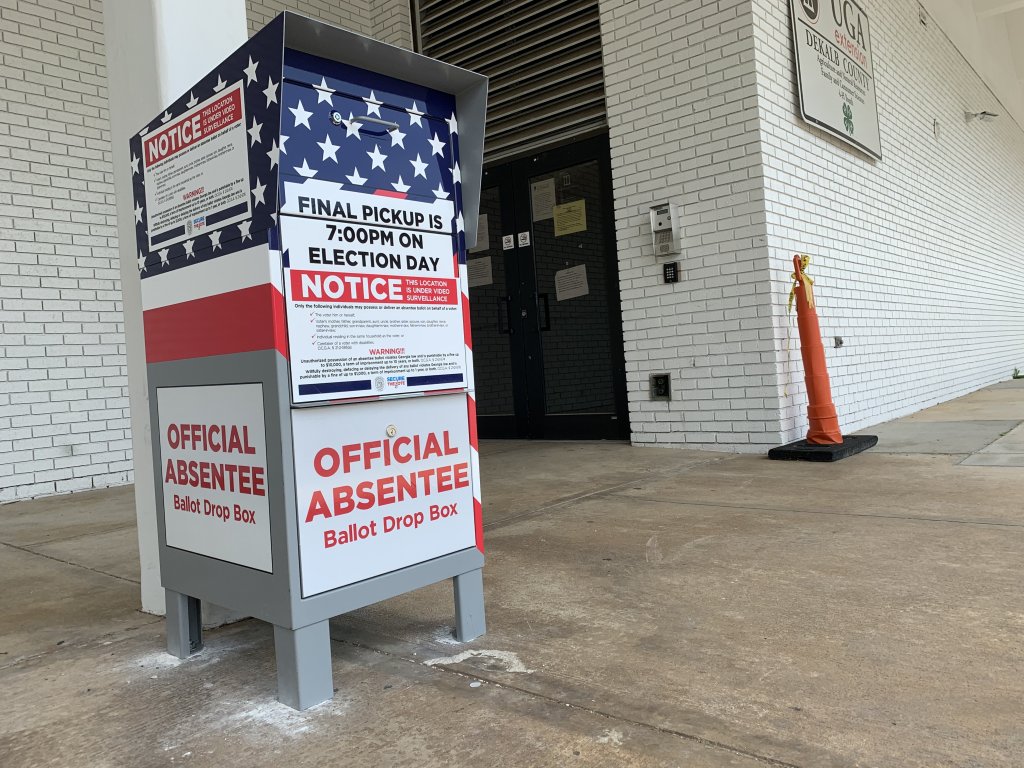
The political landscape has shifted greatly since the 2020 presidential election when a record number of Georgians voted absentee during the COVID-19 pandemic.
Four years ago after Election Day, then-President Donald Trump and his Republican allies sparked a wildfire of conspiracy theories regarding absentee ballot voting fraud as the reason he lost the election to Joe Biden in Georgia by less than 12,000 votes.
Mail-in voting will be an important aspect of this year’s Nov. 5 presidential election, which has so far seen a record early voting turnout of more than 3,2 million Georgia casting ballots in person at the polls, or 44% of all active voters.
The state’s early voting period ends Friday.
As of Monday, more than 199,000 Georgians have turned in mail-in ballots out of a total of 342,000 requested ballots. Voters who did not request an absentee ballot by Friday’s deadline must vote early in person or on the Nov. 5 Election Day.
Election officials in Georgia and several voting rights organizations are encouraging voters to directly return their mail-in ballots to county election offices and drop boxes, or to vote in person if they have not yet received them.
Georgia’s county election workers greeted a historic number of early-bird voters since select polling places opened on Oct. 15, with some locations experiencing wait times in excess of an hour daily. Statewide, reports of long lines were minimal. Voter turnout is expected to increase during this final week of early voting.
Georgia nonprofit Fair Fight Action, a voting access advocacy organization, noted significant problems with mail-in ballot processing this fall and advised voters to return their ballots via drop boxes or in-person voting instead of sending them by postal mail. An overhaul of the postal service’s Atlanta Regional Processing and Distribution Center in Palmetto is blamed for delaying mail delivery so much that a bipartisan group of Georgia’s congressional delegation has issued stinging criticism of the U.S. postmaster general.
According to Fair Fight Action, a number of county registrars are coping with delays in vote-by-mail processing, with one-third of voters contacted still waiting for their ballots.
A third of the about 190,000 ballots sent to Georgia voters that were unreturned as of last week were within the metro Atlanta area, including the counties of Cobb, Fulton. Gwinnett, and DeKalb. Unreturned ballots in other parts of the state were reported to be at their highest levels in Bibb, Dougherty, and Sumter counties, according to Fair Fight.
Absentee ballots must be received by the time the polls close at 7 p.m. Election Day in order to be counted.
“We do not recommend at this point, that voters, put their ballot in the postal system,” Fair Fight CEO Lauren Groh-Wargo said last week. “They need to return it into a drop box, or they need to go into an early voting center and cancel their mail vote and vote in person because of the postal delays.”
Since the 2020 election, Georgia lawmakers introduced new voter ID laws that specifically limit options for absentee voters.
About 1,200 absentee ballots are on the Georgia Secretary of State’s office list of ones rejected for deficiencies.
Many of the rejections were due to ID errors, which could be a result of Georgia voters being unaware of the new ID requirements that differ for each form of voting, according to VoteRiders, a national voter ID resource organization.
VoteRiders is collaborating with Fair Count of Georgia for a ballot cure program that will assist voters to have their absentee ballots counted by fixing the issues that resulted in their ballots being rejected.
“What we are seeing is in addition to the changes in the deadline for requesting an absentee ballot, there are new voter ID requirements for absentee ballots that did not exist in 2020,” said Randy Faigen, Georgia state coordinator for VoteRiders.
Voters who have had their absentee ballots rejected are being contacted directly by Fair Count. Election officials in some areas have already contacted voters to inform them of the problem.
“A lot of times it requires that they submit a copy of their state ID or their driver’s license, and that isn’t always easy, especially for some of our elderly voters who may not have access to a photocopy machine or have a smartphone to send that in,” Faigan said. “They may need a ride to go to the county elections office to show them their ID. If so, then we’re really just brainstorming with the voter to figure out what we can do to make sure their ballot counts.”
This year’s election has seen a substantial number of Republican operatives change their stance to emphasize early voting. Georgia is considered one of seven swing states for the Nov. 5 presidential election contest between Trump and Vice President Kamala Harris.
Throughout his 2024 campaign, Trump has publicly encouraged Republicans to vote early at polling stations, but there has been mixed messaging about absentee voting.
In 2020, Trump’s early lead over Biden evaporated after Election Day as mail-in votes were tabulated in Democratic strongholds such as Fulton County. Trump and other supporters spread false allegations that the election was stolen in order to cause doubt in Georgia, Michigan, Pennsylvania, and other states where Trump was defeated after the 2020 election.
In the following 10 weeks, there were over 60 failed voter fraud lawsuits, multiple new conspiracy theories about election theft, violent threats against election officials, and a deadly attack on the U.S. Capitol, David Becker, executive director of The Center for Election Innovation & Research, said on an October episode of his podcast “The Count with David Becker.”
“(Trump’s) message to his party was clear,” Becker said. “Any election we lose cannot be trusted. Election distrust was now hardwired into a major political party.
“So when that party lost in 2020, the partisan effect combined with the hardwired message, fully half of Republicans expressed no confidence in the vote, a 32-point gap below Democrats,” Becker said. “There’s a painful paradox in this lost confidence. As overall confidence in elections was dropping, the elections themselves were getting better and better.
“More professional, more transparent, more verified, more secure, until we reached the most trustworthy and least trusted election in American history,” Becker said
Faigan said absentee voting remains a secure way for Georgians to make their voices heard in an election.
“Absentee is a great method of voting,” Faigan said. “People get nervous about it. There’s a lot of misinformation out there, but the ballots are secure. if you take it to a drop box, you can put it in yourself, and you see it go in. The hard part is the mail and that’s the one factor we cannot control. Georgia is a received-by-absentee ballot date, which means absentee ballots have to be received by 7pm on Election Day. It doesn’t matter what the postmark says.”



After a huge ratings boost in the updated Rivals300 rankings that now has Joakim Gouda as a top-30 prospect in the 2027 class, the Florida Gators remain in contention for the elite Georgia linebacker despite an apparent leader in his recruitment.
Gouda, once unranked by Rivals, is now the second-highest-rated linebacker in his class. He has seen multiple expert predictions to land with Kirby Smart and the in-state Georgia Bulldogs recently. However, the Gators have consistently been in the mix for the athletic backer under Jon Sumrall, with both schools making his top five, as well as Texas, Auburn and Alabama, and official visits scheduled to all remaining contenders.
Despite the smoke around Georgia, Florida will still have a strong shot at the 6-foot-2, 225-pound defender with plenty of time left before his decision is officially made.
“Florida is definitely still strongly in the race,” Gouda told Florida Gators on SI. “I’m just focused on building relationships and taking my time. I’m not rushing a commitment — I want to make the best decision for me and my future.”
Though the Gators offered Gouda only just over two months ago, Florida has wasted no time in aggressively pursuing the talented athlete, who is expected back on campus for a visit this spring on top of his scheduled official visit from June 4 to June 6. While still somewhat early in the building of a relationship, the new staff member has stood out.
“Florida sits in my top 5 because I really like the program and the energy around it right now. Even with a lot of competition, I believe in my ability to compete and contribute.” Gouda said. “I think I could fit in well with Sumrall and the new staff because I’m coachable, hardworking, and focused on team success. I like their energy and vision for the program, and that’s earned them a real chance in my recruitment.”
Florida’s chances will rely heavily on the next few months, however, as Gouda goes through his visits looking for the best program fit amongst multiple premier options. With a long way to go till signing day, the Gators will have plenty of time to prove to the elite prospect that they meet his criteria.
“From Florida, I’m looking for a staff that truly believes in me, a system where I can develop, and a culture that feels like family,” Gouda said. “A program will earn my commitment by showing consistency, developing players, and giving me the best opportunity to grow on and off the field.”
After making 100 tackles during junior season at South Pauling High School (Ga.), Gouda is expected to surge up recruiting rankings as he heads toward a decision next year. While becoming one of the largest risers in his class as of late, the four-star is not getting complacent.
“The attention on Rivals feels good because it shows people are noticing my work,” Gouda said. “…I think it’s just a result of staying consistent and improving every day, but I’m still keeping my head down and grinding.”
The Gators will likely be in it till the end for the potential future five-star Gouda, with Sumrall and staff looking to fight off Smart in his home state and land one of the more exciting prospects at his position in 2027.
More From Florida Gators on SI

VALDOSTA Ga. (WALB) – Family, friends, and law enforcement agencies from across South Georgia gathered at Martin Stadium to remember Officer Caleb Abney.
First responders from across the region stood alongside Abney’s family as Lowndes County opened the stadium for the service.
Lowndes County Board member Chris Buescher said community attendance was important.
“Obviously, these first responders give their all to our community. It is important to come out and support them. We are all heartbroken as a community as one Lowndes family,” Buescher said.
Abney’s ties to the community
Buescher noted Abney’s deep roots in Lowndes County, describing his connection to the area beyond his role in law enforcement.
“Caleb was not only a first responder in terms of the fire department, a police officer. He was a former Lowndes County High graduate. He was a former Georgia Bridgeman. So he marched on this very field that these last respects were paid to. So his mom and dad were big volunteers within the school system. So it is important to recognize the sacrifices these first responders make for all of us in the community,” Buescher said.
Procession travels through Lowndes County
The procession exited Lowndes High School and traveled through several roadways across the area. Family members, guests, and first responders made their way to Fellowship Baptist Church.
Have a news tip or see an error that needs correction? Let us know. Please include the article’s headline in your message.
To stay up to date on all the latest news as it develops, follow WALB on Facebook and X (Twitter). For more South Georgia news, download the WALB News app from the Apple Store or Google Play.
Copyright 2026 WALB. All rights reserved.

ATHENS, Ga. – A 19-year-old is facing assault-related charges after police said he raped a University of Georgia student early Saturday morning while she was walking home.
What we know:
Tydarius Wingfield of Athens allegedly approached the student in the area of 400 North Thomas Street just before 1:40 a.m. and asked to walk her home.
Wingfield and the victim did not know each other.
Wingfield then forced the woman behind a building where he sexually assaulted her, police said.
Investigators used the Real Time Crime Center’s camera system to see where the assault happened and track the victim and Wingfield’s movements. Officers continued tracking Wingfield until his arrest and positively identified him using the RTCC technology.
He is charged with rape, kidnapping, aggravated sexual battery and battery.
An investigation is ongoing.
What we don’t know:
It is unclear whether the victim was taken to the hospital after being attacked.
What you can do:
Anyone with information on this case is asked to contact Detective Burgamy at Charles.Burgamy@accgov.com or 762-400-7173.
The Source: Information in this report comes from the Athens-Clarke County Police Department.

2 Aspira charter high schools to close by April due to financial issues

Home Gym Supplies Squat Rack Cage Package Released to Market for Exercise Lovers by Strongway Gym Supplies

‘Hoppers’ review: Who can argue with hilarious talking animals?

‘God of War’ Creator Says TV First Look Is ‘So Dumb’ and ‘Terrible’: Looks Like He’s ‘S—ing in the Woods’

How President Trump’s Image Permeates the White House and Beyond

Florida High School Football Rankings: Top 25 teams – Oct. 21

Cleary's 21 help Le Moyne down Central Connecticut State 69-64 in OT

How old is Bo Nix? What to know about Oregon quarterback ahead of 2024 NFL Draft

99th annual Pony Swim held in Virginia

Indiana Members Credit Union announced as new anchor tenant at Bottleworks District

Trump sends official notification to Congress on strikes against Iran

Unexpected birth brings hope to near-extinct Amazon tribe

Supreme Court blocks redrawing of New York congressional map, dealing a win for GOP

Map: Earthquake Shakes Central California

Gas prices could jump as Middle East tensions threaten global oil supply
-

 World5 days ago
Exclusive: DeepSeek withholds latest AI model from US chipmakers including Nvidia, sources say
-

 Massachusetts5 days ago
Mother and daughter injured in Taunton house explosion
-

 Denver, CO5 days ago
10 acres charred, 5 injured in Thornton grass fire, evacuation orders lifted
-

 Louisiana1 week ago
Wildfire near Gum Swamp Road in Livingston Parish now under control; more than 200 acres burned
-

 Technology1 week ago
YouTube TV billing scam emails are hitting inboxes
-

 Politics1 week ago
OpenAI didn’t contact police despite employees flagging mass shooter’s concerning chatbot interactions: REPORT
-

 Technology1 week ago
Stellantis is in a crisis of its own making
-

 News1 week ago
World reacts as US top court limits Trump’s tariff powers