Delaware
Government transparency in Delaware is far from perfect. Here are three fixes


3-minute read

Governor John Carney’s farewell at Delaware’s State of the State 2024
Governor John Carney’s delivers his farewell at Delaware’s State of the State 2024.
Recently, I introduced three bills not just because they are important on their own but also because I believe strongly in good government and transparency. For a number of years, in multiple surveys and studies, Delaware’s grades for good government and transparency have consistently been a D or an F. Also, according to multiple polls, Americans’ faith in government and electoral politics is at an all-time low. We cannot just talk the talk. We must walk the walk and institute laws in these areas to work towards better government and electoral processes.
Once per year in non-election years and several times per year in election years, candidates for public office — including elected officials — submit campaign finance reports detailing contributions and expenditures. I’ve introduced House Bill 292 requires that all such reports be reviewed by the Department of Elections, or DOE, for any violations of campaign finance rules. Currently, a candidate submits a campaign finance report and it immediately appears on the DOE public website after undergoing only a few high-level system checks. Per HB 292, reports would appear on the website immediately but the would show in “Submitted But Not Reviewed” status.
Then, the report would be reviewed by DOE employees. If no violations or suspicious patterns of contributions or expenditures are found, the report status is updated to “Reviewed and Final.” If issues are found, the DOE works with the candidate to rectify the situation and submit an amended report. If violations are found that are not simply mistakes, the DOE refers the case to the Attorney General’s office. It is unfathomable to me that candidates’ reports currently undergo no “eyes-on” scrutiny.
I’ve also introduced HB 291 which does three things. First, it requires that candidates’ campaign finance reports include the names of donors’ employers and the donors’ job titles. This is already required in 38 other states and at the federal level. These two pieces of information will be retained by the DOE “behind the scenes.” The information will not appear on campaign finance reports or be subject to FOIA requests. Donors’ employers and job titles raise a flag for the DOE regarding possible campaign finance violations. (See the information below about the infamous Tigani case.)
Second, HB 291 requires that when a candidate unintentionally accepts more money from an individual or entity than they are allowed, they must return that surplus money to the donor. It prohibits such candidates from donating the surplus money to a charitable organization (which they may currently do) so they cannot make such those donations public and gain “political mileage” from them. Third, HB 291 requires the DOE to maintain a specific telephone number and area on their website through which individuals may report suspected campaign finance violations.
These three parts of HB 291 came from a 2013 report written by E. Normal Veasey. At the time, he was a Special Deputy Attorney General. Later, he served as the Chief Justice of the Delaware Supreme Court. Veasy served as Independent Council in a case in which the owner of NKS Distributors, Christopher J. Tigani, plead guilty to violating federal and state campaign finance and tax laws and was sentenced to two years in prison. Tigani had been giving money to his employees to donate to certain candidates for public office — known as “pass-through donations.”
In the 107-page report, Veasy included various recommendations on how to improve campaign finance laws in Delaware. Unfortunately, hardly any of those recommendations have been instituted since the report was issued eleven years ago. It is not just me — and other legislators including Republicans who have signed onto my bill — who know we need HB 291. It is also a former Special Deputy Attorney General and former Chief Justice of the Delaware Supreme Court who served as Independent Council for the most notorious case of campaign finance rules in Delaware history.
Finally, I’ve introduced HB 319 to address nepotism in state government, having worked with the Delaware Department of Human Resources, or DHR, on this effort. DHR recently instituted a much more restrictive nepotism policy than their previous one, but it does not apply to all state employees including the judiciary, executive, and legislative branches. HB 319 mandates that these branches of governments and other state agencies must draft and implement nepotism policies that are at least as restrictive as the new DHR policy. Otherwise, the DHR policy applies to those governmental branches and state agencies.
I hope that my colleagues in Dover will support all three of these important bills.
Eric Morrison is state representative for the 27th District which includes parts of Newark, Bear and Middletown.



Delaware
Delaware Found A Genius Way To Stop Trucks From Hitting Low Bridges By Dangling Boat Fenders From Poles – The Autopian

One of the most hilarious auto-related Internet sensations is watching a big truck attempting to fit under a low bridge. It always ends poorly for the truck, usually with a large chunk munched off the top by the bridge. While it’s fun to watch, trucks crashing into low rail bridges is a serious problem, as not only do the trucks get damaged, but traffic has to halt on the road and on the rails as the accident is cleared up and the bridge is inspected. Ideally, these crashes just wouldn’t happen at all, but too many drivers keep messing up. For the past few years, the state of Delaware might have found the best solution yet by placing giant plastic balls before a bridge. Here’s how so-called “Clanker Balls” have saved both trucks and bridges from hits.
America’s roads are full of bridges that offer varying levels of clearance underneath. If you’re driving down the Interstate Highway System, you can usually expect 16 feet of clearance between the pavement and a bridge. This number reduces to about 14 feet in some urban areas. These clearances generally work because the typical tractor-trailer sits at 13 feet, six inches high.
However, the bridges found on local roads may vary. Many of the old rail bridges peppering America’s secondary roads offer far less than 14 feet of clearance because they were built before modern standards. The most infamous bridge is the Norfolk Southern–Gregson Street Overpass in Durham, North Carolina, which is also known as the “11-foot-8+8 Bridge” or the “Can Opener Bridge.” This bridge, which isn’t even the lowest that you’d find in America, attained its infamy because an office worker near the bridge pointed some cameras at the bridge for all to watch. Take a look!
When Old Infrastructure Meets Modern Traffic
These many low bridges across America cause headaches for trucks on the road because their drivers have to route around them, hopefully not causing any other problems in the process. If the drivers ignore warnings or don’t realize how tall their trucks are, they may end up clogging both road traffic and rail traffic after slamming into a bridge. These bridges sometimes need to be repaired after a hit from a truck. One crash can cause a ripple effect on a particularly busy rail line as trains have to stop.
In a perfect world, these accidents wouldn’t happen. The approaches for these bridges have yellow signs that clearly call out their low height. A trucker should also always know how tall their vehicle is. However, signs are only effective if drivers look at them. Likewise, the signs aren’t any help if the driver doesn’t realize how tall their vehicle is, as might be the case for someone driving a rental truck or someone towing a fifth-wheel camper.

Sadly, the solution isn’t as simple as you’d think. These bridges often cannot be raised easily, and roadbeds sometimes cannot be lowered easily. Raising a rail bridge would require a reconfiguration of the rail grade approaching and departing the bridge. The bridge would then be rebuilt, causing delays or full stops on the rail line for potentially months. Of course, this would cost the bridge’s owner, usually the railroad, millions of dollars.
Lowering the roadbed might be difficult due to any infrastructure that may be under the road. Of course, this would also take time and cost a town a ton of cash. Even when the infamous Can Opener Bridge was raised, it was increased only eight inches to 12 feet, four inches, so it still messes up trucks.
Convincing Big Trucks To Stop

The alternative is to develop a solution to stop trucks from slamming into the bridge in the first place. At the Can Opener Bridge, for example, a sensor placed a half-block from the bridge detects when a truck is too tall, and then triggers an LED board to flash in an attempt to warn the driver. The traffic light in the intersection before the bridge also automatically turns to red. In theory, a driver approaching the bridge has 50 seconds to react before hitting the bridge, and there are warnings all over during the approach.
Yet, drivers still ignore all of the warnings, run the red light, and let the Can Opener Bridge slice their trucks open. Since drivers still can’t get the message, the North Carolina Railroad Company has a heavy steel crash beam that munches up the trucks so the bridge doesn’t get damaged.
The state of Delaware has taken a different approach. There is an infamous train trestle in Newark, Delaware, along Casho Mill Road.

This bridge, which has been around since the late 19th century, originally offered 11 feet, one inch of clearance. In the modern era, the bridge offers only eight feet, seven inches of clearance. This bridge makes the Can Opener Bridge seem roomy in comparison. The Casho Mill Road bridge is so short that it can easily trim off the tops of camper vans and lifted SUVs, forget about any sort of commercial vehicle.
As such, this bridge, which is just one of many short bridges in Delaware, has been beaten up by tall trucks throughout its long life. Mark Luszcz, the Delaware Department of Transportation’s Deputy Director for Operations & Support, published a presentation where he even found a news report from the 1970s about the bridge eating a truck.

Between 2005 and 2022, the Delaware Department of Transportation says, 78 vehicles crashed into the bridge. Eight of those crashes happened in 2021 alone, with another six crashes occurring in 2022.
The state has been trying to curb the crashes, with most methods being unsuccessful. In 2003, the state installed a set of lights that flash and are accompanied by a sign that says “Vehicle Exceeds Tunnel Height When Flashing”. Drivers ignored both. In 2017, the sign next to the lights was updated to say “TRUCKS – Too High When Flashing – Use Turnout”. Another sign was added to the bridge height marker that said: “Your Truck WILL NOT FIT”. Again, drivers ignored the lights and signs, just like they do with the bridge in North Carolina.
Delaware’s Big Orange Balls

In 2018, CSX Transportation had become tired of trucks running into its bridge. So, it petitioned the Delaware Department of Transportation to close the under-grade crossing and then to fill the hole in so that no vehicle may ever crash into the rail bridge again. This lit a fire under Newark and Delaware state officials to try to fix the issue.
In 2019, the Delaware General Assembly proposed a solution. What if Delaware started using an over-height vehicle warning system? Such systems were already in place at the NYC Port Authority and parts of Pennsylvania and New Jersey. These systems were simple, too, utilizing a set of metal cans dangling from an overhead beam. If an over-height truck approached a low bridge, it would slam into the metal cans long before hitting the bridge, and its drivers would be alerted, alarmed, and come to a stop.

In 2021, the State of Delaware, DelDOT, and the City of Newark penned an agreement to install so-called “clankers” at the Casho Mill Road bridge.
Delaware’s interpretation was a bit different than what engineers found at the NYC Port Authority and elsewhere. Engineers had found that the metal cans of those over height vehicle vehicle warning systems weren’t very loud. They also didn’t look particularly appealing. The solution? They grabbed a bunch of Taylor Made Tuff End vinyl boat fenders.

Apparently, the sound created from hitting a bunch of boat fenders sounds more like a loud boom than a clank, but the nickname “clankers” stuck, anyway. The existing signage and lights were retained as well.
Whitman, Requardt & Associates, LLP, the engineers behind the project, added an additional sign that’s not only so huge that you basically can’t miss it, but also says in bold letters that if you don’t stop, your truck will go “kaboom”.

Add it all up, and there’s a lot of drama when a truck hits the clankers. The boat fenders make a loud boom and bounce all over the place while connected to their chains. Usually, the driver of the truck is snapped out of whatever daze or distraction they’re in and slams on the brakes. Then they see the sign warning of impending doom and decide not to press forward.
DelDOT admits that the signage and hanging boat fenders are not Manual on Uniform Traffic Control Devices-compliant. However, the state, the city, and residents do not care because the clankers have been super effective. In 2023, there were zero reported crashes at the bridge; the first time such has been recorded since 2005.

The state, city, and locals have also had some great fun with the clankers. People have decorated their homes with clanker replicas during the holidays, fire departments have hung clankers from their trucks during parades, and there’s even a satirical Facebook page that publishes funny posts around the clankers. Weirdly, these boat fenders hanging from a metal bar have become a bit of an in-joke in Delaware.
As NBC10 Philadelphia reports, other clankers have been installed in Milford, Newport, near Delaware Park, and on Chapel Street. DelDOT says that while the clankers have been amazingly effective, they haven’t been perfect. In more recent times, DelDOT has discovered that some trucks hit the clankers, come to a stop, but then continue forward, hitting the bridge. The state believes that the majority of these few remaining incidents may be college students driving rental moving trucks and not understanding what the clankers mean.

Still, the clankers have been so good at their jobs that officials in California, Ohio, and other states have been reaching out to DelDOT to see if they can rig up their own version of the system.
So, if you happen to drive through one of these states and see what looks like a bunch of plastic balls hanging down from a traffic light, now you know why. Those are just simple boat fenders, and they’re there to stop truckers from blowing up their load onto a train bridge. If you’re driving a truck of some kind and you hear a loud boom just before going under a bridge, it’ll probably be wise to turn around. If you don’t, you might just turn your rig into a convertible.
Topshot graphic image: WRA, LLP

A dispute at the Delaware County Board of Elections has prompted a state lawmaker to propose changes to how county election boards work.
But the bill could boot several state party leaders from their roles as county election officials, including Ohio Republican Party Chairman Alex Triantafilou.
House Bill 752, introduced by Rep. Brian Lorenz, R-Powell, would prohibit members of a state political party’s governing body from serving as a county board of elections member or employee. It would also create a mechanism to appoint alternative board members in case of conflicts of interest.
Lorenz wants to solve problems like the one that recently popped up at the Delaware County Board of Elections.
Knox County resident Rebecca Nourse is challenging Delaware County Board of Elections member Melanie Leneghan for the woman’s seat on the Ohio Republican Party’s state central committee. This 66-member governing body issues statewide endorsements and makes other decisions about the party’s future.
Nourse made a mistake on her paperwork, which led to her being removed from the May ballot. During a hearing reconsidering that decision, Leneghan voted against Nourse. The district covers Delaware, Knox, Holmes and Coshocton counties.
Ohio Secretary of State Frank LaRose got involved, and after a revote, Nourse was ultimately allowed back on the primary ballot.
“This legislation provides a practical solution when potential conflicts arise while ensuring decisions made by our boards of elections remain fair and equitable,” Lorenz said in a statement. “It is a commonsense reform that benefits both Republicans and Democrats across Ohio.”
The Ohio Association of Election Officials is still reviewing the bill, but some members pointed out that Ohio already has policies that address conflicts of interest. “So, the ban (on state central committee members at election boards) seems pretty superfluous to most people that I’ve spoken to,” Executive Director Aaron Ockerman said.
Ohio has a bipartisan system of elections with two Democrats and two Republicans serving on each county board of elections. In Hamilton County, for example, Triantafilou serves as one of those Republican members,
“We do want people who understand politics and political considerations to be in these positions,” Ockerman said. “The fact that you have an equal number of both yields, generally speaking, nonpartisan results. But it’s made by partisan people who have an understanding of the election system.”
The bill, introduced on March 10, is in the early stages of the legislative process. It would need approval from the Ohio House of Representatives, Ohio Senate and Gov. Mike DeWine to become law.
State government reporter Jessie Balmert can be reached at jbalmert@usatodayco.com or @jbalmert on X.

Got story updates? Submit your updates here. ›
The National Weather Service is forecasting the potential for severe thunderstorms in northern Delaware, especially in New Castle County, late this evening and overnight into tomorrow morning. The storms could bring large hail, damaging winds, and even an isolated tornado, though the severity is expected to taper off as the storms move south towards Kent and Sussex Counties.
Why it matters
Severe weather can pose significant risks to public safety, property, and infrastructure. While tornado touchdowns are relatively rare in Delaware, the state does experience its fair share of high-wind events, hail, and thunderstorms that can cause substantial damage, power outages, and disruptions.
The details
According to the latest forecasts, the northern areas of New Castle County, including Wilmington and surrounding communities, are at the highest risk for experiencing the most severe weather conditions. Residents in these areas should monitor weather alerts and be prepared to take shelter if warnings are issued.
- The storms are expected to arrive in northern Delaware late this evening and continue into the overnight hours of tomorrow morning.
What’s next
Residents in the affected areas should stay tuned to local news and weather sources for the latest updates and be prepared to take shelter if severe weather warnings are issued.
The takeaway
While severe storms are not uncommon in Delaware, the potential for hail, high winds, and even an isolated tornado underscores the importance of being weather-aware and having an emergency plan in place, especially for those living in the northern part of the state.

Why the potential return of the Sonics to Seattle has never felt closer

Historic Tall Ship Faces Eviction in San Diego

Milwaukee man identified as victim in shooting that injured four others

US Soccer trains in Atlanta ahead of friendlies at Mercedes-Benz Stadium

Woman dies in Minneapolis hit-and-run crash, driver still at large

Florida High School Football Rankings: Top 25 teams – Oct. 21

How old is Bo Nix? What to know about Oregon quarterback ahead of 2024 NFL Draft

Cleary's 21 help Le Moyne down Central Connecticut State 69-64 in OT

99th annual Pony Swim held in Virginia

Indiana Members Credit Union announced as new anchor tenant at Bottleworks District

See TSA Wait Times at Major U.S. Airports

Senate hopeful with deep Dem ties slapped with scathing complaint targeting alleged family payout ‘scheme’

How the Iran war is about to hit your wallet

Suspect in slaying of Loyola University student was in the country illegally, officials say

Video: Plane Collides With Vehicle at LaGuardia Airport
-

 Detroit, MI5 days ago
Drummer Brian Pastoria, longtime Detroit music advocate, dies at 68
-

 Oklahoma1 week ago
Family rallies around Oklahoma father after head-on crash
-

 Georgia1 week ago
How ICE plans for a detention warehouse pushed a Georgia town to fight back | CNN Politics
-
 Science1 week ago
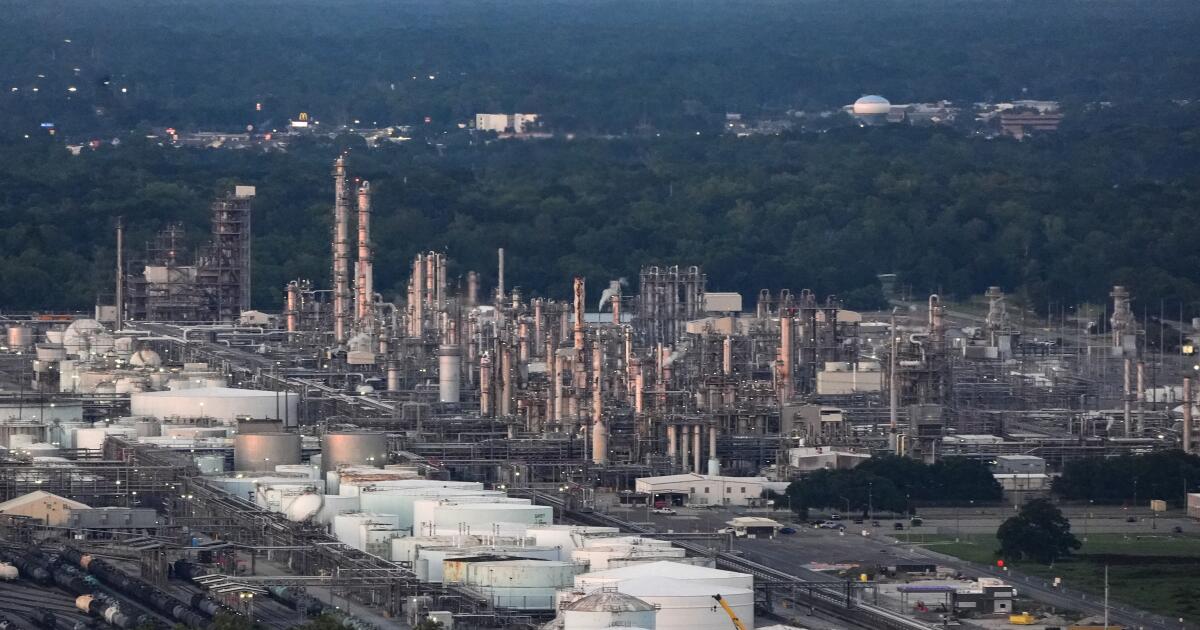
Federal EPA moves to roll back recent limits on ethylene oxide, a carcinogen
-

 Alaska1 week ago
Police looking for man considered ‘armed and dangerous’
-

 Movie Reviews5 days ago
‘Youth’ Twitter review: Ken Karunaas impresses audiences; Suraj Venjaramoodu adds charm; music wins praise | – The Times of India
-
 Science1 week ago
Long COVID leaves thousands of L.A. county residents sick, broke and ignored
-

 Education1 week ago
Video: Turning Point USA Clubs Expand to High Schools Across America