As climate change exacerbates extreme heat, organizations across the city are looking for solutions to mitigate its effects. Advocates say a relationship of trust with the community needs to be built for these solutions to be effective.
Dallas, TX
Texas Trees a five-year plan to make South Dallas more green
Anamelia Jaramillo has lived in Jubilee Park for almost 20 years and is concerned about the heat getting worse every summer.
She fears her air conditioning system failing because her husband has diabetes and can be vulnerable to extreme heat.
“I wish we didn’t have to have the A/C running all day long, but it is impossible to survive in the summer without it,” said Jaramillo, 54, after attending a Zumba class at Jubilee Park on Nov. 11.
In 2023, more than 20 people died in Dallas and Tarrant counties from heat-related illnesses as Texas saw record heat waves and triple-digit temperatures, according to the counties’ medical examiners. The lack of trees and green spaces, such as community gardens and parks, in an urban area contributes significantly to the ‘urban heat island effect,’ as buildings, roads, and other hard surfaces absorb and retain more heat.
Dallas’ District 7, where most of the neighborhoods participating in the South Dallas Greening Initiative are located, was ranked the third-highest priority for tree canopy, according to the Dallas Tree Equity Mapping Report published in 2022 by the Texas Trees Foundation.
Districts 4 and 6 ranked as the first and second highest priority for tree canopy, and the organization has been deploying some of their programs to plant more trees in these areas. Early this year, the Texas Trees Foundation released its plan to tackle the lack of trees in the Southwestern Medical District as part of its initiatives to combat the urban heat island effect.
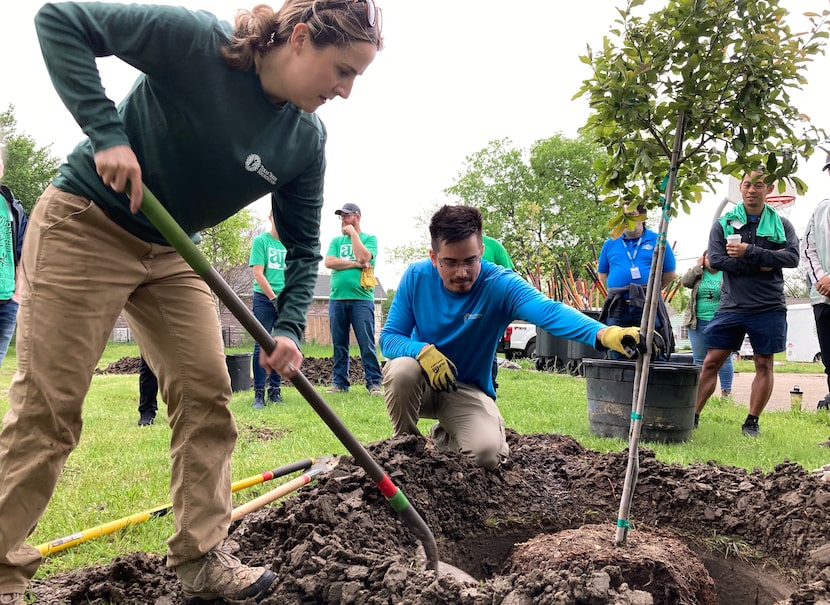
Texas Trees, through the South Dallas Greening Initiative, also is working in the Jubilee neighborhood to address the area’s lack of trees to combat the extreme heat affecting residents’ health and quality of life. The nonprofit is providing thousands of trees to the almost 50,000 residents of Fair Park, Mill City, Queen City, Wheatley Place and adjacent neighborhoods over five years. Jubilee Park is just below Interstate 30 and north of Fair Park.
Chandler Stephens’ father, Calvin W. Stephens, has owned two vacant lots in South Dallas since the 1980s. The younger Stephens has been talking with the nonprofit Texas Trees about working together on his vision to create a community garden.
Stephens dreams of having a green space in every corner of South Dallas to improve residents’ quality of life.
“I can see [the initiative] as something that will prolong the community’s livelihood. Not only with addressing the urban heat island issue but just by providing greenery,” Stephens said. “Plants and our health is so linked to the health of the earth and the planet.”
The Dallas Comprehensive Environmental Climate Action Plan established protocols for adapting to climate change challenges in 2020. It states that Dallas needs approximately 735,000 trees to reach a goal of 37% tree canopy cover and, specifically, mitigate the urban heat island effect.
Since Its founding in 1982, Texas Trees has planted an estimated 1.5 million trees across the Dallas-Fort Worth region. In 2023, the Dallas-based nonprofit secured a $15 million grant from the Reduction Act through the U.S. Forest Service’s Urban and Community Forestry program for the South Dallas Greening Initiative.
The project, however, is part of a long-term solution to extreme heat, and many of Jubilee’s residents want to see more.
“I am in favor of the initiative and for them to plant more trees in the area, but we also need help with how to pay the electricity bills,” Jaramillo said.
In any community, including South Dallas, trees may not be at the top of each resident’s list of the needs they see for their community, said Elissa Izmailyan, chief strategy and operations officer with Texas Trees.
“We are showing up with a commitment to help and the ability to offer trees and urban forestry education but realize that we’re entering a landscape where there are a lot of other needs and priorities,” Izmailyan said.
“So first, we need to be sensitive to that broad range of priorities and capacities. Second, we need to think about how our offering intersects with other needs in a way that’s additive.”
The project will have several components beyond planting trees in the community, Izmailyan said.
The first phase has been to reach out to the community and work with nonprofits and organizations in South Dallas to establish a trusting relationship and understand the community’s needs and wants.
That’s where partnerships with local organizations come into play, as well as involvement with community leaders.
The Jubilee Park and Community Center is a nonprofit that works to restore equity and resources for the 3,000 residents of the Jubilee neighborhood. The community center has been around for almost 30 years and offers education, health, food access and after-school programs.
Emily Plauche, Texas Trees’ community greening manager, said the initiative includes an educational component that teaches residents about trees, their benefits, how to care for them, green jobs, and other measures that can be taken to combat extreme heat.
“So there’s always going to be other needs or things that arise, too, and we can’t necessarily, with our money, purchase that. But we can help advocate and get the city involved and bring other people to the table who have some of these potential solutions,” Plauche said. “We are deeply committed to the well being of the community.”
Texas Trees will work with some of the area’s schools to boost green spaces and tree planting on the campuses. The organization already runs a program across the city focusing on schools needing more canopy.
907 Bank Street in Dallas on November 11, 2024.(Steve Hamm / Special Contributor)
Marissa Castro Mikoy, president and chief executive officer at Jubilee Park, said over the years, Texas Trees has helped plant over 150 trees on their campus, and they can see the benefits to the community, from providing shade to beautifying the park.
Benefits of trees
In April, Dallas shared findings from a study that identified at least 10 neighborhoods as ‘urban heat island spots.’ Some of these spots have less green space, and the temperature is 10 degrees hotter in these areas than in other parts of the city.
Trees can help reduce the urban heat island effect and improve people’s and the environment’s health in several ways.
They provide shade and block incoming solar radiation, lowering temperatures by several degrees. They also release water vapor, which can help cool temperatures. According to the Environmental Protection Agency, trees sequester carbon from the atmosphere in their wood and roots, absorb gases and provide a place for harmful air particles to land.
At the same time, according to the U.S. Forest Service, trees provide mental health benefits such as stress reduction, improved mood, and a sense of well-being due to increased exposure to nature.
Cities across the country and the world have documented the long-term effects of planting trees strategically in urban areas.
In Chicago, Illinois, according to studies, neighborhoods with higher tree canopy cover have experienced temperature reductions of up to 2.7–3.8°C compared to areas with little or no tree canopy.
Similarly, in Medellin, Colombia, temperatures fell by 2°C in the first three years of their program installing green corridors, and officials expect a further decrease of 4 to 5C over the next few decades, even taking into account climate change, the Secretary of Environment of Medellin reported.
Limitations
Trees are one solution that can help residents in South Dallas combat extreme heat, but Castro Mikoy said the initiative needs to be combined with other solutions to the area’s problems.
Displacement, making ends meet, and food insecurity are some issues facing South Dallas residents that make heat waves even more damaging for them.
Silvia Herrera, 48, a Jubilee resident, avoids turning on lights and household appliances during the day in the summer to keep her home cooler and reduce her electricity bills. She said her bill is around $500 in the peak summer months.
“You have to make decisions such as when you turn on the A/C and what things to avoid to spend less energy so the bill [electricity] is not too high because then I can’t pay for it,” Herrera said.
Planting trees and having the ecosystem to purchase, transport, and maintain them can also be expensive. The South Dallas Greening Initiative was able to come to life because of the grant Texas Trees secured. Not all cities or organizations can afford this type of solution, which is a limitation to replicating this program everywhere.
Community First
Through the five-year plan, Brittani Hite, strategic director of Ethos Equity Consulting, which is working with Texas Trees on the initiative, said there should be no surprises for the residents.
The project is for the community and by the community, said Hite.
“We understand that the solutions are already within the community,” Hite said. “South Dallas residents know what they want. They know what they need, but because of environmental and ultimately systemic racism, unfortunately, we lack green spaces, trees and other basic necessities in our city’s Black and brown neighborhoods.”
From Hite’s perspective, the conversations of the Jubilee moms after the Zumba classes to Stephen’s dream of having community gardens that work with the wants and needs of the South Dallas community will have an impact on finding the right solution.
María Ramos Pacheco wrote this story as part of a climate solutions fellowship with the Solutions Journalism Network. Did you know that what you just read was a solutions journalism story? It didn’t just examine a problem; it scrutinized a response. By presenting evidence of who is making progress, we remove any excuse that a problem is intractable.

Dallas, TX
World Cup volunteers receive uniforms, new tickets released
We’re less than a month out from the start of the 2026 FIFA World Cup, and North Texans volunteering in the event have received their uniforms. FOX 4’s Peyton Yager has more on that and the new hospitality tickets released today.
Dallas, TX
Fair Park Advocates Push to Make Dallas’ ‘Crown Jewel’ Shine Year-Round
What is Fair Park? What is it supposed to be?
At City Hall, officials commonly refer to it as Dallas’ crown jewel. The sprawling campus of Art Deco edifices and midways has hosted an Elvis Presley concert, World Cup matches, a Martin Luther King Jr. speech and 97-consecutive Red River Rivalry games in its 140-year history. And every year, the State Fair of Texas attracts over 2 million visitors to the fairgrounds, leaving North Texas residents with their own attachments to Big Tex and the Hall of State.
The State Fair, however, only operates 24 days each fall, attendance is dropping, and the Cotton Bowl hasn’t consistently hosted major concerts since the 2000s. Structures commissioned for the Texas Centennial celebration in 1936 represented one of the largest collections of exposition-style Art Deco buildings in the world at the time, but most now sit in paint-chipped decay and need millions of dollars in repairs after years of neglect.
Questions over how to activate the grounds year-round have plagued Dallas officials for decades. City leaders have implemented plan after plan designed to maximize the campus, with most — such as the city’s now-infamous management contract with the nonprofit Fair Park First — falling short. The residential neighborhoods around Fair Park in South Dallas normally get left behind as well.
At a March Park and Recreation Board meeting, Park and Recreation Director John Jenkins called Fair Park “the toughest political issue to solve in this city.” So why does the city keep knocking its proverbial head against the wall? Fair Park’s potential isn’t up for debate. The 277-acre site sits only a few minutes away from downtown Dallas, abuts major thoroughfares like Interstate 30 and offers prime real estate that could become an economic engine for the city.
Key to the Future, Problems of the Past
Hasani Burton, a South Dallas resident and real estate investor, said unlocking Fair Park’s potential could be key to Dallas’ future.
“Here’s the reason we keep talking about it at the end of the day: it’s because of the economic potential,” Burton said. “In maximizing economic potential, flat out, we’re talking about on a local level, on a national level and as we keep aspiring to be the type of global city that we’re becoming on a global level.”
Having assumed control from Fair Park First in 2025, city officials have unveiled plans they believe will finally bring a sustainable vision to the grounds. Proposals include redeveloping parking lots into a hotel and retail district to organically create revenue for the park. The plans, they say, will bring Fair Park closer to what it should be — a year-round destination driving economic growth for neighboring communities and the city as a whole.
Dallas has struggled to keep up with the grounds for almost as long as they’ve been around. City and state officials quarreled over responsibility for Fair Park almost immediately after the end of the Centennial Celebration, and by 1985, noted Dallas architecture pundit David Dillon was comparing the city’s treatment of the 277 acres to that of an “embarrassing poor relation-eligible for periodic handouts.”
Handouts, in the form of periodic bond funding for stopgap maintenance needs, didn’t address the problem, as Dillon saw it. The real problem, “as it had been for decades,” he wrote, was the lack of a clear vision for the crown jewel’s future.
A need for an effective long-term framework was part of what drove Dallas leaders to delegate management of the grounds to Fair Park First in 2019. Billed as “public-private” at the time, the Fair Park First privatization ended after an audit found the nonprofit’s hired operations manager had misspent nearly $6 million in donor funds. By the time the City Council terminated the contract in 2024, decay was evident: maintenance requests around the park had gone unanswered, and the esplanade’s centerpiece fountain no longer spouted water.
“They didn’t change the filters for the water pumps, and it clogged all the pipes,” Daniel Wood, who represents the Fair Park area on the Park and Recreation board, said. “So it cost millions of dollars.”
After the Fair Park First contract ended, the Park and Recreation Department and the park board were tasked with leading the revitalization. Officials have tried to tackle the most pressing maintenance concerns and added events like weekly farmers markets in an attempt to turn the traditionally seasonal venue into an everyday asset for residents.
Still, the park’s $50 million plus in estimated deferred maintenance needs far exceed the department’s financial resources. Fair Park Coliseum needs over $3 million in repairs alone, while the expected total to repair the music hall sits at roughly $1.6 million.
Wood pointed to the city’s dubious track record of maintaining its buildings. That record is well documented and has persisted in recent years amid the debate over the future of Dallas City Hall. Reports estimate the building needs more than $350 million in deferred maintenance, as part of a $1 billion-plus total expected to fully modernize I.M. Pei’s brutalist city headquarters.
“We’re not 100% in the clear either, because it was under our control for many years and we neglected it,” Wood said. “We don’t do any better. I think we’ve learned our lesson, and we’re trying to do better now. So there’s a lot of lessons learned. There’s a lot of love for Fair Park right now. So I think we’re in a better place.”
The reason for Wood’s optimism comes from the proposal’s emphasis on a hybrid public-private model with the city operating alongside private partners and nonprofits, which he said “will hold each other accountable,” as opposed to previous unilateral management by private entities or the city.
Vana Hammond is one of two remaining members who were on the park board at the time of Fair Park First’s inception. The communications professional previously worked 12-hour shifts during the State Fair as a Dallas Police officer and said the venue has never lived “fully up to its potential” in her lifetime. She also said that she’s cautiously optimistic about the plan and thinks the city has reached a crucial point in Fair Park’s history.
“I do not think we have too many more bites out of the Fair Park apple before people are like, ‘Ah, we’ve heard about Fair Park for 10 years. Nothing’s changed,’” Hammond said.
Walled Off
Resident Norma Shaw walks the fairgrounds almost daily. She’s originally from Chicago and, despite what she called a “stigma for South Dallas,” bought a house in the neighborhood after first landing in Cedar Hill.
While she said she knows now that the grounds are open to the public daily, she didn’t when she first arrived in 2013 — a misapprehension many Dallas natives operate under.
“It’s blocked off. Just walking up, you can’t see what’s going on,” Shaw said. “That’s been my experience with Texas, is that if you don’t know where to go. You may not see that you’re standing right in front of the building where all the people are inside.”
Between miles of parking lots, fences and a noticeable lack of pedestrian crossings on Fitzhugh Avenue, connecting Fair Park to the neighborhood isn’t easy. Neighborhood advocates have called for the fences to come down, and officials outlined a need to integrate Fair Park in South Dallas as one of the reasons for privatization in 2019.
Shaw said that while she’d like to see barriers come down, the real issue is marketing.
“The visibility is the problem. It’s not the fence, it’s the visibility,” Shaw said.
Since taking over, park department staff have outlined five pillars for success at Fair Park. The first focuses on fostering cooperation between campus partners, such as the African American Museum and Texas Discovery Gardens, through shared programming to increase visits. The second draws on community events like weekend farmers markets to create a draw for residents.
“Too many of our residents only experience Fair Park through the State Fair, or through Dos Equis shows, or through Broadway Dallas, or going to one of the museums,” Ryan O’Connor, senior deputy parks director, said. “But we need people. We need and want people out there all the time.”
Opening Fair Park to South Dallas residents was also a leading reason for the plan to replace parking lots on the northeast side of the campus with a 10-acre community park. Plans for the park stalled for years before the Dallas City Council approved an agreement this spring to allow Fair Park First to raise the $40 million required to build it. With a groundbreaking expected by the end of 2026, the park will have a 44-tent vendor area, green space, fitness amenities, picnic areas and a community pavilion, according to plans presented to council.
Shaw said the park represents progress toward a better future for Fair Park, where she said, “I want to see openness.”
“I want to see people. If I go to the back area, because I’m usually open there by the Women’s Museum… and I walk all the way over to the other side, the park will be behind there. So over there, I would like to see more life and little kids. There are no kids over here. Where are the kids? You know that they exist. We have two full schools, but there’s no life over there.”
“I would like to see shops in or around the hotel, and then the park on the back. And I don’t know why we’re having the hotel in front, but it needs to be visible so people know it’s there.”
The Plan
Plans for Fair Park have been a dime a dozen since 1936. The Fair Park First debacle is fresh in the memories of many Dallasites, while public-led management has time and time again failed to cover the necessary operational and maintenance expenses.
O’Connor said he knows residents will be skeptical of the plans and may wonder what has changed at the official level. He said, with the failures of private and public models in mind, that a hybrid model utilizing private partners with city oversight presents the best path forward.
“It’s just so clear that this is the path that will yield results,” O’Connor said. “We’ve done it fully ourselves. We fully privatized. Both had their significant issues, but implementing this, this hybrid model of strategically partnering with, you know, companies that are really, really successful in certain areas, it’s just so clear that that’s the right way to do it.”
As outlined by staff, the city could contract with private partners to provide security, parking, janitorial service or event management. The city has already approved a nearly $2.5 million contract with Visit Dallas to provide event-booking and sales services for major events, a third pillar of the staff’s plan for the grounds.
The park department is also planning to contract a private partner to run day-to-day operations at the Cotton Bowl, the epicenter of Fair Park which hosted major artists like Bruce Springsteen and Ozzy Osbourne in the early 1980s. O’Connor said staff traveled to the Rose Bowl to study its operations, and that the proposal to include a non-profit in the stadium’s running is largely based on the model they saw working in Pasadena. In addition to football games, the Rose Bowl also hosts community markets and major concerts, something the Cotton Bowl could benefit from.
The Cotton Bowl recently received a $140 million renovation, funded by the 2% Dallas receives from hotel occupancy tax returns under the Brimer Bill, and the funds can also be used for a variety of projects around the grounds. Along with luxury suites, air conditioning and new concourses, which will allow the stadium to continue hosting Texas-OU through at least 2036, the renovations also brought sorely-needed upgrades to backstage facilities. O’Connor said the upgrades should help draw artists.
Jenkins, who has been with the department for 33 years and led it since 2020, said the Cotton Bowl is the first step in a plan to help create a self-sustaining revenue stream to fund Fair Park operations. Which is especially important, he said, considering Dallas’ growingly constrained city budget.
“Once we get the activation of the Cotton Bowl going,” Jenkins said. “That’s going to be another revenue stream to come in. So we can put the pieces in place right today, but I need that bigger revenue stream, so I can start tackling some of those other bigger things.”
Park Hospitality
Officials hope that revenue stream can come from the potential redevelopment of parking lots around the planned community park into a lodging and entertainment district. The district could include a hotel, retail and possibly even a sports venue. Under the proposal, surface lots would be replaced with structured parking facilities.
Based on conversations with industry leaders, Jenkins said there is “significant” interest in developing a portion of the campus into a mixed-use district. Staff will study the potential for redevelopment and begin requesting proposals from developers in the next few months.
He also said that, along with interest from the business community, city officials have rallied behind the plan more than what he’s seen in the past.
“It’s the first time I’ve seen this type of support from the political community,” he said. “I just haven’t seen this type of momentum before, where everybody’s trying to get behind Fair Park.”
According to a briefing delivered to the City Council Parks Trails and Environment Committee on April 4, the plan would create revenue for Fair Park through lease agreements that would “mostly or fully fund all park and facility maintenance and operations.” Jenkins said that a mechanism to ensure revenue stays in Fair Park and isn’t diverted to the general fund will be crucial, and that state legislators may need to get involved as they did with the Brimer Bill in 2022.
The plan calls for any new development to conform with the existing character of the park. Jenkins wants to see the district take on a Western feel and said it will need to have a symbiotic relationship with State Fair operations, which have been criticized for hamstringing opportunities for year-round activation in the past.
“It has to be something that also, when the State Fair comes around, it kind of complements the State Fair,” Jenkins said. “We’ve got the cattle back there anyway. It needs to be something that you want to come from all across the world to go have that experience in Fair Park, in this entertainment venue. That’s what we’re looking for.”
The director has an ambitious goal, which O’Connor said may be aggressive: to start development in 2027. He is close to retirement, and said creating a long-term plan that sets the fairgrounds up for success is “personal” to him.
“We’re gonna be looking back two years from today, because you’re gonna see everything in motion, and we are gonna be looking back saying it was the best decision we ever made,” he said. “And I do feel like the surrounding community is finally going to say, ‘That’s the pride’ because that’s still their neighborhood. Fair Park is still their front door, and they’re going to look back and say with pride that they have this in their neighborhood, and that’s what I need them to feel.”
Fair Skepticism
Ken Smith, 72, lives in the South Dallas home he grew up in. He’s also served on community boards, worked for the city of Dallas and currently leads the South Dallas Revitalization Coalition.
Smith agrees that Fair Park could be an “economic engine operating on all cylinders for the benefit of everybody,” but said he doesn’t have faith in the city’s ability to reverse its fortunes.
“You’re talking about a concept,” Smith said. “And I’m talking about the persons who oversaw the privatization that failed miserably in every aspect, are the same people resurrecting it.”
He was one of the lone dissenting voices in approving the Community Park agreement with Fair Park First as a member of a task force organized to oversee the agreement. The information provided to the task force was insufficient, he said, leaving him with many of the same questions he had before the nonprofit’s takeover.
“We don’t know clearly in the community what the role of Fair Park First is,” he said. “It’s the exact same issue as it was in 2018. We don’t know where they’re located.”
Along with allowing the nonprofit to oversee planning for the community park, language in the council resolution approving the agreement with the nonprofit also allows for “FPF to raise funding for the entire Fair Park.”
While O’Connor said nonprofits will have a role in the future of Fair Park, he added “that’s not to say they will be managing anything.” However, an operations model update delivered to the park board in October noted that “a non-profit or quasi-governmental operating model may organically develop over the next 3 to 5 years.”
“It really doesn’t matter what they’re trying out,” Smith said. “The city is trying to do a mea culpa and save face. You oversaw seven years of basically setting Fair Park back multiple years after the whole privatization divide. So we’re not even starting off in the same place. We’re starting off behind where we were seven years ago. How do you account for that?”
Smith said he has no confidence in the city’s ability to revitalize Fair Park due to turnover at the city council and fragmented departmental management. The only way forward, he said, is giving the community a stake in Fair Park.
“I think that’s up to the citizens and the community to put on its big boy pants and think like leaders, and we need to work on that,” he said.
The Time is Now
The community park will sit on land currently occupied by lots 10A and 10B lots inside Gate 11. Once, the land was home to about 300 houses comprising a sprawling residential neighborhood in a historically Black community.
Parking lots are a symbol of South Dallas’ complicated relationship with the fairgrounds. Even after Black residents were able to attend the State Fair outside of designated “negro days,” Fair Park has failed to be a catalyst for vibrancy in the area, where some residents see a story of broken promises behind once-locked gates. As previously reported by the Observer, between 1999 and 2014, property values in the whole city increased four times faster than values near Fair Park.
Adam Bazaldua represents the South Dallas area as a City Council member. The fairgrounds were part of the reason he decided to run in 2018, and he said the history isn’t lost on him.
“For people to tell us that we’re going to invest in certain parts of the city and it’s going to trick my constituents,” Bazaldua said. “That’s not how this works. My constituents have waited long enough — the investment needs to come to their community, and we need to have policy that is driving that conversation and actually paving a way for what that future can look like. I refuse to accept that we’re going to continue to wait.”
He campaigned strongly for progress on the community park, which residents have been waiting on for over a decade. At the council meeting where the agreement was approved, he said that there is “an unnecessary level of scrutiny when it comes to having a project like this being shovel-ready” in South Dallas.
Along with most of his fellow members of the Parks, Trails and the Environment Committee, Bazaldua supports the plan proposed by staff. He said he wants small businesses from his district to be involved in the development, and believes South Dallas must benefit from the next steps.
As proposed by staff, developers would have to provide reports on local hiring, workforce development and economic benefit in the community. Bazaldua said opening a hotel “is something that’s going to provide job opportunities here” and that he wants more livable wage jobs in his district.
If the plans to build a multi-use district come to fruition, the surrounding area is likely to see renewed investment and a rise in real estate values. Those prospects often raise alarms of gentrification, but Bazaldua said he thinks the area won’t lose its character.
“I don’t want South Dallas to be Bishop Arts 2.0, and I don’t want South Dallas to be Trinity Groves 2.0,” he said. “I believe that South Dallas can thrive and still have an identity of being South Dallas, one that is prideful for black Dallasites of many generations that feel like the growth that they see in their community is one that came for them.”
That growth is already occurring in South Dallas, and has been for years. In 2019, the Observer reported that home values in certain parts of the area had increased by 110% since 2014.
Bazaldua said he felt the need for change is urgent, given the growth, and added that “you miss every shot you don’t take.”
“This is the moment for South Dallas,” Bazaldua said. “I think that it is absolutely critical for many reasons. One is the momentum that’s been built. And I think that speaks to that skepticism, we have momentum behind us, and if we aren’t going to take advantage of the wind that’s in our sail, then we’ve missed a huge opportunity because it hasn’t been presented to us in this way ever in the past.”
‘It Needs To Be More‘
At 73-years-old, Delphine Ganious has seen just about everything south of I-30. She’s a third-generation South Dallas homeowner living in the house where she used to pick up her grandmother for shopping trips.
Ganious remembers avoiding the fairgrounds when she was in school because she thought the food had been deep-frozen from “maybe the year before or something.”
“As I grew older, I had a girlfriend that used to own a turkey stand at the Fair Park, and she told me all the requirements and how the food had to be fresh,” Ganious said. “So I still go sometimes just to walk around and eat.”
She said she’s heard proposal after proposal to the fairgrounds, but still doesn’t feel there’s enough of a draw to bring people in.
“They need stuff there that we can attend year-round,” she said. “And they’ve been talking about for many years, but nothing’s happening yet, as far as I know, and like I say, they need a marquee billboard or something to tell you what’s going on at the fairgrounds, because I have no idea.”
Ganious still prioritizes fresh food and said she wants to see more restaurants at Fair Park — namely a cafeteria— given South Dallas’ classification as a food desert. According to the U.S. Department of Agriculture, virtually all of the census tracts surrounding Fair Park are considered low-income and low-access, meaning that at least 500 people and/or 33 percent of the population live more than 1 mile from the nearest supermarket, supercenter or large grocery store.
Overall, she said, Fair Park should — and needs — to be a more vibrant part of South Dallas’ footprint.
“It needs to be more,” she said. “It needs to offer something for the community and the surrounding areas for people to enjoy year-round, every day.”
Dallas, TX
North Texas prepares for FIFA World Cup makeover
North Texas is preparing for a FIFA World Cup makeover as the region gets ready to host nine matches, the most of any single venue this year.
While World Cup signs are already appearing in other host cities, including Houston, the branding has been slower to show up across North Texas. In Arlington’s Entertainment District, much of the advertising still reflects local sports teams.
Local organizers said that’s about to change.
“This week is when it’s starting, you’ll see a lot of it,” said Noelle LeVeaux, chief marketing officer for the North Texas FIFA World Cup Organizing Committee.
LeVeaux said billboards are already promoting events leading up to the games, including the Countdown to the Cup 5K and Community Fun Run on May 30. By the beginning of June, she said, World Cup advertising will be much more visible across the region.
“We’re 30 days out today, so you’re gonna start seeing city dressing, pole banners, fenced scrims, all kinds of stuff,” LeVeaux said.
Caroline Stoeckel, vice president of marketing at the Arlington Convention and Visitors Bureau, said the goal is to create a welcoming environment for fans coming from across the country and around the world.
“Just making sure that there is just this immersive, wonderful, welcoming FIFA environment out there,” Stoeckel said.
Stoeckel shared images of banners beginning to go up in the area and said organizers want international visitors to feel welcomed when they arrive in Arlington.
“One of the things that’s really important to us, right, not only from welcoming people on the domestic front, so everybody in the United States that is coming to Arlington, but we want to make sure that the international visitors feel very welcome,” Stoeckel said.
Organizers are anticipating 100,000 visitors a day, not just in Dallas and Arlington, but across the entire region.
“We want to make sure that nobody lands here, turns on a street, goes anywhere without knowing that the World Cup is happening right here,” LeVeaux said.
This story was originally reported for broadcast by NBC DFW. AI tools helped convert the story into a digital article, and an NBC DFW journalist edited it again before publication.
-
Atlanta, GA2 minutes agoAtlanta Dream sign forward Amy Okonkwo to developmental contract ahead of home opener
-
Minneapolis, MN8 minutes agoPTSD leave policy adds financial pressure to Minneapolis Fire Department
-
Indianapolis, IN14 minutes ago
Conor Daly, Alex Palou become 1st drivers to top 228 mph on 2nd day of Indianapolis 500 practice
-
Pittsburg, PA20 minutes agoWhere to watch Colorado Rockies vs Pittsburgh Pirates: TV channel, start time, streaming for
-
Augusta, GA26 minutes agoSouth Georgia wildfires 90% contained, but hot spots still a concern
-
Washington, D.C32 minutes agoThe Work Behind the Welcome: NPS Tradespeople Restore Dupont Circle, Making D.C. Safer and More Beautiful (U.S. National Park Service)
-
Cleveland, OH38 minutes agoThe Movie Nerd Report: Independent movie premieres in Cleveland this week – The Land
-
Austin, TX44 minutes ago
Jane Austin Improv celebrates third anniversary with Texas shows & a national NYC stage

