As climate change exacerbates extreme heat, organizations across the city are looking for solutions to mitigate its effects. Advocates say a relationship of trust with the community needs to be built for these solutions to be effective.
Dallas, TX
Texas Trees a five-year plan to make South Dallas more green


Anamelia Jaramillo has lived in Jubilee Park for almost 20 years and is concerned about the heat getting worse every summer.
She fears her air conditioning system failing because her husband has diabetes and can be vulnerable to extreme heat.
“I wish we didn’t have to have the A/C running all day long, but it is impossible to survive in the summer without it,” said Jaramillo, 54, after attending a Zumba class at Jubilee Park on Nov. 11.
In 2023, more than 20 people died in Dallas and Tarrant counties from heat-related illnesses as Texas saw record heat waves and triple-digit temperatures, according to the counties’ medical examiners. The lack of trees and green spaces, such as community gardens and parks, in an urban area contributes significantly to the ‘urban heat island effect,’ as buildings, roads, and other hard surfaces absorb and retain more heat.
Dallas’ District 7, where most of the neighborhoods participating in the South Dallas Greening Initiative are located, was ranked the third-highest priority for tree canopy, according to the Dallas Tree Equity Mapping Report published in 2022 by the Texas Trees Foundation.
Districts 4 and 6 ranked as the first and second highest priority for tree canopy, and the organization has been deploying some of their programs to plant more trees in these areas. Early this year, the Texas Trees Foundation released its plan to tackle the lack of trees in the Southwestern Medical District as part of its initiatives to combat the urban heat island effect.
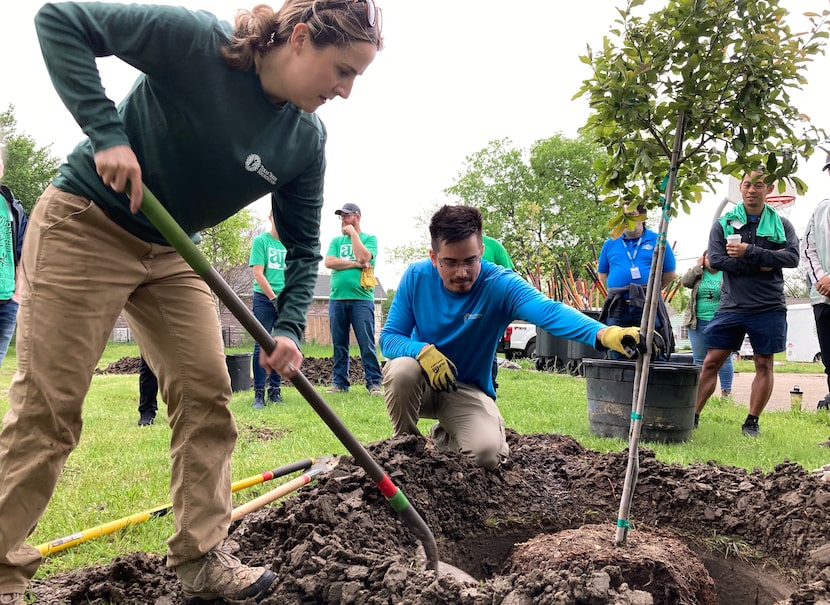
Texas Trees, through the South Dallas Greening Initiative, also is working in the Jubilee neighborhood to address the area’s lack of trees to combat the extreme heat affecting residents’ health and quality of life. The nonprofit is providing thousands of trees to the almost 50,000 residents of Fair Park, Mill City, Queen City, Wheatley Place and adjacent neighborhoods over five years. Jubilee Park is just below Interstate 30 and north of Fair Park.
Chandler Stephens’ father, Calvin W. Stephens, has owned two vacant lots in South Dallas since the 1980s. The younger Stephens has been talking with the nonprofit Texas Trees about working together on his vision to create a community garden.
Stephens dreams of having a green space in every corner of South Dallas to improve residents’ quality of life.
“I can see [the initiative] as something that will prolong the community’s livelihood. Not only with addressing the urban heat island issue but just by providing greenery,” Stephens said. “Plants and our health is so linked to the health of the earth and the planet.”
The Dallas Comprehensive Environmental Climate Action Plan established protocols for adapting to climate change challenges in 2020. It states that Dallas needs approximately 735,000 trees to reach a goal of 37% tree canopy cover and, specifically, mitigate the urban heat island effect.
Since Its founding in 1982, Texas Trees has planted an estimated 1.5 million trees across the Dallas-Fort Worth region. In 2023, the Dallas-based nonprofit secured a $15 million grant from the Reduction Act through the U.S. Forest Service’s Urban and Community Forestry program for the South Dallas Greening Initiative.
The project, however, is part of a long-term solution to extreme heat, and many of Jubilee’s residents want to see more.
“I am in favor of the initiative and for them to plant more trees in the area, but we also need help with how to pay the electricity bills,” Jaramillo said.
In any community, including South Dallas, trees may not be at the top of each resident’s list of the needs they see for their community, said Elissa Izmailyan, chief strategy and operations officer with Texas Trees.
“We are showing up with a commitment to help and the ability to offer trees and urban forestry education but realize that we’re entering a landscape where there are a lot of other needs and priorities,” Izmailyan said.
“So first, we need to be sensitive to that broad range of priorities and capacities. Second, we need to think about how our offering intersects with other needs in a way that’s additive.”
The project will have several components beyond planting trees in the community, Izmailyan said.
The first phase has been to reach out to the community and work with nonprofits and organizations in South Dallas to establish a trusting relationship and understand the community’s needs and wants.
That’s where partnerships with local organizations come into play, as well as involvement with community leaders.
The Jubilee Park and Community Center is a nonprofit that works to restore equity and resources for the 3,000 residents of the Jubilee neighborhood. The community center has been around for almost 30 years and offers education, health, food access and after-school programs.
Emily Plauche, Texas Trees’ community greening manager, said the initiative includes an educational component that teaches residents about trees, their benefits, how to care for them, green jobs, and other measures that can be taken to combat extreme heat.
“So there’s always going to be other needs or things that arise, too, and we can’t necessarily, with our money, purchase that. But we can help advocate and get the city involved and bring other people to the table who have some of these potential solutions,” Plauche said. “We are deeply committed to the well being of the community.”
Texas Trees will work with some of the area’s schools to boost green spaces and tree planting on the campuses. The organization already runs a program across the city focusing on schools needing more canopy.

907 Bank Street in Dallas on November 11, 2024.(Steve Hamm / Special Contributor)
Marissa Castro Mikoy, president and chief executive officer at Jubilee Park, said over the years, Texas Trees has helped plant over 150 trees on their campus, and they can see the benefits to the community, from providing shade to beautifying the park.
Benefits of trees
In April, Dallas shared findings from a study that identified at least 10 neighborhoods as ‘urban heat island spots.’ Some of these spots have less green space, and the temperature is 10 degrees hotter in these areas than in other parts of the city.
Trees can help reduce the urban heat island effect and improve people’s and the environment’s health in several ways.
They provide shade and block incoming solar radiation, lowering temperatures by several degrees. They also release water vapor, which can help cool temperatures. According to the Environmental Protection Agency, trees sequester carbon from the atmosphere in their wood and roots, absorb gases and provide a place for harmful air particles to land.
At the same time, according to the U.S. Forest Service, trees provide mental health benefits such as stress reduction, improved mood, and a sense of well-being due to increased exposure to nature.

Cities across the country and the world have documented the long-term effects of planting trees strategically in urban areas.
In Chicago, Illinois, according to studies, neighborhoods with higher tree canopy cover have experienced temperature reductions of up to 2.7–3.8°C compared to areas with little or no tree canopy.
Similarly, in Medellin, Colombia, temperatures fell by 2°C in the first three years of their program installing green corridors, and officials expect a further decrease of 4 to 5C over the next few decades, even taking into account climate change, the Secretary of Environment of Medellin reported.
Limitations
Trees are one solution that can help residents in South Dallas combat extreme heat, but Castro Mikoy said the initiative needs to be combined with other solutions to the area’s problems.
Displacement, making ends meet, and food insecurity are some issues facing South Dallas residents that make heat waves even more damaging for them.
Silvia Herrera, 48, a Jubilee resident, avoids turning on lights and household appliances during the day in the summer to keep her home cooler and reduce her electricity bills. She said her bill is around $500 in the peak summer months.
“You have to make decisions such as when you turn on the A/C and what things to avoid to spend less energy so the bill [electricity] is not too high because then I can’t pay for it,” Herrera said.
Planting trees and having the ecosystem to purchase, transport, and maintain them can also be expensive. The South Dallas Greening Initiative was able to come to life because of the grant Texas Trees secured. Not all cities or organizations can afford this type of solution, which is a limitation to replicating this program everywhere.
Community First
Through the five-year plan, Brittani Hite, strategic director of Ethos Equity Consulting, which is working with Texas Trees on the initiative, said there should be no surprises for the residents.
The project is for the community and by the community, said Hite.
“We understand that the solutions are already within the community,” Hite said. “South Dallas residents know what they want. They know what they need, but because of environmental and ultimately systemic racism, unfortunately, we lack green spaces, trees and other basic necessities in our city’s Black and brown neighborhoods.”
From Hite’s perspective, the conversations of the Jubilee moms after the Zumba classes to Stephen’s dream of having community gardens that work with the wants and needs of the South Dallas community will have an impact on finding the right solution.
María Ramos Pacheco wrote this story as part of a climate solutions fellowship with the Solutions Journalism Network. Did you know that what you just read was a solutions journalism story? It didn’t just examine a problem; it scrutinized a response. By presenting evidence of who is making progress, we remove any excuse that a problem is intractable.



Dallas, TX
Dallas Mayor Eric Johnson is confident about cost estimates to repair, rehab City Hall and insists the process has been transparent

Mayor Eric Johnson said he hasn’t made up his mind about the future of Dallas City Hall, the iconic I.M. Pei-designed landmark, but remains confident in the cost estimates to fix it.
City‑hired experts said it will cost $329 million to repair the nearly 50‑year‑old building and about $1 billion to rehabilitate and modernize it for the next 20 years.
Johnson said he trusts the numbers.
“I believe that those numbers are accurate,” Johnson said. “I just want to say that right up front, because I do know that there’s questions about whether or not these numbers are or have been inflated, or should we trust these numbers? I don’t know where we’d get another set of numbers that would be more trustworthy.
“These companies that have looked at this are very reputable, and so, I believe the numbers. I really believe that our jobs as a council and as a city are to do the best thing that we can, the best thing we can for our taxpayers. Not a good thing, but the best thing with the taxpayers’ dollars.”
The mayor said he, like everyone else, is waiting for more information. Earlier this month, he and eight council members voted to have the city manager determine how much it would cost to move City Hall to another building and compare that to staying and making repairs.
The city manager is also evaluating whether the current site could support private development. That report is due to the council no later than May, and the Finance Committee may be briefed on May 26. The full council could vote in June.
Development potential enters the conversation
Many people have floated the idea of a new arena and entertainment district downtown for the Dallas Mavericks, though no proposals exist.
Former mayors Ron Kirk, Tom Leppert, and Mike Rawlings have urged city leaders to move City Hall, saying it could attract billions in new development.
Johnson said he wants data, not instinct.
“I can’t govern the city based on a hunch or instinct or gut feel. I have to look at data. I would like to see what comes back and what they say this site could unlock,” he said. “Does my gut tell me that the best use of this part of downtown, is not to be a government center, which I think is kind of a dated concept in and of itself, to have a cluster of government buildings right in the middle of what could be the most vibrant part of your downtown that by definition closes at 5 p.m.
“My gut tells me that’s not a great idea. But I want the city manager to go through the exercise of actually exploring what private development options there would be. What interest would there be in this site? If there are really great economic development opportunities for the city that would be unlocked by us leaving this site, I would be very, very compelled by that.”
Preservationists push back strongly
Residents and preservationists have been vocal in their opposition. Former Mayor Laura Miller told CBS News Texas she doesn’t want City Hall sold or torn down and believes the process has lacked transparency and been “riddled with self‑interest.”
Johnson rejected that.
“I’m not sure why former Mayor Miller feels that way because I can tell you that the process has been the definition of transparent,” he said. “It’s just not true that this process hasn’t been transparent. You can go back to what I initially sent out, a memo. I put it in writing. I distributed it publicly, saying to the council, I want a committee to look at options for City Hall.
“So, that was very transparent. The meetings that were called subsequent to my request were all open to the public. Discussions were had at those meetings, and every single thing that has happened has been compelled by council action.”
Emails raise questions about engagement
The Dallas Morning News recently reported on 5,000 pages of emails related to the project and others, raising questions about how engaged the mayor has been.
Johnson dismissed the criticism.
“I’m fully engaged in everything that goes on around here. I’ve been fully engaged, and honestly, I’m going to decline to go quibble with the Dallas Morning News,” he said. “I don’t even know what these emails that they have found say. I do know what I do every day, which is I wake up early in the morning, come to this building, and give this city everything I have.
“I work tirelessly on behalf of the city, and I do everything I possibly can to make sure this city is represented well here, locally, nationally, internationally.”
Sports negotiations happening in parallel
The debate over City Hall comes as city leaders negotiate with the Dallas Mavericks and Dallas Stars to keep both teams in the city. Johnson said he cannot discuss negotiations publicly.
“Keeping the Dallas Stars and keeping the Dallas Mavericks playing in the city of Dallas is one of the highest priorities of my administration, and it has been since I got here,” he said. “I can tell you this: We are going to do everything we possibly can to make these deals work for both of those teams and keep them in the city. I am confident that we will work this out.”
Watch Eye On Politics at 7:30 Sunday morning on CBS News Texas on air and streaming.
Follow Jack on X: @cbs11jack

The Dallas Mavericks (23-50) dropped their fifth straight game Wednesday, falling 142-135 to the Denver Nuggets (45-28) in a game that felt within reach early before completely getting away from them late. Dallas had a few solid stretches to start, showing some offensive rhythm and energy, but couldn’t sustain it as Denver’s shot-making and overall execution took over. Cooper Flagg continued his strong stretch with 26 points, eight rebounds, and seven assists, while P.J. Washington added 19 points and 15 rebounds with steady production inside. On the other side, Jamal Murray put together a dominant performance with 53 points, and Nikola Jokić orchestrated everything with 23 points, 21 rebounds and 19 assists, as the Nuggets controlled the game from the middle quarters on.
The Mavericks hung around for stretches in the first half, but a Jamal Murray explosion ultimately tilted the game, as the Denver Nuggets took a 68-59 lead into halftime in a game that quickly started to feel like it was slipping away. Dallas opened with solid energy, getting contributions from multiple spots, as Naji Marshall scored efficiently and Cooper Flagg made his presence felt early as both a scorer and a playmaker, helping keep things within reach. Flagg had a noticeable impact in those opening minutes—knocking down pull-ups, attacking downhill, and creating looks for others—while Marshall’s shot-making kept the offense afloat during key stretches.
But every time the Mavericks made a push, Murray had an answer. He completely took over the second quarter, piling up 33 first-half points on 11-of-15 shooting and 6-of-9 from deep, hitting pull-ups, step-backs, and tough contested shots that Dallas simply couldn’t slow down. At the same time, Nikola Jokić quietly controlled everything else, finishing the half with 11 assists and 9 rebounds, consistently creating easy looks and keeping Denver’s offense flowing even without scoring much himself.
Dallas had some bright spots, though. There were moments especially in the third where Dallas strung together a few stops and got downhill, but it never turned into anything real, as missed shots, turnovers, and Denver’s instant responses kept resetting the margin.
If this game didn’t make it obvious, nothing will Dallas desperately needs a guard who can defend at the point of attack. Jamal Murray didn’t just have a good night, he had complete control, getting wherever he wanted and scoring however he wanted, finishing with 53 points on 19-of-28 shooting and 9-of-14 from three. There was no real resistance at the top of the defense no one who could consistently stay in front, disrupt his rhythm, or even make him uncomfortable. Once he got downhill or into his pull-up game, it was over, and that kind of pressure completely breaks a defense before it even has a chance to rotate.
This is where roster construction starts to matter. Dallas has length and some versatility in the frontcourt, but without a guard who can actually contain the ball, none of it holds up. You can’t ask your bigs to clean everything up every possession, especially against elite shot-makers. That’s why this draft becomes so important. It’s not just about adding talen it’s about adding the right kind of player. Someone who can fight over screens, stay attached, and at least make life harder for guys like Murray at the point of attack.
Because nights like this aren’t just about one player getting hot they expose a structural issue. And until Dallas finds a guard who can defend at that level, this is going to keep happening.
Someone seeds to close, eventually
The Mavericks have played a ton of close games this season, but the results just haven’t followed, and that’s something that continues to show up late in these losses. Too often, possessions in crunch time turn into rushed shots, stalled actions, or empty trips, while a single defensive breakdown on the other end swings momentum the other way. It’s not just one game it’s been a pattern, and it speaks to a team that’s still learning how to execute when everything tightens up.
That said, context matters right now. Dallas isn’t necessarily trying to squeeze out every late-game win at this point in the season, and losses like these actually help their lottery positioning. There’s value in being competitive and getting those reps without sacrificing long-term upside, especially in a strong draft class.
But long term, this is something to watch especially with Cooper Flagg. He’s already showing flashes as a primary creator, but closing games is the next step: controlling tempo, getting to the right spots, and making the right reads under pressure. It’s okay that it’s messy right now given where the team is, but if the Mavericks want to take a real step forward next season, turning these close games into wins has to be part of that growth.
Cooper Flagg continues to shine
Cooper Flagg continues to look more and more like the centerpiece of what Dallas is building, and nights like this are a big part of why. He finished with 26 points, 8 rebounds, and 7 assists, impacting the game in just about every way despite the result. What stands out isn’t just the production it’s how he’s getting it. He’s initiating offense, pushing in transition, making reads out of drives, and consistently putting pressure on the defense as both a scorer and playmaker.
This stretch has been especially encouraging. Over the past few games, Flagg has been steadily trending upward, not just in scoring, but in overall control of the game. He’s starting to look more comfortable as the primary option, picking his spots better and showing more patience when defenses collapse. Even when shots don’t fall, he’s still influencing possessions through rebounds, assists, and defensive activity.
There are still things to clean up, especially late-game execution and shot selection in tighter moments, but that’s expected at this stage. The important part is that the flashes are becoming more consistent. For a team leaning into development, Flagg isn’t just putting up numbers he’s showing real signs of growth as a lead initiator, and that’s the biggest takeaway moving forward.

DALLAS – No contracts have been signed, and no proposals have been made, but representatives of the National Republican Party did receive all the rental information for the American Airlines Center (AAC).

American Airlines Center for potential RNC
What we know:
Sources confirm that the Republican Party is exploring a national convention for the midterm elections, with Dallas being one of the cities under consideration to host the event.
Dave Brown, the general manager of the American Airlines Center, told FOX 4 representatives of the National Republican Party toured the AAC in late February, but they didn’t share any details about the possible event.
The reps were given all the rental information, including technical aspects and rental fee details, which, on average, is about $125,000 per day.
As of now, no contracts have been signed, and there are no official proposals on the table.
Why the Republican Party is targeting Texas
What they’re saying:
Matthew Wilson is a political science professor at SMU.
“Typically, parties don’t have national conventions during the midterm cycle, but it signals, I think, a desire on the Republicans’ part to rally the troops,” said Wilson. “I think there are a lot of good electoral and coalition-building reasons why Republicans would focus on Texas, in particular as a site for trying to build some momentum to gin up greater Republican turnout in this fall’s electoral cycle.”
Cornyn, Paxton, and the 2026 Midterms
Dig deeper:
Wilson says choosing Dallas would signal that the Republican Party is taking the Texas races, in November, very seriously.
In particular, the race for U.S. Senate where Democratic state representative James Talarico will face the Republican runoff winner, either U.S. Senator John Cornyn or Texas Attorney General Ken Paxton.
It’s unclear when the convention will be held.
The chairman of the Dallas Republican Party, Allen West, said he has no knowledge of the subject.
The Dallas Police Department says it doesn’t have any information about a potential RNC either.
“Typically, their presidential year conventions give both parties at least a temporary boost or bounce. We’ll see if this can work in the same way it’s not been done before, and depending on whether it succeeds or not, we’ll see whether it gets done again,” said Wilson.
The only city under consideration
What’s next:
FOX 4 reached out to Mayor Eric Johnson’s office for comment but have not heard back yet.
Sources say that Dallas is the only location in Texas being considered. Some other state locations have been mentioned, including Las Vegas.
The Source: Information in this article was provided by FOX 4’s Amelia Jones.

Maryland4 minutes ago
Showers and falling temperatures across Maryland Friday

Michigan10 minutes ago
Woman struck, fatally injured, while walking on the Lodge Freeway, state police say

Massachusetts16 minutes ago
Think you’re middle class in Massachusetts? Here’s the income range

Minnesota22 minutes ago
Over 840,000 Minnesotans Assist Aging Loved Ones, Shaping Their Daily Lives

Mississippi28 minutes ago
What channel is Mississippi State baseball vs Ole Miss on today? Time, TV schedule to watch college baseball game

Florida1 year ago
Florida High School Football Rankings: Top 25 teams – Oct. 21

Oregon2 years ago
How old is Bo Nix? What to know about Oregon quarterback ahead of 2024 NFL Draft

Connecticut2 years ago
Cleary's 21 help Le Moyne down Central Connecticut State 69-64 in OT

Virginia2 years ago
99th annual Pony Swim held in Virginia

Indiana2 years ago
Indiana Members Credit Union announced as new anchor tenant at Bottleworks District

News4 hours ago
Video: Will ICE Change Under Its New Leader?

Politics5 hours ago
DHS shutdown breakthrough comes at cost for Republicans as funding fights nears end

World6 hours ago
Rubio joins crucial G7 talks as Iran war set to dominate second day

News6 hours ago
A surprise resignation could open the door for an independent to win a Montana Senate seat

News16 hours ago
Video: Savannah Guthrie Says She Believes Her Mother Was Taken for Ransom
-

 Detroit, MI1 week ago
Drummer Brian Pastoria, longtime Detroit music advocate, dies at 68
-

 Science1 week ago
How a Melting Glacier in Antarctica Could Affect Tens of Millions Around the Globe
-

 Movie Reviews1 week ago
‘Youth’ Twitter review: Ken Karunaas impresses audiences; Suraj Venjaramoodu adds charm; music wins praise | – The Times of India
-
 Science1 week ago
I had to man up and get a mammogram
-

 Sports6 days ago
IOC addresses execution of 19-year-old Iranian wrestler Saleh Mohammadi
-

 New Mexico5 days ago
Clovis shooting leaves one dead, four injured
-
 Business1 week ago
Disney’s new CEO says his focus is on storytelling and creativity
-

 Texas1 week ago
How to buy Houston vs. Texas A&M 2026 March Madness tickets