News
Rare earths: Federal backing and tech advances aim to help the U.S. catch up to China

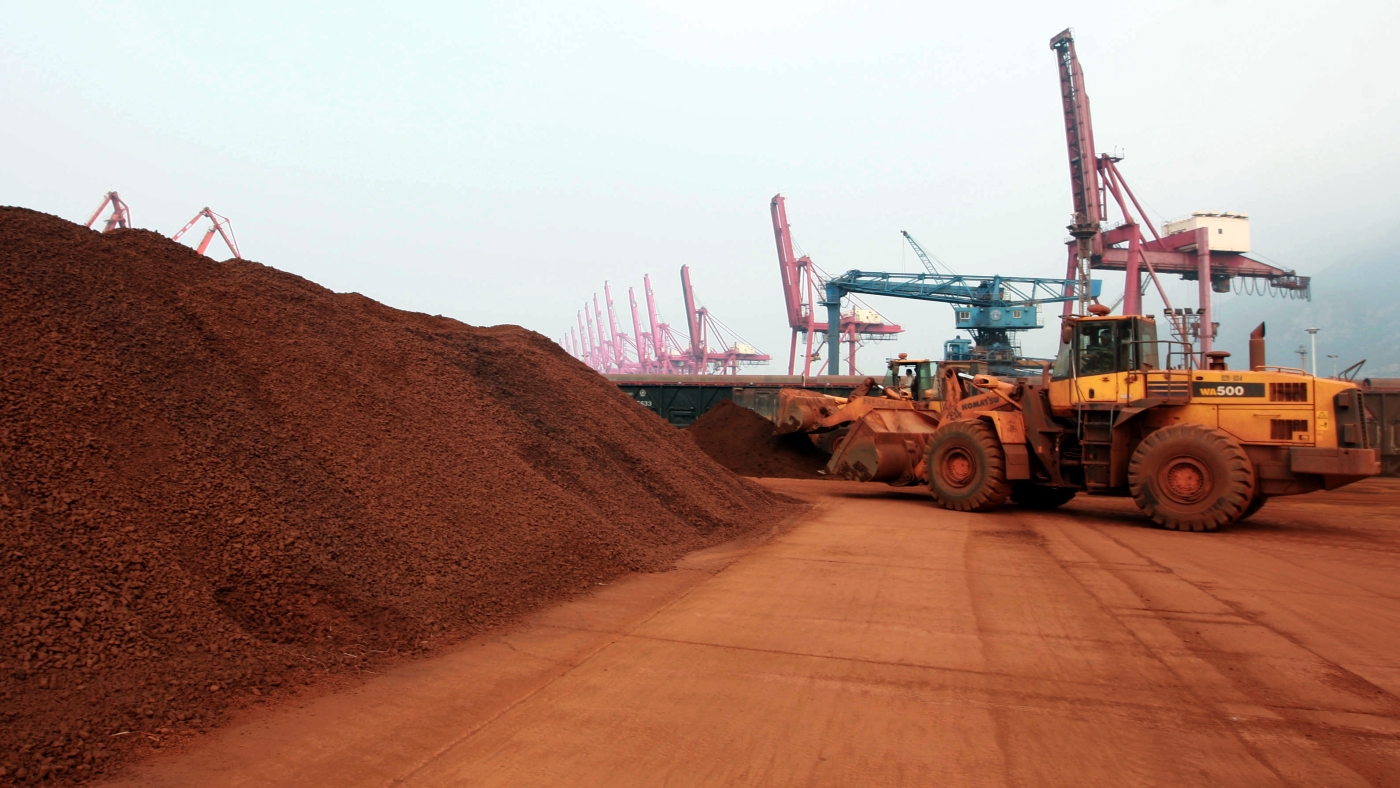
A rare earth minerals mine in China’s Jiangsu province, photographed in 2010.
/AFP via Getty Images
hide caption
toggle caption
/AFP via Getty Images
With names like neodymium and dysprosium, rare-earth elements sound exotic — and their perceived scarcity has only added to the mystique.
In reality, rare earths aren’t that rare, but just difficult to extract and refine. Yet they’ve become indispensable to modern life, embedded in everything from our smartphones and electric-vehicle motors to wind turbines and medical imaging machines.
And demand is climbing.
The real choke point is processing and refining — a complex and environmentally sensitive step that the U.S. has lagged behind in and that China now dominates, controlling nearly 90% of global output.
The need for high-torque, compact EV motors — which use rare-earth magnets that are three to four times stronger than conventional magnets — is helping drive demand. Production of these motors is soaring by roughly a third each year. Military aircraft also rely heavily on these elements; one RAND estimate suggests an F-35 contains over 900 pounds of rare-earth materials in its engines and electronics.
Taking a private-public approach
To reduce reliance on foreign supply, the White House is pursuing U.S. self-sufficiency in rare-earth production. The federal government under President Trump has supported the sector in ways that depart from traditional free-market principles. Rather than relying solely on private industry, the federal government has followed a strategy similar to China’s, providing hundreds of millions in loans and even taking stakes in key mines and startups.
Indiana-based ReElement Technologies is among the beneficiaries of this government backing. Earlier this month, the Trump administration announced a partnership between the Pentagon, via its Office of Strategic Capital (OSC), ReElement and Vulcan Elements, a North Carolina based firm that produces rare-earth magnets for military applications.
ReElement says it has developed a more efficient, environmentally friendly method of rare-earth processing and recycling that involves chromatography. The company operates a commercialization facility in Noblesville, Ind., with a larger production site in Marion, Ind., slated to come online next year.

Stacks separate rare earths at ReElement’s Noblesville, Ind., plant.
ReElement Technologies Corp.
hide caption
toggle caption
ReElement Technologies Corp.
ReElement Technologies CEO Mark Jensen says confidently that by the end of 2026, “we’ll be the largest producer of rare earth oxides in the United States.”
Because China’s dominance in refining is so great, the U.S. benchmark for success is modest, according to Bert Donnes, a research analyst at investment banking firm William Blair.
ReElement, in partnership with Vulcan Elements, aims in the next few years to produce 10,000 metric tons of neodymium-iron-boron magnets used not only in EVs, but also wind-turbine generators, hard-disk drives and MRI machines. Even that ambitious target is a fraction of the approximately 230,000 tons produced globally in 2024, according to the Institute of Electrical and Electronics Engineers, or IEEE.
“I would say if you see those numbers, you think this is going to be a massive facility,” says Donnes of ReElement’s current operation. “It isn’t.”
Compared to a traditional processing facility, ReElement’s operation is compact, he says, helping avoid any “not-in-my-backyard” (NIMBY) backlash. “So it’s not like people are scared of this process. Maybe they don’t know about it as much because you can keep the process so small,” he says.
How the U.S. lost its lead
Starting in the 1980s, China began surging ahead of the U.S. and the rest of the world in rare earth production. Around the same time, environmental concerns mounted at the only major U.S. rare earth mine, Mountain Pass in California, where spills of radioactive and toxic wastewater — byproducts of refining — raised alarms.
Mountain Pass is an open-cut mine where they “drill and blast, blend their types and locations in the pit” before grinding the solid materials into smaller particles, according to Kelton Smith, a lead process engineer for mining at Tetra Tech, a global consulting and engineering services firm. A flotation process then concentrates the rare earths that are in turn leached with hydrochloric acid.
The California mine had to halt production multiple times over the years due to environmental concerns. During that time, it changed ownership and ultimately filed for bankruptcy protection before being acquired by MP Materials in 2017, which reopened the mine.
The troubles at Mountain Pass helped China to gain a foothold and eventually overtake the U.S. in rare earths — just as demand for them was rising. Beijing now produces about 60% of the world’s supply of these substances, according to the International Energy Agency. China also holds a substantial amount of the world’s proven reserves of the ores that contain these elements — roughly 34%, according to the U.S. Geological Survey, but several other countries — including the U.S. — have substantial reserves as well.
Trump’s trade war with China has made the squeeze in rare earths even more acute. Because the U.S. lacks the ability to process rare earths on a large scale, MP Materials has had to send its ore from Mountain Pass to China for refining. But no more. Instead, the company is having to ramp up its limited capability to process the ore on-site.
Further complicating the issue are expanded export controls that Beijing announced last month that require foreign companies to obtain a license in order to sell products overseas that contain Chinese-sourced rare earths.
Aaron Mintzes is deputy policy director and counsel at Earthworks, a national group focused on preventing the adverse impacts of mineral and energy development. “What we’re urging … is to do that processing in ways that reduce energy and water intensity and toxicity,” he says.

Brent Elliott, a research associate professor of geology at the University of Texas, estimates the U.S. has sufficient resources to meet demand. “It’s about the extraction potential and the logistics of getting it out of the ground in a way that is environmentally sensitive but also socially responsible,” he says.
Partly because it is environmentally messy, with toxic byproducts, Beijing has gained an advantage by ignoring those consequences. “China can do it faster and better because they don’t have the environmental concerns that we have,” Elliott says.

Many experts agree that the U.S. has enough reserves but lacks the processing capability to go along with it. Simon Jowitt, a geologist and the director of the Nevada Bureau of Mines and Geology, says there are a number of rare earth deposits in the U.S. that have potential, but it’s rarely a straightforward proposition.
“You need a source of the rare earths, some way of transporting the rare earths, some way of concentrating the rare earths, and some way of putting those rare earths into a form that they can then be extracted,” Jowitt says. “If you don’t have one of those, then you end up with something that isn’t a mineral deposit and you’ll never get anything out of it.”
Last year, China decreed new regulations for rare earth processing that include strict environmental and safety regulations, but it remains to be seen how stringent enforcement will be.
Meanwhile, it not only processes its own ore, but it imports raw ore from places like Southeast Asia and Africa. It’s part of a broader strategy by China to set itself up as a global hub for rare earths, according to Gracelin Baskaran, director of the Critical Minerals Security Program at the Center for Strategic and International Studies.
“They put a lot of state resources behind building processing capabilities, such that the minerals come from different places and then they get sent to China for refining,” Baskaran says. “What China has been extraordinarily good at is connecting their foreign policy to secure rare earths from around the world.”
A new process and federal investments
Refining is where ReElement comes in. The company uses large columns in a specialized filtration process developed at Purdue University to extract and purify valuable metals from raw ore, but also recycled rare earths from old magnets. The process is more efficient and less environmentally damaging than older methods, such as those used by China.
Jensen, the ReElement CEO, says that method, known as solvent extraction, is “ecologically challenging” and difficult to scale. “It’s a dead technology,” he says, adding that his company’s ultimate goal isn’t necessarily to achieve U.S. dominance, but to produce enough rare earths domestically to break China’s monopoly.
The One Big Beautiful Bill passed in July appropriated $7.5 billion toward securing critical minerals. Days later, the Pentagon’s Office of Strategic Capital announced a $400 million investment in MP Materials, making the U.S. government the company’s largest shareholder. The Pentagon agency plans further investments in “[c]ritical components, raw materials, and rare earth elements utilized in microelectronic manufacturing.”
As part of the deal with ReElement, Vulcan Elements will get a $620 million loan from the Pentagon’s OSC with an additional $50 million provided by the Department of Commerce under the CHIPS and Science Act signed by former President Joe Biden. ReElement Technologies will receive an $80 million loan to support the expansion of its recycling and processing operations.
“I think we’re making big strides now because of all the grants and all the critical-mineral-focused grants coming out,” says Elliott, the University of Texas geology professor. “I think it really can set us up for success.”


Lionel Messi #10 of Argentina celebrates scoring his team’s second goal during their World Cup match against Egypt in Atlanta on Tuesday.
Elsa/Getty Images
hide caption
toggle caption
Elsa/Getty Images
They looked beaten. And out. Argentina, the defending World Cup champion and No. 1-ranked team, was down 2-0 late against Egypt.

Then, in a span of 13 remarkable minutes, Argentina scored not once, not twice, but three times, capping a comeback for the ages and leaving Egypt stunned and shellshocked.
For much of the game in Atlanta, Egypt was in control, hobbling Argentina early. The Egyptian attack began almost immediately with a stunning header goal delivered by Yasser Ibrahim in the 15th minute. After that, Egypt’s defense closed ranks, making it practically impossible for Argentina to equalize.
It was downhill from there for the Argentines: team captain Lionel Messi failed to convert a penalty kick, and in the 67th minute, Egypt got a second goal from Mostafa Ziko (after an earlier Egyptian goal had been disallowed after a video review). It looked like Argentina was finished. On the brink of elimination.
But no one told the Argentine players that.
In the 79th minute, Lionel Messi began doing his thing. He fired a cross near the Egyptian goal, and Cristian Romero headed it in. Messi was not done. Four minutes later, he powered a shot past the Egyptian keeper. It was his eighth goal of this tournament, the most of any player. The score was 2-2.
Then, in stoppage time, yet another Argentina header and another goal, this time from Enzo Fernandez.
“This is the World Cup for you,” said Messi after the game. “It wasn’t easy to come back from two goals down. But as I always say, this group never gives up. We always try to fight until the end.”

French referee François Letexier speaks with Egypt forward Mohamed Salah during the World Cup Round of 16 match between Argentina and Egypt in Atlanta.
Roberto Schmidt/AFP via Getty Images
hide caption
toggle caption
Roberto Schmidt/AFP via Getty Images
Afterward, Egypt coach Hossam Hassan complained about the French referee and the officiating. “I am not convinced. I am not convinced with this outcome. I’m not convinced with the way things unfolded during this match,” said Hassan in a post-match news conference. “We have been treated unfairly today. We have suffered injustice.”
“We would have deserved to earn this win, but we are leaving with honor, with pride, regardless of this defeat,” said Hossan.
African soccer teams have been the stars of this World Cup. Morocco has yet to lose a game. Cape Verde qualified for the first time in its history and stymied Spain, Uruguay and Saudi Arabia. Argentina barely beat them in a nail-biter of a match.
For Egypt, getting this far in the tournament is historic in itself: it’s the first time the team has made it this far. For Argentina, it was a terrifying yet relieving victory: several players, including Messi himself, cried after the game.
Next, they move to the quarterfinals and will play the winner of today’s Switzerland-Colombia match.

Top Senate Democrats are pushing for answers on whether a provision in a controversial settlement agreement between President Trump and his own administration applies to companies co-founded by or affiliated with the Trump family.
As part of a deal struck in May by the Justice Department to resolve a lawsuit brought by Mr. Trump, the Internal Revenue Service is permanently barred from pursuing claims against Mr. Trump, his oldest sons Don Jr. and Eric, and the Trump Organization based on prior tax returns.
In a one-page document signed by Acting Attorney General Todd Blanche and dated May 19, the Justice Department said the defendants in the president’s lawsuit — the IRS and the Treasury Department — are “FOREVER BARRED and PRECLUDED” from “prosecuting or pursuing, any and all claims” arising from tax returns filed before the settlement took effect. Blanche also wrote that the settlement applies to “parties including trusts, parent, sister, or related companies, affiliates, and subsidiaries.”
Now, Senators Elizabeth Warren of Massachusetts, Senate Minority Leader Chuck Schumer of New York, and Ranking Member of the Senate Finance Committee Ron Wyden of Oregon are pushing 11 businesses and organizations with ties to the Trump family to get answers for the “significant questions” the settlement raises relating to the tax audit provision, and whether the companies are included in the deal.
“Under the guise of a so-called legal settlement, the Trump administration has attempted to decree that the President, his family, and their entire business empire — potentially including entities with even the vaguest ‘affiliation’ to the family — are to face zero consequences if they have committed a range of financial crimes or misdeeds — regardless of the severity of the violation,” the senators wrote in letters transmitted to the companies Monday night.
The letters were sent to mining company Kaz Resources, defense firm Powerus, cryptocurrency companies World Liberty Financial and American Bitcoin, robotics startup Foundation Future Industries, investment firm 1789 Capital, private aviation company Tag Air, and prediction markets Polymarket and Kalshi.
All of the companies either were founded by Mr. Trump and his two adult sons, or list members of the Trump family as advisers, board members, or partial owners. Donald Trump Jr. sits on Polymarket’s advisory board and 1789 Capital, where he’s a partner, has invested in Polymarket. Days before Mr. Trump took office for his second term, Kalshi also announced Trump Jr. would be a strategic adviser.
The Democrats, who are in the minority, lack subpoena power, so Mr. Trump, his children and his companies can’t be forced to answer the questions posed by the senators.
According to recent financial disclosures, the president earned more than a billion dollars from cryptocurrency ventures alone last year, including from his meme coin business and World Liberty Financial, his family’s cryptocurrency firm.
Separately, the senators also asked the Trump Organization in a separate letter if it believes it has “immunity from all audits, civil penalties or federal prosecution” for any crimes that could have occurred before the settlement.
Trump Media and Technology Group, which is majority owned by a trust that lists Mr. Trump as the sole beneficiary and operates the Truth Social platform he uses daily, also received a letter from the Democratic senators.
“The public deserves transparency about the scope of this get-out-of-jail free card for Trump-aligned businesses, and about whether you intend to rely on this settlement as a free pass for any possible violations of the law,” the senators continued in their letter, which also seeks any communications that executives at the companies have had with the Justice Department and White House leading up to or after the settlement was signed.
The settlement was announced months after Mr. Trump and two of his sons and the Trump Organization accused the IRS and Treasury Department of unlawfully allowing a government contractor to leak tax returns to media outlets in 2020.
In a statement, a Justice Department spokesperson said “the IRS routinely provides releases as part of resolving taxpayer reviews and audits. This settlement follows that same standard practice.”
The spokesperson did not provide specific information about which companies are covered by the audit provision, or whether the Trump Organization and Trump family are the only entities covered by that addendum.

Charles De Ketelaere #17 of Belgium celebrates after scoring his team’s second goal during the World Cup Round of 16 match against the United States on Monday in Seattle.
Alex Grimm/Getty Images
hide caption
toggle caption
Alex Grimm/Getty Images
SEATTLE — This time was supposed to be different.
The U.S. men’s national team came into this FIFA World Cup with a lineup full of players with key roles in Europe’s top leagues. They had the name-brand coach — Mauricio Pochettino, of Tottenham, PSG and Chelsea fame. And they had homefield advantage, with every game on U.S. soil for the first time in three decades.

For weeks, the hype seemed like it might be real: The team’s three wins over Paraguay, Australia and Bosnia-Herzegovina were the most ever by a U.S. men’s squad in a World Cup. A new generation of American fans filled stadiums by the tens of thousands and tuned in on TV by the tens of millions.
But in the end, the Americans’ exit was the same as it ever was: Eliminated yet again in the Round of 16 at the hands of a European team — this time, Belgium, by a score of 4-1.
From the moment they stepped onto the Seattle field, the U.S. was outclassed by their opponent, No. 9-ranked Belgium. Countless turnovers and defensive lapses were seized on by the Belgians, who needed only nine minutes to take a 1-0 lead.
Then, once the Americans equalized on a free kick by midfielder Malik Tillman, Belgium scored yet again in barely a minute of play. Belgian forward Charles De Ketelaere scored both his team’s first-half goals.
After halftime, came an embarrassing nail in the coffin that silenced the Seattle sellout crowd for good — a 57th minute roll-in by Hans Vanaken after a slip-up by goalkeeper Matt Freese outside of the penalty area left the goal unguarded. Belgian forward Romelu Lukaku added a stoppage-time goal to seal the final score at 4-1.

Malik Tillman #17 of the United States celebrates scoring his team’s only goal during their World Cup match against Belgium. In what was one of the few bright spots of the game, the U.S. pulled even with Belgium at 1-1. The tie lasted less than two minutes before Belgium scored again.
Luke Hales/Getty Images
hide caption
toggle caption
Luke Hales/Getty Images
“It stinks,” said U.S. midfielder Tyler Adams. “Tonight was not a good performance overall. It’s not what we look to achieve. There [were] a lot of things that we could have done better.”
The U.S. had entered Monday’s game under a cloud of controversy around their striker Folarin Balogun, who was shown a red card in last week’s Round of 32 match against Bosnia-Herzegovina. An automatic one-game suspension was set to sideline Balogun, the Americans’ leading scorer at the World Cup, for Monday’s game.
Then, the day before the game, a FIFA disciplinary panel took the highly unusual step of delaying Balogun’s suspension by a year to allow him to participate. Then, news broke that President Trump had personally called FIFA president Gianni Infantino to encourage him to review the red card.
The Royal Belgian Football Association said it would protest Balogun’s inclusion in the lineup. But even at full strength, the U.S. were never real contenders in Monday’s game.
U.S. defender and team captain Tim Ream said the controversy swirling around the team had no impact. “We were fully focused on us as a group and as a team and fully focused on the game and not really worrying about what was being said or debated in the outside world.”
Belgium will advance to the quarterfinals for the third time in the past four World Cups, where it will face Spain on Friday in Los Angeles.

Mauricio Pochettino, Head Coach of the United States, walks down the touchline during the Round of 16 World Cup match between the USA and Belgium in Seattle on Monday.
Carl Recine/Getty Images
hide caption
toggle caption
Carl Recine/Getty Images
-

 Los Angeles, Ca1 hour ago
Bicyclist killed by hit-and-run driver in Long Beach
-

 Detroit, MI1 hour ago
Child shot while riding bike outside home on Detroit’s west side, police say
-

 San Francisco, CA2 hours ago
Bay Area restaurant has strict policy on acceptable children behavior
-

 Dallas, TX2 hours ago
Detroit Pistons trade Marcus Sasser to Dusty May’s Dallas Mavericks
-

 Miami, FL2 hours ago
The offseason has been a massive success for the Miami Heat
-

 Boston, MA2 hours ago
Can’t afford Boston’s priciest restaurants? Try these instead. – The Boston Globe
-

 Denver, CO2 hours ago
City of Denver says images of piling waste a case of illegal dumping
-

 Seattle, WA2 hours ago
14-year-old dies in electric motorcycle crash at Seattle bike park

