South
Biden cancels overseas trip as Milton bears down on Florida; DeSantis tells VP 'it's not about you Kamala'

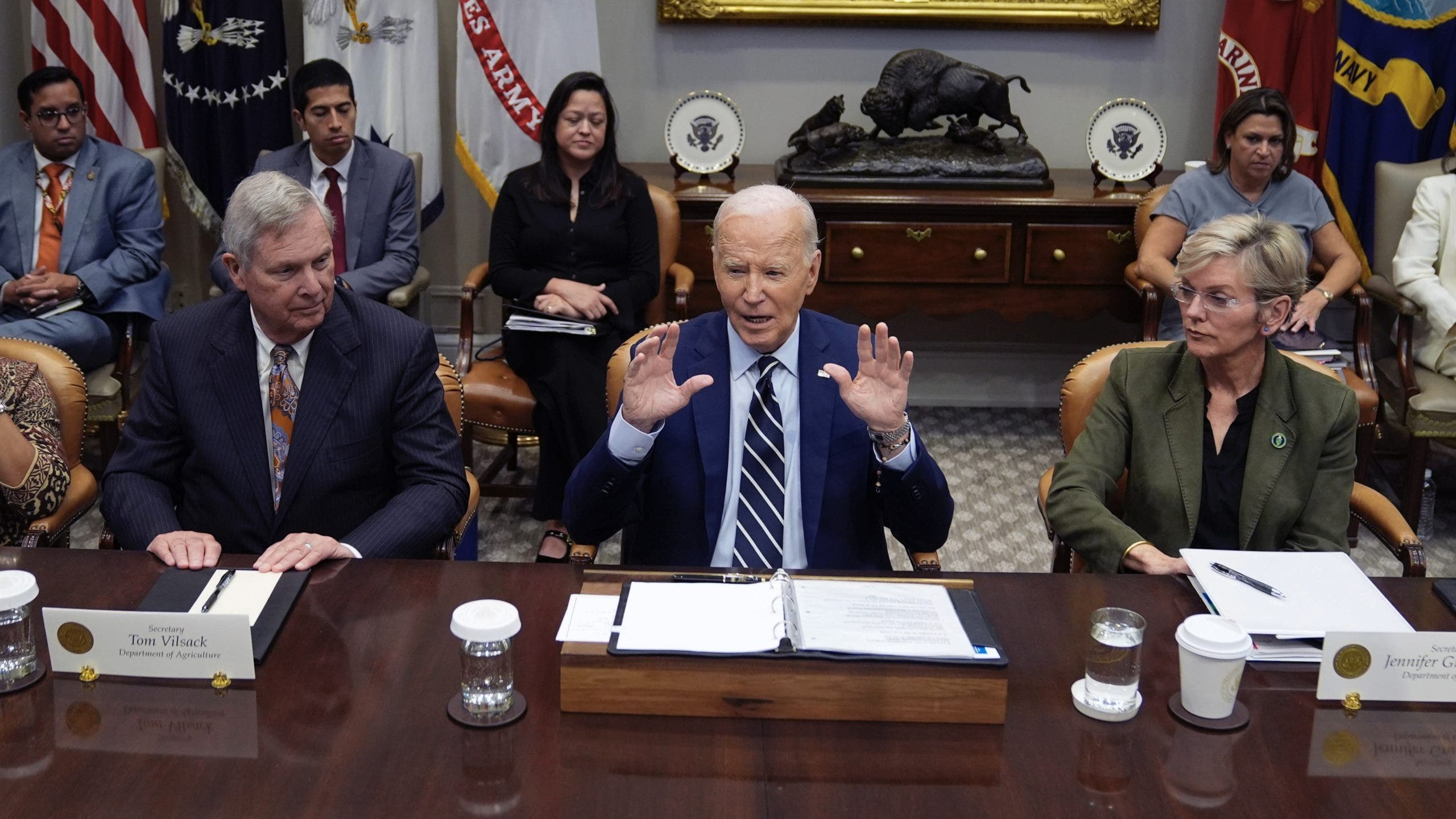
With a second powerful hurricane in less than two weeks bearing down on Florida, President Biden on Tuesday canceled an upcoming international trip in order to oversee federal storm preparations and response efforts.
As the death toll rises and nearly 200,000 people remain without power or running water over a week and a half after Hurricane Helen tore a path of destruction through the southeast United States, Hurricane Milton – an extremely dangerous Category 5 storm – is on course to slam into Florida on Wednesday.
“Given the projected trajectory and strength of Hurricane Milton, President Biden is postponing his upcoming trip to Germany and Angola in order to oversee preparations for and the response to Hurricane Milton, in addition to the ongoing response to the impacts of Hurricane Helene across the Southeast,” White House press secretary Karine Jean-Pierre said in a statement on Tuesday.
The president was scheduled to leave for Berlin on Thursday, followed by a stop in Angola before returning home on Oct. 15. The trip would have marked Biden’s first stop on the African continent during his tenure as president.
EYE OF THE STORM: BACK-TO-BACK HURRICANES IMPACT HARRIS-TRUMP PRESIDENTIAL RACE
President Biden, center, delivers remarks on the federal government’s response to Hurricane Helene and preparations for Hurricane Milton in the Roosevelt Room of the White House on Tuesday, Oct. 8, 2024 in Washington, D.C. (AP Photo/Evan Vucci)
Speaking with reporters on Tuesday, the president called Milton a potentially “devastating” storm that could be one of the worst to hit Florida in a century. He also urged anyone under an evacuation order to “evacuate now, now, now.”
“It’s a matter of life and death,” Bien emphasized.
Biden also said he spoke on Monday with Florida Gov. Ron DeSantis, adding that the conservative governor had been cooperative and that he gave his personal phone number to DeSantis.
CLICK HERE FOR UP-TO-DATE FOX NEWS REPORTING ON THE STORMS
When asked about the federal storm response, DeSantis said during a news conference on Monday that “we have gotten what we need from the feds… the president has approved what we asked for… I’m thankful for that.”
“Everything we’ve asked for from President Biden, he’s approved,” DeSantis highlighted.
The governor reiterated those comments Tuesday morning in an interview on “Fox and Friends.”
“Every request that we’ve made – I’ve been in contact with the president, I’ve been in contact with the FEMA director,” DeSantis highlighted. “All of our requests have been answered.”
Florida Gov. Ron DeSantis holds multiple storm preparation news conferences on Oct. 7, 2024, as Hurricane Milton bears down on Florida. (Office of Florida governor)
While DeSantis has complimented the president’s actions, he has taken aim at Vice President Kamala Harris. The Democrats’ presidential nominee on Monday – reacting to reports that the governor had refused to take her calls regarding federal storm efforts – described him as “selfish.”
When asked about the dispute, DeSantis argued in his “Fox and Friends” interview that “my focus has not been on dealing with Kamala Harris. I saw the news report. I didn’t know that she tried to contact me. But I’d also say it’s not about you, Kamala. It’s about the people of Florida. My focus is exactly where it should be.”
“I’ve worked on these Hurricanes under both President Trump and President Biden. Neither of them ever tried to politicize it. She’s never called on any of the storms we’ve had since she’s been vice president until apparently now. Why all of a sudden is she trying to parachute in and inject herself when she’s never shown any interest in the past? We know it’s because of politics. We know it’s because of her campaign. I have zero time to entertain these political games,” DeSantis charged.
HEAD HERE FOR THE LATEST FOX NEWS WEATHER UPDATES ON HURRICANE MILTON
The war of words appeared to be triggered by reports from NBC and later ABC News on Monday afternoon that the Florida governor was not taking calls from Harris regarding storm recovery efforts, citing unnamed aides to the governor who said the calls seemed political in nature.
When asked a couple of hours later, DeSantis said he was not aware Harris was trying to reach him.
“I didn’t know that she had called. I’m not sure who they called. They didn’t call me,” he said. “It wasn’t anything that anybody in my office did, in terms of saying it was political.”
Speaking around the same time, as she departed the nation’s capital for New York, the vice president took aim at DeSantis.
“People are in desperate need of support right now and playing political games at this moment in these crisis situations…is just utterly irresponsible, and it is selfish,” Harris charged. “It is about political gamesmanship, instead of doing the job that you took an oath to do, which is to put the people first.”
Democratic presidential nominee Vice President Kamala Harris arrives at LaGuardia Airport on Monday Oct. 7, 2024, in New York. (AP Photo/Jacquelyn Martin)
However, DeSantis, pushing back in his Fox News interview, argued that “Harris is not even in the chain of command. She has no role in this. The idea that I should be…worrying about her when I’m focused on the task at hand is quite frankly absurd.”
When asked if his vice president has been helpful as the federal government deals with back-to-back dangerous hurricanes, Biden nodded and told reporters “yes.”
CLICK HERE TO GET THE FOX NEWS APP
Harris, speaking on Tuesday on the popular daytime program “The View,” said, “I have called and talked with, in the course of this crisis, this most recent crisis, with Democrat and Republican governors…. So, obviously, this is not an issue that is about partisanship or politics for certain leaders, but maybe it’s for others.”
With four weeks to go until Election Day in November and Harris and former President Donald Trump locked in a bitter margin-of-error showdown in the race to succeed Biden in the White House, and with two of the hardest-hit states from Helene — North Carolina and Georgia — among the seven key battlegrounds that will likely determine the outcome of the 2024 election – the politics of federal disaster relief are once again front and center on the campaign trail.
Trump, for a week and a half, has been repeatedly attacking Biden and Harris over the federal response to Hurricane Helene, and making unproven claims.
On Monday, Harris clapped back, accusing Trump of pushing “a lot of mis and disinformation.”
Fox News’ Nick Rojas contributed to this story.
Get the latest updates from the 2024 campaign trail, exclusive interviews and more at our Fox News Digital election hub.

North Carolina
Bill To Put Marijuana On The Ballot In North Carolina Unlikely To Advance, GOP Senate Leader Says – Marijuana Moment

“I’m not sure that we’re in a place where legalizing marijuana is going to be taken up.”
By Brandon Kingdollar, NC Newsline
A new bill proposed by North Carolina Senate Democrats would put constitutional amendments to legalize recreational and medical cannabis on the ballot. But its odds of getting a vote in the Senate are not high, Republican leadership says.
Senate Bill 1072 would put two separate amendments on the ballot in November, asking voters to legalize possession of “limited amounts of cannabis” for recreational use and medical use by patients with qualifying conditions, respectively.
“The people of North Carolina deserve a voice in determining the future of cannabis policy in our state,” said Sen. Kandie Smith (D-Edgecombe), one of the bill’s lead sponsors. “What it does is, it provides a pathway for North Carolinians to vote on whether limited personal possession and medical use should be permitted under our state’s constitution.”
Senate President Pro Tem Phil Berger (R-Rockingham) had a blunt response: “I’m not sure that we’re in a place where legalizing marijuana is going to be taken up,” he said Wednesday afternoon.
“I think there is some interest in looking at the hemp situation and the components of hemp and the sale of some of the derivatives,” Berger said. “It’s really undetermined whether we’re talking about a complete ban, or we’re talking about a regulatory scheme, or we’re talking about including these and not including those. There are just discussions that are taking place as to what we garner consensus over.”
One such proposal currently moving through the House would ban individuals under the age of 21 from purchasing hemp-derived consumables.
Berger has lent support to medical marijuana in the past. In 2024, the Senate passed a bill that would have legalized medical marijuana while restricting hemp-based consumables. The bill, which passed by a margin of 36-10, was championed by Senate Rules Chairman Bill Rabon (R-Brunswick), a cancer survivor who said cannabis helped him withstand intensive chemotherapy for colon cancer.
However, the House declined to take up Rabon’s bill due to insufficient GOP support in that chamber. North Carolina remains one of only 10 states that have not yet approved medical marijuana.
In the absence of a medical cannabis program in North Carolina, many have turned to the state’s burgeoning hemp industry to meet what they describe as medical needs, such as alleviating pain, insomnia, and anxiety among other conditions. Many of those products, however, are set to disappear following much stricter federal restrictions on hemp-based consumables set to take effect in November.
The Meredith College Poll found in February 2025 that 71 percent of North Carolinians support the passage of a bill permitting medical marijuana, with 17 percent of respondents opposed. Polls by Elon University and progressive think tank Carolina Forward have also shown majorities in favor of recreational marijuana in recent years.
Sen. Caleb Theodros (D-Mecklenburg), another lead sponsor of S1072, said the bill would allow state law to catch up with public opinion on cannabis use.
“If the legislature cannot resolve this issue after years of debate, who should? I believe the answer is simple, and it’s the people of North Carolina,” Theodros said. “Senate Bill 1072 provides an opportunity for voters to have a direct voice on an issue that has remained unresolved for far too long.”
He said Berger has acknowledged momentum around cannabis legislation in the past year, an apparent reference to the Senate Leader’s past comments on medical cannabis. That makes him “cautiously optimistic” about the bill’s fate.
“We’re aware of the political climate in this building. But again, we didn’t get elected to just sit on our hands and say we’re in the superminority and therefore there’s nothing we could ever do,” Theodros said. “We’re just trying to move along our colleagues here and to join the rest of America and the rest of the planet in suggesting that we need to have some kind of policy on this.”
This story was first published by NC Newsline.
Photo courtesy of Philip Steffan.


Kamden Mantooth caps wild week by leading Mustang to 6A baseball title
It was a wild week for Kamden Mantooth, who helped Mustang beat Edmond Santa Fe 5-4 for the 6A baseball title. After being forced to sit in the semifinals due to an ejection in the quarterfinals, he pitched 5 2/3 innings Saturday.
Joe Patterson was hoping it would be different this time.
The Mustang baseball coach is no stranger to state championship games.
But as Mustang headed into its Class 6A title matchup against Edmond Santa Fe in May, a state championship victory remained a goal that hadn’t been fulfilled for Patterson as a player or head coach.
“That was all together — playing and coaching — my (sixth) state championship game, and I was 0-5,” Patterson said.
Patterson can now revise that record to 1-5 as the Broncos beat defending champion Edmond Santa Fe 5-4 at ONEOK Field in Tulsa.
An unforgettable day for Patterson.
An unforgettable season.
After leading Mustang to its third title and a 39-6 record while playing a brutally difficult schedule, Patterson is The Oklahoman’s 2026 All-State Coach of the Year.
“It was one of those years where it felt like I wasn’t working the whole year,” Patterson said. “Just a special group and everybody involved did such an amazing job and the players got along and the senior leadership was just unbelievable.”
A year after going 19-16 and falling at regionals, this season was vastly different for Patterson as Mustang dominated from beginning to end.
The Broncos won 11 of their first 12 games and ended the season the exact same way, claiming victories in 11 of their last 12 matchups.
They thrived in tight games, going 12-3 in matchups decided by two or fewer runs.
“We lost a bunch of close games last year,” Patterson said. “We didn’t have as great a season as we wanted, so we talked about trying to change the team morale and change the culture just a little bit in the fall, and we really focused on that. Just trying to make the place a more positive place for the kids and emphasize them having a little bit more fun but still working.”
Born and raised in Duncan, Patterson’s love of baseball and sports in general go back to those days.
His dad, Bill, was Duncan’s head football coach from 1997-2003 before accepting an assistant position at Owasso and serving as the Rams’ head coach from 2007-2016.
A standout in football and baseball in high school, Joe Patterson was at Duncan as a freshman and sophomore before spending his final two years at Owasso and then playing college baseball from 2007-2010. He went to Oral Roberts for one year, Seminole State for a season and Texas A&M for his final two.
Patterson was named the national junior college player of the year at Seminole State and had a successful stint at Texas A&M, hitting .362 with 21 homers and 100 RBIs with the Aggies.
He’s been at Mustang since the summer of 2019 after coaching at Westmoore.
Former OU shortstop Brandon Zaragoza played for Patterson during his senior year at Westmoore and was a Mustang assistant for the last four seasons before recently being named Westmoore’s new head coach.
Patterson has had a huge impact on Zaragoza, who will take what he’s learned from his former coach into his new gig.
“He just brought pure joy to the game for me, especially with just his ability to, one, obviously coach the game, but two, to allow his players to go out there and perform,” Zaragoza said. “The coolest thing about Pat was his ability to just pick up on player knowledge. Just kind of knowing what he has in terms of personnel and then of course his ability to just game plan, strategize, just get his guys ready to play.”
Patterson always wanted to coach at a one-high school town like Mustang.
He has his wish now, and Zaragoza says it’s a well-oiled machine.
“That’s kind of how I describe it a lot to people,” Zaragoza said. “Just a well-oiled machine in terms of just the coaches that are over there and the attention to detail and the preparation. There’s no loose ends at Mustang. And given how big the school is, you can always get kind of lost in personnel or all that stuff, but just the way that Mustang operates, it’s top tier.”
Mustang didn’t necessarily have big names this season like some teams in the state, but the Broncos had several guys who shined.
Outfielder and Northern Oklahoma College-Enid signee Nate Sutton hit .449 with 15 homers and 70 RBIs.
Fellow senior Kamden Mantooth was second on the team with a .442 batting average. A shortstop, Mantooth started at pitcher in the title game and held Edmond Santa Fe to eight hits and four runs — three earned — over 5 2/3 innings.
“It means everything for us,” Mantooth said after the championship win. “We’ve been working for this since we were in seventh grade. We’ve been working for this, and we finally achieved our goal that we wanted.”
For Patterson, it’ll forever be a special moment as he had his 6-year-old son with him in the dugout and his dad watching from the stands.
Patterson had lost two title games as a player at Owasso and three as a head coach — two at Westmoore and one at Mustang.
The outcome was different this time, and it was well worth the wait.
“It was just a feeling of relief and happiness,” Patterson said.
Nick Sardis covers high school sports for The Oklahoman. Have a story idea for Nick? He can be reached at nsardis@oklahoman.com or on Twitter at @nicksardis. Sign up for The Varsity Club newsletter to access more high school coverage. Support Nick’s work and that of other Oklahoman journalists by purchasing a digital subscription today at subscribe.oklahoman.com.

Top astronomy events for June 2026
From a trio of planets lining up with a crescent moon to a solstice bringing the beginning of summer, here are the top astronomy events to mark down in June.
It may have felt like summer in South Carolina these past few weeks, but it is just now the first official day of summer.
Days have become longer, and temperatures have pushed toward 100 on some days ahead of the first day of summer. Now the longest day of the year is here, and the hottest months in the South are ahead of us.
On June 21, Greenville and Upstate South Carolina will experience more than 14 hours of daylight, according to Time and Date. From there, days will start being shorter once again.
Here’s how much daylight Upstate South Carolina is expected to see for the summer solstice.
When is the first day of summer 2025?
Well, there are technically two answers.
The first official day of summer astronomically for 2026 is Sunday, June 21, which is when the Northern Hemisphere has the longest day of the year, according to the Old Farmer’s Almanac.
But when we talk meteorologically, summer starts on June 1. The reason for this is that meteorologists divide the year into four seasons based on the months and the temperature cycle. Doing it this way also allows them to compare and organize climate data more easily. In this system, summer begins on June 1 and ends on August 31.
What is the summer solstice?
The summer solstice marks the astronomical first day of the summer season in June in the Northern Hemisphere.
This is also when the Earth arrives at the point in its orbit where the North Pole is at its maximum tilt toward the sun, according to the Almanac. This makes it the longest day with the longest period of sunlight hours and the shortest night of the calendar year.
It will begin at 8:25 UTC or 4:25 a.m. ET on June 21, according to EarthSky.org.
When is the longest day of the year?
The summer solstice is the longest day of the year. On June 21, it will be the day with the longest period of sunlight, with some areas in the Northern Hemisphere getting upwards of 15 hours of sunlight on that day, according to EarthSky.org.
In South Carolina, communities will see around 14 hours and 28 minutes of daylight on the longest day of the year, according to timeanddate.com, which tracks when sunrise and sunset occur in communities across the United States.
-

 Nevada5 minutes ago
The nation’s data center debate has reached Southern Nevada
-

 New Hampshire12 minutes ago
'New Hampshire Outright' creates open, safe spaces for LGBTQ+ families
-

 New Jersey15 minutes ago
Gun shots fired in Greenwich Township NJ, police investigating
-

 New Mexico20 minutes ago
Fiesta Subaru helps hundreds of New Mexico dogs find homes with big donation
-

 North Carolina27 minutes ago
Bill To Put Marijuana On The Ballot In North Carolina Unlikely To Advance, GOP Senate Leader Says – Marijuana Moment
-

 North Dakota30 minutes ago
Theodore Roosevelt Presidential Library opening in North Dakota Badlands
-

 Ohio35 minutes ago
Zipse: Preakness participants shine brightly in the Ohio Derby
-

 Oklahoma42 minutes ago
Oklahoma All-State baseball: Joe Patterson guided Mustang through brutal 6A field to title

