Austin, TX
'terrace mountain residence' cantilevers over austin with design by a parallel architecture


a parallel architecture Shapes Space Through Material
The first glimpse of A Parallel Architecture’s newly completed Terrace Mountain Residence suggests a defiance of gravity. Sited above the wooded slopes of Westlake Hills suburb of Austin, Texas, the home seems to hover between sky and earth. The approach begins with a suspended bridge and ends at a glass-framed threshold that opens to the city skyline beyond. The architects, working closely with Arrowhead Construction, guides the structure into a dialogue with its terrain, not through imitation but by contrast. Steel and glass are braced against the softness of tree canopies and stone.
Materiality shapes the home’s atmosphere. A Parallel Architecture draws from a palette of concrete, steel, and local stone, all anchored by dark-stained wood elements that warm the otherwise elemental geometry. At once muscular and restrained, the home’s outer shell opens selectively, revealing framed glimpses of Austin’s shifting daylight. Interior transitions, between the entry bridge, central living space, and stepping outdoor terraces, are expressed through changes in texture and light, rather than walls.
images © Chase Daniel
terrace mountain Residence opens onto austin landscape
Suspension becomes a recurring theme throughout A Parallel Architecture’s Terrace Mountain Residence. The team positions the main living areas above a sloping terrain, leaving the ground untouched and shaded beneath. From this raised perch, the structure cantilevers gently over an infinity pool that seems to dissolve into the hill country. The reflection pond that flows beneath the house does more than echo its silhouette. It threads through the site like a quiet architectural counterpoint, drawing the landscape into the design with a sense of rhythm and ease.
The heart of the dwelling lies in a luminous volume that houses the living room, kitchen, and dining space. Here, the architects work with interior designer Allison Burke to maintain a restrained interior language, allowing large panels of glass to turn the city into an active backdrop. The kitchen is centered around a singular marble island, almost monastic in its precision, and balanced by cabinetry that disappears into the surrounding walls.
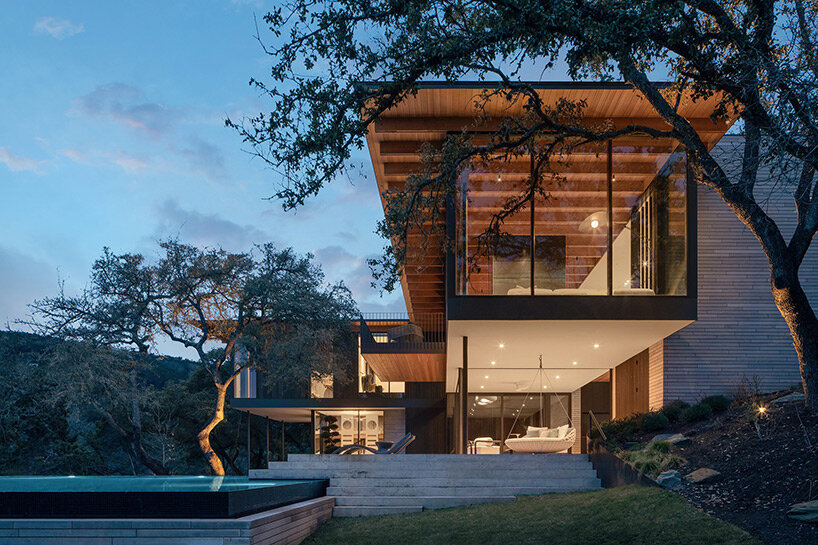
the Terrace Mountain Residence hovers above the wooded slopes of Westlake Hills in Austin, Texas
Descending Into Landscape
In the main suite of the Terrace Mountain Residence, A Parallel Architecture offers an intimate composition of proportion and detail. A fireplace floats at the center of the room, less a barrier than a suggestion, gently separating the sleeping area from a sitting alcove. Dual bathrooms and closets recede discreetly along the perimeter, their presence registered more by surface and material than enclosure.
Along the lower level, the architecture extends downward without losing its clarity. The design team organizes this part of the home around the slope itself, creating guest suites and a double-height media room that open directly to the outdoor terrace. The change in elevation is embraced, not masked. Inside and outside, the shift in grade becomes a way to introduce shade and intimacy among the surrounding foliage.
The landscape design complements the home without overstating its presence. Much of the natural site is preserved, allowing native plantings and shaded groves to surround the exterior. An infinity pool, set along the home’s axis, acts as both a mirror and a margin. It reflects the open sky and defines the boundary of the terrace. The outdoor kitchen is tucked within a breezeway, kept close but visually quiet.
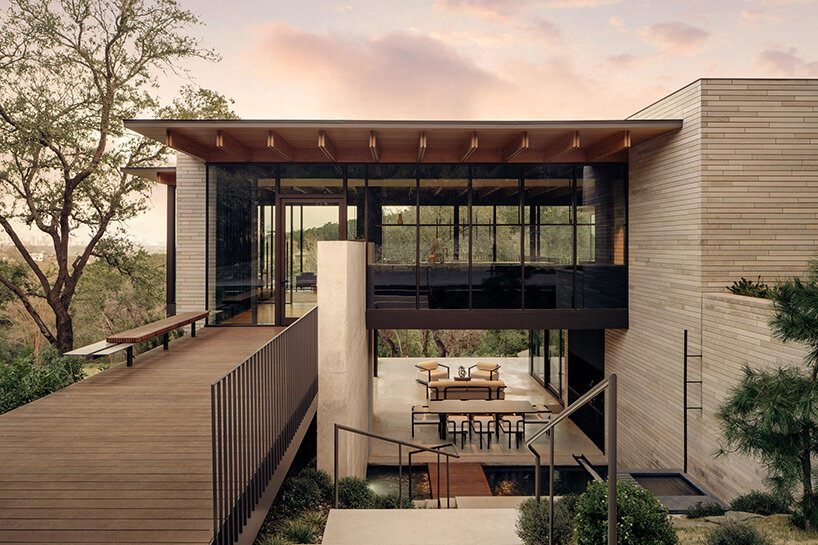
a floating bridge that leads to a glass-framed threshold overlooking the city skyline
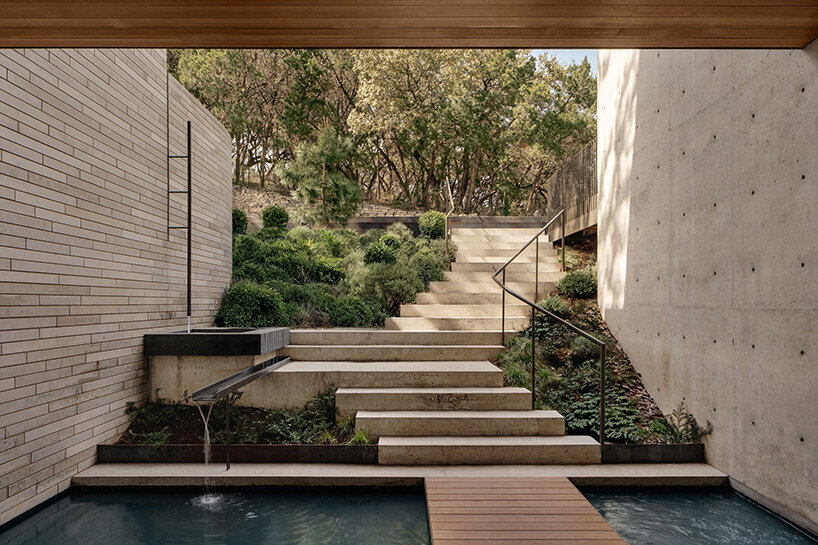
a reflection pond threads beneath the house to create an integration between architecture and terrain
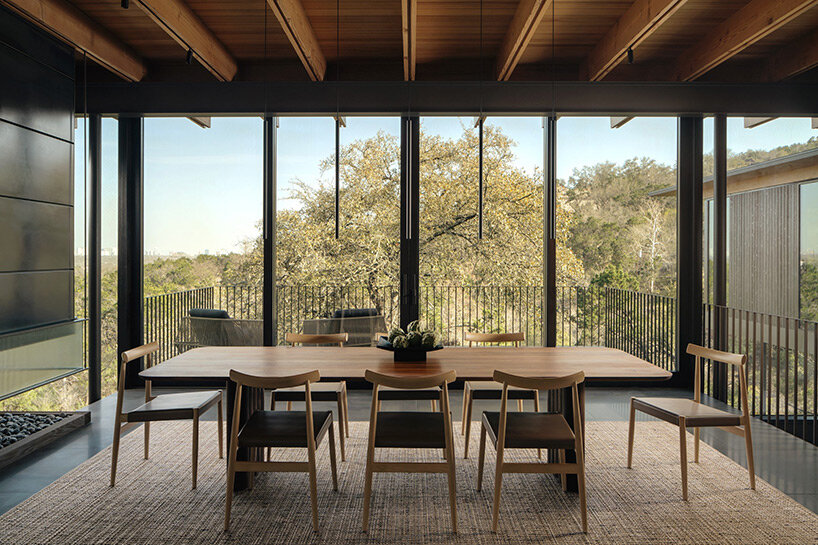
the concrete, steel and wood structure opens onto framed views of the surrounding landscape



AUSTIN, Texas — The housing market has cooled, with J.P. Morgan predicting house prices in the U.S. will stall. Despite the stagnate home price analysis, one Texas-based tech company is developing an unconventional way to build. An Austin church is tapping into ICON’s 3D printing technology to rebuild its church campus.
St. Mark’s Episcopal Church has been on its 8-acre property since the late 1950s.
“We’ve long been in this kind of predicament here as a congregation that we have these really deep-level structural problems with our buildings, and we’ve really never been able to imagine being able to pay for it,” said Father Zac Koons, the leader of the church.
He said costly quotas to repair aging infrastructure is one big reason they partnered with ICON to develop a whole new church campus.
“It’s not only a less expensive or a more affordable way to build, it’s also a more environmentally friendly way to build,” Koons said.
ICON’s “Titan” construction system will be used for this project, bringing the world’s first 3D-printed church to Austin.
“I think this will be a famous building,” said Jason Ballard, the CEO and co-founder of ICON. “I think it will stand for hundreds of years, and I think they’re just so pleased with what they’re able to get on their budget out of this building.”
The company says its concrete mixture can save future homeowners and businesses roughly 40% compared to conventional wood and metal frameworks.
“For the past two years, we have been working on a second generation of printer technology that is multi-story, easier to set up, easier to operate, even lower cost, even faster,” Ballard said.
Had it not been for the partnership with ICON, Koons said his church would not have been able to afford such a large-scale project.
“We wouldn’t have been able to do something as ambitious as we’re talking about doing without ICON, for sure,” Koons said.
He said they’ll break ground in about a year, with hopes to finish the first building by the summer of 2028.

Austin, TX — If you’re looking for an easy way to make a difference this Earth Day, Goodwill Central Texas has a simple challenge for you.
It’s called “Swap Your Shop,” and the idea is straightforward. Instead of buying something new, try picking up one secondhand item. That one small switch can help cut down on waste and reduce your environmental impact.
According to a 2023 report, if every U.S. shopper made that choice just once this year, it could reduce carbon emissions by more than 2 billion pounds. That’s like taking 76 million cars off the road for a day. It could also save more than 20 billion gallons of water and keep hundreds of millions of pounds of waste out of landfills.
And it doesn’t have to be a big commitment. Even buying one thrifted clothing item instead of a new one could prevent about 450 million pounds of waste each year.
So whether you already love thrifting or have never tried it, this is a good time to start. Swap out one purchase, give something pre-owned a second life, and see the difference it can make.
BE THE FIRST TO COMMENT
If you do take part, you can even share your find on social media and tag @austingoodwill.

AUSTIN, Texas — The Austin airport expects over 18,000 departing passengers on Saturday, this coming the morning after Trump signed an executive order to pay TSA employees after Congress failed to agree on DHS funding.
The airport recommends travelers arrive 2.5 hours early for domestic flights and three hours early for international departures.
ALSO | Hays County judge says Rep. Erin Zwiener turned away from meeting over water dispute
AUS noted that many MotoGP fans will be departing from the airport this weekend, the motorcycle racing event at Circuit of the Americas happening this weekend and ending on Sunday.
The DHS shutdown has burdened airports nationwide with hours-long TSA lines. Austin’s lines were especially long during SXSW, stretching out the terminal and down the road.

‘The Last Critic’ Review: A Captivating Portrait of Robert Christgau, the Brilliant Mad Professor of Rock Critics, and How He Made the Grade

Mary Beth Hurt, Who Starred in ‘The World According to Garp,’ Dies at 79

Sunday Puzzle: Vowel Renewals

Red Rooms makes online poker as thrilling as its serial killer

Over 2 dozen children among 33 bodies pulled from Kenyan mass grave: authorities

Florida High School Football Rankings: Top 25 teams – Oct. 21

How old is Bo Nix? What to know about Oregon quarterback ahead of 2024 NFL Draft

Cleary's 21 help Le Moyne down Central Connecticut State 69-64 in OT

99th annual Pony Swim held in Virginia

Indiana Members Credit Union announced as new anchor tenant at Bottleworks District

Scathing report claims nation’s oldest labor union ‘betrayed’ MAGA members through ‘shocking’ spending

Republican US lawmaker demands Congress vote on any Iran troop deployment

So you went to a No Kings protest. Now what?

JD Vance says he was ‘obsessed’ with UFOs, believes aliens are actually ‘demons’
The EU's recipe for trade deals : easy on beef, tough on wine
-

 Sports1 week ago
IOC addresses execution of 19-year-old Iranian wrestler Saleh Mohammadi
-

 New Mexico7 days ago
Clovis shooting leaves one dead, four injured
-

 Miami, FL3 days ago
Jannik Sinner’s Girlfriend Laila Hasanovic Stuns in Ab-Revealing Post Amid Miami Open
-

 Tennessee6 days ago
Tennessee Police Investigating Alleged Assault Involving ‘Reacher’ Star Alan Ritchson
-

 Minneapolis, MN3 days ago
Boy who shielded classmate during school shooting receives Medal of Honor
-

 Technology1 week ago
YouTube job scam text: How to spot it fast
-

 Politics1 week ago
Schumer gambit fails as DHS shutdown hits 36 days and airport lines grow
-

 Science1 week ago
Record Heat Meets a Major Snow Drought Across the West