Austin, TX
FAFSA delays stall Austin-area students’ college decisions into summer


Brian Lerma-Alfaro, a senior at Lehman High School in Hays County, started his Free Application for Federal Student Aid with paper forms in December.
After months of trying to submit the paper forms, he opened an online application in March.
Two weeks from graduating from high school, he’s still wading through technical difficulties.
“Literally, the only thing I need is a signature from my mom,” Lerma-Alfaro said. “When I go into her account, my form doesn’t pop up.”
Lerma-Alfaro received his acceptance to the University of Texas in February, where he wants to study data science and statistics. But he needs his aid package from the university — which requires the FAFSA form — to receive other scholarships.
He spent two hours in his counselor’s office Monday, trying to work through the form’s technical issue.
“It’s been a huge pain in the butt,” Lerma-Alfaro said.
Delays in the FAFSA process have plunged what’s already a stressful and cumbersome matter for high school seniors into a plague of uncertainty.
Weeks after the usual May 1 college decision deadline, many seniors are still waiting on aid information that’s crucial to making a decision.
A lot of things went wrong this year to create the uncertainty, said Shareea Woods, director of the Texas College Access Network. The organization is meant to improve students’ ability to attend college.
The U.S. Department of Education overhauled the entire system to one that’s meant to be a more streamlined, easier process.
However, glitches pushed back the opening of the FAFSA application process from the typical October date to January. The federal department also didn’t start processing applications until March.
Processing turnaround times are down to one to three days now, according to the federal department.
Burden on colleges
Cindy Melendez, the vice president of student success at Concordia University Texas in Northwest Austin, said universities’ largest challenge with sending out financial aid packages has been waiting on data from the U.S. Department of Education.
“We’re used to these packages going out in February,” Melendez said. “So from February to May, our staff has been really working hard to figure out how we prepare for this time when we have to condense packaging into a much shorter time frame than usual.”
For students with multiple acceptances trying to decide which college will give them the most educational bang for their buck, the delays are causing stress.
“There has been some understanding that our students need more time, especially our students that are coming from economically disadvantaged backgrounds,” Woods said. “We’ve heard some stories of parents putting in deposits at multiple institutions so they can hedge their bet.”
Melendez said the university sent out the first round of aid packages last week. Because Concordia works so closely with families, the deadlines are very flexible, and university staffers have been working with applicants one on one to offer support and guidance.
The University of Texas included an option for students to extend their deadline to June 1. Miguel Wasielewski, vice provost of admissions, said about 1,000 students opted for more time, while about 9,000 committed to the university without knowing their financial aid packages. The office has been in contact with all 1,000 students, he said.
“In this case, it’s all about just making sure that we advocate wherever possible to get them the resources that they need, while also monitoring where they are in the process,” Wasielewski said.
To date, the university hasn’t noticed differences in the makeup of next year’s class compared with previous years because of the FAFSA delays, he said.
Brian Dixon, vice provost for enrollment management, said UT plans to start sending out packages this week. Earlier in the process, the admissions team identified some particularly strong candidates that it anticipated would need financial aid, something typically evaluated from FAFSA data, and offered some early tuition guarantees.
“The institution took that financial risk to try to provide the assurance for those students, and that has been highly effective,” Dixon said. “About 4 out of 5 students who received those early guarantees have taken us up on that offer.”
Cost of delays
Even if colleges let students push back their decision, the delays still cost them, Woods said.
A postponed college acceptance means students could miss out on summer boot camps that colleges offer for some intensive programs or might delay housing choices, she said.
“Our concern is some students may be so turned off by this process they may choose not to enroll,” Woods said.
For students who are still waiting, they should keep an eye on their inboxes and stay in communication with the colleges they’d like to attend, she said.
Dixon still thinks there will be problems to work out next year. For instance, students of parents without a Social Security number initially could not complete the form this year.
Nationwide, fewer students have completed the FAFSA this year compared with last year.
Only 50.4% of Texas high school seniors had completed the FAFSA by May 3, according to the federal Education Department.
By this time last year, 70% of students had completed the application, according to the Texas College Access Network. Even in 2021, which was a record low year because of the pandemic, 58% of Texas seniors filled out the application.
Dixon expects more students will still fill out the form once their peers start receiving letters.
Lerma-Alfaro is the only one among his group of friends left still awaiting an aid package, he said.
With graduation ahead, he’s been working to keep his grades up, look for jobs and spend time with his friends. The balance is already difficult, and he’s ready to get his college plans set in stone.
“I don’t like saving things until the last day,” Lerma-Alfaro said.
The Education Department has updates at studentaid.gov.



AUSTIN, Texas — After Senator Charles Perry vowed to introduce another bill to ban THC in Texas next legislative session, an Austin cannabis shop owner is urging lawmakers to find a middle ground.
Estella Castro owns Austinite Cannabis Co., a family-owned shop that makes and sells cannabis and hemp products.
Austinite Cannabis Co. (Photo: CBS Austin/Audrey Wong)
Her business has faced a potential THC ban before. During the 2025 legislative session, Senate Bill 3 attempted to enact a broad ban on all cannabinoids except CBD and CBG.
Castro says she was most worried for her customers. “It was a big initial hit of like, what are we gonna do? How are we gonna pivot? How are we gonna keep the doors open for everybody to keep their jobs?” she said.
RELATED | Texas state senator plans to introduce new THC ban bill in upcoming session
That bill passed, but was later vetoed by Governor Greg Abbott. Similar legislation failed to pass during the subsequent special session.
However, the possibility of a total ban bill being introduced and passed next session could spell trouble for Austinite Cannabis.
During a hearing Tuesday, July 7, Senator Charles Perry vowed to present such a bill next session as public officials, medical experts, and others discussed THC’s medical uses, effects on minors, and regulation.
Castro says over half of the store’s revenue comes from products that contain THC.
“I would say it’s about a 60/40 split: 60% THC and 40 CBD… So feel like it is a huge number that affects my store in so many ways,” she said.
ALSO | Texas French Bread reopens dining room four years after fire
She feels that a total ban on THC would negatively affect multiple parties.
“Banning it is just hurting the consumer,” she said. “Making the consumer go and find a street dealer… killing any dispensaries… it’s gonna hurt your small business owner.”
If another THC ban bill is written, it will be introduced during the next legislative session, which begins in January 2027.
In the meantime, Castro’s two stores will continue to operate as normal. She hopes lawmakers will think twice about instituting a complete ban on THC.
“I feel like we’re better than that, you know, we’re Texas,” she said. “We need to find some middle ground where it’s not a complete ban, and we can still be able to come together.”

AUSTIN (KXAN) – Trevor Goosby is a projected first-round pick in the upcoming 2027 NFL Draft. The Texas offensive lineman anchors the group up front for one of the best teams in the country and was named a preseason All-American by Walter Camp.
But his football career felt in jeopardy when he was in high school.
“That was kind of my biggest question,” said Goosby. “I was really nervous because would I be the same football player coming back?”
Goosby was born with a congenital heart defect and had open-heart surgery when he was just 16 years old. He wasn’t sure how this would change his everyday life, including his football career.
“Definitely a lot of nerves just because you’re getting your ribs cracked open essentially and getting your heart worked on…It was a scary moment. I remember driving up to the hospital super nervous.”
Goosby was able to recover and become a great football player. He said not only has he become a person in learning to fight through adversity, but it helped him as a player as well with improved endurance.
Now, the star Longhorn is giving back as much as possible.
Goosby hosted a camp in Austin to benefit the Children’s Heart Foundation. The organization works to fund research on congenital heart defects.

The offensive tackle is matching all donations up to $20,000 made to the Children’s Heart Foundation through the event and campaign.
“It means a lot to me just because of the heart condition I did have back when I was 16. That just kind of changed my life. I just want to bring awareness to that.”
The camp was at Hyde Park High School in Northwest Austin. Goosby spoke about what he hopes the young campers took away from the event.
“I think it’s just more than football. Football is a big part of what I do but it’s not who I am…I just want to show all these kids that I’m just another great guy and just someone they can look up to.”

-
 Lifestyle2 minutes ago
Meow Wolf taps famed L.A. animation house for its new Los Angeles venue
-
Politics9 minutes ago
Column: Trump decries ‘communism’ while his government takes ownership of companies
-
 Science12 minutes ago
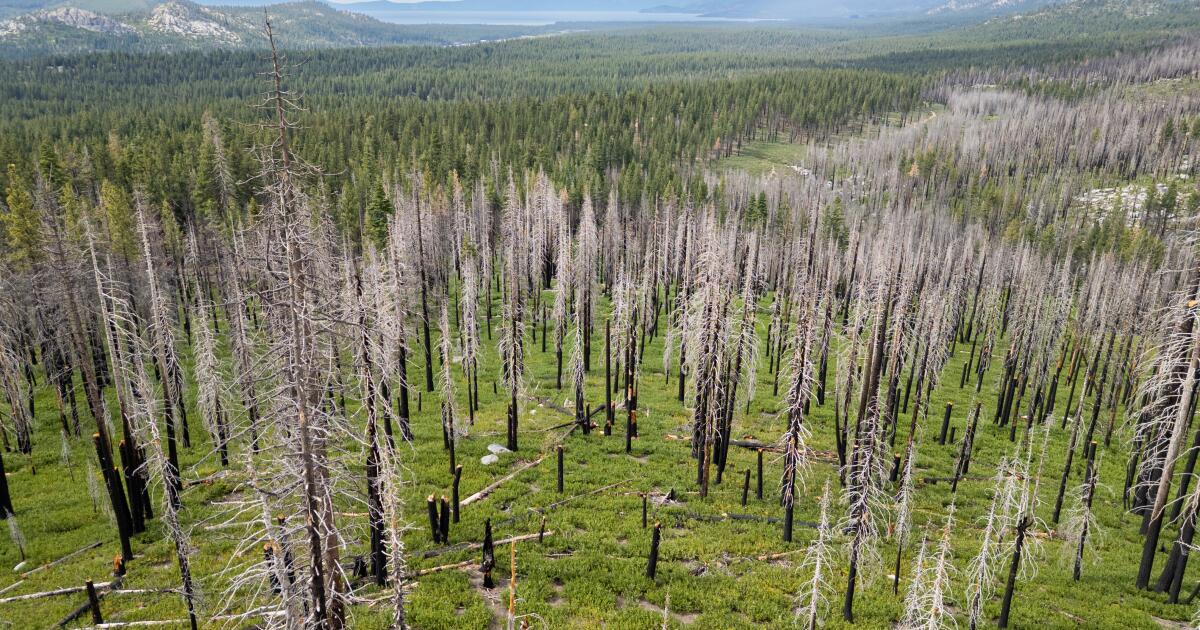
‘I’d rather my house burn down than get cancer’: Herbicide use upends California’s fight to save forests
-
 Sports17 minutes ago
Dodgers scheduled to visit White House in late July to celebrate 2025 World Series win
-

 World27 minutes ago
Former US Olympian pleads not guilty in DC reflecting pool vandalism case
-
 News54 minutes ago
Former Olympian pleads not guilty in reflecting pool vandalism charges
-

 Los Angeles, Ca2 hours ago
Heat advisory, beach hazards in effect as Southern California sizzles
-

 Detroit, MI3 hours ago
Teen on moped hit by car after cruising through stop sign in Detroit


