Austin, TX
ABC13's years of Houston-area squatter stories leads to first steps in Austin to bolster laws


HOUSTON, Texas (KTRK) — The sound of construction equipment at a house on the 6300 block of Costa Mesa is music to the ears of long-time neighbor Jethro Cooper.
The southwest Houston house sat empty for years, and a mix of teenagers after school, squatters, and a fire left the home as a community eyesore.
“Thank you for your effort in trying to bring it to their attention,” Cooper told ABC13 on Tuesday, about two weeks after Eyewitness News first noted problems with the house. “Now, since you brought it to their attention, they’re doing something about it.”
SEE MORE: Houston homes taken over by squatters leave owners, neighbors frustrated by legalities
However, Cooper knows one repair project on this house is insufficient to solve the more significant problem of homes in bad shape or occupied by squatters proliferating neighborhoods.
“We need help,” he said, noting that efforts to get the house torn down have gone nowhere, and chasing out drug users and others who may squat in the house offered temporary relief.
State Sen. Paul Bettencourt, R-Houston, promised, “We’re going to put this all together and fix it.”
Bettencourt is leading the Texas Senate’s initiative to improve the state’s squatter laws.
Generally speaking, squatter situations in Texas are considered civil matters, and it is challenging to get squatters out of a home without going through the tedious eviction process. In addition, Texas has strong property rights laws, so demolishing abandoned or dilapidated homes is also a prolonged problem.
Bettencourt said he has seen reports of these issues across the state, including the cases ABC13 highlighted over the past year.
“I’ve seen horror stories about squatting – some of your good work – all across the state. So, we’re bringing everyone in to talk about what we can do to stop squatting,” he said.
On Wednesday, Bettencourt is holding a hearing in Austin with an eye on passing bills next year to make it easier to push out squatters by increasing criminal penalties and giving law enforcement more tools.
“It’s just part of the times, but that doesn’t mean it’s acceptable. It shouldn’t be tolerated. It’s illegal, and we’re going to make it a lot more illegal once we get bills passed in the next legislative session,” he said.
“I think anything to help the person who is the victim is needed,” Riana Sherman, one of the squatting victims ABC13 first profiled in 2023, said. “When our situation happened, we called this person, we called that person for help, and nobody was able to help because the person who was squatting had a lease that was not a real lease.”
Sherman and her family were under contract to buy a house in Houston’s Meyerland area but had to pull out because squatters moved in and stayed.
She said her children were traumatized, and she lost thousands of dollars in the process.
“Am I hopeful? I always try to see the good in situations. I always like to be hopeful,” Sherman said, reacting to the possibility of new laws passing.
The Texas Legislature will convene next January. ABC13 will keep you updated on whether the state’s squatter laws will be refreshed to address the problem plaguing homeowners.
For news updates, follow Miya Shay on Facebook, X and Instagram.
Woman claims trespassers moved into her Meyerland rental home and changed her locks
The Meyerland homeowner reached out to ABC13 extremely frustrated, saying a family of five is refusing to leave her rental home after changing its locks.
Copyright © 2024 KTRK-TV. All Rights Reserved.



AUSTIN, Texas — With heavy rain expected across parts of Central Texas this week and flooding top of mind, the city of Austin is proposing to put more money toward flood mitigation improvements in next year’s budget.
The proposal would invest in new flood infrastructure, add staff, and help move flood mitigation projects forward, according to city leaders. Austin City Councilmember Ryan Alter said the investments are aimed at keeping the city prepared for future flooding.
Residents who live near waterways say they have seen how quickly conditions can change. David Haderspeck, who lives near Shoal Creek, said the creek “fills up pretty fast” and “gets a lot higher than you’d expect.” He said he has watched the water rise dramatically after rain.
“I’ve seen it come up probably 10 to 15 feet to the ordinary high-water mark,” he said.
This week, parts of Central Texas, including the Hill Country, are expected to get heavy downpours. While Austin is not expecting the same impacts as parts of the Hill Country, leaders said the city is using this year’s budget planning to continue investing in flood safety.
Alter said the city has the expertise to address flooding risks but needs to follow through on projects.
ALSO| Central Texas urged to prepare as heavy rainfall sits in forecast over next two days
“We have the experts. We just have to put the plans into practice, and that’s what we’re doing in this budget,” he said.
Under the budget proposal, the city would provide about $134.5 million for the Drainage Utility Fund, which helps pay for flood mitigation, drainage infrastructure and watershed protection efforts.
Alter said the proposal would shift more of the funding balance toward building new infrastructure.
“What we’re going to do is shift that balance a little bit more to building new infrastructure so that when we do have large flooding events, we’ve got that infrastructure in place to keep people safe,” he said.
The proposal also adds staff and invests in both new and existing flood mitigation projects across the city.
Asked whether the proposed investments would be enough moving forward, Alter said, “I do…I think we’re doing the right thing and just making sure that our residents have the infrastructure to stay safe.”
Alter said heavy rain cannot be prevented, but the city’s goal is to have infrastructure in place to help keep people safe when it happens.

FILE – LinkedIn logos are displayed on an iPhone and computer screen. (Photo by Carl Court/Getty Images)
AUSTIN, Texas – The Texas Attorney General’s office has opened an investigation into LinkedIn over allegations that the professional networking platform misleads consumers with advertising and profiting from misleading or fake job listings, otherwise known as “ghost jobs.”
LinkedIn investigation

In this photo illustration a Linkedin logo seen displayed on a mobile phone. (Photo Illustration by Stanislav Kogiku/SOPA Images/LightRocket via Getty Images)
What we know:
Texas announced on Tuesday it has issued a Civil Investigative Demand (CID) seeking documents, data and internal communications related to LinkedIn’s advertising, marketing, job listing verification practices and its Premium subscription services.
The investigation centers on whether LinkedIn violated Texas’ consumer protection laws by promoting paid subscription services while allegedly failing to disclose that some job listings on the platform may not actually be representative of hiring opportunities.
What is a ‘ghost job’?
An image of a woman holding a cell phone in front of a LinkedIn logo displayed on a computer screen. On Tuesday, January 12, 2021, in Edmonton, Alberta, Canada. (Photo by Artur Widak/NurPhoto via Getty Images)
Dig deeper:
LinkedIn is owned by Microsoft and the world’s largest professional networking platform, with more than 1 billion registered users worldwide.
A “ghost job” generally refers to a position advertised online that either is no longer available or that an employer has no immediate intention of filling. The attorney general’s office cited independent studies estimating that ghost jobs account for between one-fifth and one-third of online job postings.
Texas AG targets Premium Subscription Fees
Photographer: Mark Felix/Bloomberg via Getty Images
What they’re saying:
According to the office of the attorney general, LinkedIn does not independently verify the hiring status of most job listings on its platform. Ken Paxton’s office alleges that the company’s marketing for its Premium subscription services does not disclose that a significant number of postings could be inactive, unfilled or not reflect genuine employment opportunity.
“I will use every resource available to my office to help job-seeking Texans find and secure real employment opportunities,” Paxton said in a statement. “LinkedIn has a duty to provide the services it advertises and ensure that consumers paying for Premium subscriptions are receiving access to legitimate job postings.”
Texas officials said LinkedIn’s Premium Career and Premium Business subscriptions cost about $39.99 and $69.99 per month, respectively, and are marketed to jobseekers looking to improve their employment prospects.
What’s next:
The investigation does not include any formal allegations of wrongdoing, and no lawsuit has been filed.
The Source: Information in this article was provided by the Texas Attorney General’s Office.

Director Kristin Tièche says the seed for her new documentary, The Invisible Mammal, was planted back in 1999, when she was a film student in upstate New York.
“I was sitting at this pub on campus, and I looked up and the sky was just filled with bats,” said Tieche, a native Californian who had never seen a bat before.
“I just thought it was the coolest thing ever,” she said.
These days, such a sight is all but impossible to behold in New York and many other states. A deadly disease called white-nose syndrome is to blame.
The Invisible Mammal follows a team of researchers as they set out to protect bats from the disease, which has emptied entire caves and roosting spots once teaming with life. It’s being screened Tuesday night at AFS Cinema and will be followed by a Q&A.
White-nose syndrome is caused by an invasive fungus found in Europe, likely brought to America on the clothes of a visitor who came to see American bats up close. It kills by starving hibernating bats.
The disease causes bats to “wake up too often during winter and they burn up their fat reserves and die before spring,” said Winifred Frick, chief scientist at Bat Conservation International.
First detected in New York state in 2006, the disease steadily spread across the continent, inflicting catastrophic damage on bat colonies in the Northeast, mid-Atlantic and Midwest. In some parts of the U.S. and Canada, white-nose has wiped out over 90% of bat populations. While the disease exists in Texas, it has not proved as destructive so far.
When it appeared in California in 2019, Tièche thought back to that night decades before when she saw her first bat flight.
“I knew at that moment that it was time to launch this film project,” she said.
The result is a nonnarrated documentary that follows researchers and conservationists across the country, as they protect bats and study ways to battle white-nose syndrome.
Its primary focus is Frick and the team of scientists behind the Fat Bat Project, an initiative started in Michigan’s Upper Peninsula that aims to keep bats well fed around their winter hibernation.
“The idea was could we help bats get fat in the fall and also help them recover their body condition in the spring?” Frick said. “Because we had research that showed that the bats that were surviving tended to be fatter at the start of hibernation.”
Tièche said it was not until she arrived in Michigan to shoot that she realized the team of scientists working on the Fat Bat Project was comprised entirely of women.
“I knew at that point that I also was going to tell the story of women in science,” she said.
White-nose exists in Texas, but the colonies of Mexican free-tailed bats so celebrated in the Hill Country are at lower risk of death. That’s largely because they do not hibernate in the same way some other species do, and insect meals are available in Central Texas deeper into the winter months.
Still, Austin’s Congress Avenue bat bridge makes an appearance in the documentary. The film also opens and closes with immersive scenes — filmed by Austin wildlife cinematographer Skip Hobbie — of bats flying out of the Bracken Cave Preserve, home to the world’s largest bat colony.
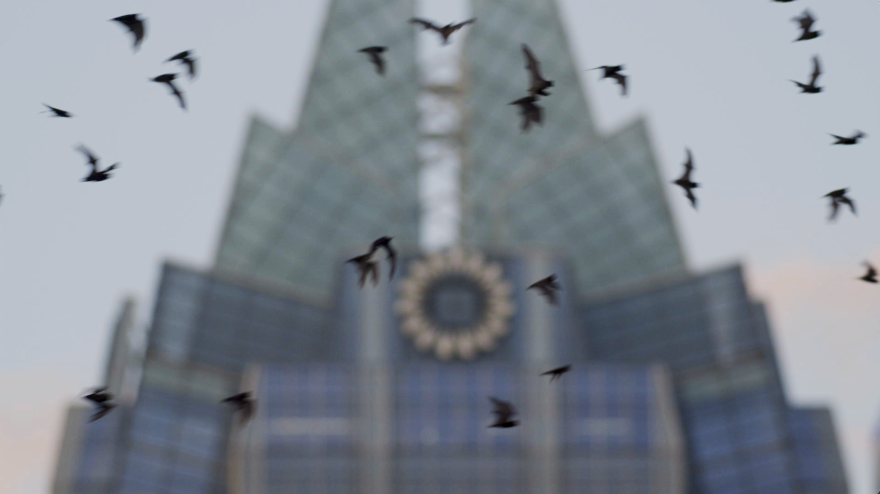
Courtesy of Kristin Tièchei
“I told him [Hobbie] I was hoping for people to fall in love with bats when they watch,” Tièche said. “You protect what you love.”
White-nose syndrome continues to decimate bats as it spreads, but there’s reason for cautious optimism. Some species that were nearly wiped out in the Northeastern states are beginning to show modest recovery, Frick said, though it is not fully clear why.
She said the Fat Bat Project, which has expanded across the Northeast and into Texas, is also showing promise as one tool of many that could stave off total population collapse in some areas.
The Invisible Mammal is screening at 6:30 p.m., Tuesday, July 14, at AFS Cinema. It will be followed by a Q&A with filmmaker Kristin Tièche, producer Matthew Podolsky, cinematographer Skip Hobbie and Winifred Frick of Bat Conservation International.
-

 New Mexico1 minute ago
McCauley Springs Fire Reaches 100% Containment
-

 North Carolina7 minutes ago
Massive great white shark spotted off NC coast. See where its headed
-

 North Dakota13 minutes ago
Neighbors, not competitors
-

 Ohio19 minutes ago
Former Powell residents indicted in $9.3M Ohio Medicaid fraud scheme
-

 Oklahoma25 minutes ago
J.D. PicKell: ‘Oklahoma is going to be a wagon once again’
-

 Oregon31 minutes ago
Oregon Ducks’ Big Ten Championship Chances Entering Fall Camp
-

 Pennsylvania37 minutes ago
Lawmakers break without addressing unconstitutional murder sentences, leave 1K Pa. lifers in limbo
-

 Rhode Island43 minutes ago
Providence mayor, City Council dispute over RENT fund program

