Arkansas
Keep Arkansas Beautiful sees another successful year


LITTLE ROCK, La. (KNOE) – Arkansas saw another year of commitment to the beauty and protection of the state as every county registered cleanups during Keep Arkansas Beautiful Commission’s cleanup challenge in 2023.
The Great Arkansas Cleanup Challenge had thousands of Arkansans volunteer to clean up litter in every county between Sept. 1, 2023, through Oct. 31, 2023. According to KAB, 120 tons of litter was removed from Arkansas roads, waterways, and acres of parks and public areas.
“The success of the 2023 Great Arkansas Cleanup is a testament to the pride and dedication of volunteers across our state,” said Robyn Taylor, volunteer program manager at KAB. “These results display what collective responsibility can accomplish and should inspire us all to foster a continued sense of ownership in preserving the beauty of Arkansas.”
Along with picking up litter, volunteers also planted 426 tress and 142 plants, shrubs. flowers and bulbs.
“We’re immensely proud of the incredible dedication shown by Arkansans during this year’s Great Arkansas Cleanup,” said Colbie Jones, director of KAB. “This year’s results underscore the passion and commitment of our communities toward preserving the natural beauty of our state. The collaborative effort and enthusiasm displayed by volunteers reflect our shared commitment to a cleaner, more beautiful Arkansas.”
KAB says they encourage Arkansans to continue working toward a more beautiful Arkansas in 2024. To learn more about the organization and its upcoming cleanup initiatives, visit keeparkansasbeautiful.com.
Copyright 2024 KNOE. All rights reserved.



LITTLE ROCK, Ark. (KATV) — A big change is rolling in for one of central Arkansas’ most recognizable nonprofits serving the unhoused community.
Aaron Reddin is stepping down as executive director of The Van, effective immediately. The organization has been a critical presence in the region, providing food, water, clothing, hygiene supplies and emergency shelter for people in need, particularly in North Little Rock.
Reddin said he’s leaving day-to-day leadership because of ongoing personal health challenges. “I was diagnosed with CRPS in 22,” Reddin said, referring to complex regional pain syndrome, a condition that can cause severe, persistent pain. He said that “in early 24 I was in a accident that caused the spread of the disease into my upper body,” and that it has “greatly impacted my ability to be present.”
“I’m in weekly treatments and medications and things like that, that caused my absence,” Reddin said. “And you know, even though I may be slowed down, the organization is not and so that’s an unsustainable imbalance, and at some point it has to be acknowledged.”
While he’s stepping away from daily leadership, Reddin will remain involved with The Van as a board member.
Parker Reid has been selected to take over as executive director. Reid said he’s ready to get started and build on what’s already in place.
“I am most excited, I think, just to really hit the ground running,” Reid said. He said he and Reddin have talked about the organization’s infrastructure and what they want it to look like going forward, with a focus on “really just refining what we what we have going on already, and really expanding our volunteer involvement.”
Reddin reflected on how much the organization has grown during his time leading it. “We’ve grown,” he said. “You know, I’ve always thought that we’ve hit a plateau, and then there’s, it just keeps going.”
He also emphasized how The Van is funded. “We’re 99.9% private donor funded. We don’t touch your tax dollars,” Reddin said. “So this is all people helping people from from the bank account to the streets. It’s people powered.”
Asked about a proud moment, Reddin pointed to a recent opportunity to share The Van’s work with a much bigger audience. “I got the chance this past winter to talk about our work here in Little Rock on CNN International live,” he said, adding that the network gave him “like, 13 total minutes, two different days.”
Reddin said he valued being able to spotlight Little Rock as a community that looks out for its neighbors. He said he was able to show people that “we care about each other, we care about our neighbors, regardless of you know what those unconventional sleeping circumstances may look like at the time.”
The Van has also raised money to find and build a shelter for the unhoused, and Reddin said the organization’s emergency shelter work started even before the first van was in service. He said having a more permanent setup will be a major step forward, rather than moving supplies in and out during each weather event.
As Reid steps into the role, he said he’s mindful of what the organization means to Reddin and to the community. He hopes to “take care of of his baby,” he said, because “it means a lot to him, and it means a lot to me to have watched him, you know, grow it for as long as I’ve gotten to watch.”
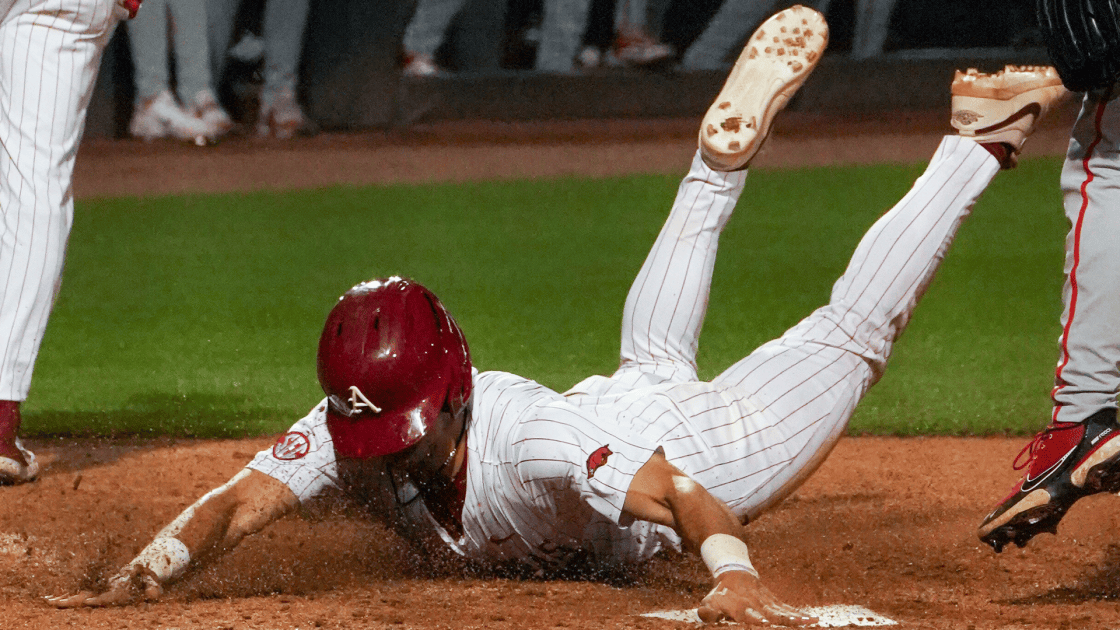
FAYETTEVILLE, Ark. – No. 16 Arkansas (26-14, 9-8 SEC) fell behind early and was unable to catch up with No. 5 Georgia (31-9, 12-5 SEC) in its 5-3 setback Friday night at Baum-Walker Stadium. The Razorbacks and Bulldogs will play for the series at 1 p.m. Sunday, April 18, on SEC Network+ with Josh Haley (play-by-play) and Troy Eklund (analyst) on the call.
Entering tomorrow’s finale, Arkansas has won four consecutive weekend series against Georgia inside Baum-Walker Stadium (2010, 2012, 2017 & 2021). The Hogs have not lost a series to the Bulldogs at home since the 2008 campaign.
Cole Gibler, making his second career start on the mound, provided Arkansas with five innings of four-run ball and two strikeouts. Georgia tagged the left-hander for a solo homer in the top half of the second and scored a pair of two-out runs in the top half of the third before adding a fourth run on a double in the sixth inning to open a 4-0 advantage.
Arkansas responded to its deficit with Damian Ruiz’s two-run home run in the bottom of the sixth and cut the deficit to two, but Georgia tacked on its fifth and final run of the night on a solo shot in the seventh inning to take a 5-2 lead.
The Razorbacks scratched out a run in the bottom half of the seventh on a wild pitch to bring their deficit back to two. It was as close as they would get, however, as Georgia’s Caden Aoki, who took over in relief for injured starter Dylan Vigue (2.0 IP, 4 SO), turned in five innings of three-run ball (two earned) with five walks and four strikeouts on 105 pitches.
In relief of Gibler, Tate McGuire (2.2 IP,1 R, 2 SO) and Steele Eaves (1.1 IP, 1 SO) combined for four innings of one-run ball with three strikeouts. Offensively, Zack Stewart was the lone Hog with multiple hits, finishing 2-for-3 with a walk.
Ruiz, meanwhile, is now the Razorbacks’ leading hitter in SEC play after going 1-for-3 with a homer, two RBI, a walk and stolen base. Through 13 league games this season, he is slashing .304/.418/.565 with three home runs and eight RBI.
For complete coverage of Arkansas baseball, follow the Hogs on Twitter (@RazorbackBSB), Instagram (@RazorbackBSB) and Facebook (Arkansas Razorback Baseball).

WASHINGTON COUNTY, Ark. (KATV) — The National Weather Service (NWS) in Tulsa confirmed on Friday two tornadoes hit parts of Washington County late Tuesday night.
Both tornadoes touched down in Adair County, Oklahoma, and then tracked across the state line into Washington County on April 14.
The NWS said the first tornado touched down around 11:46 p.m. about a mile from Christie, Oklahoma, and continued into Washington County, ending near Cincinnati.
According to the NWS, a few outbuildings were damaged, and trees were uprooted.
The second tornado touched down around 11:54 p.m., nearly five miles southeast of Baron, Oklahoma. The NWS said the second tornado uprooted numerous trees and damaged outbuildings.
The tornado tracked into Washington County near Lincoln.
-

 Nevada3 minutes ago
IN RESPONSE: Cortez Masto lands bill would keep the proceeds in Nevada
-
 New Hampshire9 minutes ago
New Hampshire grapples with nuclear waste storage – Valley News
-

 New Jersey15 minutes ago
Nearby shooting interrupts 13-year-old’s birthday party in Paterson; 1 killed, 3 injured
-

 New Mexico21 minutes ago
Calm and warmer conditions move into New Mexico
-

 North Carolina27 minutes ago
Memorial service held for former Miss North Carolina Carrie Everett
-
North Dakota33 minutes ago
Richard D. Langowski Obituary April 16, 2026 – Tollefson Funeral Home
-

 Ohio39 minutes ago
Three Buckeyes Who Proved They Belong at Ohio State Spring Game
-

 Oklahoma45 minutes ago
Oklahoma’s Jahsiear Rogers ‘Knew It Was Time to Showcase’ His Talents In Spring Game

