Science
What to Know About the Hepatitis A Outbreak in L.A. County


Public health officials in Los Angeles County have declared an outbreak of hepatitis A, a highly contagious liver infection driven by a virus that can, in rare cases, cause severe illness.
The condition, which is typically identified in fewer than 50 people in L.A. County each year, infected at least 138 people in 2024 and cases have remained unusually high so far in 2025. Officials say that levels of the virus in local wastewater suggest these figures are an undercount.
Here’s what to know.
How is hepatitis A transmitted?
The hepatitis A virus is spread through the so-called oral-fecal route, which means it is ingested through food or drinks that have been contaminated by microscopic bits of stool from an infected person. It can also spread through close contact with someone who is carrying the virus, even if they don’t show any symptoms.
Unhoused people are often at greater risk of contracting hepatitis A because they have limited access to proper toilets and hand-washing facilities. The virus is also more common among travelers to places with poor sanitation, men who have sex with men and people who use drugs.
But officials say many of the recent cases have occurred in people without those risk factors. They do not yet know why, but Dr. Timothy Brewer, an infectious disease physician and epidemiologist at U.C.L.A., said it had led him to worry about two things: food contamination, and community circulation.
“If you’re practicing good hygiene in a community that has access to potable water, you really should not be seeing a lot of this,” he said. “Something is going on — but exactly what that something is, we don’t yet know.”
What are the symptoms of a hepatitis A infection?
The first signs of the infection can look a lot like a classic stomach bug: fever, fatigue, nausea and a loss of appetite, followed by vomiting and diarrhea. Over time, people who become infected can also experience yellowed skin and eyes, dark urine and pale stools.
One of the challenges to halting a hepatitis A outbreak is that contact tracing can be nearly impossible. The infection can incubate for up to seven weeks before symptoms appear, and a person carrying the virus can spread it for up to two weeks before they feel ill.
In addition, a significant proportion of people who become infected don’t experience major symptoms, said Dr. Edward Jones-Lopez, an infectious disease specialist with Keck Medicine of the University of Southern California, so they do not visit their doctor, who in turn does not run a blood test and report the case.
Severe symptoms are most often seen in older adults, people with chronic liver conditions, and those with weakened immune systems or H.I.V. On rare occasions, a hepatitis A infection can be fatal. In this outbreak, at least seven people have died. That may seem like an unusually high fatality rate, but officials believe far more people have been infected than the official numbers show. Most have probably been asymptomatic, or shown symptoms mild enough to have been misidentified.
How is hepatitis A treated?
There is no specific antiviral medication for hepatitis A. The infection usually resolves on its own within a few weeks, and most people do not face lasting liver damage. But for some, hospitalization can be necessary.
In rare cases, the infection can devolve into an acute liver failure called fulminant hepatitis, which may require a transplant, said Dr. Jones-Lopez. “It can progress very, very quickly — that’s a very serious disease.”
If you think you might be infected, be sure to visit your doctor, drink lots of fluids, and get adequate rest.
How can I avoid it?
The best way to prevent a hepatitis A infection is through vaccination. The regimen — two doses of vaccine, at least six months apart — provides protection for life. It has been routinely given to children for the last two decades, but many adults 25 and older have not gotten the shots unless they were in a high-risk group.
The fact that the outbreak is occurring outside of traditional populations “underscores the need to reassess how — and where — we target prevention efforts,” said Dr. Anne Rimoin, an epidemiology professor at U.C.L.A., since “an infection anywhere is potentially an infection everywhere.”
If you are unvaccinated but know you have been exposed to a person carrying the virus, a prompt vaccination can prevent your becoming infected. Experts say that some people with weakened immune systems who are exposed could also benefit from receiving immune globulin as well. And good hygiene is a wise protective measure for everyone; wash your hands with soap and water, especially after using the bathroom, and before preparing food.






Heavier rain is expected to fall across Los Angeles this weekend, bringing wetter weather and a chance for thunderstorms after spring kicked into full bloom.
“This is when the weather gets a little more wild, technically, because we’re starting to see some more differential heating on the Earth,” said Todd Hall, a meteorologist at the National Weather Service.
Parts of Los Angeles will probably see rain after 11 p.m. Saturday, according to a forecast from the National Weather Service. Scattered showers are anticipated on Sunday afternoon before 2, and there is a potential for thunderstorms in some parts of the city.
There’s a 15% to 25% chance of thunderstorms, according to the forecast discussion from the NWS Los Angeles on Saturday. “Any thunderstorms that develop will likely produce brief heavy rain, gusty outflow winds, small hail and potentially waterspouts or weak, short-lived, tornadoes,” the NWS said.
A ridge of high pressure has already moved east, and now a storm system is arriving in the area.
There’s a chance that the storm system will linger across parts of Los Angeles through Monday, Hall said. Snow levels are expected to drop at high elevations, but some places, such as the northern Ventura County mountains, could have wet snow, so drivers should be cautious.
Gusty winds are expected in portions of the Mojave Desert as well.
“Just like in the ocean, we have waves. The atmosphere behaves the same way,” Hall said.
The total rainfall through Sunday night is anticipated to be between 0.50 and 1.50 inches. On average across L.A., temperatures on Sunday are expected to reach a high of 65 degrees — a full 26 degrees lower than the high recorded a week ago.
Dry and warm weather is expected to return after Monday. Temperatures are forecast to climb to more than 75 degrees later in the week and reach nearly 80 degrees next Saturday.
Heavier rain — including some thunderstorms — is expected in other parts of California such as the counties of San Luis Obispo, Santa Barbara and Ventura, the National Weather Service Los Angeles said Saturday afternoon on X.
Wind gusts north of Point Conception in Santa Barbara County could come with risks such as downed trees or powerlines. Major flooding and debris flows are unlikely, the social media post said.
Up north, the San Francisco Bay Area has already been experiencing the severe weather. Heavy rain hammered the region Saturday, and wind gusts were expected to reach up to 28 mph. The National Weather Service was advising people to allow extra time for travel because of the slippery roads.
In Southern California, the National Weather Service suggested that people be ready to adjust plans and monitor the situation.

The Artemis II astronauts safely splashed down off the coast of San Diego at 5:07 p.m. Friday. After their historic 10-day mission around the moon, the crew and NASA officials are finally breathing a sigh of relief.
“I’m still at a loss for words. The childhood Jared right now can’t believe what I just saw,” said NASA Administrator Jared Isaacman, standing aboard a Navy warship assisting with recovering the four returned astronauts in the Pacific Ocean.
Isaacman was born more than a decade after the last time humans walked on the moon.
“I’ve almost been waiting my whole lifetime to see this, and then as NASA administrator, I just couldn’t be more proud of the entire workforce,” he said.
The return mission was highly anticipated and attracted rapt viewers from across the nation. The Empire State Building was lit up in red, white and blue to welcome the crew home. Multiple MLB stadiums displayed footage of the landing on their scoreboards.
NASA regarded the high-energy reentry — streaking through the atmosphere in a nearly 5,000-degree-Fahrenheit fireball at more than 32 times the speed of sound — as one of the riskiest moments of the mission.
-
Share via
Space agency officials’ blood pressure was further elevated as experts closely watched the performance of the craft’s heat shield, which astronauts rely on to slow them down and keep temperatures livable.
During the crew-less 2022 Artemis I test mission, the heat shield unexpectedly chipped in more than 100 spots. NASA determined that any astronauts aboard would have been unscathed, but noted the problem posed an increased risk to future crews. Instead of redesigning the heat shield — which NASA will do for future missions — the agency opted to bring the capsule in on a steeper trajectory intended to inflict less stress on the materials.
After splashdown, multiple minor snafus delayed Navy divers as they tried to bring the astronauts out of the capsule.
First, the divers struggled to contact the astronauts inside — though both parties could still reach Mission Control. After the Navy crew opened the hatch, ocean currents hindered their ability to deploy inflatable devices around the capsule to stabilize it and help the astronauts exit.
Eventually, nearly an hour and a half after splashdown, the team helped the astronauts out of the toasty Orion capsule, to the cheers of dozens of flight controllers in Mission Control.
The Navy team then airlifted the astronauts by helicopter to the USS John P. Murtha Navy warship, about 1.5 miles away, for medical evaluation.
Crews will continue to work into the night securing the capsule and guiding it back to the Murtha, which is expected to reach Naval Base San Diego early Saturday.
For many NASA scientists and engineers across the country, the work to analyze every bit of data from the capsule has just begun.
“We’re going to want to definitely take a look at the thermal protection system,” Isaacman said. “We’re going to want to download all the data they couldn’t transmit back to us and use that to inform Artemis III.”
The Artemis Program, an international collaboration spearheaded by NASA, aims to put boots back on the moon for the first time in more than 50 years. The space agency hopes to establish a lunar base as a testing grounds for future missions to Mars.
Artemis II, a flyby mission around the moon that lifted off on April 1, was focused on testing out life support systems and practice piloting the spacecraft to make the journey a smoother ride for future crews who will be focused on the complex challenge of actually landing on the lunar surface.
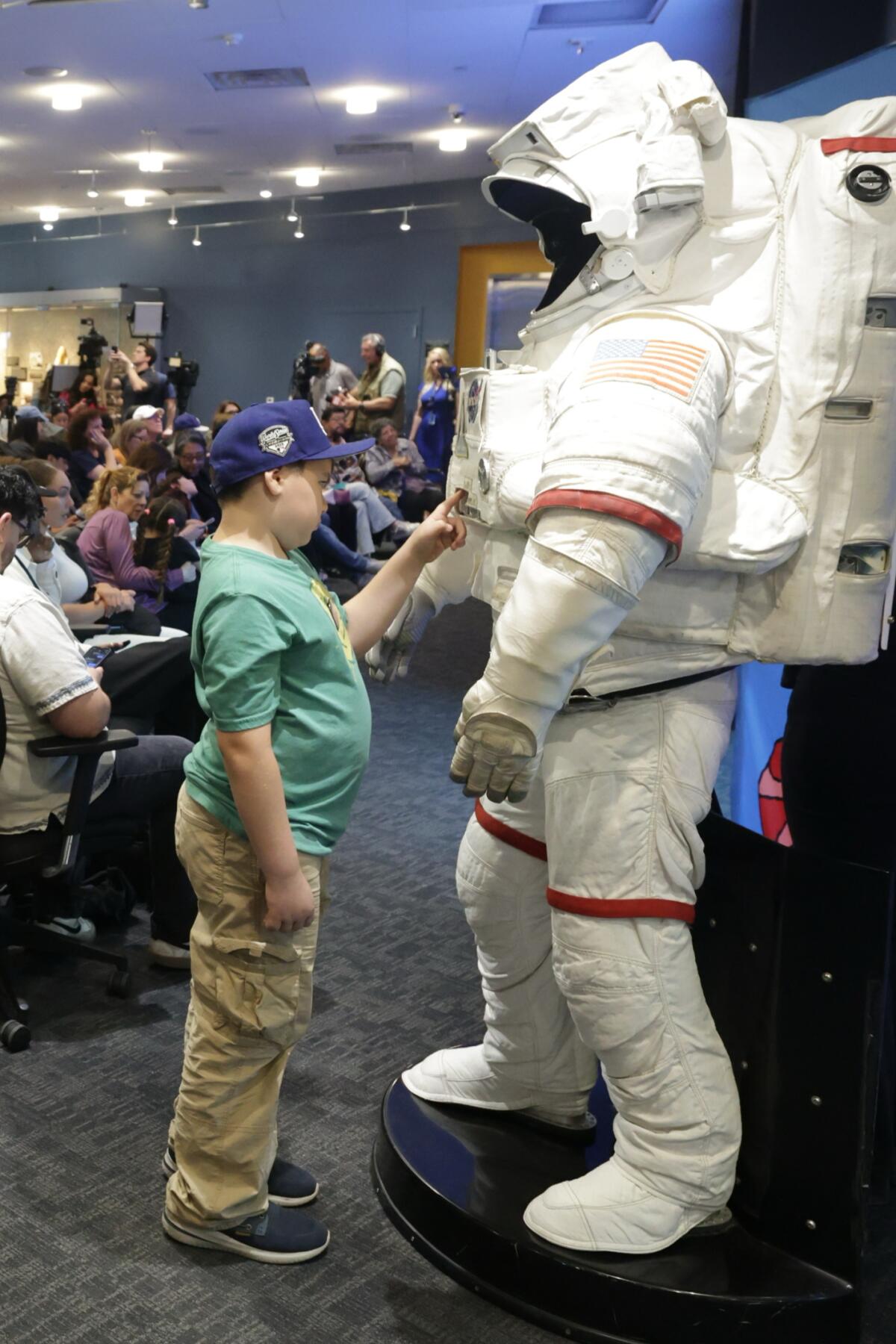
Christian Ramirez, Jr., 8, checks out an astronaut suit while waiting for the Artemis II Landing Watch Party featuring a live broadcast of the splashdown on a large screen at the Columbia Memorial Space Center in Downey on Friday.
(Myung J. Chun / Los Angeles Times)
They worked out problems with the capsule’s space toilet (multiple times), piloted the spacecraft by hand, and tested procedures such as sheltering from solar radiation in the cargo locker.
Yet Monday’s flyby — the first time humans had reached the moon since 1972 — held emotional significance for the crew and space enthusiasts beyond the mission’s technical objectives.
While in space, the crew spoke of the surreal sights of our dusty, rugged natural satellite, appearing about the size of a bowling ball at arm’s length, suspended in nothingness. The astronauts couldn’t help but feel a renewed appreciation for our home planet.
“Maybe the distance we are from you makes you think what we’re doing is special,” Artemis II pilot and Southern California native Victor Glover said on Easter while on his way to the moon. “But we’re the same distance from you, and — I’m trying to tell you, just trust me — you are special. In all of this emptiness — this is a whole bunch of nothing, this thing we call the universe — you have this oasis, this beautiful place that we get to exist, together.”
About 25 minutes before the crew splashed back down on our oasis, Artemis II Cmdr. Reid Wiseman radioed Mission Control.
“We have a great view of the moon out window two,” he said. “Looks a little smaller than yesterday.”
“Guess we’ll have to go back,” Mission Control replied.

new video loaded: Artemis Astronauts Splash Down After Historic Lunar Flyby
transcript
transcript
Artemis Astronauts Splash Down After Historic Lunar Flyby
The four astronauts aboard Artemis II splashed down at 8:07 p.m. Eastern time in the Pacific Ocean near San Diego on Friday, concluding their historic 10-day mission, the first to send humans to the moon in more than 50 years.
-
“Houston, Integrity splashdown. Sending post-landing command now.” “Splashdown confirmed.” “Copy splashdown. Waiting on V.L.D.R.” “Splashdown confirmed at 7:07 p.m. Central time.” “All four crew members now out of Integrity.”

By Jackeline Luna
April 10, 2026

Sunday Puzzle: Sweet Treat

Allow me to explain why I love this camera that can’t shoot color

Pope Leo calls out ‘delusion of omnipotence’ fueling Iran war in vigil for peace at St. Peter’s Basilica

Carney casts himself as NATO defender amid Trump beef, despite Canada missing key benchmark for decades

What is butt microneedling? Behind the ‘desperate’ procedure Kelly Ripa tried

Florida High School Football Rankings: Top 25 teams – Oct. 21

How old is Bo Nix? What to know about Oregon quarterback ahead of 2024 NFL Draft

Cleary's 21 help Le Moyne down Central Connecticut State 69-64 in OT

99th annual Pony Swim held in Virginia

Indiana Members Credit Union announced as new anchor tenant at Bottleworks District
Carney casts himself as NATO defender amid Trump beef, despite Canada missing key benchmark for decades

‘Enough of war!’ says Pope Leo XIV who grows increasingly frustrated
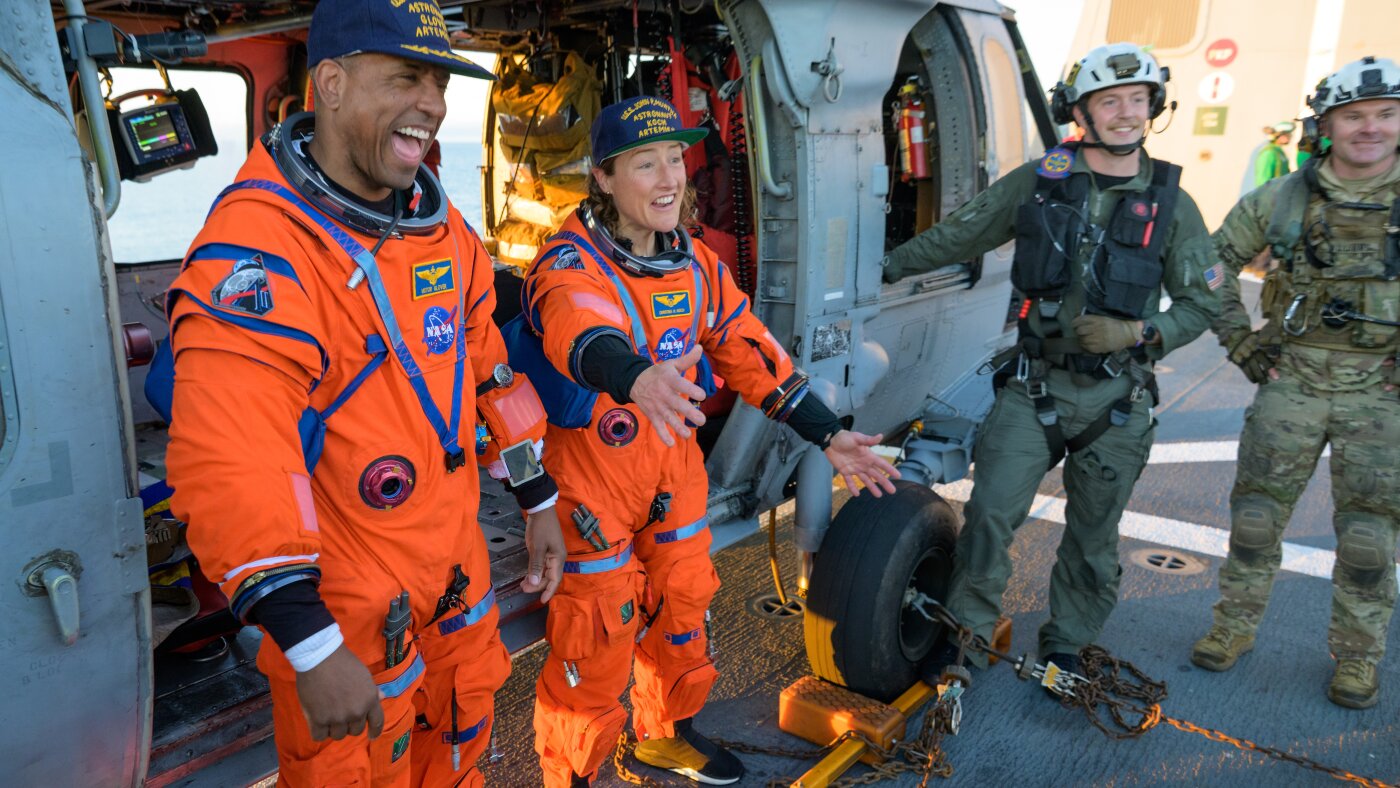
Artemis II splashdown captures nationwide attention

Video: Police Fatally Shoot Man After Stabbings at Grand Central Subway Station

Trump blasts Spanberger ahead of Virginia meetings, says state faces tax base exodus like New York, California
-

 Atlanta, GA1 week ago
1 teenage girl killed, another injured in shooting at Piedmont Park, police say
-

 Georgia5 days ago
Georgia House Special Runoff Election 2026 Live Results
-

 Pennsylvania5 days ago
Parents charged after toddler injured by wolf at Pennsylvania zoo
-

 Arkansas2 days ago
Arkansas TV meteorologist Melinda Mayo retires after nearly four decades on air
-
 Milwaukee, WI6 days ago
Potawatomi Casino Hotel evacuated after fire breaks out in rooftop HVAC system
-

 Indianapolis, IN1 week ago
Fighting Illini begin Final Four preparations in Indianapolis
-

 Technology1 week ago
Anthropic essentially bans OpenClaw from Claude by making subscribers pay extra
-

 Detroit, MI1 week ago
Puppy rescued after getting stuck on chimney in Detroit