Science
Torrance residents call for the ban of ‘flesh-eating’ chemical used at refinery

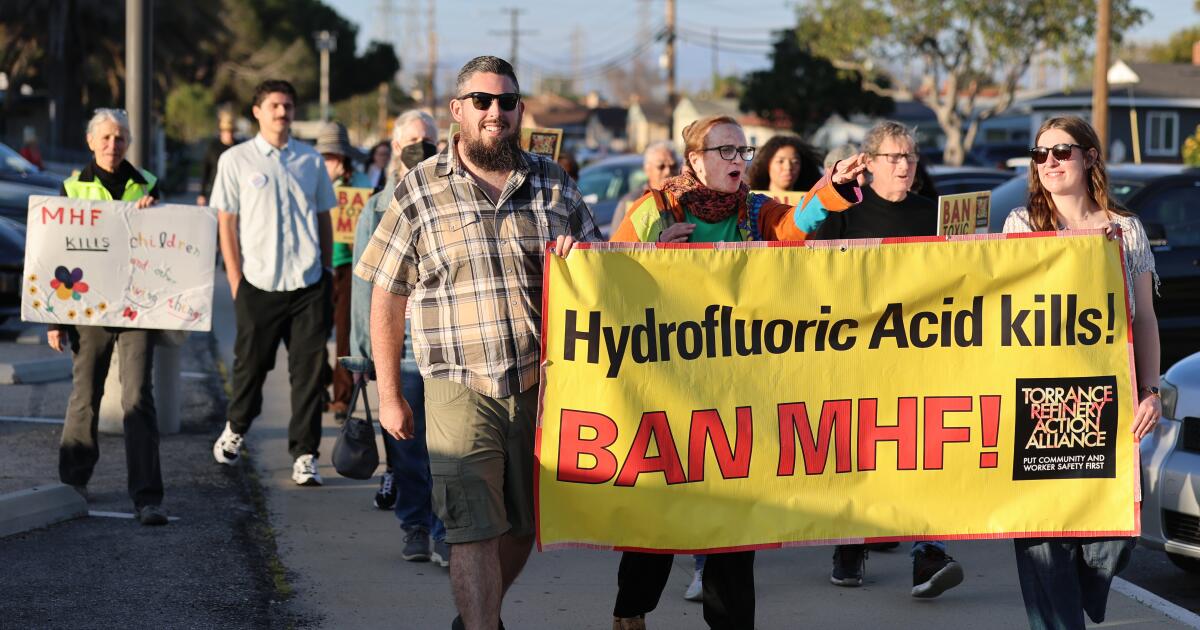
Residents and advocates gathered Saturday to demand the ban of a chemical that’s used at a Torrance oil refinery and that they say has the potential to cause a mass casualty disaster.
Hydrofluoric acid is used in about 40 gasoline refineries across the United States, according to the National Resources Defense Council. The defense council states that “exposing as little as 1% of a person’s skin to HF (about the size of one’s hand) can lead to death. When inhaled, HF can fatally damage lungs, disrupt heart rhythms, and cause other serious health effects.”
The Torrance Refinery uses modified hydrofluoric acid, or MHF, which the refinery considers to be a safer alternative to HF, though the claim is disputed by advocates. Steve Goldsmith, president of the Torrance Refinery Action Alliance, which hosted the Saturday event, said that if MHF were to be been released into the air, it would create irreversible health effects within 6.2 miles of the refinery, trickling into other parts of Los Angeles County.
And in 2015, he said, this almost happened.
On Feb. 18, 2015, there was an explosion at the refinery, then operated by ExxonMobil, caused by the rupture of an eroded valve. The incident, which released flammable hydrocarbons, injured four workers and forced 14 schools into lockdown.
The Saturday event, held at North High School’s Performing Arts Center in Torrance, marked the 11th anniversary of the explosion.
Goldsmith described the chemical as “murderous.”
Audience members participate in a “peace clap” at North Torrance High as they listen to speakers against the use of hydrofluoric acid in the Los Angeles region and across the country.
(Allen J. Schaben / Los Angeles Times)
“Torrance Refinery had an enormous explosion, and a piece of equipment the size of a bus came within five feet of the hydrofluoric acid, causing a near miss,” Goldsmith said. “We’ve been working to get rid of it.”
Residents like Christopher Truman say replacing MHF with an alternative option is the least that can be done. His parents live near the refinery.
“I’m born and raised in the South Bay, and my family lives in, effectively, what would be the blast radius if another accident happened,” Truman said. “So just in that aspect, I’m very worried about it.”
MHF is also used to clean semiconductor surfaces and produce pesticides and herbicides in the agricultural and pharmaceutical industries, according to the Torrance Refinery.
County Supervisor Janice Hahn said residents should not assume “they will be lucky” if another refinery accident were to occur.
“Only two refineries in California use MHF, Torrance Refinery and the Valero Refinery in Wilmington,” Hahn said. “MHF is simply too dangerous to use. It is a flesh-eating, low-crawling, toxic vapor cloud. Our communities will not be safe until this chemical is gone.”
Goldsmith said a Chevron refinery in Salt Lake City found an ionic-liquid alkylation process as an alternative to MHF. He added that the 2025 Chevron refinery explosion in El Segundo “would have been different if they had been using MHF.”
“They used another chemical that did not endanger the community,” Goldsmith said. “And that’s the thing about refineries, they have explosions. But that’s why you can’t have [MHF] around things that can blow up.”
U.S. Representative

U.S. Rep. Maxine Waters (D-Los Angeles) appears on a video message explaining her legislation, which she says will have a positive impact for communities in the Los Angeles region.
(Allen J. Schaben / Los Angeles Times)
U.S. Rep. Maxine Waters, (D-Los Angeles), who represents the city of Torrance, greeted attendees in a prerecorded message, in which she reintroduced her bill, the “Preventing Mass Casualties from Release of Hydrofluoric Acid at Refineries Act,” which targets plants using MHF.
“I originally introduced this bill in December of 2024,” Waters said in the video. “I faced considerable opposition, especially from the United Steel Workers Union, [who were] concerned that if refineries converted to safer technologies, some of the refineries might close, leaving workers without jobs. They agreed with me that hydrofluoric acid is dangerous. But they still would not support my bill. So I decided to go ahead and reintroduce this bill, [without] union support.”
The bill would give refineries five years to find an alternative to the dangerous chemical. Violators may be subject to fines up to $37,000 per infraction.

Los Angeles County Supervisor Janice Hahn speaks out against the use of hydrofluoric acid.
(Allen J. Schaben / Los Angeles Times)
Some residents stressed the need for transparency from local officials.
Ian Patton, a Long Beach resident, said most parts of the investigation into the 2015 explosion were withheld.
“Why can’t they not make this report public? The [Torrance Refinery Action Alliance] has been asking for it for years,” Patton said. “The next step was to look at litigation under the California Public Records Act. It’s not something that we want to do, but the public deserves to know whether these plants are safe.”


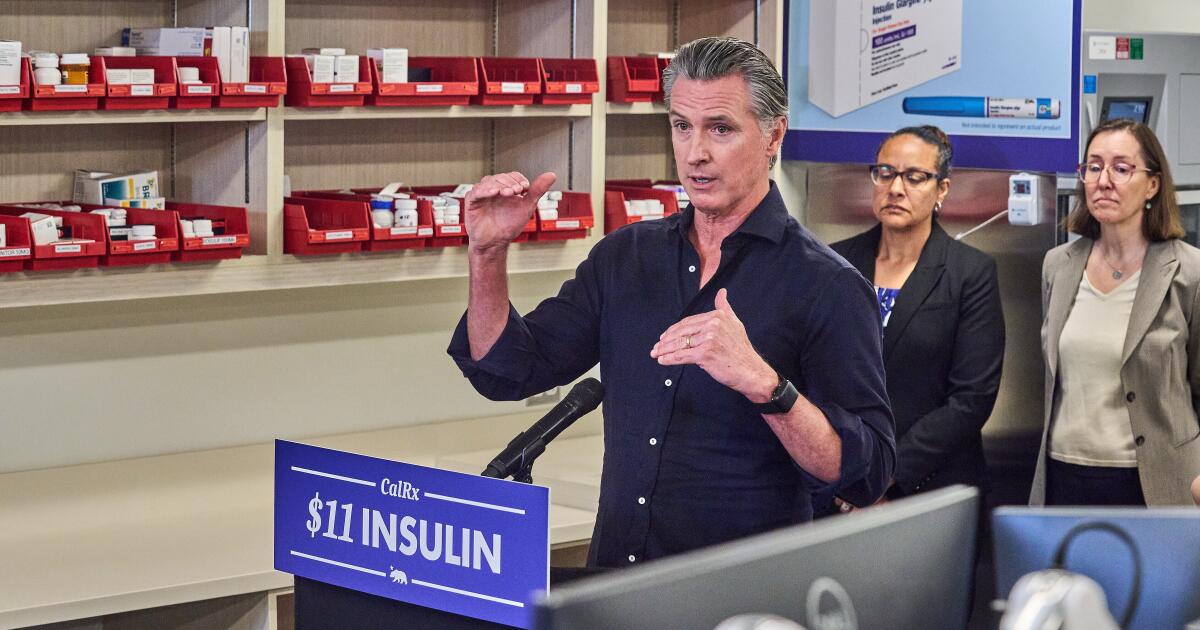
SACRAMENTO — California Gov. Gavin Newsom has positioned himself as a national public health leader by staking out science-backed policies in contrast with the Trump administration.
After Health and Human Services Secretary Robert F. Kennedy Jr. fired Centers for Disease Control and Prevention Director Susan Monarez for refusing what her lawyers called “the dangerous politicization of science,” Newsom hired her to help modernize California’s public health system. He also gave a job to Debra Houry, the agency’s former chief science and medical officer, who had resigned in protest hours after Monarez’s firing.
Newsom also teamed up with fellow Democratic governors Tina Kotek of Oregon, Bob Ferguson of Washington and Josh Green of Hawaii to form the West Coast Health Alliance, a regional public health agency, whose guidance the governors said would “uphold scientific integrity in public health as Trump destroys” the CDC’s credibility. Newsom argued establishing the independent alliance was vital as Kennedy leads the Trump administration’s rollback of national vaccine recommendations.
More recently, California became the first state to join a global outbreak response network coordinated by the World Health Organization, followed by Illinois and New York. Colorado and Wisconsin signaled they plan to join. They did so after President Trump officially withdrew the United States from the agency on the grounds that it had “strayed from its core mission and has acted contrary to the U.S. interests in protecting the U.S. public on multiple occasions.” Newsom said joining the WHO-led consortium would enable California to respond faster to communicable disease outbreaks and other public health threats.
Although other Democratic governors and public health leaders have openly criticized the federal government, few have been as outspoken as Newsom, who is considering a run for president in 2028 and is in his second and final term as governor. Members of the scientific community have praised his effort to build a public health bulwark against the Trump administration’s slashing of funding and scaling back of vaccine recommendations.
What Newsom is doing “is a great idea,” said Paul Offit, an outspoken critic of Kennedy and a vaccine expert who formerly served on the Food and Drug Administration’s vaccine advisory committee but was removed under Trump in 2025.
“Public health has been turned on its head,” Offit said. “We have an anti-vaccine activist and science denialist as the head of U.S. Health and Human Services. It’s dangerous.”
The White House did not respond to questions about Newsom’s stance and Health and Human Services declined requests to interview Kennedy. Instead, federal health officials criticized Democrats broadly, arguing that blue states are participating in fraud and mismanagement of federal funds in public health programs.
Health and Human Services spokesperson Emily Hilliard said the administration is going after “Democrat-run states that pushed unscientific lockdowns, toddler mask mandates, and draconian vaccine passports during the COVID era.” She said those moves have “completely eroded the American people’s trust in public health agencies.”
Public health guided by science
Since Trump returned to office, Newsom has criticized the president and his administration for engineering policies that he sees as an affront to public health and safety, labeling federal leaders as “extremists” trying to “weaponize the CDC and spread misinformation.” He has excoriated federal officials for erroneously linking vaccines to autism, warning that the administration is endangering the lives of infants and young children in scaling back childhood vaccine recommendations. And he argued that the White House is unleashing “chaos” on America’s public health system in backing out of the WHO.
The governor declined an interview request, but Newsom spokesperson Marissa Saldivar said it’s a priority of the governor “to protect public health and provide communities with guidance rooted in science and evidence, not politics and conspiracies.”
The Trump administration’s moves have triggered financial uncertainty that local officials said has reduced morale within public health departments and left states unprepared for disease outbreaks and prevention efforts. The White House last year proposed cutting Health and Human Services spending by $33 billion, including $3.6 billion from the CDC. Congress largely rejected those cuts last month, although funding for programs focusing on social drivers of health, such as access to food, housing and education, were axed.
The Trump administration announced that it would claw back more than $600 million in public health funds from California, Colorado, Illinois and Minnesota, arguing that the Democratic-led states were funding “woke” initiatives that didn’t reflect White House priorities. Within days, the states sued and a judge temporarily blocked the cut.
“They keep suddenly canceling grants and then it gets overturned in court,” said Kat DeBurgh, executive director of the Health Officers Assn. of California. “A lot of the damage is already done because counties already stopped doing the work.”
Federal funding has accounted for more than half of state and local health department budgets nationwide, with money going toward fighting HIV and other sexually transmitted infections, preventing chronic diseases, and boosting public health preparedness and communicable disease response, according to a 2025 analysis by KFF, a health information nonprofit that includes KFF Health News.
Federal funds account for $2.4 billion of California’s $5.3-billion public health budget, making it difficult for Newsom and state lawmakers to backfill potential cuts. That money helps fund state operations and is vital for local health departments.
Funding cuts hurt all
Los Angeles County public health director Barbara Ferrer said if the federal government is allowed to cut that $600 million, the county of nearly 10 million residents would lose an estimated $84 million over the next two years, in addition to other grants for prevention of HIV and other sexually transmitted infections. Ferrer said the county depends on nearly $1 billion in federal funding annually to track and prevent communicable diseases and combat chronic health conditions, including diabetes and high blood pressure. Already, the county has announced the closure of seven public health clinics that provided vaccinations and disease testing, largely because of funding losses tied to federal grant cuts.
“It’s an ill-informed strategy,” Ferrer said. “Public health doesn’t care whether your political affiliation is Republican or Democrat. It doesn’t care about your immigration status or sexual orientation. Public health has to be available for everyone.”
A single case of measles requires public health workers to track down 200 potential contacts, Ferrer said.
The U.S. eliminated measles in 2000 but is close to losing that status as a result of vaccine skepticism and misinformation spread by vaccine critics. The U.S. had 2,281 confirmed cases last year, the most since 1991, with 93% in people who were unvaccinated or whose vaccination status was unknown. This year, the highly contagious disease has been reported at schools, airports and Disneyland.
Public health officials hope the West Coast Health Alliance can help counteract Trump by building trust through evidence-based public health guidance.
“What we’re seeing from the federal government is partisan politics at its worst and retaliation for policy differences, and it puts at extraordinary risk the health and well-being of the American people,” said Georges Benjamin, executive director of the American Public Health Assn., a coalition of public health professionals.
Robust vaccine schedule
Erica Pan, California’s top public health officer and director of the state Department of Public Health, said the West Coast Health Alliance is defending science by recommending a more robust vaccine schedule than the federal government. California is part of a coalition suing the Trump administration over its decision to rescind recommendations for seven childhood vaccines, including for hepatitis A, hepatitis B, influenza and COVID-19.
Pan expressed deep concern about the state of public health, particularly the uptick in measles. “We’re sliding backwards,” Pan said of immunizations.
Sarah Kemble, Hawaii’s state epidemiologist, said Hawaii joined the alliance after hearing from pro-vaccine residents who wanted assurance that they would have access to vaccines.
“We were getting a lot of questions and anxiety from people who did understand science-based recommendations but were wondering, ‘Am I still going to be able to go get my shot?’” Kemble said.
Other states led mostly by Democrats have also formed alliances, with Pennsylvania, New York, New Jersey, Massachusetts and several other East Coast states banding together to create the Northeast Public Health Collaborative.
Hilliard, of Health and Human Services, said that even as Democratic governors establish vaccine advisory coalitions, the federal Advisory Committee on Immunization Practices “remains the scientific body guiding immunization recommendations in this country, and HHS will ensure policy is based on rigorous evidence and gold standard science, not the failed politics of the pandemic.”
Influencing red states
Newsom, for his part, has approved a recurring annual infusion of nearly $300 million to support the state Department of Public Health, as well as the 61 local public health agencies across California, and last year signed a bill authorizing the state to issue its own immunization guidance. It requires health insurers in California to provide patient coverage for vaccinations the state recommends even if the federal government doesn’t.
Jeffrey Singer, a doctor and senior fellow at the libertarian Cato Institute, said decentralization can be beneficial. That’s because local media campaigns that reflect different political ideologies and community priorities may have a better chance of influencing the public.
A KFF analysis found some red states are joining blue states in decoupling their vaccine recommendations from the federal government’s. Singer said some doctors in his home state of Arizona are looking to more liberal California for vaccine recommendations.
“Science is never settled, and there are a lot of areas of this country where there are differences of opinion,” Singer said. “This can help us challenge our assumptions and learn.”
KFF Health News is a national newsroom that produces in-depth journalism about health issues and is one of the core operating programs at KFF — the independent source for health policy research, polling and journalism.

Two friends bought nearly identical homes last year, in the same northern Minnesota neighborhood, for the same price.
But Tara Novak pays more than twice as much for home insurance as Petra Rodriguez. The only difference? Ms. Novak has a lower credit score.
Across the country, people with weaker credit histories are paying far more for home insurance than owners with spotless records.
Where the home insurance rate gap between “fair” and “excellent” credit is higher
Home insurance premiums have risen rapidly in recent years, fueled by climate change, building costs and inflation. The price shock has rippled into the real estate market, dragging down home prices in areas vulnerable to disasters and leading insurers to abandon homeowners in risky places.
But these dynamics obscure another problem: The home insurance market has cleaved in two along a boundary defined more by a customer’s personal history than by the risk of a disaster hitting their home.
Americans with weaker credit histories, usually from missed payments or high amounts of debt, now pay significantly more for insurance, regardless of where they live, two new studies have found. While those with poor credit histories often can’t purchase homes at all, people with “fair” scores, which range from around 580 to 669, are paying twice as much in some places as people with “excellent” scores of about 800 or higher. And the gap is growing.
Insurers use a metric based on credit history known as an insurance score to set rates, and the figure tracks closely with a customer’s credit score.
The penalty for having a “fair” credit history versus an “excellent” one
States with the biggest pricing gaps
That can mean owners of identical homes, like Ms. Novak and Ms. Rodriguez, pay wildly different rates to insure them. For most people, it’s now just as expensive to have a credit score of “fair” as it is to live in an area likely to experience a disaster like a hurricane or wildfire. About 29 percent of consumers have credit scores that are categorized as “fair” or “poor.”
“There’s so many reasons people have bad credit,” Ms. Novak said. “It’s not like I’ve ever not paid a bill on time. I’m a stickler on my bills, I’m a stickler on my rent, never been late. This is not fair.”
“The choice to use credit scores in pricing means that those lower-credit home owners in risky areas are effectively subsidizing more affluent high-credit homeowners who also live in risky areas,” said Nick Graetz, assistant professor of sociology at the University for Minnesota, who wrote one of the recent papers. “So in a lot of ways, you can keep your insurance price down if you’re high income, high credit — even if you live on the coast of Florida.”
A handful of states have banned insurers from using credit data because of concerns about fairness and the potential for discrimination against low-income people and people of color, but the majority allow it.
For those with both weaker credit and high disaster risk, the combination can set them up for a downward spiral: disasters tend to be followed by decreases in credit scores as people use credit cards and bank loans to recover. That can lead to higher insurance rates, pushing monthly housing costs further out of reach.
“When a disaster hits, there’s a loss of income that occurs, and then that can impact someone’s credit score because they can’t pay their debt, they can’t pay their rent, they can’t pay their mortgage,” said Lance Triggs, executive vice president at Operation HOPE, a financial literacy nonprofit. “And now they’re faced with higher insurance premiums post-disaster.”
A working paper released today by the National Bureau of Economic Research found that homeowners with the lowest credit scores paid, on average, $550 more in 2024 for home insurance than those with the highest scores.
The findings broadly track with data from Quadrant Information Services analyzed by The New York Times, which found that, on average, lower credit scores meant higher premiums across every state that allowed the practice. Dr. Graetz used the same data set for his research, which he did in collaboration with the Consumer Federation of America and the Climate and Community Institute.
When a windstorm last year hit the home of Audrey Thayer, a city council member in Bemidji, Minn., it ripped the siding off her house and stripped shingles from her roof.
Ms. Thayer’s insurance did not cover all the damage. As she fought her insurer for more money, she opened new credit cards and bank loans to repair her home. Her credit score dropped as she tried to find a new insurance plan.
Ms. Thayer, a member of the White Earth Nation, said she was not aware that her credit score could affect her home insurance rates, even though she teaches about credit ratings at a nearby tribal college. “Most of the folks here do not have good credit,” said Ms. Thayer, whose community is one of the poorest in the state. “I did not know what a credit score was until I was 35 or so.”
In Texas, the advocacy group Texas Appleseed found that some insurers charge people with poor credit up to 12 times as much as people with excellent credit for certain policies, said Ann Baddour, the director of the nonprofit’s Fair Financial Services Project.
Higher costs have serious implications for low-income homeowners who live in the path of hurricanes, said Nadia Erosa, the operations manager at Come Dream Come Build, a nonprofit community housing development organization. After the Brownsville, Texas, region saw intense flooding last spring, some residents turned to companies offering high-interest loans to fund repairs, she said, raising the risk of the disaster-credit spiral.
“Delinquencies are going up because people cannot afford their payment,” she said.
The price of risk
Before they can get a mortgage, homebuyers are usually required by lenders to purchase home insurance.
“Households with insurance have fewer financial burdens, fewer unmet needs, they recover faster, they’re more likely to rebuild,” said Carolyn Kousky, an economist and founder of Insurance for Good, a nonprofit that focuses on finding new approaches to risk management. “Yet the people who need insurance the most are the least able to afford it.”
Insurance companies consider a variety of factors when setting the premium for a property. They might examine the age of the roof, or the area’s vulnerability to hurricanes or wildfires. They factor in how much it would cost to rebuild the house if it were damaged.
Insurers have argued that credit history is also worth considering because people with low scores tend to file more claims than those with excellent scores, an assertion that is backed up by the working paper published in the National Bureau of Economic Research today. This likely happens because people with weaker credit histories tend to have less income, and when their home is damaged, they file insurance claims for smaller fixes that a wealthier homeowner might pay for out of pocket.
Paul Tetrault, senior director at the American Property Casualty Insurance Association, a trade organization, said credit scores are a valid way to price premiums.
But others argue that using credit information to price insurance doesn’t make sense.
Because a homeowner pays for insurance upfront, “it’s not like you’re really extending a loan to the customer where you would be worried about the risk of repayment,” Ms. Kousky said. She points out that insurance companies can opt not to renew a homeowner’s policy if they believe it is too risky — a tactic they have been using with increasing frequency.
The NBER analysis found that homeowners who want to pay less for insurance should pay off debt to raise their credit score rather than replace roofs and make other improvements to avoid damage when disaster strikes.
Others believe that even if credit scores are accurate predictors of future claims, they shouldn’t be used to set premiums because that can perpetuate or worsen disparities. For example, people in their mid-20s who are Black, low-income, or grow up in impoverished regions have significantly lower credit scores than their peers, a July working paper from Opportunity Insights, a not-for-profit organization at Harvard University, found.
“When the government and the financial system mandate that we buy a product, there’s a special obligation to make sure the pricing is fair,” said Doug Heller, director of insurance at the Consumer Federation. “To me that is an absolutely solid reason, just like we don’t allow pricing based on race or income or ethnicity or religion.”
A natural experiment
A handful of states, including California and Massachusetts, have banned or limited the use of credit scores in setting home insurance premiums, despite opposition from the insurance industry.
In Nevada, where a temporary pandemic-related rule prevented insurers from using credit history to increase premiums for existing customers from 2020 to 2024, companies refunded approximately $27 million to nearly 200,000 policyholders, said Drew Pearson, a spokesman for the Nevada Division of Insurance.
Perhaps the clearest example of the effects of these bans comes from Washington State, which banned the use of credit information in setting home insurance premiums starting in June 2021. The rule immediately faced legal challenges, and was in effect for just a few months until it was overturned in court.
But the episode allowed researchers to evaluate the effect of credit factors on insurance premiums. When the rule took effect, people with the lowest credit scores saw a decrease in premiums of about $175 annually while those with the highest scores saw an increase of about $100, the NBER analysis found.
“We could see the dynamics of insurance pricing for the same households over time,” said Benjamin Keys, a professor at the University of Pennsylvania’s Wharton School, who co-authored the paper.
What homeowners paid before and after a ban on credit-based pricing in Washington State
Values compared with premiums paid by homeowners with “medium” credit scores (717 to 756)
In Minnesota, where Tara Novak, Petra Rodriguez and Audrey Thayer live, a state task force looked at ways to lower insurance costs for residents. It recently considered a ban or limit on the use of credit scores to set rates, but did not move forward with a recommendation.
Ms. Rodriguez said she doesn’t think it’s fair that her friend Ms. Novak should have to pay so much more for insurance to live in an identical house.
A credit score doesn’t capture anything about a person’s habits, or what they’re like as a tenant, or even years of on-time rent payments, she said. “It’s not who you are,” she said.
Methodology
Home insurance policy rates were supplied by Quadrant Information Services, an insurance data solutions company. The rates shown are representative of publicly sourced filings and should not be interpreted as bindable quotes. Actual individual premiums may vary.
‘States with the biggest pricing gaps’Rates shown are based on a home insurance policy with $400,000 of dwelling coverage and a $100,000 liability limit on a new home, for a homeowner age 50 or younger. Rates are averaged for all the individual company filings represented in the sample, which add up to a majority of the market share in each state but do not cover all active insurers in the state. Rates are also averaged to the state level from zip code level data.
‘The credit penalty in each state’Each insurance company incorporates credit history information differently, often using proprietary methods, so the scores do not map directly to FICO credit scores.
‘What homeowners paid before and after a ban on credit-based pricing in Washington State’Data shown are based on observations of real home insurance policies and homeowner credit scores from ICE McDash analyzed by the researchers of Blonz, Hossain, Keys, Mulder and Weill (2026). The price comparisons across credit score tiers controlled for variance in disaster risk, insurance policy characteristics, geography, and other year to year fluctuations.

Planetary warming has significantly accelerated over the past 10 years, with temperatures rising at a higher rate since 2015 than in any previous decade on record, a new study showed.
The Earth warmed around 0.35 degrees Celsius in the decade to 2025, compared to just under 0.2C per decade on average between 1970 and 2015, according to a paper published on Friday in the scientific journal Geophysical Research Letters. This is the first statistically significant evidence of an acceleration of global warming, the authors said.
The past three years have been the hottest on record, compared to the average before the Industrial Revolution. In 2024, warming went past 1.5C, the lower limit set by the Paris Agreement. That target refers to temperature increases over 20 years, but breaching it for one year shows efforts to slow down climate change have been insufficient, the scientists who wrote the new paper said.
The findings shed light on an ongoing debate among researchers. While there is consensus that greenhouse gas emissions have caused the planet to heat up since pre-industrial times, that warming had been steady for decades. But record-breaking temperatures in recent years have led scientists to question whether the pace of temperature gains is accelerating.
Demonstrating that was difficult due to natural fluctuations in temperatures. The researchers filtered out the “noise” to make the “underlying long-term warming signal” more clearly visible, said Grant Foster, a co-author of the study and a U.S.-based statistics expert.
Researchers isolated phenomena including the El Niño weather phase, volcanic eruptions and solar irradiance. When looking at temperature increases without their influence, the authors concluded the evidence is “strong” that the accelerated warming was not due to an unusually hot 2023 and 2024, but that since 2015 global temperatures departed from their previous, slower path of warming.
The new report adds to a growing body of work that indicates climate change is having a quicker and larger impact on the planet than scientists have understood. A separate paper published this week found that many studies on sea-level increases underestimate how much water along the coast has already risen.
“If the warming rate of the past 10 years continues, it would lead to a long-term exceedance of the 1.5C limit of the Paris Agreement before 2030,” said Stefan Rahmstorf, the lead author of the warming study and a researcher at the Potsdam Institute for Climate Impact Research. “How quickly the Earth continues to warm ultimately depends on how rapidly we reduce global CO2 emissions from fossil fuels to zero.”
Millan writes for Bloomberg.

You could be sharing your Social Security number when you don’t need to

Feud between Vegas gambler and Paramount exec sparks $150-million fraud lawsuit

His underground puppet shows draw massive crowds to L.A. street corner — and fans don’t even know his name

L.A. Times Concierge: ‘Our anniversary trip to Paris fell through! Help us plan an L.A. escapade that feels special’
CBS News’ Justice Department correspondent Scott MacFarlane exits network

Florida High School Football Rankings: Top 25 teams – Oct. 21

Cleary's 21 help Le Moyne down Central Connecticut State 69-64 in OT

How old is Bo Nix? What to know about Oregon quarterback ahead of 2024 NFL Draft

99th annual Pony Swim held in Virginia

Indiana Members Credit Union announced as new anchor tenant at Bottleworks District

What defence support could Ukraine offer Middle East states amid Iran war?

Warrants served in New Jersey, Pennsylvania as feds look into possible NYC terrorism

Video: Airports Struggle to Staff T.S.A. During Partial Government Shutdown

Before-and-after satellite imagery offers a rare look at damage inside Iran
Hungary's opposition leader Péter Magyar calls on Russia to refrain from election interference
-

 Wisconsin1 week ago
Setting sail on iceboats across a frozen lake in Wisconsin
-

 Massachusetts6 days ago
Massachusetts man awaits word from family in Iran after attacks
-

 Maryland1 week ago
AM showers Sunday in Maryland
-

 Florida1 week ago
Florida man rescued after being stuck in shoulder-deep mud for days
-

 Pennsylvania4 days ago
Pa. man found guilty of raping teen girl who he took to Mexico
-

 Oregon1 week ago
2026 OSAA Oregon Wrestling State Championship Results And Brackets – FloWrestling
-

 News1 week ago
2 Survivors Describe the Terror and Tragedy of the Tahoe Avalanche
-

 Sports5 days ago
Keith Olbermann under fire for calling Lou Holtz a ‘scumbag’ after legendary coach’s death