Science
The librarian who became Palomar’s first female telescope operator, and who discovered her own comets

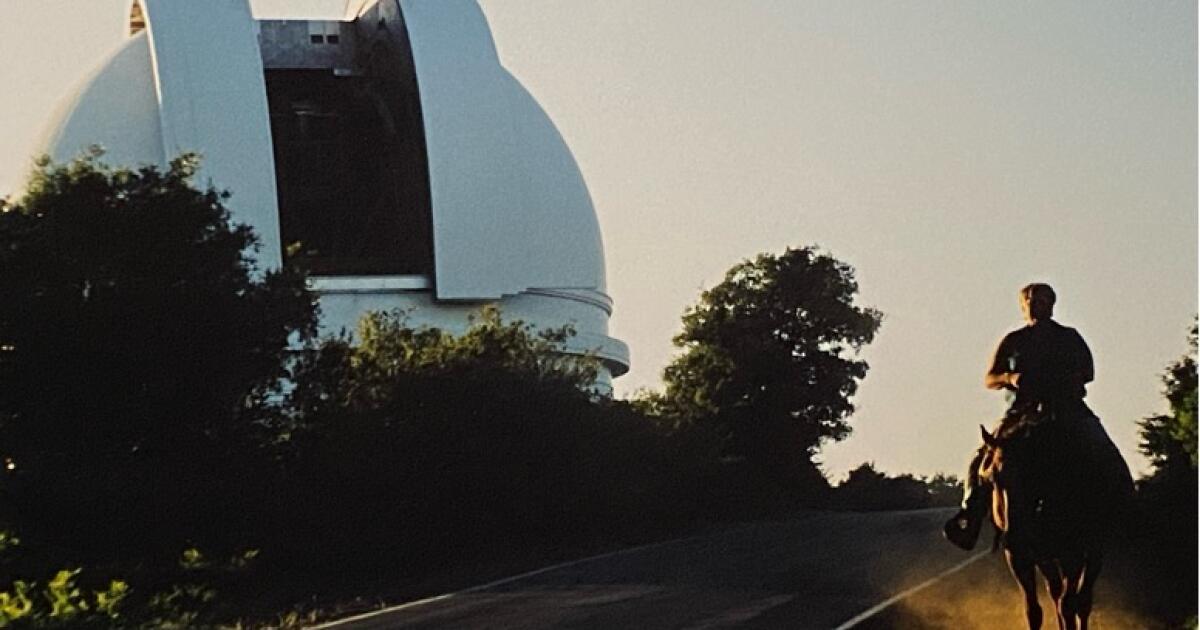
More times than she can remember, Jean Mueller stood on the catwalk of the 200-inch Hale Telescope at the Palomar Observatory scanning the night sky, trying to time the exact moment to close the dome.
An hour and a half northeast of San Diego, the Palomar Observatory is owned and operated by Caltech, and as telescope operator, Mueller was responsible for protecting its instruments from the weather. Inside the structure, a 200-inch mirror captured light from distant stars in a time window crucial to the observing astronomer’s research. But when a fog bank rolled closer, Mueller had to make the call.
“I would get the dome closed within a minute or two of the fog actually hitting it,” said Mueller. “We are vigilant for anything that might damage the mirror. You don’t want acid rain on the mirror because that’s going to eat the aluminum coating. Ash, combined with humidity, can be caustic.”
Mueller, a telescope operator at Palomar from 1985 to 2014, called her path to astronomy “nonstandard.” She had a graduate degree in library science and had worked as a librarian for USC for 10 years when she learned about a job opening at a different Southern California observatory: Mt. Wilson, near Pasadena, run by the Carnegie Institution of Washington. The role: collecting data and operating the 60-inch telescope.
Mueller had begun exploring astronomy by taking a four-week evening class at Griffith Observatory. Drawn to know more, she continued taking classes at USC and Rio Hondo College. As Mueller’s astronomy community grew, her friend Howard Lanning, an astronomer and telescope operator, encouraged her to apply for a position at Mt. Wilson Observatory.
“That was probably when my life changed,” Mueller said. “It had never occurred to me to leave my library job and pursue astronomy. I didn’t have an astronomy degree; I had just taken a handful of classes.”
Jean Mueller sits in front of the control panel of the 200-inch Hale Telescope at the Palomar Observatory.
(Kajsa Peffer)
For as long as she can recall, Mueller has loved the stars. She remembers one specific day in 1958, when she was just 8 years old:
“My brother and I were jumping on the bed, and he told me Halley’s Comet would be visible in 1985.”
Mueller was born in an era when major research telescopes throughout the country still excluded women. Since the early 1900s, although the Carnegie Institution employed women as “computers,” with few exceptions, they were not permitted to use its telescopes. Both Mt. Wilson and Palomar had named their astronomers’ quarters “The Monastery,” male retreats where women were barred from scientific conversations. The male-only housing later became a justification to routinely deny women access to these telescopes.
By the 1950s, women were only beginning to overcome gender barriers to gain access to the telescopes at the Mt. Wilson and Palomar observatories. From Margaret Burbidge to Vera Rubin to Nobel Prize winner Andrea Ghez, pioneering women astronomers built an intergenerational legacy of research and discoveries at Palomar that would transform understanding of the universe forever.
As the first female telescope operator on Palomar, Mueller supported their work, and generations of astronomers. With the expertise and technical training she gained on Palomar, she also began to make her own discoveries.
When Mueller was offered the Mt. Wilson job, she initially worried about the financial risk of changing careers and leaving 10 years of previous experience at USC. But during this time, she chanced to attend a lecture by author Ray Bradbury.
Mueller still remembers the words that led her to take the leap into astronomy. “Whatever you do,” Bradbury advised, “be sure it makes you happy.”
After operating the 60-inch telescope on Mt. Wilson for two and a half years and becoming the first woman to operate the observatory’s 100-inch Hooker Telescope, Mueller interviewed for a new job at Palomar. In 1985, she became the operator for the Samuel Oschin 48-inch telescope, making her the first female telescope operator at the Palomar Observatory. She would stay for 29 years.
“During her first year at Palomar, Mueller worked with Caltech staff astronomer Charles Kowal, who had successfully searched for solar system objects and supernovae. An expert in taking images and scanning the fragile 14-by-14-inch plates that captured data from Palomar’s telescopes during those years, Kowal taught Mueller critical techniques in the complex process.
“Charlie Kowal was the first person to tell me that transient objects like comets and asteroids needed to be identified in a timely manner,” Mueller said. She also learned from Alain J. Maury, a French photographic scientist for the Palomar Observatory Second Sky Survey (POSSII), who taught her astrometry techniques to record the location of celestial objects.
With the encouragement of Kowal and Maury, Mueller began scanning POSSII’s plates, looking for comets, asteroids and supernovae. Scanning involved moving the plate by hand beneath a stationary eyepiece.
“There was something unbelievably exciting about discovering a new comet in the sky,” Mueller said. “A real adrenaline rush.
Mueller learned to operate all three large telescopes on Palomar: the 200-inch Hale Telescope, where she was the senior operator for 15 years; the 60-inch telescope, and the 48-inch Samuel Oschin Telescope.
Over the course of her observational career, Mueller made significant discoveries of her own. Using the Samuel Oschin Telescope, she discovered 15 comets, 13 asteroids — seven of which are near-Earth objects — and 107 supernovae.
And when Comet Halley appeared in the skies in December 1985, Mueller was operating the 200-inch telescope on Palomar. At the time, it was the most powerful telescope in the world.


California researchers are leading a nationwide effort to find out why some Asian American communities have high rates of certain cancers.
It comes as health experts see rising rates of lung cancer among Asian American women who have never smoked and increasing rates of early-onset breast cancer.
“Asian Americans are actually the first racial and ethnic group for whom cancer is the leading cause of death,” said Scarlett Gomez, a cancer epidemiologist at UC San Francisco and a lead on the project.
UCSF joins researchers from UC Irvine, UC Davis, Cedars-Sinai and Temple University in launching a $12.5 million National Cancer Institute-funded study called the ASPIRE Cohort, that will follow 20,000 Asian Americans over time. Researchers say it’s the first large-scale longitudinal cancer study focused on Asian Americans.
Lung cancer incidence has declined across much of the United States as smoking rates have fallen. However, researchers have observed a slight increase among Asian Americans, despite relatively low smoking rates, particularly among women. More than half of Asian American women diagnosed with lung cancer are nonsmokers, they say.
Many existing studies of lung cancer risk among nonsmokers have been conducted in Asia, where exposure patterns can differ significantly from those in the United States, said Iona Cheng, a molecular epidemiologist at UCSF and also a lead on the project.
Researchers know that outdoor air pollution, secondhand smoke and cooking oil fumes can contribute to lung cancer risk. But it’s not clear if these explain disease patterns among Asian Americans in the United States.
Rising rates of breast cancer among Asian American women are also driving the push.
“Early onset breast cancer” — diagnosed before age 50 — “is going up the fastest among Asian Americans,” Gomez said. Recent data show rates among Asian Americans, Native Hawaiians and Pacific Islanders are approaching those of non-Hispanic white women, she said. Cancer experts don’t know why.
One of the central goals of the ASPIRE study is to move beyond treating Asian Americans as a single category. The term can include people with roots in dozens of countries from Sri Lanka to China’s border with Russia to Pacific islands, with completely different exposure patterns and cuisines.
“When we separate and look at all the distinct Asian ethnicities, we see a wide variation,” Cheng said.
Filipino women have a higher incidence of thyroid cancer, and stomach cancer has been more common among some Korean and Japanese people. Combining all Asian Americans into one category can make those differences impossible to detect.
The study also seeks to address longstanding gaps in representation. Although Asian Americans make up nearly 8% of the U.S. population, they have historically received little research funding.
Existing cancer studies have also often included too few Asian Americans to draw meaningful conclusions about specific ethnic groups, researchers said. Salma Shariff-Marco, a social and behavioral scientist at UCSF and also a lead on the projects, aid that has made it hard to show the need for more targeted research. The ASPIRE cohort, she said, is designed to show the variation by including a broader range of ethnic groups and more contemporary exposures than previous work.

Last summer, a NASA-funded asteroid impact warning system detected a mysterious object speeding through the solar system.
Scientists determined the object had entered the solar system from deep space, making it the third known object to have come from another star system.
NASA called it Comet 3I/ATLAS and said it didn’t pose a threat. But its discovery in July led to wild speculation that the object was a piece of extraterrestrial technology — maybe even an alien spacecraft.
The SETI Institute, a nonprofit that explores the origins of life and searches for extraterrestrial intelligence, said this week that a team of scientists had used a radio telescope to try to detect signals that could indicate extraterrestrial life on the comet.
But they found none.
“While observations strongly indicate that 3I/ATLAS is a natural object, interstellar visitors are also compelling technosignature targets because an artificial object — however unlikely — could represent detectable extraterrestrial technology and potentially provide the first evidence of life beyond Earth,” the institute said in a news release.
SETI scientists said they used the Allen Telescope Array at the Hat Creek Radio Observatory in Northern California to scan the object for seven hours, covering a spectrum of 1 to 9 gigahertz.
“This broad range allows scientists to search for narrowband radio signals, which are not produced in nature and would be evidence of technology,” the news release said.
The institute said the team identified nearly 74 million narrowband signals, but ultimately traced them back to technology on the Earth’s surface or orbiting satellites.
“The results from 3I/ATLAS show how realistic it is to detect a signal with the technology we have today,” said Valeria Garcia Lopez, one of scientists on the SETI team. “That is why it is important to keep searching for technosignatures, even from objects we might not expect to have signals.”
The institute said the researchers also can learn more about the natural properties of interstellar objects as they travel through our solar system.
“As more interstellar objects are discovered, each offers a new opportunity to probe the cosmos for technosignatures, advancing our understanding of both natural and possible technological phenomena beyond our Solar System,” the SETI statement said.
Science
Emergency room visits during heat waves available to the public in ‘near-real time’ in L.A. County

For the first time, Los Angeles County residents can see how many people are ending up in emergency rooms, their bodies pushed past the limit, during heat waves.
The county Department of Public Health says its new Heat-Related Illness and Mortality Dashboard will provide heat illness counts in “near real time,” which means weekly. That might seem like a lag, but until now the data were only provided upon request and in ad hoc reports.
Heat is the leading cause of weather-related death in the United States and heat waves are only getting more frequent and intense as the climate changes.
Public health experts called the tracker a meaningful step toward assessing how well county programs are addressing heat risks.
“It’s showing the county’s commitment to reducing the burden of heat on people’s health,” said David Eisenman, director of UCLA’s Center for Public Health and Disasters. “As the county puts more resources into that, this is a metric that allows the public to judge the effectiveness of the work.”
“There’s a handful of other places that also do this, but they’re all relatively new,” said Bharat Venkat, director of the UCLA Heat Lab, noting as examples Imperial and Riverside counties in California, Harris County in Texas and Maricopa County in Arizona. “It is very much welcome.”
The tracker takes heat illness data from patient complaints and doctor diagnoses provided by a countywide monitoring project that was previously available only to public health officials. The website says that what it provides is an undercount. The records often fail to count people when heat exacerbates more obvious health problems.
“Heat piggybacks off of preexisting health conditions,” Venkat said. “Say you go to the ER and you’re experiencing an intense psychotic episode, or a heart attack or a stroke. It’s very likely that the doctor is going to diagnose that as a psychotic episode, heart attack or stroke, and less likely that they’ll note that heat is contributing to that.”
Heat-related deaths are counted from death certificates, which present similar issues for undercounting. Those numbers will be reported monthly on the dashboard.
L.A. County has a recently approved heat action plan that aims to educate the public and reduce indoor and outdoor temperatures with strategies such as opting for shade and air conditioning.
The new tracker breaks down daily heat-related emergency room visits and deaths by age group, geography, and race and ethnicity.
It shows that people over 65 are more vulnerable to heat illness. For Black residents, heat is disproportionately fatal. And people in the San Fernando, San Gabriel, and Antelope valleys see the most heat-related emergency room visits.
Kelly Turner, a professor of urban planning at UCLA, stressed that heat sickness tracks closely with social inequality and is preventable.
“A heat death or heat illness is dependent on who you are and what assets you have,” Turner said. “If you have air conditioning or not, if you work outside or you don’t, all of those factors factor in.”
She noted that there is more risk in the San Fernando and San Gabriel valleys because of the combination of hotter days and more people who are unprotected. “When you map those two things on top of each other, you get a hot spot of vulnerability,” she said.
California already has a tool called CalHeatScore that uses historical hospital records and temperatures to forecast risk for different ZIP Codes in the state during heat events.
Public health officials hope to use the new dashboard to target messaging and public outreach when extreme heat strikes.
“If we’re having an extended heat event we can show that, ‘Hey, we’re having heat impacts’ as they’re happening,” said Dr. Nicole Quick, chief science officer at the L.A. County Department of Public Health.
Venkat said he would like to see the tool become more robust, in line with Maricopa County’s dashboard, widely viewed as the current gold standard for heat illness and mortality tracking. He said the Arizona county, which includes Phoenix, dives deeper into health records and conditions surrounding hospitalizations and deaths to better reflect the role of heat.
“They do scene investigations and send someone out to take notes about where the body was found,” Venkat said. “What was going on? Did they have air conditioning? Were they outside? Did they have access to water? What medications were they taking? All those things provide important context.”
Eisenman said he would like to see the county train physicians on recording heat-related illness, as it has been “clear for a long time” that doctors don’t make the diagnosis enough.
“It would have to be more than just a handout or a few slides. You’d really have to have each institution make some effort to change physicians’ behaviors,” Eisenman said. He added that it probably hasn’t been done because of the costs involved.
-

 Maryland7 minutes ago
Maryland Sen. Dalya Attar barred from using criminal case evidence in campaign
-

 Michigan10 minutes ago
Crews work to repair several water main breaks in Madison Heights
-

 Massachusetts15 minutes ago
Opioid deaths fall below 1,000 a year in Massachusetts
-

 Minnesota22 minutes ago
9 Offbeat Minnesota Towns To Visit In 2026
-

 Mississippi25 minutes ago
How Mississippi State baseball star Ace Reese got his name
-

 Missouri30 minutes ago
Missouri launches anti-trafficking app ahead of World Cup events
-

 Montana37 minutes ago
Senate race takes shape as Bankhead emerges from primary
-

 Nebraska40 minutes ago
Southeast Nebraska neighbors: Obituaries for June 6

