Science
The desperate hours: a pro baseball pitcher's fentanyl overdose


Not many victims of the opioid crisis in America make national headlines. Tyler Skaggs was different.
The 27-year-old was a professional athlete, a pitcher for the Angels, wealthy and famous. On a road trip with the team, he was found in his hotel room. He had choked on his own vomit after consuming a mix of alcohol, oxycodone and fentanyl.
His death on July 1, 2019, sent shock waves through the sports world. A highly publicized criminal investigation not only revealed that Skaggs had secretly used painkillers for years, but also led to the arrest of a team employee accused of providing him with tainted, black market pills.
Five years later, The Times has pored over hundreds of pages of court documents and cellphone records to reconstruct Skaggs’ final hours. Playing cards with teammates on a three-hour flight. Teasing rookies on the bus. Trading affectionate texts with his wife until late at night.
Even the most ordinary details tell an important story, offering an intimate look at an epidemic that has ravaged the country.

Tyler Skaggs pitches against the Oakland Athletics on June 29, 2019, two days before his death.
(Marcio Jose Sanchez / Associated Press)
Skaggs pitches at Angel Stadium against the Oakland A’s and is pulled after surrendering two runs in four-plus innings. CAA agent Nez Balelo texts to commiserate about “the quick hook … after cruising basically through 3 and 4.”
Skaggs is nothing if not dogged. At 6 feet 4 and 225 pounds, he has fought back from a string of serious injuries, refusing to quit, which might help explain his painkiller use. After the game, his mother, Debbie Hetman, a longtime softball coach at Santa Monica High, calls him and his wife.
“I didn’t FaceTime him because I was – we were super busy, so we just talked really quickly,” Hetman later testifies during the team employee’s trial. “I think he was in line at In-N-Out with Carli.”
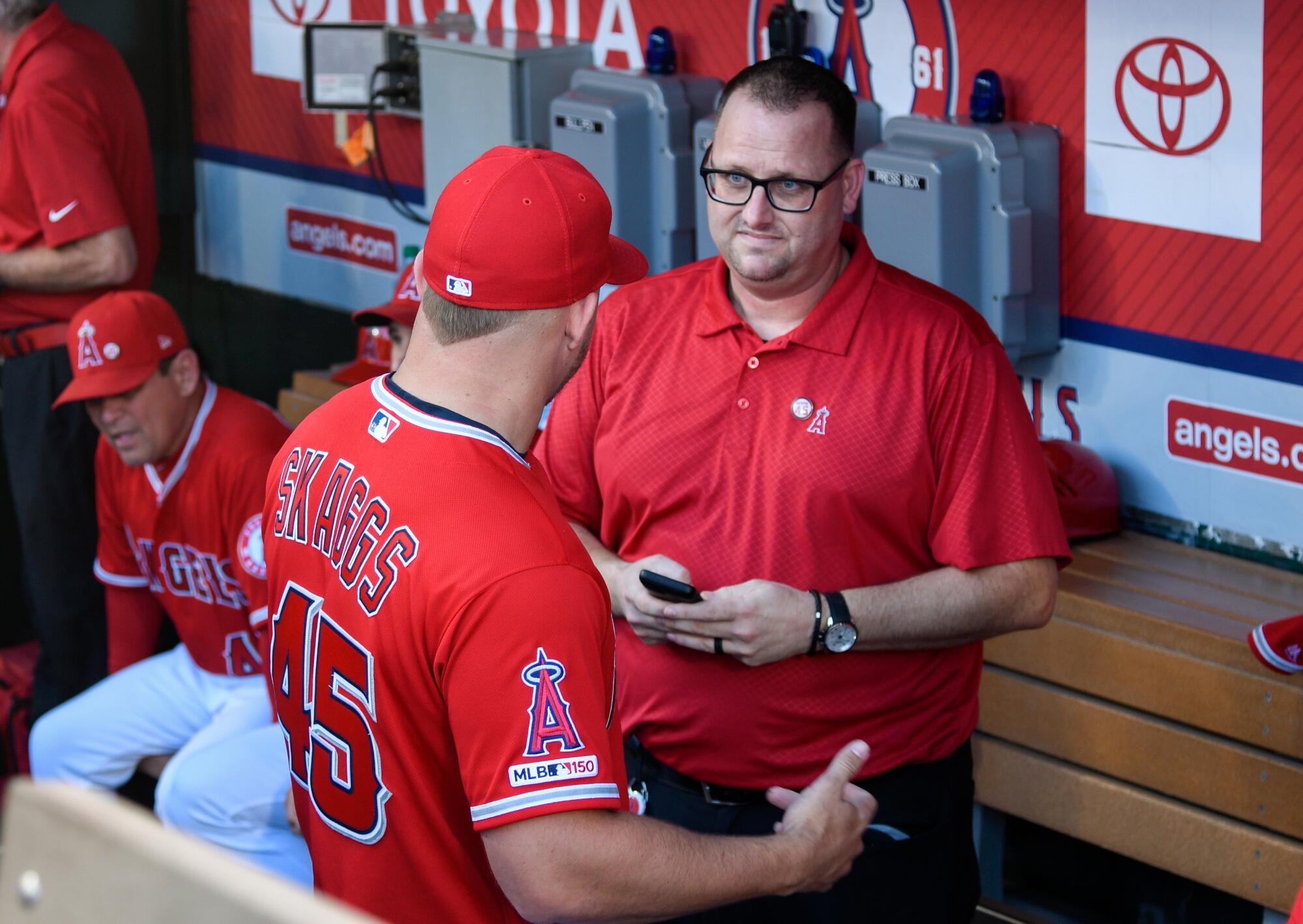
Mike Trout, wearing Tyler Skaggs’ number in his honor, speaks to Eric Kay in the dugout before a July, 12, 2019, home game against the Seattle Mariners.
( John McCoy / Getty Images)

(Animation by Kelvin Kuo/Los Angeles Times)
Shortly before a 1:07 p.m. game against the A’s, Skaggs receives a text from Eric Kay, the team communications director who for years has allegedly supplied him with “blue boys” — blue, 30-milligram oxycodone pills.
Kay: “Hoe [sic] many?”
Skaggs: “Just a few like 5”
Kay: “Word”
Skaggs: “Don’t need many”

4:25 p.m. Pacific Time
The Angels conclude their four-game home series with a 12-3 loss. It is a get-away day, meaning the team will head directly from the stadium to Long Beach Airport, where a charter plane waits for the start of the road trip.
Skaggs has previously asked his manager’s permission for the players to dress like cowboys for the flight to Texas. Before leaving the stadium, he meets his wife, Carli, so she can snap pictures of him in his black hat, bolo tie and boots.
“When did he buy that outfit?” a prosecutor later asks her during Kay’s trial.
“The day before.”
“Did you help him pick it out?”
“Yes.”
6:11 p.m. PT
Skaggs gathers with teammates on the tarmac beside a United Airlines charter plane for another photo to show off their Western wear. He hitches his thumbs in his belt like a cowboy. Seeing the picture on Instagram, Carli comments: “So cute”
8:07 p.m. PT
(Animation by Kelvin Kuo/Los Angeles Times)
With the Texas Rangers next on the schedule, the flight to Dallas Fort Worth International Airport lasts about three hours. Along the way, Carli texts to ask how things are going.
Skaggs: “Good gambling … losing”
Carli: “Damn babe … How much cool … Lol*”
Skaggs: “200 bucks … I’m winning now”
Carli: “Sweet”
11:06 p.m. Central Time
On the 15-minute ride from the airport to a Dallas-area hotel, Skaggs grabs a microphone at the front of the bus.
“So, he would have been kind of like emceeing, doing the music,” teammate Andrew Heaney later testifies. “You know, we would call younger guys up, ask them, you know, embarrassing questions or make them tell a funny story or whatever it may be, make them sing a song, something like that.”
Throughout the league, Skaggs is known as friendly, funny, eminently likable. Teammate Mike Trout later says: “The energy he brought to a clubhouse … every time you saw him, he’s just picking you up.”
11:25 p.m. CT
The Angels arrive at the Hilton Dallas/Southlake Town Square, where players receive key cards to their rooms and peruse a table of snacks, protein bars and Gatorade. A friend invites Skaggs to go out, but the pitcher remains in his room.
11:47 p.m. CT
(Animation by Kelvin Kuo/Los Angeles Times)
Skaggs texts his room number to Kay.
“469,” he writes, adding: “Come by”
“K,” the communications director responds.
Kay had used opioids enough to know black market oxycodone pills might be laced with dangerous drugs such as fentanyl, a synthetic opioid 50 to 100 times more powerful than morphine. In a jailhouse call recorded after his trial, he denies giving drugs to Skaggs that night, saying he visited the pitcher to talk about something else.
“I guess he hated the rookies or something — and he was one flight up so I flipped my door and went up,” he says.
The hotel does not have security cameras in the hallway, so it is unclear how long Kay spends in room 469.

12:02 a.m. CT
(Animation by Kelvin Kuo/Los Angeles Times)
Skaggs texts with teammate Ty Buttrey. He then trades messages with his wife.
Skaggs: “Miss you babe”
Carli: “Miss u too”
When the two met in 2013, Skaggs reportedly fell hard. Now, they have a house and are thinking about kids. They text continually when the Angels are traveling.
12:42 a.m. CT
“What u Doin,” Carli asks.
No answer. She tries again: “Helllooooo.”
1:09 a.m. CT
It is late in Dallas — two hours later than Los Angeles — and Carli is still waiting for a “goodnight” from her husband. She writes: “U know better than to get drunk and fall asleep without texting me”
Approx. 12:53 p.m. CT
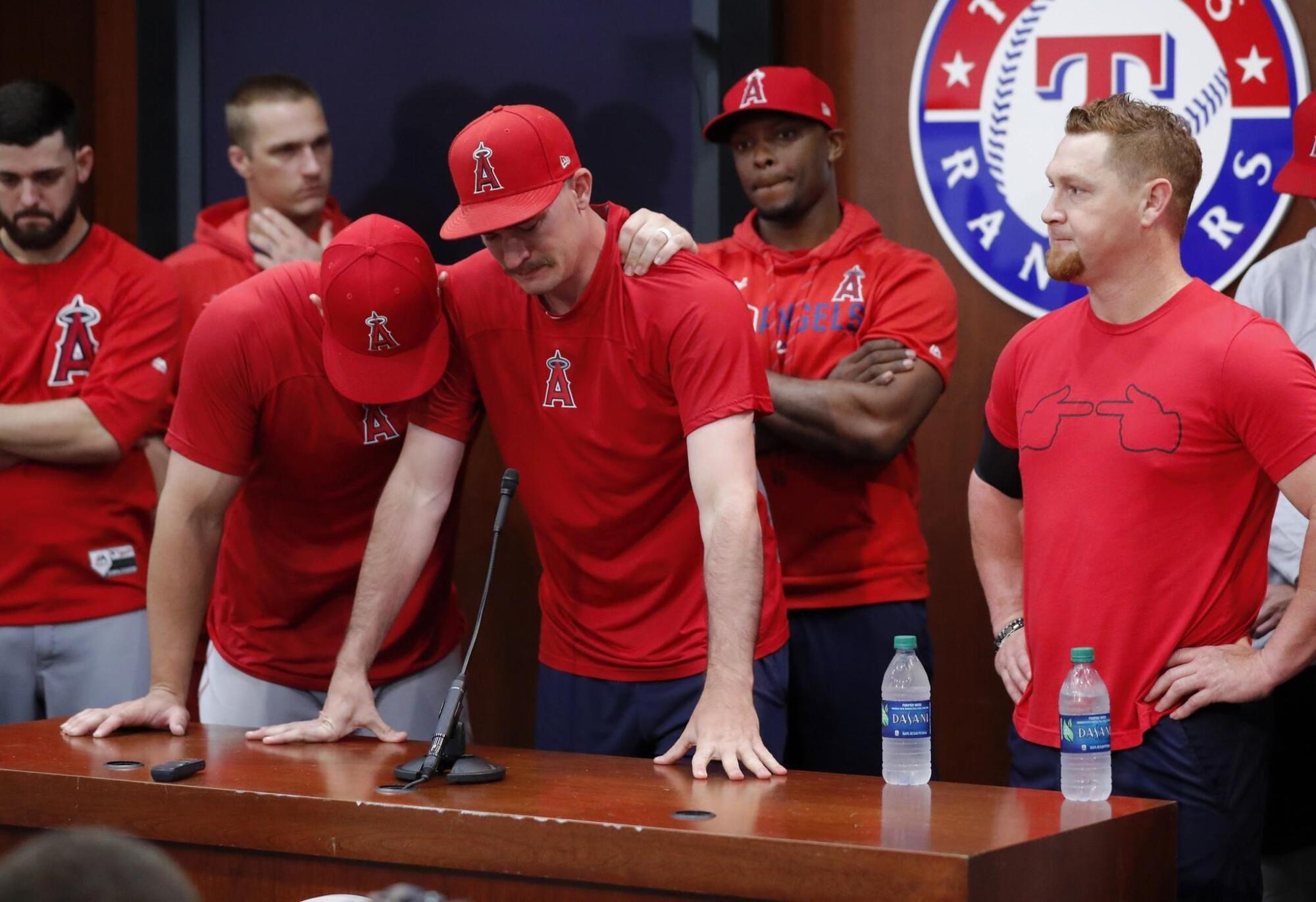
Angels’ Mike Trout, left, embraces Andrew Heaney, who fights back tears as he answers questions about their late friend and teammate Tyler Skaggs.
(Tony Gutierrez / Associated Press)
The night passes, followed by morning, and still no word from Skaggs. Heaney texts him: “Lunch?”
After a few minutes, Heaney stops by room 469. Light shines from under the door; the curtains must be open in there. Nearby, hotel workers are noisily cleaning a carpet. Heaney wonders how anyone could sleep through all this.
When his knock gets no response, he goes back to his room and tries calling Skaggs on the hotel phone.
1:49 p.m. CT
Tom Taylor, the Angels traveling secretary, is having lunch with Kay at a nearby barbecue joint and recalls Carli texting him. Heaney also reaches out to Taylor.
“He hadn’t heard from him either,” Taylor later testifies.
More than 12 hours after Carli’s last exchange with her husband, she messages again: “You have a drinking problem. I’m about to text tom Taylor.”
Carli later insists these words were sent “purely out of anger” with “no truth to it.”
Irritation gives way to another emotion. Carli contacts Skaggs’ mother, Hetman.
“She was really nervous,” Hetman later testifies. “I was really nervous because it was very unusual not to hear back from Tyler. Tyler was very good about returning text messages.” Hetman dials his number, and it sounds as if the call goes directly to voicemail. Her husband, Dan Ramos, sends a text:
“Hi kid. How r u doing. How is life treating u. How is your arm feeling”
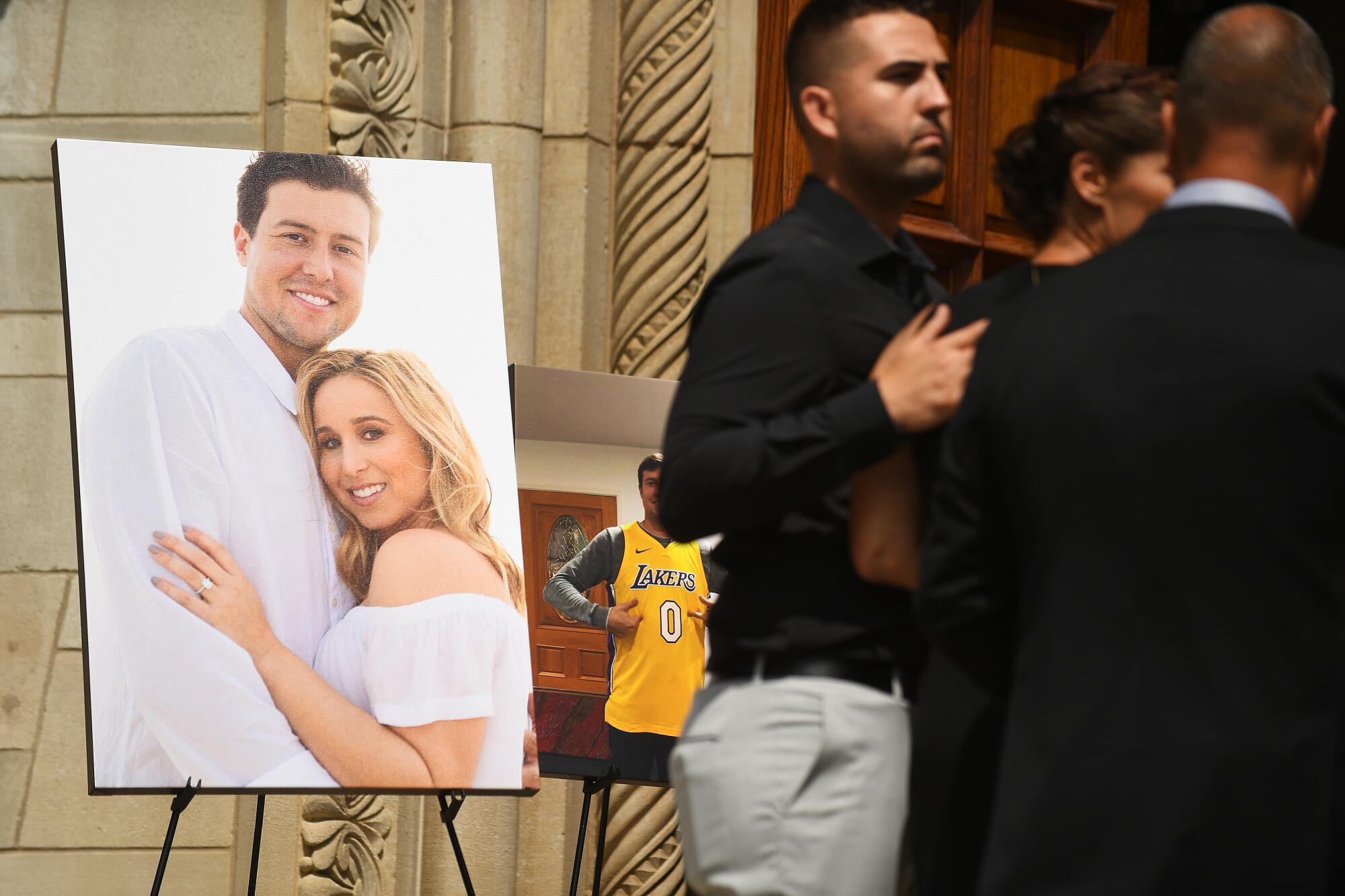
A photo of Tyler Skaggs and his wife, Carli, is displayed outside a memorial service for the Angels pitcher in 2019.
(Christina House / Los Angeles Times)
2:04 p.m. CT
Now Hetman tries texting: “Hey Ty Are you okay today?”
Around the same time, Taylor returns to the hotel and knocks on Skaggs’ door. He then summons Chuck Knight, one of the team’s security men, and they ask hotel management to let them into room 469.
A former Anaheim Police Department officer, Knight enters the room alone, staying less than a minute. Taylor later recalls him emerging with “a shocked-looking face, almost like, it’s not good, what he saw.”
2:16 p.m. CT
Knight calls 911. Asked later about what he encountered in the room, he testifies: “I saw two legs hanging off the end of the bed in a position that I thought was unusual for someone that might be sleeping … I walked closer in an attempt to obtain a pulse. I reached down to grab his wrist and noticed that his skin was very cool to the touch. I did not obtain a pulse.”
Heaney, who is getting messages from Carli, returns to the hallway outside room 469. Taylor tells him: “It’s not good.”
“I knew what was going on, but his wife didn’t,” Heaney later testifies. “And she was texting me, so it was — I just felt like I wanted her to know what was going on.”
He decides not to answer.
A call crackles over the scanner: “Medic 4-1, truck 4-1 respond. Medical emergency, Hilton Southlake Town Square.” The dispatcher adds: “It’s gonna be … a possible death investigation. PD is arriving on scene now.”
A Southlake police officer finds Skaggs’ room looking mostly undisturbed — the bed still made, a backpack and another bag on the couch, unopened beers on the coffee table. There is a white, “almost chalky” substance on the desk. Skaggs’ cellphone lies near his head.
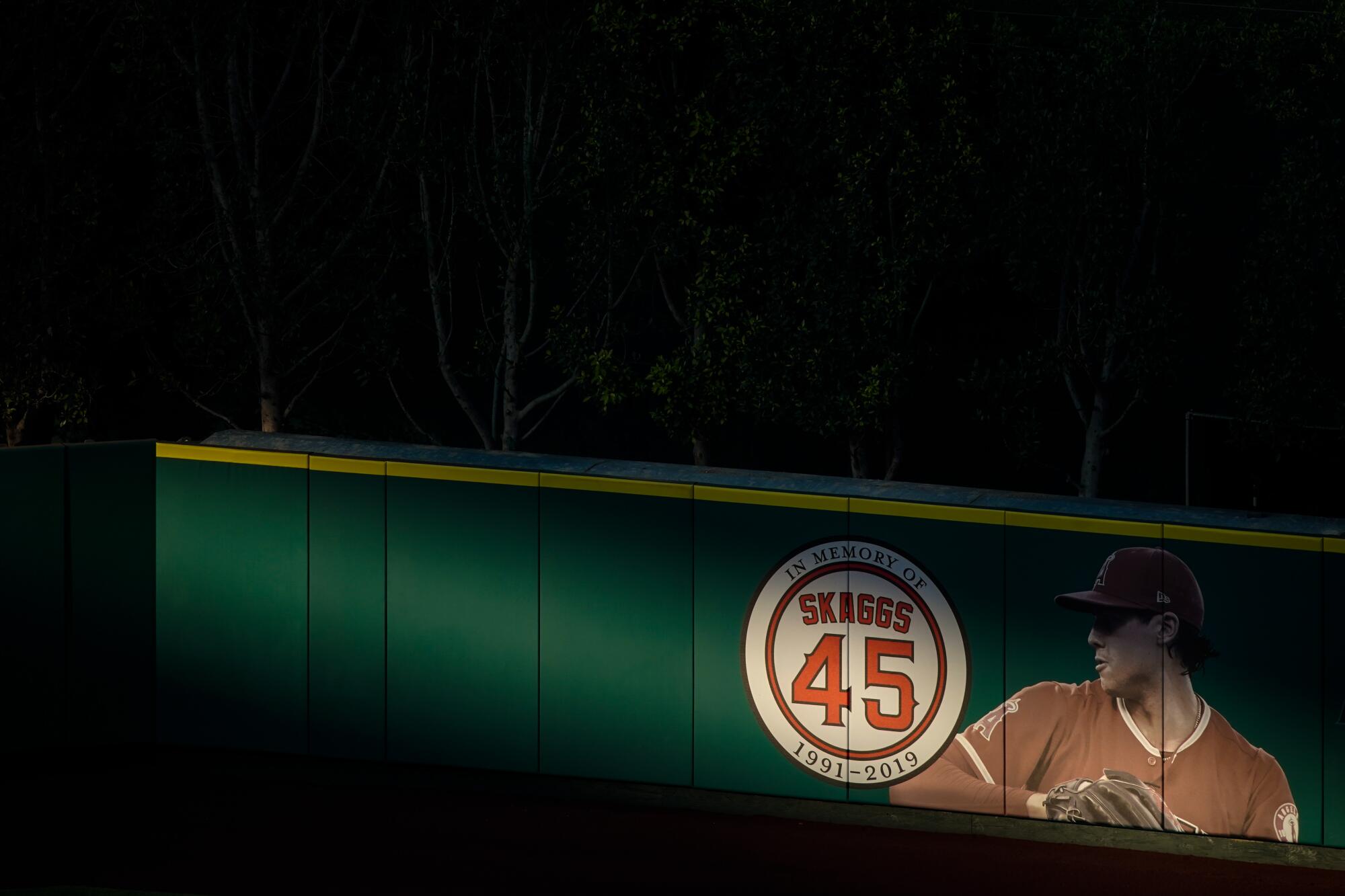
A memorial for Tyler Skaggs on the outfield wall at Angel Stadium.
(Los Angeles Times)
2:23 p.m. CT
Cory Teague, a Southlake Fire Department paramedic, arrives at room 469. His medical supplies include Naloxone, which can be administered to reverse the effects of opioid overdose.
“Did you use it?” a prosecutor later asks at trial.
“No.”
“Why not?”
“The patient had signs incompatible with life, unable to be revived.”
3:05 p.m. CT
Carli’s phone rings as she pulls up to her parents’ house in Santa Monica. It’s Billy Eppler, the Angels’ general manager. “I’ll never, ever forget that call,” she later says. She dials Hetman, who is at her Los Angeles home, and breaks the news. Hetman later recalls “crying and yelling and screaming.”
Buses are scheduled to take the Angels to their evening game. Instead, players and staff are told of Skaggs’ death and shepherded into a hotel banquet room where police take statements.
“The questions that we asked were generic for each player and employee,” Cpl. Delaney Green of the Southlake Police Department later testifies. “And it was along the lines of: When was the last time that you had seen or spoken to Tyler Skaggs? Had you seen him consume any alcohol on the plane? And did you know of any drug use that you were aware of?”
Kay is among those interviewed. He tells police that Skaggs was drinking on the flight to Texas but adds, “I didn’t think he had a lot.” He says he last saw the pitcher when they collected their room keys in the lobby.
3:52 p.m. CT
The Times and other news agencies report Skaggs’ death on social media. Family members call his mother at home. She later testifies that “before I could even talk to anybody, that whole — everything was like blowing up and it was super-crazy.”
4:11 p.m. CT
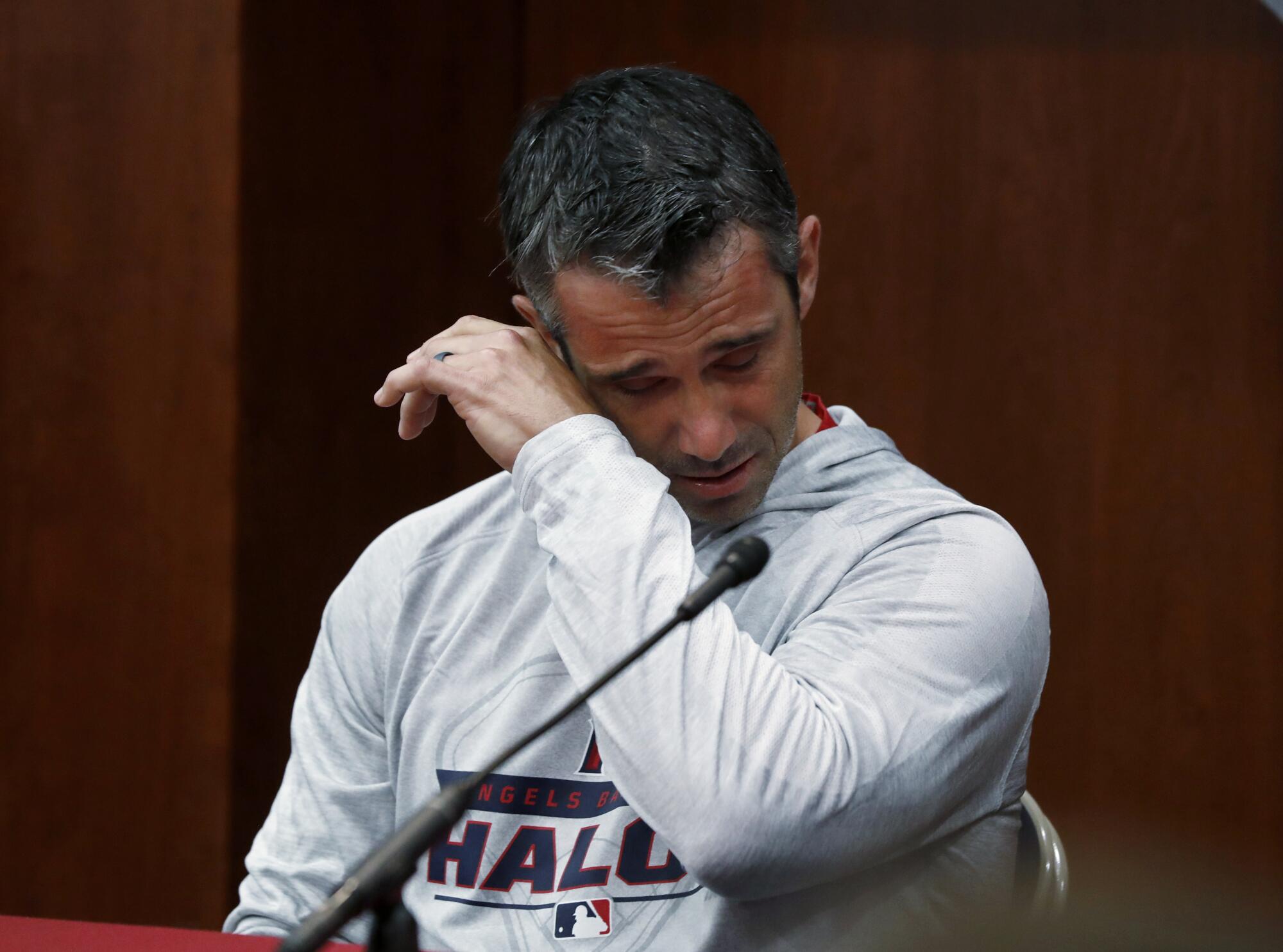
Angels manager Brad Ausmus speaks at a 2019 news conference about Tyler Skaggs’ death.
(Tony Gutierrez / Associated Press)
The Rangers announce the postponement of that night’s game as the Angels switch to another hotel. The team gathers for an emotional meeting. “We were able to talk about Tyler and laugh at some of the stories and some of the goofy things he did, listen to some of his music,” manager Brad Ausmus later says before breaking down.
On social media, players from around the league post messages.
“RIP to my longtime friend and Little League teammate,” then-St. Louis Cardinals pitcher Ryan Sherriff writes. “i love you brotha.”
About 8 p.m. CT
Carli and the Skaggs family board a flight to Texas.

About 10 a.m. CT
Carli and the Skaggs family visit the medical examiner’s office in Fort Worth. She later recalls kissing her husband’s cold lips as he lay on a gurney.
11:10 a.m. CT
The medical examiner begins an autopsy. He will eventually determine that “alcohol, fentanyl and oxycodone intoxication” caused Skaggs to choke on his own vomit.
Later that morning, Carli and the Skaggs family arrive at the Southlake police station to retrieve his luggage, iPad and other belongings.
In words that underscore the anguish of losing a loved one to opioids, Hetman later testifies: “I was angry because I knew that my son loved life and he did not want to die. He did not know that there was poison in that pill that cost him his life.”
About 5:30 p.m. CT
Team officials hold a news conference with Kay standing quietly to the side, hands clasped at his waist. At one point, he appears to take a deep breath, look toward the ceiling and exhale.
7:05 p.m. CT

Teammates place jerseys with Tyler Skaggs’ number 45 on the mound at Angel Stadium at their first home game after his death.
(Kent Nishimura / Los Angeles Times)
The game against the Rangers proceeds as scheduled. The ballpark is eerily quiet, with the home team forgoing the usual walk-up music.
The Angels, wearing black No. 45 patches on their jerseys, score early and cruise to a surprising 9-4 victory, but Trout says: “All I was thinking about was Tyler. It was just a different feeling, you know. Just shock.”

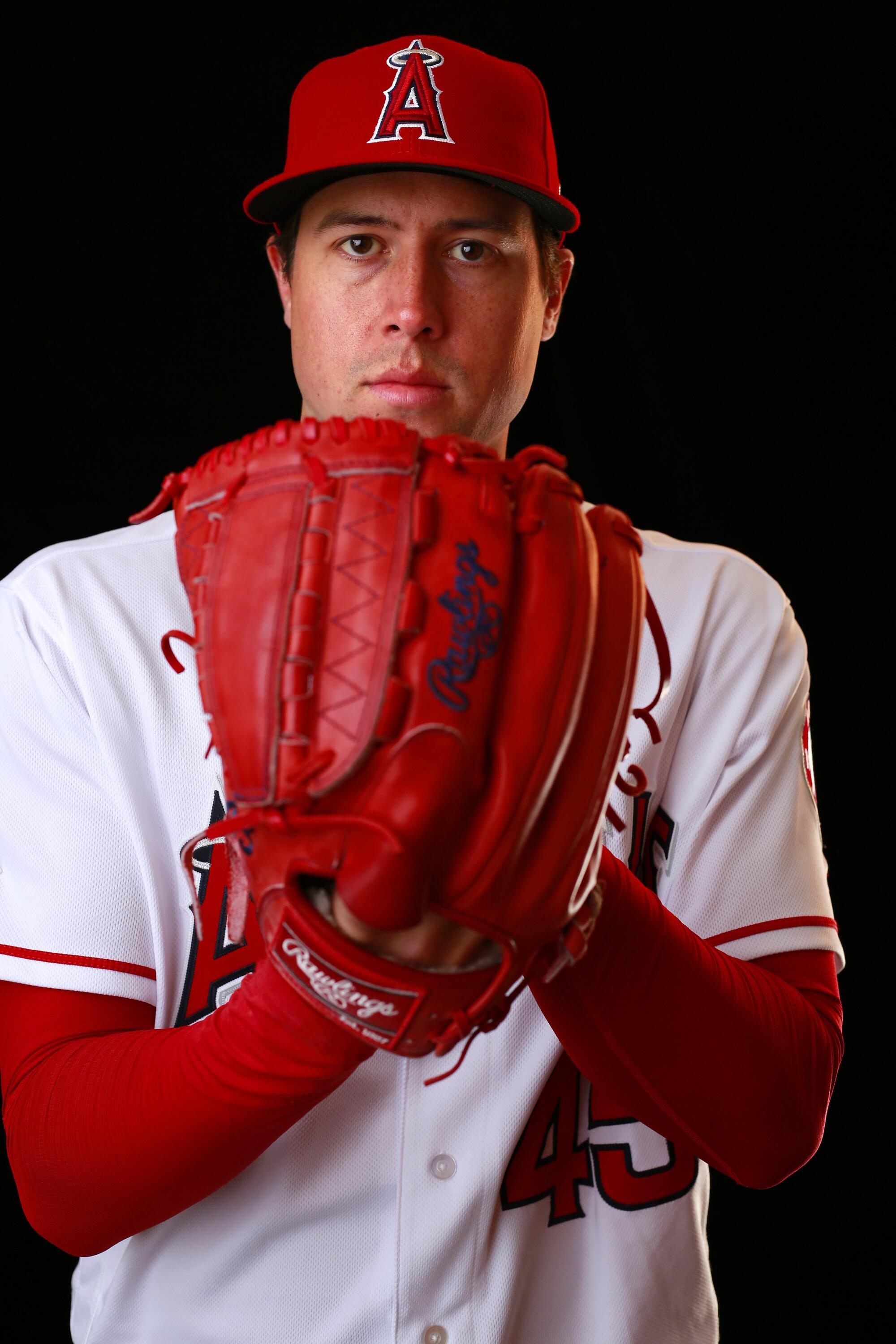
Angels pitcher Tyler Skaggs died of an overdose in a hotel room on July 1, 2019.
(K.C. Alfred/San Diego Union-Tribune)
Federal prosecutors charged Kay with distribution of a controlled substance resulting in death and conspiracy to possess with intent to distribute controlled substances. A trial began in February 2022.
“This was a case of one, one person who went up to that room on June 30,” a prosecutor said in court. “One person who went into that room and gave Tyler Skaggs fentanyl.”
The jury deliberated less than 90 minutes before returning a guilty verdict on both counts.
At a hearing where the judge sentenced him to 22 years in federal prison, Kay — who didn’t testify during trial — apologized to his family for the “disgrace and embarrassment” he had caused them.
Privately, however, he continued to profess innocence. In a recorded jailhouse call, he told a friend: “The worst thing, though, is that text that he sent me … because I didn’t know what he wanted. I had no idea. In my head, I think he thought I already got more [pills] for him but I told him they were going to be s—.”
By then, the Skaggs family had filed a wrongful-death suit against the Angels. The team has denied wrongdoing, and the case continues.
In the five years since Skaggs died, opioid overdoses — fueled by illicitly manufactured pills — have claimed hundreds of thousands of American lives.
The Substance Abuse and Mental Health Services Administration has a 24-hour helpline for individuals and families facing mental and substance abuse disorders. The number is (800) 662-HELP (4357).


new video loaded: NASA Announces Artemis III Crew
transcript
transcript
NASA Announces Artemis III Crew
NASA announced the crew of Artemis III mission, which will fly to low-Earth orbit to test rendezvous and docking maneuvers with one or two lunar landers.
-
“I am excited to welcome you as the next crew in the Artemis journey to successfully return to the moon — this time to stay.” “I’m honored by the role that I’ve been given. I’m also very humbled by the task in front of us. But first and foremost, I’m grateful.” “So with that, the Artemis II crew, comrade, hands you the baton. You got the controls.” “As you know, we had a significant anomaly at our Launch Complex 36A on May 28. We’ve redoubled our efforts and are moving forward.”
By Alisa Shodiyev Kaff
June 9, 2026
Science
Santa Monica Mountains’ last steelhead trout survived the Palisades fire — and even had babies

Scientists feared the Santa Monica Mountains’ last remaining steelhead trout were dead, smothered by debris flows unleashed by the Palisades fire.
But the endangered fish surprised them: A team of biologists recently spotted 30 of the rare trout — and 21 babies — in Topanga Creek.
“There was a lot of happy dancing in the creek,” said Rosi Dagit, principal conservation biologist for the Resource Conservation District of the Santa Monica Mountains, which works with public and private landowners to conserve natural resources.
That’s because the steelhead here are endangered, at both the state and federal levels. Once, they swam in most streams of the Santa Monicas, but their numbers plummeted amid overfishing and coastal development. Increasingly frequent wildfire has further stressed their habitat. Topanga Creek, a biodiversity hot spot, is home to their last known population in the mountains that stretch from the Hollywood Hills to Point Mugu in Ventura County.
The trout that were spotted, including this one, are part of a distinct Southern California population that’s listed as endangered at the state and federal levels.
(RCDSMM Stream Team)
The California Department of Fish and Wildlife spearheaded a complex mission to rescue trout threatened by the Palisades fire that sparked in January 2025.
Time was of the essence. The fire hadn’t yet been fully contained. But rain was on the way, which would sweep massive amounts of sediment from the denuded hillsides into the water. Fish are often killed this way.
Crews stunned the fish with electricity, scooped them up in buckets, trucked them to a hatchery and ultimately moved them to Arroyo Hondo Creek in Santa Barbara County.
Within days, Topanga Creek was choked with mud. Some assumed the fish left behind were goners.
But in March, the conservation district’s team found four. The following month, when water conditions were clearer, they saw more.
“These fish continue to amaze me,” said Kyle Evans, environmental program manager for the state Department of Fish and Wildlife, who had seen the damage to the creek. “I had seen populations get wiped out in similar situations. So when I heard, I was thrilled.”
Evans surmises the fish that survived were in an area of the creek where less charred material and sediment were swept in.
“These fish likely hunkered down, were hiding under some rocks or places to try to get away from the main concentration of flow,” he said. “And luckily they weren’t buried.”
The ones that were spotted were fairly small, around 6 to 14 inches. Rainbow trout and steelhead trout are the same species, but with different lifestyles. If the fish remain in freshwater, they’ll be considered rainbows. However, they can migrate to the ocean and become steelhead, where they typically grow larger before returning to their natal waters to spawn.
Topanga Creek hasn’t fully recovered from the damage it sustained, but scientists say it’s looking better. Surveys last year were “so depressing,” Dagit said, with very few animals, and stretches that were essentially transformed into flat roads from all the sediment buildup. Some of the riparian canopy burned right down to the creek.
Then came 32 inches of rain over the last nine months, scouring out and moving sediment, creating deeper pools. Dagit said they recently found newt egg masses for the first time in years, as well as a few adult newts and many frogs. Plants that provide cover are starting to recover.
She provided photos comparing certain pools last year and this year, some dramatically transformed. In September 2025, the Shrine Pool could have been an overgrown hiking trail. This April, it was filled with shallow water.

The Shrine Pool in September 2025, left, and the same location in April 2026, right, with RCDSMM’s Isaac Yelchin donning a wetsuit.
(RCDSMM Stream Team)
Topanga Creek is home to another endangered fish, the small but hardy northern tidewater goby, often described as cute. Not long before the trout operation, Dagit led a rescue of hundreds of these fish too. Many were repatriated to the lagoon at the mouth of the creek in a moving ceremony last June.
There’s still the matter of what to do with the trout that were moved to Santa Barbara County last year. Evans would like to bring them home to the Santa Monicas at some point, but isn’t sure if it will happen. On one hand, they could bolster the small, genetically isolated surviving population. On the other, they might inadvertently bring in a disease or bacteria. There is some time to decide. Evans estimates the creek still needs to recover for two to three more years.
For now, the fish are functioning fine in their adopted creek. Experts worried the trauma wrought by the move would disrupt their spawning process, but they had babies that spring. This year, they spawned again.

The Pacifica Municipal Pier was shut down and taped off Thursday after city workers noticed cracks running through the landmark structure and concrete chunks falling into the ocean.
It’s just one of many coastal California structures that have recently crumbled under pressure from a rising and relentless ocean.
Officials from the small, beach city south of San Francisco said the pier was closed due to “cracking, separation, and displacement of the concrete walkway and structural elements.”
It will stay closed while structural engineers asses its safety.
Photos taken by city employees show a wide crack that runs from top to bottom and across the structure as well. Other photos show a large horizontal crack under the foundation of a small restaurant on the pier, the Chit Chat Cafe.
The cafe was also shut down.
This is not the first time the 53-year-old pier has shown signs of stress. In 2021, part of it was shut down after handrails along the edge collapsed. And in 2023, after a series of storms pummeled the Central California coast, damaging parts of the pier, the structure was partially closed for more than year.
Those same storms caused extensive damage in Aptos and Capitola, 70 miles south, where piers and waterfront infrastructure were swept away or damaged.
In 2024, a 150- to 180- foot section of the Santa Cruz wharf was ripped off by powerful waves.
At least 10 of the state’s dozens of coastal public piers were closed for part or all of 2024 due to structural damage sustained in winter storms since 2022. At least five others have longer-term upgrades planned to address structural issues.
“These things are costly to maintain,” said Zach Plopper, senior environmental director at Surfrider. “They are a part of our California coastal culture in many ways, but we’re going to need to reckon with, one, the state that they’re in, and two, the continuous and worsening threats they’re going to experience,”
He said most of the piers were constructed in the early 1900s, and they weren’t built to withstand decades of rough seas, storms and rising sea level.
“With this incoming El Niño, which is forecasted to be significant, and this marine heat wave we’re in the midst of, we’re kind of in uncharted waters as far as what this winter could bring in terms of storms and swells to the California coast, and we’re likely going to see a lot more damage,” he said. “Not just piers, but roads and other coastal infrastructure up and down the state.”
There was no storm in Pacifica earlier this week, so no single event could be blamed for the destruction.
However, a 2025 report from an outside engineering firm, GHD, found that several sections of the pier were in “poor” or “serious” condition, and they recommended closure before anticipated storms or events that could “subject the piles to high winds, swells and large waves.”
The firm found several areas of the pier where concrete was missing and rebar was exposed and corroding.
“The pier has continued to experience high winds and large waves in a harsh marine environment,” the engineers wrote in the report, noting that continuous exposure to seawater or marine spray was “detrimental” to the structure.
A 2023 city report estimated it would cost $19 million to repair.
That same year, a state law was enacted to require local governments along the California coast to plan for sea level rise in the coming decades.
Sea level has risen some 8 inches, on average, along the coast in the past 150 years, Plopper said, and researchers anticipate another foot in the next 25 years.
“We’re going to see profound shifts on our coastline, none that we have ever experienced before, and building static structures on the coast just doesn’t work all that well,” he said. “We’re going to have to make some really hard decisions.”
-

 New Jersey7 minutes ago
New Jersey Food Council kicks off nationwide search for new CEO
-

 North Carolina9 minutes ago
4 charged after massive party in Alamance County ends with gunfire, stabbing, fights
-

 New Mexico9 minutes ago
The Battle of Socorro, New Mexico and the Uprising Against AI Data Centers
-

 North Dakota22 minutes ago
North Dakota election results: Latest on US House primary race
-

 Ohio25 minutes ago
$150,000 funding to be voted on for the Lisbon pool
-

 Oklahoma36 minutes ago
Oklahoma primary election guide for Bartians
-

 Oregon40 minutes ago
‘Changed my life’: Portland man warns of Facebook Marketplace dangers after robbery leaves him injured
-
 South-Carolina45 minutes ago
Evette and Wilson advance to runoff for South Carolina governor while Graham clinches nomination

