Science
Researchers discover thousands of nanoplastic bits in bottles of drinking water

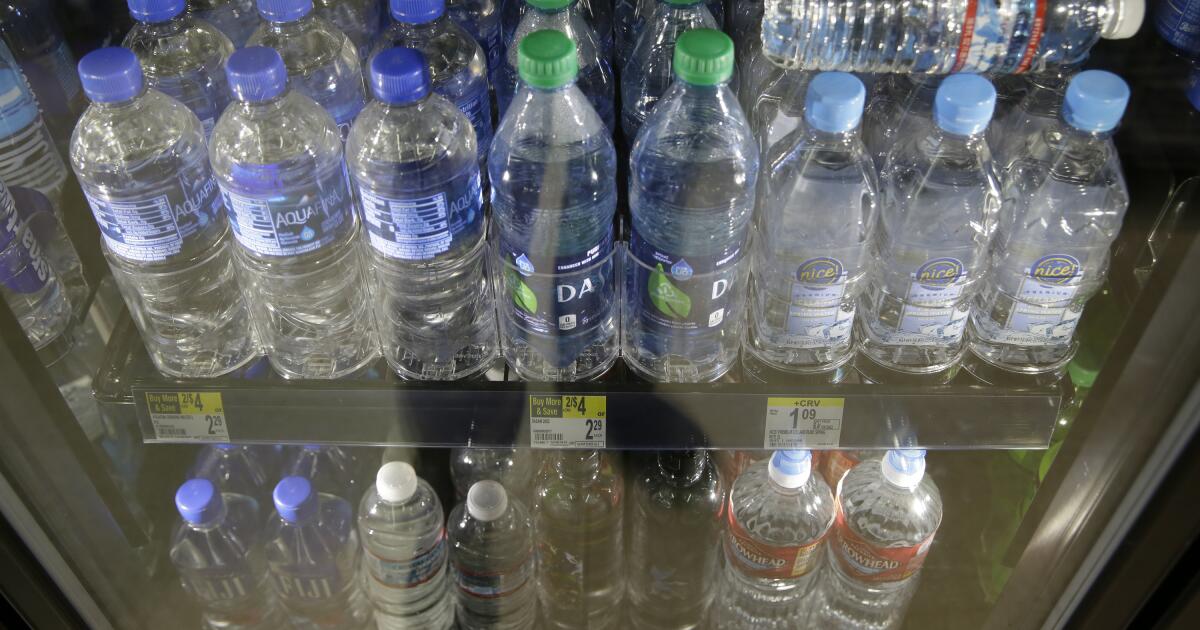
It seems anywhere scientists look for plastic, they find it: from the ice in Antarctica, to the first bowel movement produced by newborn babies.
Now, researchers are finding that the amount of microscopic plastics floating in bottled drinking water is far greater than initially believed.
Using sophisticated imaging technology, scientists at Columbia University’s Lamont-Doherty laboratory examined water samples from three popular brands (they won’t say which ones) and found hundreds of thousands of bits of plastic per liter of water.
Ninety percent of those plastics were small enough to qualify as nanoplastics: microscopic flecks so small that they can be absorbed into human cells and tissue, as well as cross the blood-brain barrier.
The research, which was published Monday in the journal Proceedings of the National Academy of Sciences, raises new concerns about the potentially harmful health effects — and prevalence — of nanoplastics. The researchers found that the quantity of such particles was 10 to 100 times greater than previously estimated.
“For a long time before this study, I actually thought that what was inside bottled water [in terms of] nanoplastics was just a few hundred PET particles,” said Naixin Qian, a Columbia chemistry graduate student and the study’s lead author. “It turns out to be much more than that.” PET, or polyethylene terephthalate, is a type of clear plastic that is commonly used for single-use water bottles.
Microplastics — particles that range from 1 micrometer to 5 milimeters in size — have been documented in bottled and tap water for several years. But the identification of nanoplastics — particles that measure just billionths of a meter — is raising alarms.
The incredibly small size of nanoparticles allows them to behave differently than larger pieces of matter, said Beizhan Yan, a Columbia environmental chemist and a co-author of the study.
Pollutants and pathogens can be carried on the surface of a particle, and the smaller a particle gets, the larger its surface area-to-volume ratio becomes.
As a result, Yan said, “even if they’re not that toxic at a larger particle size, when they become smaller they become toxic, because they can interfere in the cells, in the tissues, inside of the organelles.”
Research on the effects of plastic on human health is still in its infancy. It’s only been recently that scientists have identified the presence of plastics in people’s bodies and organs.
But research on other animals suggests a strong, negative influence on health. In laboratory studies of fish and rodents, microplastics were shown to interfere with development, reproductive ability and health, gut health, hormone levels, immune responses, the heart and more.
Study authors used a new type of microscope that can image the vibration of molecules to analyze the nanoparticles against a library of seven common plastics. They were unsurprised to find tiny bits of PET, as that’s what the bottles were made of. However, the amount of PET was dwarfed by the amount of polyamides, a form of nylon used in the reverse osmosis filters that water is run through before bottling.
Other plastics confirmed in the water in microscopic quantities include polystyrene, polyvinyl chloride and polymethyl methacrylate, also known as plexiglass. But only 10% of the nanoparticles analyzed could be classified as one of those seven known plastics, the researchers found. The origin of the rest is unknown.
During the past several years, researchers have identified microplastics from the deepest oceanic waters to the snowy tops of the planet’s highest mountains. They’ve found it in human blood, lung tissue and in the brain, and in organisms ranging from worms and zooplankton to whales and polar bears.
In some cases, the particles are ingested with food and water. In other cases, they are inhaled — scientists have found them in outdoor and indoor air, as well as in clouds — or absorbed through the skin.
The laundering of synthetic clothing and the breaking down of automobile tires are two of the largest sources of airborne plastics.
“As people, we are in environments where plastic is everywhere,” Yan said.
There’s also evidence that these small particles bioaccumulate, or grow more concentrated as they move up the food chain from one organism to the next.
Though the Columbia study didn’t analyze samples of tap water, previous studies looking at microplastics have found much lower concentrations of those particles in tap water than in bottled water.
Food packaging is also a known source of plastic contamination in food. On Jan. 4, Consumer Reports released the results of its investigation into plastic chemicals in common processed foods widely available in the U.S.
Plastic chemicals and nanoplastics “are part of the same problem, but they’re two totally different animals,” said James E. Rogers, a microbiologist who is acting director of product safety at Consumer Reports. “One is a chemical and one is a physical piece, even if it is micro-sized.”
Of the 85 food products tested, 84 had traces of phthalates, the most common type of chemical used to make plastic more durable. Nearly 80% of the foods contained bisphenols, another industrial chemical.
Both phthalates and bisphenols are known endocrine disruptors, meaning they interfere with the body’s hormonal systems. Exposure to these chemicals over time is associated with higher risks of diabetes, obesity, cancers and fertility problems, Rogers said.
“You may not be able to get to zero exposure, but at least you can reduce your risk by reducing your exposure,” Rogers said. “Cut out the fast food. Eat less processed foods. Eat less fatty food.”
Now that they’ve grossed us out about bottled water, the Columbia team are looking at how else they can use stimulated Raman scattering microscopy to seek out nanoplastics in other areas of life.
One project looks at the nanoplastics in exhaust and wastewater from commercial and residential washers and dryers. A pair of British adventurers currently trekking across Antarctica are collecting samples of snow for the team to analyze. The Columbia team is also collaborating with other research institutions to measure nanoplastics in human tissues and try to understand their effects on health.
And a group at the University of Waterloo, in Canada, are using artificial intelligence to help sort through the plastic bits they find in wastewater — providing a novel, and potentially more powerful and accurate, way of identifying different and often difficult to identify varieties of plastic in water samples.
“It’s an example of using AI for good,” said Wayne Parker, a professor of civil and environmental engineering at the school.
Methods like AI, or the technology used by the Columbia team to identify micro- and nanoplastics, will enable researchers to better identify “and assess the risks of these of these particles” in the environment and in ourselves, Parker said.


new video loaded: NASA Announces Artemis III Crew
transcript
transcript
NASA Announces Artemis III Crew
NASA announced the crew of Artemis III mission, which will fly to low-Earth orbit to test rendezvous and docking maneuvers with one or two lunar landers.
-
“I am excited to welcome you as the next crew in the Artemis journey to successfully return to the moon — this time to stay.” “I’m honored by the role that I’ve been given. I’m also very humbled by the task in front of us. But first and foremost, I’m grateful.” “So with that, the Artemis II crew, comrade, hands you the baton. You got the controls.” “As you know, we had a significant anomaly at our Launch Complex 36A on May 28. We’ve redoubled our efforts and are moving forward.”
By Alisa Shodiyev Kaff
June 9, 2026
Science
Santa Monica Mountains’ last steelhead trout survived the Palisades fire — and even had babies

Scientists feared the Santa Monica Mountains’ last remaining steelhead trout were dead, smothered by debris flows unleashed by the Palisades fire.
But the endangered fish surprised them: A team of biologists recently spotted 30 of the rare trout — and 21 babies — in Topanga Creek.
“There was a lot of happy dancing in the creek,” said Rosi Dagit, principal conservation biologist for the Resource Conservation District of the Santa Monica Mountains, which works with public and private landowners to conserve natural resources.
That’s because the steelhead here are endangered, at both the state and federal levels. Once, they swam in most streams of the Santa Monicas, but their numbers plummeted amid overfishing and coastal development. Increasingly frequent wildfire has further stressed their habitat. Topanga Creek, a biodiversity hot spot, is home to their last known population in the mountains that stretch from the Hollywood Hills to Point Mugu in Ventura County.
The trout that were spotted, including this one, are part of a distinct Southern California population that’s listed as endangered at the state and federal levels.
(RCDSMM Stream Team)
The California Department of Fish and Wildlife spearheaded a complex mission to rescue trout threatened by the Palisades fire that sparked in January 2025.
Time was of the essence. The fire hadn’t yet been fully contained. But rain was on the way, which would sweep massive amounts of sediment from the denuded hillsides into the water. Fish are often killed this way.
Crews stunned the fish with electricity, scooped them up in buckets, trucked them to a hatchery and ultimately moved them to Arroyo Hondo Creek in Santa Barbara County.
Within days, Topanga Creek was choked with mud. Some assumed the fish left behind were goners.
But in March, the conservation district’s team found four. The following month, when water conditions were clearer, they saw more.
“These fish continue to amaze me,” said Kyle Evans, environmental program manager for the state Department of Fish and Wildlife, who had seen the damage to the creek. “I had seen populations get wiped out in similar situations. So when I heard, I was thrilled.”
Evans surmises the fish that survived were in an area of the creek where less charred material and sediment were swept in.
“These fish likely hunkered down, were hiding under some rocks or places to try to get away from the main concentration of flow,” he said. “And luckily they weren’t buried.”
The ones that were spotted were fairly small, around 6 to 14 inches. Rainbow trout and steelhead trout are the same species, but with different lifestyles. If the fish remain in freshwater, they’ll be considered rainbows. However, they can migrate to the ocean and become steelhead, where they typically grow larger before returning to their natal waters to spawn.
Topanga Creek hasn’t fully recovered from the damage it sustained, but scientists say it’s looking better. Surveys last year were “so depressing,” Dagit said, with very few animals, and stretches that were essentially transformed into flat roads from all the sediment buildup. Some of the riparian canopy burned right down to the creek.
Then came 32 inches of rain over the last nine months, scouring out and moving sediment, creating deeper pools. Dagit said they recently found newt egg masses for the first time in years, as well as a few adult newts and many frogs. Plants that provide cover are starting to recover.
She provided photos comparing certain pools last year and this year, some dramatically transformed. In September 2025, the Shrine Pool could have been an overgrown hiking trail. This April, it was filled with shallow water.

The Shrine Pool in September 2025, left, and the same location in April 2026, right, with RCDSMM’s Isaac Yelchin donning a wetsuit.
(RCDSMM Stream Team)
Topanga Creek is home to another endangered fish, the small but hardy northern tidewater goby, often described as cute. Not long before the trout operation, Dagit led a rescue of hundreds of these fish too. Many were repatriated to the lagoon at the mouth of the creek in a moving ceremony last June.
There’s still the matter of what to do with the trout that were moved to Santa Barbara County last year. Evans would like to bring them home to the Santa Monicas at some point, but isn’t sure if it will happen. On one hand, they could bolster the small, genetically isolated surviving population. On the other, they might inadvertently bring in a disease or bacteria. There is some time to decide. Evans estimates the creek still needs to recover for two to three more years.
For now, the fish are functioning fine in their adopted creek. Experts worried the trauma wrought by the move would disrupt their spawning process, but they had babies that spring. This year, they spawned again.

The Pacifica Municipal Pier was shut down and taped off Thursday after city workers noticed cracks running through the landmark structure and concrete chunks falling into the ocean.
It’s just one of many coastal California structures that have recently crumbled under pressure from a rising and relentless ocean.
Officials from the small, beach city south of San Francisco said the pier was closed due to “cracking, separation, and displacement of the concrete walkway and structural elements.”
It will stay closed while structural engineers asses its safety.
Photos taken by city employees show a wide crack that runs from top to bottom and across the structure as well. Other photos show a large horizontal crack under the foundation of a small restaurant on the pier, the Chit Chat Cafe.
The cafe was also shut down.
This is not the first time the 53-year-old pier has shown signs of stress. In 2021, part of it was shut down after handrails along the edge collapsed. And in 2023, after a series of storms pummeled the Central California coast, damaging parts of the pier, the structure was partially closed for more than year.
Those same storms caused extensive damage in Aptos and Capitola, 70 miles south, where piers and waterfront infrastructure were swept away or damaged.
In 2024, a 150- to 180- foot section of the Santa Cruz wharf was ripped off by powerful waves.
At least 10 of the state’s dozens of coastal public piers were closed for part or all of 2024 due to structural damage sustained in winter storms since 2022. At least five others have longer-term upgrades planned to address structural issues.
“These things are costly to maintain,” said Zach Plopper, senior environmental director at Surfrider. “They are a part of our California coastal culture in many ways, but we’re going to need to reckon with, one, the state that they’re in, and two, the continuous and worsening threats they’re going to experience,”
He said most of the piers were constructed in the early 1900s, and they weren’t built to withstand decades of rough seas, storms and rising sea level.
“With this incoming El Niño, which is forecasted to be significant, and this marine heat wave we’re in the midst of, we’re kind of in uncharted waters as far as what this winter could bring in terms of storms and swells to the California coast, and we’re likely going to see a lot more damage,” he said. “Not just piers, but roads and other coastal infrastructure up and down the state.”
There was no storm in Pacifica earlier this week, so no single event could be blamed for the destruction.
However, a 2025 report from an outside engineering firm, GHD, found that several sections of the pier were in “poor” or “serious” condition, and they recommended closure before anticipated storms or events that could “subject the piles to high winds, swells and large waves.”
The firm found several areas of the pier where concrete was missing and rebar was exposed and corroding.
“The pier has continued to experience high winds and large waves in a harsh marine environment,” the engineers wrote in the report, noting that continuous exposure to seawater or marine spray was “detrimental” to the structure.
A 2023 city report estimated it would cost $19 million to repair.
That same year, a state law was enacted to require local governments along the California coast to plan for sea level rise in the coming decades.
Sea level has risen some 8 inches, on average, along the coast in the past 150 years, Plopper said, and researchers anticipate another foot in the next 25 years.
“We’re going to see profound shifts on our coastline, none that we have ever experienced before, and building static structures on the coast just doesn’t work all that well,” he said. “We’re going to have to make some really hard decisions.”
-

 New York47 minutes ago
This Parking Spot Is Free. Should It Be?
-

 Los Angeles, Ca52 minutes ago
O.C. Uber customer says driver asleep in Tesla on 405 Freeway
-

 Detroit, MI1 hour ago
One person dead, another in custody following shooting in Detroit, police say
-

 San Francisco, CA1 hour ago
Bay Area artists celebrate Wong Kim Ark’s legacy in San Francisco’s Chinatown
-

 Dallas, TX2 hours ago
Plano’s new tax increment reinvestment zone could allocate $700M for Dallas Stars arena
-

 Miami, FL2 hours ago
Home intruder shot and killed in Miami Gardens
-

 Boston, MA2 hours ago
Rays hold on to beat Tolle, Red Sox 4-3
-

 Denver, CO2 hours ago
The steep price the Denver Nuggets must pay to get off Zeke Nnaji’s contract

