Science
Older People Seeking Care for Cannabis Use at Greater Risk for Dementia, Study Finds


Middle-aged and older adults who sought hospital or emergency room care because of cannabis use were almost twice as likely to develop dementia over the next five years, compared with similar people in the general population, a large Canadian study reported on Monday.
When compared with adults who sought care for other reasons, the risk of developing dementia was still 23 percent higher among users of cannabis, the study also found.
The study included the medical records of six million people in Ontario from 2008 to 2021. The authors accounted for health and sociodemographic differences between comparison groups, some of which play a role in cognitive decline.
The data do not reveal how much cannabis the subjects had been using, and the study does not prove that regular or heavy cannabis use plays a causal role in dementia.
But the finding does raise serious concerns that require further exploration, said Dr. Daniel T. Myran, the first author of the study, which was published in JAMA Neurology.
“Figuring out whether or not cannabis use or heavy regular chronic use causes dementia is a challenging and complicated question that you don’t answer in one study,” said Dr. Myran, an assistant professor of family medicine at University of Ottawa.
“This contributes to the literature and to a sign, or signal, of concern.”
Dr. Myran’s previous research has found that patients with cannabis use disorder died at almost three times the rate of individuals without the disorder over a five-year period. He has also reported that more cases of schizophrenia and psychosis in Canada have been linked to cannabis use disorder since the drug was legalized.
The latest study, focusing on dementia, adds to a growing body of literature on regular or heavy cannabis use and cognition. Researchers have reported impacts on verbal learning, memory and attention, while imaging studies have pointed to changes in the brain related to the use of cannabis and other substances.
Veterans with traumatic brain injuries in addition to cannabis use disorder may be at heightened risk for early-onset dementia, researchers reported last year.
But many of the studies are relatively small. The new report’s strength was its large sample and the ability to track patients over time who did not have a diagnosis of dementia when they entered the study, said Madeline Meier, an associate professor of psychology at Arizona State University, who was not involved in the study.
“They were able to rule out dementia at the time of the first cannabis visit, and were able to show the temporal order — the cannabis came first, and the dementia came second,” said Dr. Meier.
Her research, which has followed and periodically tested a cohort of over 1,000 individuals over a period of many years, has linked cannabis use and neuropsychological decline.
“I think you want to combat this whole idea that cannabis is harmless and maybe even has some medical benefits,” Dr. Meier said. “This study is showing an association that I think people should take seriously and say, ‘Maybe this is putting me at risk.’”
She noted that the work by Dr. Myran and his colleagues also found that people seeking care for alcohol use were even more likely to receive a dementia diagnosis than were cannabis users.
“I’m worried about the substance abuse in that Baby Boomer age,” she said.
More and more people, including seniors, are using cannabis. Medical visits related to cannabis increased more than fivefold among adults 45 and older between 2008 and 2021, the new study found. Among adults 65 and over, visits increased almost 27-fold.
The study included more than 6 million people age 45 and over who did not have a diagnosis of dementia at the start of the research. Of them, 16,275 had an acute-care medical encounter because of cannabis.
The patients with cannabis-related visits were compared to the matched general population, and in a separate comparison, to 140,824 matched patients who needed medical care for all other reasons.
Within five years, 5 percent of those with acute care cannabis visits received a dementia diagnosis. The figure for individuals needing care for other reasons was 3.6 percent, and for similar individuals in the general population, 1.3 percent.
But people who are heavy cannabis users differ from those who are not in a variety of ways, some of which may help explain the increased risk for dementia, Dr. Myran explained.
While some of the factors can be accounted for, he said, “you can’t control for all of them.”
Another unknown is self-medication, he said. Someone who has started experiencing symptoms of cognitive decline may be more likely to turn to cannabis. If so, then “it looks as if the cannabis is causing dementia, but it’s just on the pathway — they were already developing dementia,” Dr. Myran said.
After making adjustments for age, sex, income and other factors, including other health conditions, he and his colleagues determined that patients who sought care for cannabis-related reasons were 1.23 times as likely as those who had gotten any kind of acute care to be diagnosed with dementia, and 1.72 times as likely as those in the healthier general population.



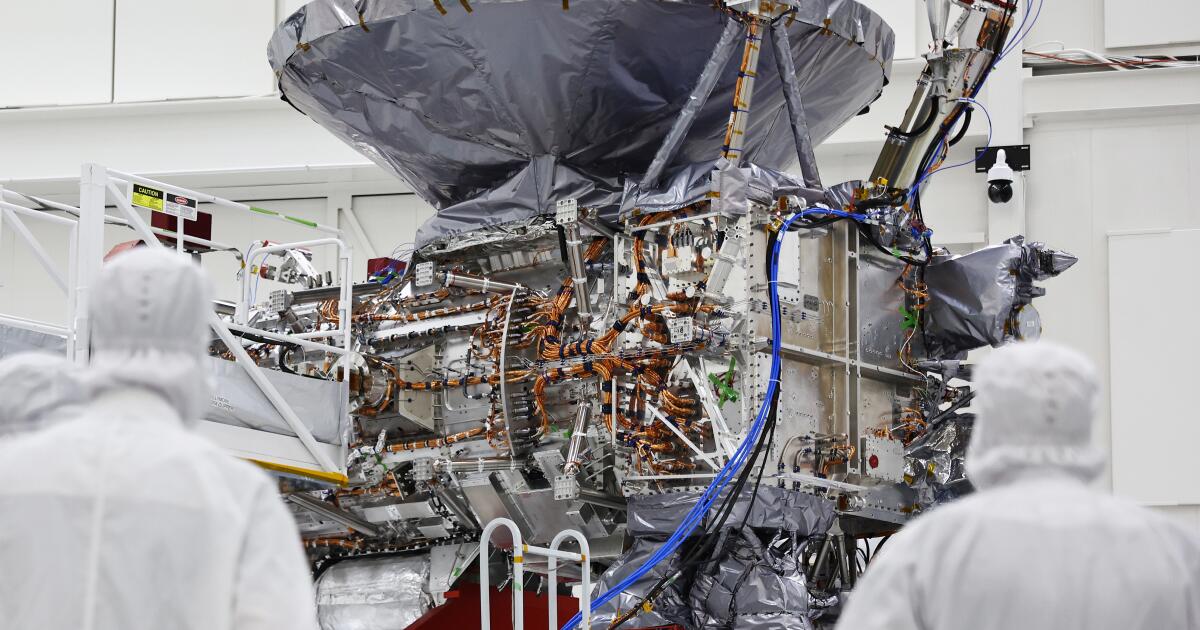
WASHINGTON — NASA recaptured the world’s attention with Artemis II, which took astronauts to the moon and back for the first time in half a century. But the agency’s scientific projects could again be under threat as the Trump administration makes a renewed push to drastically cut their funding — including at the Jet Propulsion Laboratory.
The cuts, proposed in the Trump administration’s 2027 budget request to Congress, would pose further challenges to the already weakened Caltech-managed lab and could be broadly damaging to American efforts to bring back new discoveries from space. They echo last year’s attempt by the administration to slash NASA funding, which Congress rejected.
Though the Artemis project is billed as laying a foundation for a crewed NASA mission to Mars, exploration of the Red Planet is among the endeavors that could be slashed. The rover currently exploring Mars’ ancient river delta and a mission to orbit Venus are among projects with JPL involvement targeted for spending cuts, according to an analysis of the NASA budget proposal by the nonprofit Planetary Society.
“This isn’t [because] they’re not producing good science anymore. There’s no rhyme or reason to it,” said Casey Dreier, chief of space policy at the Planetary Society, which led opposition to the administration’s similar effort to cut NASA funding last year.
Storm clouds hang over the Jet Propulsion Laboratory on Feb. 7, 2024.
(David McNew / Getty Images)
This time, the administration is asking Congress to cut NASA funding by 23% — including a 46% cut to its science programs, which are responsible for developing spacecraft, sending them into outer space to observe and analyzing the data they send back.
The proposal would cancel 53 science missions and reduce funding for others, according to the Planetary Society analysis. The effort to pare down NASA Science comes amid the Trump administration’s broader effort to cut scientific research across federal agencies.
The plan swiftly drew bipartisan criticism from members of Congress, who rejected the administration’s similar 2026 proposal in January. Republican Sen. Jerry Moran of Kansas, who chairs the Senate appropriations subcommittee that oversees NASA, indicated last week that he would work to fund NASA similarly for 2027, saying it would be “a mistake” not to fund science missions.
Moran plans to hold a hearing with NASA Administrator Jared Isaacman before the end of April to review the budget request, a spokesperson for his office said. The president’s budget request is an ask to Congress, which ultimately holds the power to allocate funding.
But until Congress creates its own budget, NASA will use the plan as its road map, which could slow grants and contracts. The proposal “still creates enormous chaos and uncertainty in the meantime for critical missions, the scientific workforce, and long-term research planning,” said Rep. Judy Chu (D-Monterey Park), whose district includes JPL.
A NASA spokesperson declined to comment Friday. In the budget request, Isaacman wrote that NASA was “pursuing a focused and right-sized portfolio” for its space science missions in order to align with Trump’s federal cost-cutting goals.
The budget “reinforces U.S. leadership in space science through groundbreaking missions, completed research, and next-generation observatories,” Isaacman wrote.

Jared Isaacman testifies during his confirmation hearing to be the NASA administrator in the Russell Senate Office Building on Capitol Hill on Dec. 3, 2025.
(Anna Moneymaker / Getty Images)
At JPL — which has for decades led innovation in space science and technology from its La Cañada Flintridge campus — questions had already swirled about the lab’s role in the future of NASA work.
Multiple rounds of layoffs over the last two years, the defunding of its embattled Mars Sample Return mission and a shift by the Trump administration toward lunar exploration and away from the type of scientific work that JPL executes had pushed the lab into a challenging stretch.
It has had a steady stream of employee departures in recent months, and those left have been scrambling to court outside funding from private investors, sell JPL technology to companies and increase productivity in hopes of keeping the lab afloat, according to two former staffers, who requested anonymity to describe the mood inside the lab.
“If we’re not doing science, then what are we doing?” asked one former employee, who recently left JPL after more than a decade there.
A spokesperson for the lab declined to comment, referring The Times to the budget proposal.
The NASA programs marked for cancellation or cutbacks support thousands of jobs at JPL and other centers, said Chu, who has led a push for increased funding for NASA Science. After last year’s layoffs, JPL “cannot afford to lose more of this expertise,” she said in a statement.
Among the JPL projects that appear to be slated for cancellation are two involving Venus, Dreier said. One, Veritas, is early in development and would give work to the lab for the next several years, he said.
The project would be the first U.S. mission to Venus in more than 30 years, Dreier said, and aims to make a high-resolution mapping of the planet’s surface and observe its atmosphere.
The Perseverance rover, which is on Mars collecting rock and soil samples, could face spending reductions. The budget request proposes pulling some funding from Perseverance to fund other planetary science missions and reducing “the pace of operations” for the rover.
Though how the Mars samples might get back to Earth is uncertain, the rover is still being used to explore the planet and search for evidence of whether it could have ever been habitable to life.
Researchers hope the tubes of Martian rock, soil and sediment can eventually be brought back to Earth for study. The team has about a half a dozen more sample tubes to fill and the rover is in good shape, said Jim Bell, a planetary scientist and Arizona State University professor who leads the camera team on Perseverance, which works daily with JPL.
He said NASA’s spending proposal put forth “no plan” for the future of the agency’s work.
“Are people just supposed to walk away from their consoles,” Bell asked, “and let these orbiters around other planets or rovers on other worlds — just let them die?”
The NASA document did not clearly show which programs were targeted for cuts and did not list which projects were targeted for cancellation. The Planetary Society and the American Astronomical Society each analyzed the proposal and found that dozens of projects appeared to be canceled without being named in the document.
Across NASA, other projects slated for cancellation according to the Planetary Society’s analysis include New Horizons, a spacecraft exploring the outer edge of the solar system; the Atmosphere Observing System, a planned project to collect weather, air quality and climate data; and Juno, a spacecraft studying Jupiter.
The administration’s plan also doesn’t prioritize new scientific projects, Bell said, which further jeopardizes long-term job stability and space discovery at centers like JPL.
“We’re going through this long stretch now with very few opportunities to build these spacecrafts,” Bell said. “All of the NASA centers are suffering from the lack of opportunities.”
Last year, the Trump administration proposed to slash NASA’s 2026 funding by nearly half. Instead, Congress approved funding in January that provided $24.4 billion for the agency — a cut of about 29% rather than the proposed 46%. The 2027 budget request asks for $18.8 billion.
Congress kept funding for science missions nearly steady, allocating $7.25 billion for science missions, about a 1% decrease from 2025. The administration had proposed cutting the science investment down to $3.91 billion. This time, the budget requests $3.89 billion.
Under the Trump administration, NASA has put an emphasis on moon exploration, including this month’s successful Artemis II mission. Isaacman, who defended the proposed cuts on CNN last week, touted the agency’s lunar plans, including a project to build a base on the moon.
The agency has indicated commitment to some existing science missions, including the James Webb Space Telescope, the to-be-launched Nancy Grace Roman Space Telescope, the Dragonfly spacecraft set to launch for Saturn’s moon in 2028, and other projects.
“NASA doesn’t have a topline problem, we just need to focus on executing and delivering world-changing outcomes,” Isaacman said on CNN.
Scientists have urged the government not to choose between funding science and exploration but to keep up investment in both.
“It’s ultimately kind of confusing, especially on the heels of the Artemis II mission,” said Roohi Dalal, deputy director for public policy at the American Astronomical Society. “The scientific community … is providing critical services to ensure that the astronauts are able to carry out their mission safely, and yet at the same time, they’re facing this significant cut.”

After years of heated debates among fire officials, scientists and local advocates, California’s Board of Forestry and Fire Protection released new proposed landscaping rules for fire-prone areas Friday that outline what residents can and can’t do within the first 5 feet of their homes.
Many of these proposed rules — designed to reduce the risk of a home burning down amid a wildfire — have wide support (or at least acceptance); however, the most contentious by far has been whether the state would allow healthy plants in the zone.
Many fire officials and safety advocates have essentially argued anything that can burn, will burn and have supported removing virtually anything capable of combustion from this zone within 5 feet of houses, dubbed “Zone Zero.” They point to the string of devastating urban wildfires in recent years as reason to move quickly.
Yet, researchers who study the array of benefits shade and extra foliage can bring to neighborhoods — and local advocates who are worried about the money and labor needed to comply with the regulations — have argued that this approach goes beyond what current science shows is effective. They have, instead, generally been in favor of allowing green, healthy plants within the zone.
The new draft regulations attempt to bridge the gap. They outline more stringent requirements to remove all plants in a new “Safety Zone” within a foot of the house and within a bigger buffer around potential vulnerabilities in a home’s wildfire armor, including windows that can shatter in extreme heat and wooden decks that can easily burst into flames. Everywhere else, the rules would allow residents to maintain some plants, although still with significant restrictions.
The rules generally do not require the removal of healthy trees — instead, they require giving these trees routine haircuts.
Once the state adopts a final version of the rules, homeowners would have three years to get their landscaping in order and up to five years for the bigger asks, including removing all vegetation from the Safety Zone and updating combustible fencing and sheds within 5 feet of the home. New constructions would have to comply immediately.
The rules only apply to areas with notable fire hazard, including urban areas that Cal Fire has determined have “very high” fire hazard and rural wildlands.
Officials with the Board will meet in Calabasas on Thursday from 1 p.m. to 7 p.m. to discuss the new proposal and hear from residents.
-
Share via
Some L.A. residents are championing a proposed fire-safety rule, referred to as “Zone Zero,” requiring the clearance of flammable material within the first five feet of homes. Others are skeptical of its value.
Where is the Safety Zone?
The proposed Safety Zone with stricter requirements to remove all vegetation would extend 1 foot from the exterior walls of a house.
In a few areas with heightened vulnerabilities to wildfires, it extends further.
The Safety Zone covers any land under the overhang of roofs. If the overhang extends 3 feet, so does the Safety Zone in that area. It also extends 2 feet out from any windows, doors and vents, as well as 5 feet out from attached decks.
What plants would be allowed in the Safety Zone?
Generally, nothing that can burn can sit in the Safety Zone. This includes mulch, green grass, bushes and flowers.
What plants would be allowed in the rest of Zone Zero?
Homeowners can keep grasses (and other ground-covers, like moss) in this area, as long as it’s trimmed down to no taller than 3 inches.
The rules also allow small plants — from begonias to succulents — up to 18 inches tall as long as they are spaced out in groups. Residents can also keep spaced-out potted plants under this height, as long as they’re easily movable.
What about fences, trees and gates?
Any sheds or other outbuildings would need noncombustible exterior walls and roofs in Zone Zero — Safety Zone or not.
Residents would have to replace the first five feet of any combustible fencing or gates attached to their house with something made out of a noncombustible material, such as metal.
Trees generally would be allowed in Zone Zero. Homeowners would need to keep any branches one foot away from the walls, five feet above the roof and 10 feet from chimneys.
Residents would also have to remove any branches from the lower third of the tree (or up to 6 feet, whichever is shorter) to prevent fires on the ground from climbing into the canopy.
Some trees with trunks directly up against a house in this 1-foot buffer or under the roof’s overhang might need to go — since keeping branches away from the home could prove difficult (or impossible).
However, the board stressed it wants to avoid the removal of trees whenever feasible and encouraged homeowners to work with their local fire department’s inspectors to find case-by-case solutions.
What’s new and what’s not
Some of the rules discussed in Zone Zero are not new — they’ve been on the books for years, classified as requirements for Zone One, extending 30 feet from the home with generally less strict rules, and Zone Two, extending 100 feet from the house with the least strict rules.
For example, homeowners are already required to remove any dead or dying grasses, plants and trees. They also have to remove leaves, twigs and needles from gutters, and they already cannot keep exposed firewood in piles next to their house.
Residents are also already required to keep grasses shorter than 4 inches; Zone Zero lowers this by an inch.

new video loaded: Rescuers Mount a Likely Final Push to Save a Stranded Whale
By Jorge Mitssunaga
April 17, 2026
-

 Florida3 minutes ago
South Florida faith leaders call for Miami mental health center to finally open
-
Georgia9 minutes ago
Georgia receiver and draft prospect Zachariah Branch arrested for misdemeanor obstruction
-

 Hawaii15 minutes ago
Kanakaʻole, Zane ʻohana transform Hawaiian cultural practices into captivating visual arts | Maui Now
-

 Idaho21 minutes ago
‘Unrelenting’: Statehouse reporters recap 2026 legislative session in Idaho Falls – East Idaho News
-

 Illinois27 minutes ago
Weather service assessing damage across Iowa, Illinois and Missouri
-

 Indiana33 minutes ago
Projecting the Indiana Fever’s 2026 Starting Lineup
-

 Iowa39 minutes ago
5 people wounded in shooting near University of Iowa campus, including 3 students
-

 Kansas45 minutes ago
Kansas Governor signs Caleb’s Law, targeting online sextortion of minors
