Science
Lithuania’s Peat Bogs Could Help the Climate and Defend the Border, Too


In a scrubby forest an hour outside the Lithuanian capital on a recent day this spring, excavators were digging ditches and tree harvesters were whirring in an effort to restore a waterlogged, mosquito-infested ecosystem that was drained in the Soviet era.
The reason is twofold: to help the climate and to defend the country from invasion.
The area was once a vast peat bog, and peat bogs are highly efficient at storing planet-warming carbon dioxide. They also happen to be very good at stopping tanks, because the spongy soil can’t support the weight of armored vehicles. The tanks get stuck and sink, often permanently.
Tomas Godliauskas, the Lithuanian vice minister of defense, said the bogs would form “an integral defensive line” when combined with other military tactics. The project also has the advantage of being relatively cheap compared with other measures like tank ditches and minefields, he added.
Lithuania isn’t the only European Union country using bogs to deter a Russian invasion. Latvia and Finland, for example, are also seeking to restore bogs for both environmental and defense purposes. And Ukrainian bogs helped to delay Russian troops in a failed push toward Kyiv in 2022.
Richard Hooker, a former director at the National Security Council who’s now a senior fellow at the Atlantic Council, a research organization based in Washington that focuses on international security, said peatland restoration could play an important role in Lithuania’s defense against an invasion from the east.
He noted that only one major highway runs from Minsk, in Byelorussia, to the Lithuanian capital, Vilnius, and that the Russian Army is heavily mechanized, without the kind of light infantry units that the U.S. Army has. That means restored, impassible peat bogs would force invading troops onto roads and trails, where they would be more vulnerable.
“The idea that you can use natural obstacles to tie in with man-made obstacles to slow down an attacker is an excellent one,” Mr. Hooker said. “A lot more could be done than has been done, but the early signs anyway are promising.”
The hazards of the bogs were illustrated in March last year, when a 70-ton M88 armored recovery vehicle from the U.S. Army sank during a training exercise near Pabrade, a city in eastern Lithuania near the border with Belarus. Four crew members died.
The bog restoration project is part of Lithuania’s total defense doctrine, a security strategy mobilizing the military, civilian and private sectors to be prepared in case of Russian aggression. The country is looking to restore 6,000 hectares of peatlands, Mr. Godliauskas said.
But it’s about more than just defending the border. It’s also about carbon capture.
Peat bogs form when oxygen-poor conditions in wetlands prevent bacteria and fungi from fully breaking down organic matter like plants and dead animals. In Lithuania, some of the resulting peat was extracted by the Soviet authorities to burn in power plants and to expand agriculture.
The restoration effort is a priority across multiple agencies in the government, said Aira Paliukenaite, Lithuania’s vice minister of the environment. The ministry is planning for restoration to continue for the next 30 years as a part of its policy of aligning with the European Union’s Nature Restoration Law.
That measure requires every country in the bloc to implement a plan, with targets, to mitigate carbon emissions and restore biodiversity and habitats in the coming decades.
Lithuania appears to be in a good starting position. The country still has large quantities of undisturbed peat underground. By rewetting it, officials said they could transform the land back into a what’s known as a carbon sink, or storage system, because peat can lock away carbon for much longer than forests can.
It’s not a simple process, though. The technical planning and site preparation can take years. The projects are still in the early stages, especially those along the border, but they are starting to work with nongovernmental groups like the Foundation for Peatland Restoration and Conservation.
While some in the country are skeptical about the restoration process and its efficacy, others are welcoming the plan.
Albertas Lakstauskas, 52, a teacher and politician, has lived his whole life in Zasliai, a small town near one of the foundation’s projects, the restoration of about 150 acres of drained land where peat was extracted to supply energy to the Soviet Union.
Mr. Lakstauskas said he, like some others in the town, was doubtful that peat bogs alone could stop a Russian invasion, but he said he thought supporting the environment was a matter of national pride.
“If we can do some things to do better, I think that’s a good opportunity,” he said. “And I choose to participate.”



Thousands of people across 34 states are experiencing explosive and prolonged diarrhea due to a food and water-borne parasitic disease that has prompted experts to urge people to take extra precautions when preparing food.
A specific type of produce, grower or supplier has not been identified as the source of each state’s outbreak; officials say there could be multiple sources.
At the epicenter of the cyclosporiasis outbreak in Michigan, where more than 3,700 residents have been infected, public health experts say a possible culprit under investigation is leafy greens.
Some Taco Bell locations in Michigan are also being investigated after the chain voluntarily stopped selling lettuce, cilantro, onion, pico de gallo and guacamole, “due to a nationwide recall.”
Even though the clusters of outbreaks are concentrated in the Midwest and East Coast, epidemiological and infection prevention experts urge people in California and the rest of the U.S. to be cautious with their produce and take the necessary steps to reduce their risk of infection.
California has reported 41 cases of cyclosporiasis, between January and June, none of which are linked to the current outbreak. That is below the average of 100 cases reported annually in California, usually between May and August, said Robert Barsanti, spokesperson for the California Department of Public Health.
“It’s important to understand that California experiences cases of cyclosporiasis every year, with a majority of cases acquired internationally,” said Erica Pan, director of the state agency. “Cases for 2026 are well within expected ranges for California.”
Rising cyclosporiasis cases shouldn’t deter Californians from eating fruits and vegetables. Instead, experts say, it’s a call to take extra precautions to reduce the risk of contracting the parasitic disease.
Which produce are potential sources of cyclosporiasis
In the U.S., food-borne outbreaks of cyclosporiasis have been linked to various types of fresh produce imported from Latin America, including raspberries, cilantro, basil, snow peas and mixed salad, according to the California Department of Public Health.
One of the largest cyclosporiasis outbreaks in North America was linked to imported raspberries from Guatemalan farms in 1996, said Dana Mordue, associate professor of pathology, microbiology and immunology with New York Medical College.
At the time, more than 1,400 cases of the disease were reported in 20 states, the District of Columbia and Canada.
How to reduce your risk of contracting cyclosporiasis
The first step is to wash your hands with soap and water before handling produce.
Then, experts say:
- Wash all fruits and vegetables thoroughly under running water before eating, cutting or cooking.
- Remove and discard outer leaves from lettuce and leafy greens.
- Cook vegetables and herbs whenever practical, especially for vulnerable populations including young children, pregnant women and immunocompromised individuals.
- Prevent cross-contamination: Use clean cutting boards, utensils and food-contact surfaces. Keep ready-to-eat foods separate from raw produce during preparation.
- Refrigerate cut, peeled or cooked fruits and vegetables as soon as possible (within two hours).
- Avoid food or water that may be contaminated by human feces, especially when traveling to countries where tap water or food may be unsafe.
If your produce comes in a package that says “pre-rinsed,” experts say you should still take the time to rinse it yourself.
Will a simple rinse of all types of fruits and veggies reduce my risk?
Some fruits and vegetables should be rinsed and others scrubbed, depending on the type of produce, said Britanny Saunier, executive director with the Partnership for Food Safety Education, a nonprofit that develops and promotes food safety material to reduce food-borne illness.
All types of produce should be rinsed under running water, including those with skins or rinds that are not eaten.
“We recommend an extra step for those firm-skinned fruits and vegetables — such as a cucumber or melon — which should be rubbed by hand or scrubbed with a clean brush while rinsing under running tap water, Saunier said.
You should dry your cleaned produce with a clean cloth or paper towel.
Some supermarkets offer “produce washes,” usually provided in spray bottles, which claim to break down surface waxes and remove dirt, pesticide residues and harmful bacteria. But the U.S. Food and Drug Administration does not recommend them because the safety of their residues has not been evaluated, she said.
“Many types of fresh produce are porous and could absorb these products, potentially changing their safety and taste,” Saunier added.
Rinsing and scrubbing is the most effective method of lessening your risk of contracting the disease but it doesn’t eliminate it entirely, Mordue said.
That’s because the parasite has a tough outer shell, making it difficult to eliminate, said Dr. Norman Beatty, associate professor of medicine with the Division of Infectious Diseases & Global Medicine at the University of Florida College of Medicine.
The parasites’ cell walls are “highly resistant to adverse environmental pressures and traditional disinfectants,” Beatty said.
In general, the parasite has been found in soil and from there it sticks to produce, likely due to the use of contaminated water or inadequate hygiene among food handlers, she said.
“It is unclear how to safely remove these [parasites] from produce once they have contaminated soil or plant matter, but merely washing with water is likely not to remove them prior to eating,” Beatty said.
Are there any types of produce I should avoid entirely?
Because lettuce and bagged salad greens have been identified as potential sources of the outbreak in Michigan, Mordue said she would be cautious with bagged leafy greens.
As a resident of New York, one of the states currently reporting an outbreak, Mordue said she has a bag of packaged greens in her fridge that she plans to toss in the trash.
The advice for Californians might be slightly different since the state isn’t reporting an outbreak. Rinsing leafy greens before serving them is fine, Mordue said. But if you can do without them for the time being, she said, avoid them.
In the case of packaged spinach, cooking the leaves can reduce your risk of contracting cyclosporiasis.
How does this type of outbreak end?
It’s difficult to say when an outbreak might end until the source of the parasitic disease is identified.
When local and federal public health officials, “zero in on a specific causative agent, they can end it pretty quickly,” Mordue said.
Once a source is identified, she said, a recall notice will be issued for the contaminated produce and people will know exactly what they shouldn’t eat.
“The sooner they can figure it out, the sooner it’s going to end,” Mordue said. “That said, if they cannot figure out the source this could go on for a while.”
What are the symptoms and remedies for cyclosporiasis?
Someone who contracts the parasite might end up with week-long watery and explosive diarrhea, “which is bad enough,” she said.
Other symptoms include loss of appetite, weight loss, cramping, bloating, increased gas, nausea and fatigue.
If you start to have debilitating diarrhea and feel fatigue, experts urge you to seek medical care.
Medical providers will likely test a stool sample to determine whether you’ve contracted cyclosporiasis and treat you with an antibiotic called Bactrim, among other treatments.
Scientists hoped for years to make a machine that could emulate the movements of diving birds, such as puffins, and offer an affordable, unobtrusive way to monitor fragile marine ecosystems. A team of researchers at M.I.T. has been able to create such a waterproof winged robot, according to a study published July 9 in the journal Science.
Nearly one month after a fire destroyed a massive cold-storage facility in Boyle Heights, the neighborhood has been overcome by the stomach-churning stench of rotting food.
As facility operator Lineage works to remove more than 85 million tons of weeks-old food from its 500,000-square-feet warehouse, the rancid odors have attracted throngs of rats and swarms of flies, as a foul-smelling brownish liquid pours from the seams of the building.
Now, with a heat wave descending over much of Southern California, residents worry the odor could get even worse and scores of residents have called air quality regulators to complain. At the same time, environmental groups are accusing Lineage representatives and emergency responders of downplaying the risks pose by chemicals released during the fire.
Boyle Heights, a neighborhood that has been subjected to decades of toxic pollution from rail yards and other industries, has again become the center of attention in another environmental disaster. Already, the official response to the Lineage fire has eroded trust in government agencies, residents say.
Remediation work continues at a Lineage facility in Boyle Heights, where residents and nearby businesses have complained of a rotting food odor for weeks.
(Allen J. Schaben / Los Angeles Times)
On Tuesday, Sen. Alex Padilla (D-Calif.) visited the gutted warehouse alongside L.A. Fire Chief Jaime Moore and representatives of the South Coast Air Quality Management District and a contingent of environmental organizations. Padilla, along with Sen. Adam Schiff (D-Calif.) and Rep. Jimmy Gomez (D-Los Angeles), wrote a letter to the U.S. Environmental Protection Agency, calling on the agency to return to the cleanup zone to monitor air and water quality.
“Given the materials present in the warehouse, we are concerned about the long-term health and environmental impacts from contaminated smoke and water runoff on communities surrounding the warehouse,” the letter read.
Joe Lyou, president of nonprofit Coalition for Clean Air, told Padilla that he has heard of people becoming sick in the weeks after the event.
“I think that pointed to a problem with the messaging while the event first happened,” Lyou said. “It wasn’t consistent [with] if you smell smoke, see ash to get out and protect yourself — make sure you’re not exposed to it. There were different messages coming from different people, and we need to fix that.”
“The whole community was completely overwhelmed … and concerned about the ammonia, concerned about burning plastic, concerned about all sorts of other [emissions] that are really hard, difficult, expensive to measure. But … we’ll just never know some of those things,” Lyou said.

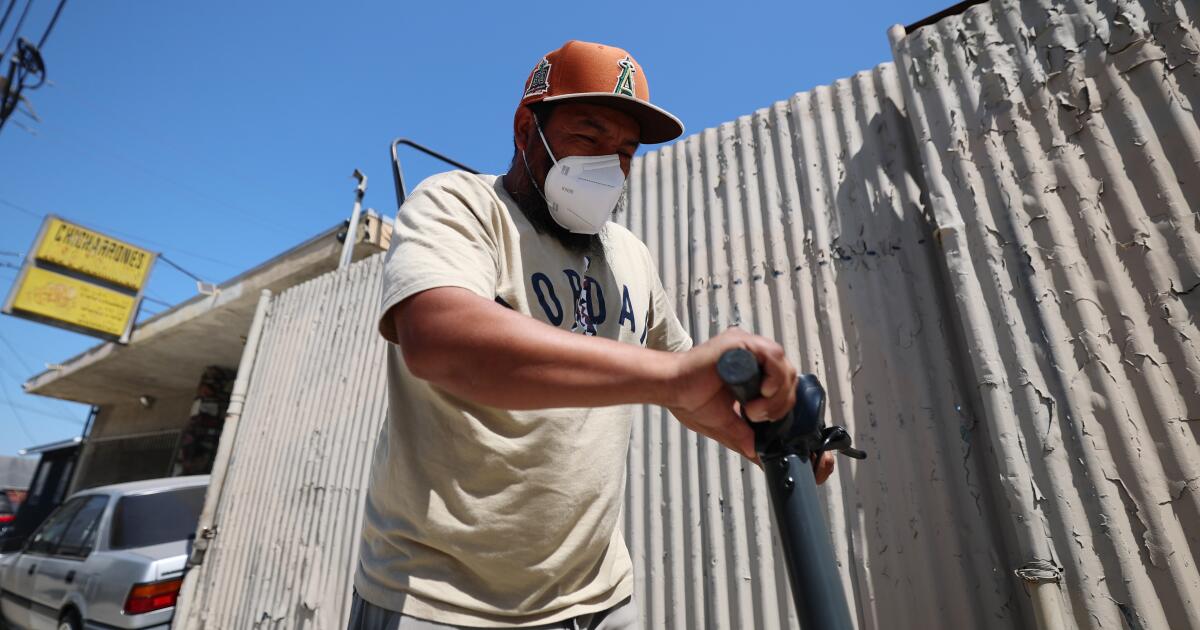
Street vendor Lupe Gonzalez pushes her cart away from a gutted warehouse in Boyle Heights.
(Allen J. Schaben / Los Angeles Times)
Chief Moore has faced criticism for his decision to advise residents to shelter indoors rather than to evacuate during the blaze. That stood in sharp contrast with Orange County fire officials, who evacuated tens of thousands of residents near an overheating chemical tank in Garden Grove in May.
On Tuesday, Moore told Padilla that the two incidents were very different. Moore said he had discussed the dilemma with TJ McGovern, the interim fire chief for the Orange County Fire Authority.
“He says everybody got mad at him because he evacuated everybody and nothing blew up,” Moore told Padilla. “But everybody’s mad at you because of the shelter-in-place [order] and it smells.”
Moore said that “there was nothing in the air that was hazardous” and that firefighters “never had a threat of an explosion.”
However, environmental experts said 14,000 pounds of flammable anhydrous ammonia were stored in tanks and used as refrigerant at the Lineage warehouse and posed a significant risk of explosion until it was removed days into the fire.
Environmental and community groups said L.A. fire officials also repeatedly emphasized the risks from ammonia in their radio communications. On the first day of the fire, a group of firefighters was hit by a plume of ammonia gas, and fire command quickly organized medical help.
“The majority of my division got exposed to ammonia gas. We’ll need to get them assessed.”
On Tuesday, Moore said no amount of ammonia was detected.
“When [firefighters] opened those doors, there was what looked like a big vapor cloud that came out,” Moore said. “That was the cold air mixing with the hot air that caused a vapor. It wasn’t ammonia.”
But residents remain skeptical.
Padilla’s visit follows a notice of violation that the South Coast Air Quality Management District issued to Lineage. The notice of violation was issued on July 12, after the agency received more than 40 public complaints of rotten, sour, garbage-type odors in the area. Inspectors confirmed the odors with community members and traced them back to cleanup operations at the facility, according to the air quality agency.
Boyle Heights residents are calling on Gov. Gavin Newsom to declare a mandatory evacuation of their community, saying the fire and the toxic aftermath are continuing to pose health risks. Without an evacuation order, they said, insurance companies won’t help residents who want to relocate with rent or mortgage relief.
“For nearly a month, a cold-storage warehouse fire has poisoned the air over the Eastside and Los Angeles County and City officials have refused to issue a mandatory evacuation,” read a statement from the community group Protect LA Now. “That refusal forces victims to pay their own way out, and leaves those who can’t afford to leave trapped in gases and toxins that no agency will name.”

Joe Lyou, president of the Coalition for Clean Air, explains how smell is affecting his health while talking to the media near a fire-gutted Lineage facility Tuesday.
(Allen J. Schaben / Los Angeles Times)
Tensions have been building in the community since the fire broke out on June 17 and burned for days.
At a contentious town meeting last week, Los Angeles Mayor Karen Bass struggled to open the meeting over the loud boos and yelling of community members, actions that were repeated as other elected officials took the microphone. The crowd grew even louder when Lineage Chief Operating Officer Jeff Rivera took to the stage and was met with shouts of “Liar!”
Air quality has been a constant concern for the community since the incident began. Beyond the health hazards of breathing in smoke from a building fire, there was a brief, temporary scare when an ammonia line that helped keep the building refrigerated was compromised, though Lineage has said the chemical was not detected in the air. Additionally, 85 million pounds of food thawed, burned and spoiled inside, creating a terrible smell that emanated from the property.
Nora Saenz, a resident of Bell, said she believed local leaders when they said there was no threat. During the fire, she took her niece and nephew to a community event in La Mirada, which was downwind of the fire.
Now Saenz fears what they might’ve breathed in.
“The day of the fire, we were told that the air was safe to breathe,” she recalled. “To this day, I don’t know what I exposed my niece and my nephew to.”
Times staff writers Salvador Hernandez, Clara Harter and Seamus Bozeman contributed to this report.
-
Science5 minutes ago
How to eat safely amid outbreak of diarrhea-causing cyclosporiasis
-
 Sports11 minutes ago
Magical Lionel Messi leads Argentina past England for trip back to World Cup final
-

 World23 minutes ago
Toronto engulfed by wildfire smoke as US cities threatened
-
 News53 minutes ago
Argentina is back in the World Cup final after a thrilling semifinal win over England
-

 Los Angeles, Ca2 hours ago
Remains of murder victim identified as missing Southern California millionaire
-

 Detroit, MI3 hours ago
4Warn Weather Alert: Wildfire smoke leading to ‘unhealthy’ air quality in Metro Detroit
-

 San Francisco, CA3 hours ago
San Francisco fishermen recount harrowing rescue after boat capsizes near Alcatraz
-

 Dallas, TX3 hours ago
Timothée Chalamet ‘Starstruck’ by Dallas Cowboys Cheerleaders

