Science
Kennedy Advises New Parents to ‘Do Your Own Research’ on Vaccines


Health Secretary Robert F. Kennedy Jr. advised parents of newborns to “do your own research” before vaccinating their infants during a televised interview in which he also suggested the measles shot was unsafe and repeatedly made false statements that cast doubt on the benefits of vaccination and the independence of the Food and Drug Administration.
Mr. Kennedy made the remarks to the talk show host Dr. Phil in an interview that aired Monday on MeritTV to mark the 100th day of the Trump administration. He said, as he has in the past, that “if you want to avoid spreading measles, the best thing you can do is take that vaccine.”
But Mr. Kennedy also made clear, as he has in the past, that he believes it is up to individuals to decide. In suggesting vaccines are unsafe, he contradicted decades of advice from public health experts, including leaders of the Centers for Disease Control and Prevention.
“I would say that we live in a democracy, and part of the responsibility of being a parent is to do your own research,” the health secretary said, in response to a question from a woman in the audience who asked how he would advise a new parent about vaccine safety. “You research the baby stroller, you research the foods that they’re getting, and you need to research the medicines that they’re taking as well.”
The phrase “I did my own research” became a cultural and political touchstone during the coronavirus pandemic, when proponents of vaccination, mostly on the political left, used it to denigrate those who had chosen not to get vaccinated. It became an internet meme and popped up on mock tombstones in Halloween-themed graveyards in liberal neighborhoods.
The Department of Health and Human Services did not immediately respond to a request for comment.
Mr. Kennedy’s comments came amid the largest measles outbreak in about 25 years in the United States, which has included the deaths of two young children and an adult.
Dr. Paul Offit, a pediatrician and vaccine expert at Children’s Hospital of Philadelphia who has often been at odds with Mr. Kennedy, said that it was “perfectly reasonable to be skeptical of vaccines,” but that parents who wanted to do their own research must be careful about their sources of information.
“What doing your own research should mean is that you should talk to, or at least look at online, people who have an expertise in the field, which doesn’t mean looking in chat rooms or just on social media blog posts,” Dr. Offit said. He added that while there is good information available, “there’s also a lot of really bad sources of information that will miseducate you about your choice. And Robert F. Kennedy Jr. is a perfect example of that.”
Another vaccine expert, Dr. Peter Hotez of Baylor College of Medicine in Houston, said Mr. Kennedy was being disingenuous. “He says that — doing your own research — knowing full well that when a parent does their own research, they are now mostly downloading an onslaught of disinformation — a lot of it from the health and wellness, nutritional supplement influencer industry trying to peddle alternatives.”
Mr. Kennedy also suggested, without evidence, that measles shots cause a variety of ailments. “Does it stop measles?” he asked. “Yeah, but does it also do something else, cause you seizures or cause neurological or autoimmune disease? We don’t know. Nobody can answer that question.”
In fact, studies have shown that, with rare exceptions, people who are vaccinated are less likely than those who suffer infections to develop autoimmune diseases, which has led researchers to conclude that vaccines “have not only the potential to protect the patient from infectious diseases, but also from its complications, including autoimmune manifestations.”
Mr. Kennedy’s other statements in the interview were also rife with inaccuracies. “New drugs are approved by outside panels, not by the F.D.A. or the C.D.C.,” he declared.
That is false. Outside panels of experts do advise the F.D.A. on controversial or high-profile drug approval decisions, and some panel members have ties to industry that are publicly disclosed before the meetings begin. But the F.D.A. alone has authority to approve or reject new drugs, vaccines and other therapies. The C.D.C. has no role in drug approvals whatsoever.
“Mr. Kennedy needs a briefing on drug development and F.D.A. decisions about marketing,” said Dr. Robert Califf, the agency’s commissioner under President Joseph R. Biden Jr. “He is either ignorant on the topic or intentionally misleading the public. Outside panels are advisory. F.D.A. makes the decisions.”
Mr. Kennedy also insisted, inaccurately, that vaccines are not evaluated for safety either before or after they are licensed. “There’s no safety studies at the outset, there’s no surveillance system afterward,” he said, adding, “Vaccines are the only medicine or medical product that is exempt from pre-licensing safety testing.”
In fact, the Food and Drug Administration licenses vaccines after a yearslong process that begins with extensive testing in the lab and in animals and progresses to trials in humans. The F.D.A. requires careful studies of vaccine safety and effectiveness, often with thousands of people in large trials, said Dr. Peter Marks, the agency’s vaccine division chief who was recently forced to resign from his position.
“I don’t know where this misunderstanding is coming from,” said Dr. Marks, who has been critical of Mr. Kennedy. “Vaccines are required to be extensively studied for safety. By definition, we’re giving these products to healthy people. So safety is paramount.”
After vaccines are licensed, they are monitored via an alphabet soup of databases. The Vaccine Safety Data Link system has relied on electronic health records from medical centers across the country. It has been responsible for detecting unusual side effects, including rare cases of myocarditis, or inflammation of the heart muscle, among young men who took Covid-19 vaccines.
Another system, the Vaccine Adverse Event Reporting System, developed in 1990 as a “national early warning system,” relies on reports from patients and providers. Although many vaccine critics, including Mr. Kennedy, have cited VAERS data to argue that vaccines are dangerous, the system was not designed to determine if vaccines cause health problems. It was designed to pick up hints that can be investigated further in other types of data systems.
The F.D.A. has an additional safety monitoring program called BEST, or the Biologics Effectiveness and Safety Initiative.
Dr. Sean O’Leary, the chairman of the committee on infectious diseases for the American Academy of Pediatrics, said it was wrong to claim that federal officials did not keep an eye on vaccine safety. “I don’t know where this is coming from,” he said, “because none of it is true.”
He added: “We are aware of many rare adverse events. If it becomes clear that the risks are even close to outweighing the benefits, the vaccine gets pulled from the market.”



The Artemis II astronauts safely splashed down off the coast of San Diego at 5:07 p.m. Friday. After their historic 10-day mission around the moon, the crew and NASA officials are finally breathing a sigh of relief.
“I’m still at a loss for words. The childhood Jared right now can’t believe what I just saw,” said NASA Administrator Jared Isaacman, standing aboard a Navy warship assisting with recovering the four returned astronauts in the Pacific Ocean.
Isaacman was born more than a decade after the last time humans walked on the moon.
“I’ve almost been waiting my whole lifetime to see this, and then as NASA administrator, I just couldn’t be more proud of the entire workforce,” he said.
The return mission was highly anticipated and attracted rapt viewers from across the nation. The Empire State Building was lit up in red, white and blue to welcome the crew home. Multiple MLB stadiums displayed footage of the landing on their scoreboards.
NASA regarded the high-energy reentry — streaking through the atmosphere in a nearly 5,000-degree-Fahrenheit fireball at more than 32 times the speed of sound — as one of the riskiest moments of the mission.
-
Share via
Space agency officials’ blood pressure was further elevated as experts closely watched the performance of the craft’s heat shield, which astronauts rely on to slow them down and keep temperatures livable.
During the crew-less 2022 Artemis I test mission, the heat shield unexpectedly chipped in more than 100 spots. NASA determined that any astronauts aboard would have been unscathed, but noted the problem posed an increased risk to future crews. Instead of redesigning the heat shield — which NASA will do for future missions — the agency opted to bring the capsule in on a steeper trajectory intended to inflict less stress on the materials.
After splashdown, multiple minor snafus delayed Navy divers as they tried to bring the astronauts out of the capsule.
First, the divers struggled to contact the astronauts inside — though both parties could still reach Mission Control. After the Navy crew opened the hatch, ocean currents hindered their ability to deploy inflatable devices around the capsule to stabilize it and help the astronauts exit.
Eventually, nearly an hour and a half after splashdown, the team helped the astronauts out of the toasty Orion capsule, to the cheers of dozens of flight controllers in Mission Control.
The Navy team then airlifted the astronauts by helicopter to the USS John P. Murtha Navy warship, about 1.5 miles away, for medical evaluation.
Crews will continue to work into the night securing the capsule and guiding it back to the Murtha, which is expected to reach Naval Base San Diego early Saturday.
For many NASA scientists and engineers across the country, the work to analyze every bit of data from the capsule has just begun.
“We’re going to want to definitely take a look at the thermal protection system,” Isaacman said. “We’re going to want to download all the data they couldn’t transmit back to us and use that to inform Artemis III.”
The Artemis Program, an international collaboration spearheaded by NASA, aims to put boots back on the moon for the first time in more than 50 years. The space agency hopes to establish a lunar base as a testing grounds for future missions to Mars.
Artemis II, a flyby mission around the moon that lifted off on April 1, was focused on testing out life support systems and practice piloting the spacecraft to make the journey a smoother ride for future crews who will be focused on the complex challenge of actually landing on the lunar surface.
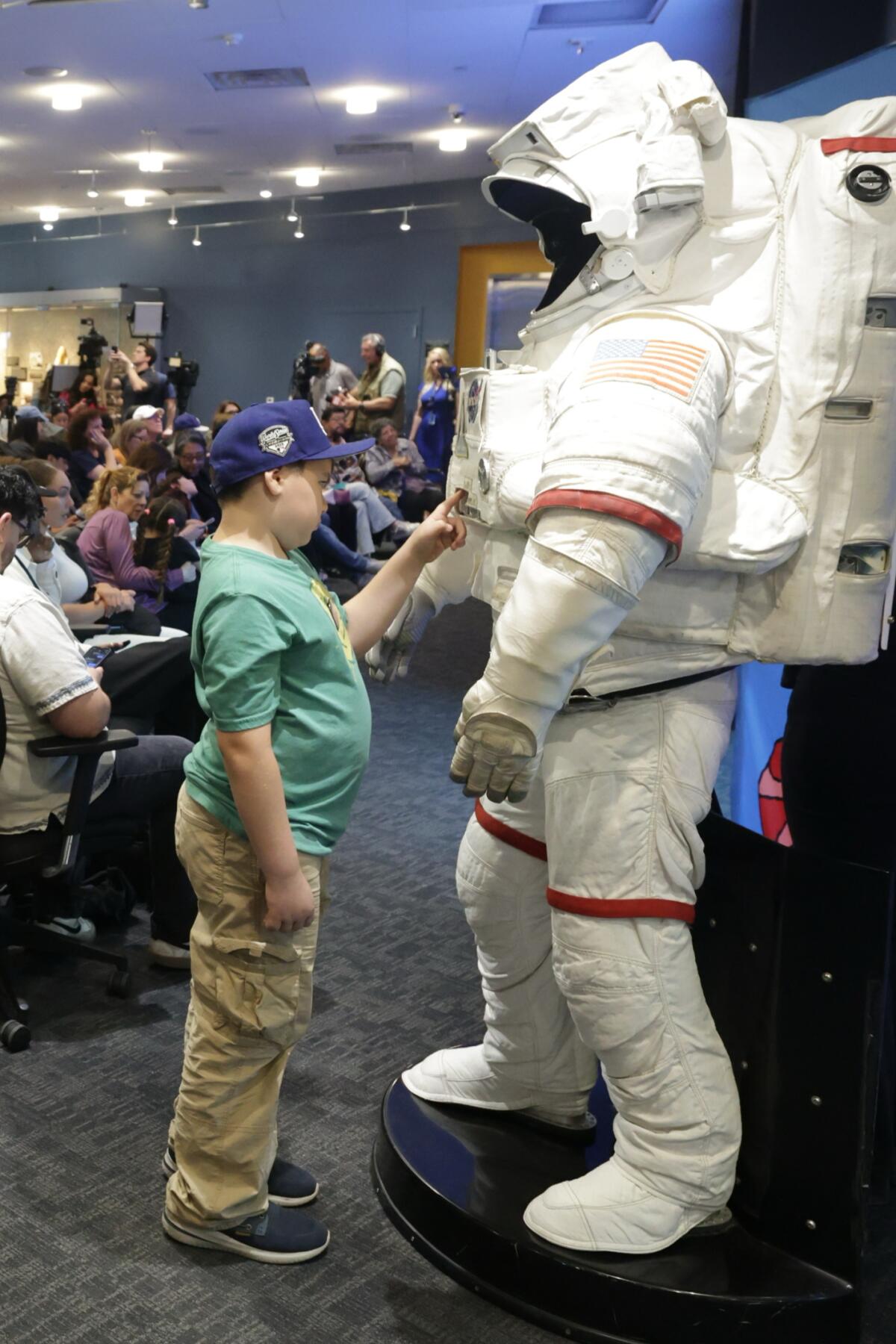
Christian Ramirez, Jr., 8, checks out an astronaut suit while waiting for the Artemis II Landing Watch Party featuring a live broadcast of the splashdown on a large screen at the Columbia Memorial Space Center in Downey on Friday.
(Myung J. Chun / Los Angeles Times)
They worked out problems with the capsule’s space toilet (multiple times), piloted the spacecraft by hand, and tested procedures such as sheltering from solar radiation in the cargo locker.
Yet Monday’s flyby — the first time humans had reached the moon since 1972 — held emotional significance for the crew and space enthusiasts beyond the mission’s technical objectives.
While in space, the crew spoke of the surreal sights of our dusty, rugged natural satellite, appearing about the size of a bowling ball at arm’s length, suspended in nothingness. The astronauts couldn’t help but feel a renewed appreciation for our home planet.
“Maybe the distance we are from you makes you think what we’re doing is special,” Artemis II pilot and Southern California native Victor Glover said on Easter while on his way to the moon. “But we’re the same distance from you, and — I’m trying to tell you, just trust me — you are special. In all of this emptiness — this is a whole bunch of nothing, this thing we call the universe — you have this oasis, this beautiful place that we get to exist, together.”
About 25 minutes before the crew splashed back down on our oasis, Artemis II Cmdr. Reid Wiseman radioed Mission Control.
“We have a great view of the moon out window two,” he said. “Looks a little smaller than yesterday.”
“Guess we’ll have to go back,” Mission Control replied.

new video loaded: Artemis Astronauts Splash Down After Historic Lunar Flyby
transcript
transcript
Artemis Astronauts Splash Down After Historic Lunar Flyby
The four astronauts aboard Artemis II splashed down at 8:07 p.m. Eastern time in the Pacific Ocean near San Diego on Friday, concluding their historic 10-day mission, the first to send humans to the moon in more than 50 years.
-
“Houston, Integrity splashdown. Sending post-landing command now.” “Splashdown confirmed.” “Copy splashdown. Waiting on V.L.D.R.” “Splashdown confirmed at 7:07 p.m. Central time.” “All four crew members now out of Integrity.”

By Jackeline Luna
April 10, 2026
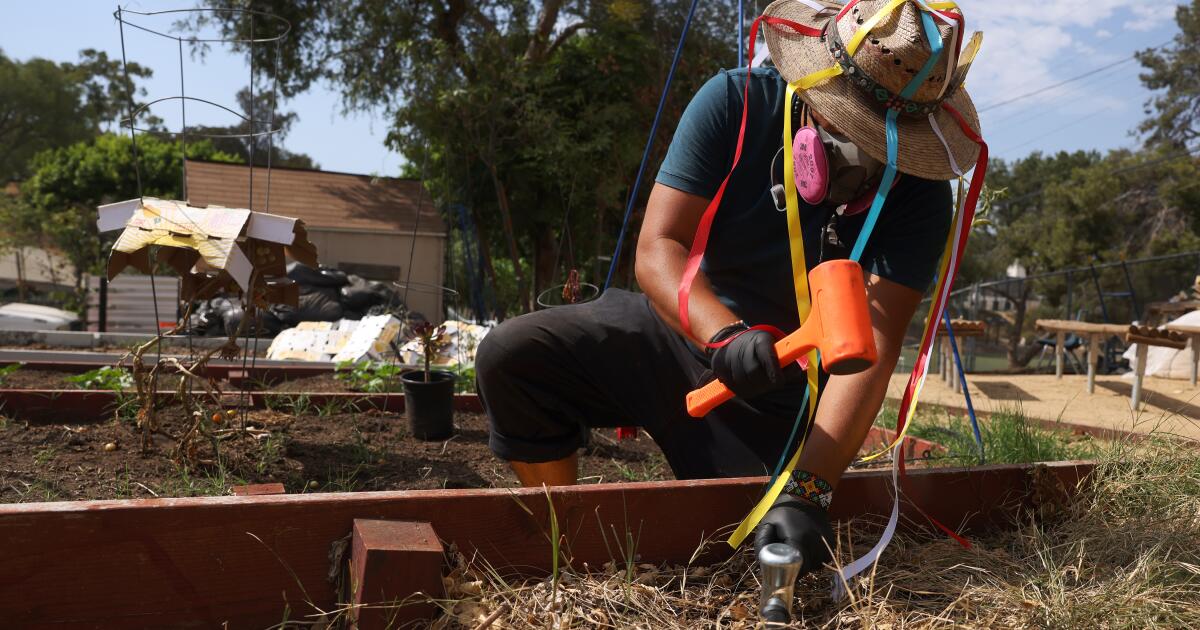
Homes near a former battery recycler in Southeast Los Angeles County still have excessive lead in their soil, even after the state spent hundreds of millions of dollars over a decade to remove it, according to a new study.
The former Exide Technologies plant in Vernon melted down pallets of lead-acid car batteries in blast furnaces for nearly a century, blanketing up to 10,000 nearby properties with toxic dust, according to state officials. They say the cleanup is the largest of its kind in the country.
The Exide plant was permanently closed in 2015 and later abandoned by the company. The California Department of Toxic Substances Control hired contractors to remove and replace heavily contaminated soil at nearby homes, schools and parks in seven communities, including Boyle Heights and unincorporated East L.A.
Now in a review of the state’s work, a team of university researchers and a local environmental health organization have tested more than 1,100 soil samples from 370 homes within and just outside the state-designated cleanup area. They found nearly three quarters of remediated homes still had lead levels above California’s standard for residential properties in at least one sample. Their study is published in Environmental Science & Technology.
Jill Johnston, lead author and associate professor of environmental and occupational health at UC Irvine, said the results suggest there were deep flaws with the cleanup. This leftover lead has the potential to stunt brain development in young children, leaving them with lifelong deficits if they inhale dust or ingest it playing in their yards.
“The state cleanup plan [said] surface soil was going to be removed or covered,” Johnston said. Instead, there is “potentially ongoing exposures to folks living there now, but also future generations.”
Exide Technologies, a former lead-acid battery recycling plant in Vernon, in October 2020.
(Al Seib/Los Angeles Times)
The cleanup started in 2016 and is ongoing. It aimed to excavate up to 18 inches of contaminated soil from each home and backfill with clean topsoil. So far, more than 6,100 properties have been remediated in Southeast L.A. County. The state has dedicated more than $700 million to the effort.
A 2023 Los Angeles Times investigation, which cited preliminary soil testing results, found that state-hired cleanup crews often did not remove contaminated soil from next to buildings, walkways and trees, where backhoes and other excavators can’t get in — areas that require a shovel.
In some cases, workers mishandled contaminated soil, spreading it onto neighboring properties. The state did not offer soil testing to confirm the properties met state standards after the cleanup, leaving many skeptical their homes were actually clean.
Mark! Lopez, a community organizer with East Yard Communities for Environmental Justice and a co-author of the study, had long heard complaints from residents and raised concerns about the cleanup. The findings, he said, substantiated many of those claims.
“The results are worse than we feared,” said Lopez, who led teams in collecting soil samples from 2021 to 2024.
When they released initial data, he said, “DTSC was trying to deny its validity … Now that can’t be denied.”
A DTSC spokesperson said the agency could not accept the study’s findings without more information.
“It is impossible to evaluate the conclusion of the UC Irvine study without the underlying data and methodology,” the agency spokesperson said. “That information has not been shared after multiple requests.”
No cleanup ever replaces every particle of soil, the agency said. “That said, DTSC has carried out an unprecedented cleanup near the former Exide facility, completing work at more than 6,000 homes, the largest residential cleanup of its kind in the nation. This work confirms DTSC’s commitment to protecting the health of residents.”
After the team shared results with state officials, DTSC committed to perform soil testing at 100 homes that had their work done early in the process, before procedures underwent an overhaul. The agency also has paid for post-cleanup testing at the most recently cleaned homes. None of that data has been published, and it’s unclear if DTSC intends to order crews to return to homes that have lead contamination above state standards.
In addition, DTSC now has third-party supervisors monitoring cleanup work.
Johnston and fellow researchers also tested more than 620 samples from 200 homes outside the official 1.7-mile cleanup area. Almost all, 89%, had lead levels above state standards, suggesting Exide’s pollution may have traveled farther than the cleanup zone designated by the state.
Some level of lead blankets many urban areas, because of lead paint, leaded jet fuel and tailpipe exhaust from leaded gasoline. But the researchers believe much of this pollution was attributable to Exide.
That’s because at the direction of state regulators, Exide sampled homes in Long Beach, about 14 miles south, in a similar neighborhood close to freeways, a rail yard and older homes — but without a lead smelter. Lead concentrations were far lower than in Southeast L.A. County.
“We essentially saw lead level patterns that mimicked lead levels in the community — before cleanup,” Johnston said. “So the vast majority of homes exceeded state thresholds.”
DTSC officials have said lead contamination also could have been from older homes with lead paint or leaded gasoline in cars.
Community leaders have pushed for extending the cleanup area to remove hidden threats in those areas, even as many still worry about residents whose properties already have been cleared. They don’t want residents to have a false sense of security that their property is clean when many still are laced with lead.
Johnston said some of the risks could’ve been avoided if the state committed to proper safeguards, such as post-cleanup sampling, sooner.
“If that process started early on and is done in a way where residents and the broader community had transparency to that data, we could have addressed” hot spots of contamination and other neighborhood concerns, she said.

Remove your personal info from the web; stop it from coming back

Man charged with arson after setting fires inside Ontario Mills mall
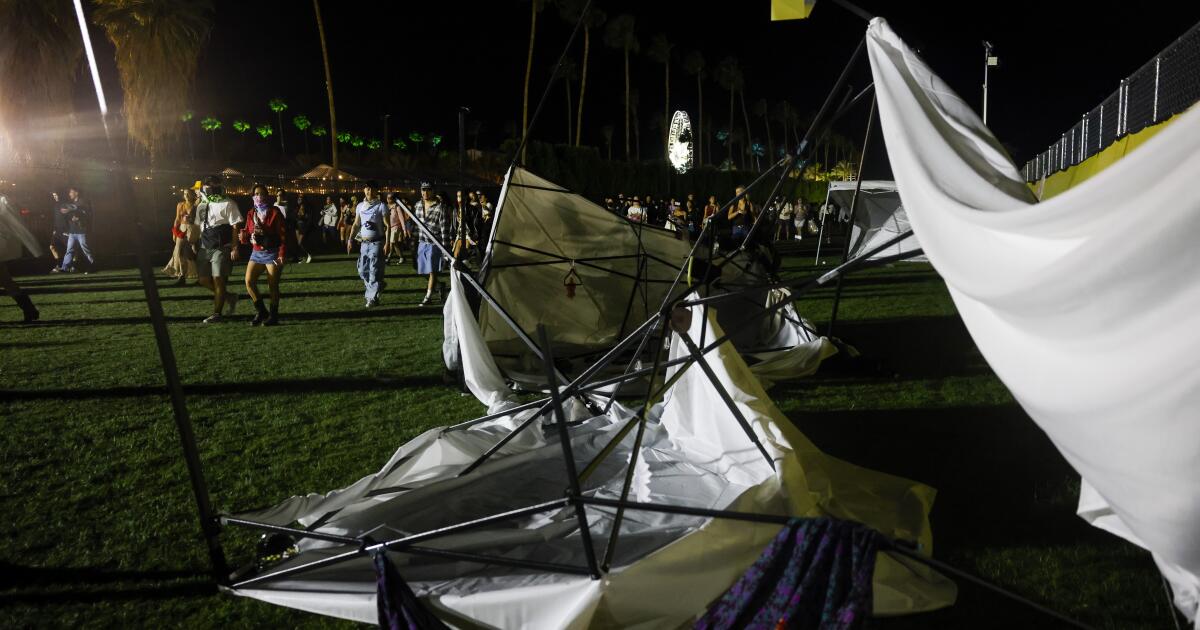
Coachella 2026: Violent winds disrupt festival, campgrounds

Are you truly infatuated with your co-worker, or do you just see them 40 hours a week?

Pressure grows for Swalwell to exit governor’s race, criminal inquiry launched

Florida High School Football Rankings: Top 25 teams – Oct. 21

How old is Bo Nix? What to know about Oregon quarterback ahead of 2024 NFL Draft

Cleary's 21 help Le Moyne down Central Connecticut State 69-64 in OT

99th annual Pony Swim held in Virginia

Indiana Members Credit Union announced as new anchor tenant at Bottleworks District

Pope Leo urges world leaders to reject war and negotiate peace

Manhattan DA’s office to investigate Swalwell sexual assault allegation

NASA’s Artemis II mission in 20 minutes

Trump adversary running for Senate borrows his filibuster playbook

Russian propaganda unit targets Hungary’s elections
-

 Atlanta, GA7 days ago
1 teenage girl killed, another injured in shooting at Piedmont Park, police say
-

 Movie Reviews1 week ago
Vaazha 2 first half review: Hashir anchors a lively, chaos-filled teen tale
-

 Georgia4 days ago
Georgia House Special Runoff Election 2026 Live Results
-

 Pennsylvania5 days ago
Parents charged after toddler injured by wolf at Pennsylvania zoo
-

 Arkansas1 day ago
Arkansas TV meteorologist Melinda Mayo retires after nearly four decades on air
-
 Milwaukee, WI5 days ago
Potawatomi Casino Hotel evacuated after fire breaks out in rooftop HVAC system
-
 Entertainment1 week ago
Inside Ye’s first comeback show at SoFi Stadium
-

 Indianapolis, IN1 week ago
Fighting Illini begin Final Four preparations in Indianapolis