News
Manhattan DA’s office to investigate Swalwell sexual assault allegation


The Manhattan District Attorney’s Office in New York has launched an investigation into a sexual assault allegation against Rep. Eric Swalwell, D-Calif., NBC News confirmed Saturday.
Multiple women in the last two days have come forward alleging that Swalwell sexually assaulted or harassed them while serving in Congress, including one who alleged he assaulted her in New York. Swalwell has denied the allegations.
A spokesperson for the district attorney’s office urged “survivors and anyone with knowledge of these allegations to contact our Special Victims Division at 212-335-9373. Our specially trained prosecutors, investigators, and counselors are well-equipped to help you in a trauma-informed, survivor-centered manner.”
On Friday, the San Francisco Chronicle reported that one woman said she had sexual encounters with the congressman when he was her boss and alleged that he twice sexually assaulted her when she was too intoxicated to consent. One of those incidents, the woman alleged, took place in New York in 2024.
And later Friday, CNN reported on sexual misconduct allegations against Swalwell from three additional women, including one who said he kissed her without her consent in public and two others who said the congressman sent them unsolicited photos or videos of his penis.
NBC News has not independently corroborated their stories.
CNN was the first to report of the Manhattan District Attorney’s Office investigation.
Representatives for Swalwell’s office and campaign did not immediately respond to requests for comment.
Swalwell on Friday denied the allegations in a video posted to X, telling viewers: “These allegations of sexual assault are flat false. They’re absolutely false. They did not happen. They have never happened, and I will fight them with everything that I have.”
The CNN and San Francisco Chronicle stories were reported just weeks before California voters are set to begin voting in the state’s primary for governor, where Swalwell has been a leading candidate in a crowded field of Democrats, including former Rep. Katie Porter, businessman Tom Steyer and former U.S. Health Secretary Xavier Becerra.
On Friday and Saturday, multiple high-profile figures and groups rescinded their previous endorsements of Swalwell, including the California Federation of Labor Unions and the California chapter of the Service Employees International Union.
Democratic leaders in the House, including House Minority Leader Hakeem Jeffries, D-N.Y., Democratic Whip Katherine Clark, D-Mass., and Democratic Caucus Chair Pete Aguilar, D-Calif., on Friday called the allegations against Swalwell “disturbing” and urged him to “immediately end his campaign to be California’s next Governor.”
On Saturday, two Republican congresswomen vowed to seek punishment against against Swalwell in the wake of the sexual assault allegations.
Rep. Lauren Boebert, R-Colo., said in a post on X that she plans to force a floor vote this week on a resolution to censure Swalwell, which would require a simple majority to succeed.
And Rep. Anna Paulina Luna, R-Fla., said in a post on X that she plans to introduce a resolution to expel Swalwell from Congress. That resolution would have a higher threshold for passage, with two-thirds of the chamber needing to vote in favor.
This is a developing story. Please check back for updates.

Adam Edelman contributed.


Topline
The National Weather Service is cautioning people in states as far south as South Carolina to monitor local air quality as smoke from hundreds of Canadian wildfires pours over the border and American politicians rail against the country as the fires burn out of control.
People sit near the Brooklyn Bridge as wildfire smoke from Canada causes hazy conditions on July 16, 2026 in New York.
AFP via Getty Images
Key Facts
The National Weather Service issued air quality alerts Friday due to wildfire smoke in parts of North Dakota, Minnesota, Michigan, Wisconsin, Illinois, Indiana, Ohio, Pennsylvania, West Virginia, Virginia, Kentucky, North Carolina, South Carolina, New Jersey, Delaware, Rhode Island, New York, Connecticut, Maryland and Washington D.C.
Air quality in parts of Michigan has been declared “hazardous”—the most extreme category—and Wisconsin, Minnesota, Illinois and Indiana are experiencing “very unhealthy” levels of air pollution.
New York, including New York City, New Jersey, Pennsylvania, Ohio, Connecticut, Rhode Island, Delaware and Maryland are warning of “unhealthy” air and a widespread haze from the smoke, and states further south and east are warning sensitive populations may be at risk.
The smoke is spilling across borders from roughly 850 wildfires burning in Canada, many of the largest in Ontario, and more than a dozen fires in northern Minnesota.
Republican members of Congress are slamming Canada’s government for what they perceive as inaction in preventing and stopping the wildfires causing the smoke and poor air quality, with one even calling for sanctions.
Four Michigan Republicans—Reps. John James, Jack Bergman, John Moolenaar and Lisa McClain—said in a letter this week that Canada “has the tools to prevent” the smoke from pouring into the U.S. and “has chosen not to,” and Sen. Bernie Moreno (R-Ohio) said in a post on X that he will table a bill next week to “sanction Canada and the responsible Canadian government officials for this atrocity.”
CRUCIAL QUOTE
“Our constituents are breathing the consequences of this failure right now, and they deserve better than to be told, again, that it will be handled,” the Michigan lawmakers said in their letter.
HOW TO STAY SAFE FROM WILDFIRE SMOKE
Those in states with extreme air quality warnings are being cautioned to limit outdoor activity and, in states with very unhealthy and hazardous warnings, to stay inside altogether with windows closed. Doctors advise anyone with heart or lung disease to stay indoors, and other groups to take precautions. For people who work outside, health officials have recommended wearing an N95 mask, which can filter at least 95% of airborne particles.
WHY IS WIDLFIRE SMOKE SO DANGEROUS?
Smoke from wildfires is made of water vapor, pollutants and particulate matter, which can penetrate the lungs and bloodstream, trigger systemic inflammation, exacerbate conditions like asthma and increase the risk of heart attacks and strokes. Smoke also contains a mix of harmful gases, most notably carbon monoxide. Wildfire smoke has been linked to respiratory and cardiovascular health problems, with children and teenagers, older adults, pregnant people and anyone with pre-existing heart or lung conditions at a particular risk.
SHOULD PEOPLE IN WILDFIRE SMOKE STATES WEAR A MASK?
When the Air Quality Index rises to unhealthy levels—as it has in Michigan, Wisconsin, Minnesota, Illinois, New York, New Jersey, Massachusetts and Connecticut on Thursday—masks are recommended for people who must spend time outside. Respirator masks worn correctly may provide some protection against fine particles in the smoke, but they do not help with hazardous gases. Staying inside is considered the safest option, but those who must go outside can mitigate some risk by wearing a mask. N95 or P100 respirators are considered the most effective.
Key background
Scientists say climate change is creating hotter, drier conditions and longer fire seasons, increasing the likelihood of large, intense wildfires across North America. NASA says human-caused warming is driving more frequent and severe wildfire conditions in many regions, and that extreme wildfire activity has more than doubled worldwide over the past two decades. Research shows fire seasons in some areas are now more than a month longer than they were 35 years ago, and those larger fires also produce more smoke, allowing hazardous air pollution to travel hundreds or even thousands of miles and affect millions of people far from the flames.
BIG NUMBER
$394 billion to $893 billion. That’s the annual cost of wildfires in the United States each year, according to the Joint Economic Committee, including direct and indirect deaths and injuries, health impacts from wildfire smoke, income loss, watershed pollution and other factors.
further reading

A person views the Guadalupe River after flash flooding occurred along its banks on July 16, 2026 in Center Point, Texas. Flash floods swept across parts of Central Texas, prompting evacuations and triggering multiple water rescues.
Brandon Bell/Getty Images
hide caption
toggle caption
Brandon Bell/Getty Images
Dangerous floods are hitting South Central Texas — a region that just marked one year since more than 130 people died in catastrophic flooding. Gov. Greg Abbott says at least two people have died in the current emergency.
More than 230 rescues have been made, the governor said Thursday evening, adding that more than 2,350 responders and 1,400 vehicles have been deployed.
A wide swath of Texas is under flood alerts, from the Kerrville area south to Uvalde and beyond to Laredo. In parts of Uvalde County, muddy floodwaters covered roads and fields and rose nearly as high as houses’ rooftops, according to a video posted by Texas Department of Public Safety.
With heavy rains expected to continue into Friday, Abbott said Uvalde and Johnson City are at the greatest risk of life-threatening floods overnight.
“The people in that area need to be very cautious,” Abbott said.
In some cases, communities that endured flooding on Wednesday are being deluged once again.
“Showers and thunderstorms continue developing and moving into areas that are currently experiencing dangerous flooding conditions,” the National Weather Service office in San Antonio and Austin said.
NPR member stations in Texas are covering the floods. In some cases, residents tell reporters that flooding exceeds levels they saw in 2025.
In Kerrville, the city police department said in a noon update that while high water had mostly receded, the emergency is ongoing, with numerous road and bridge closures. The agency urged residents not to venture out.
“There is a lot of people driving around to take a look and that is not helpful,” the police said.
At least one summer camp has evacuated, according to the Texas Newsroom, and state lawmakers say they’re seeing an improved safety response to the floods, thanks to an increase in disaster resources such as funding for warning systems and flood mitigation.
The Guadalupe River rose at terrifying speed near Comfort, Texas, Thursday morning — from 5.46 feet at 5 a.m. CT to 37.05 feet at 8:05 a.m. — according to the U.S. Geological Survey.
Flood sirens blared Thursday morning in the town, northwest of San Antonio that’s some 35 miles east of Camp Mystic.
“We have already had several vehicles swept away,” the Comfort Volunteer Fire Department said on social media, urging people to stay off the roads. It posted a video of fast-moving high water moving through a neighborhood.
“Even if the rain has stopped where you are, water levels are likely to continue surging throughout the day as runoff from upstream moves through our creeks and rivers,” the department said.
Gov. Greg Abbott warned that the flood will likely break records, in an area that’s historically prone to flooding.
“I want to give you a comparison: The Fourth of July floods last year had rainfall of 20.29 inches,” Abbott said, according to the Texas Newsroom. “The expected rainfall during this rainstorm is expected to be more than 30 inches.”
Camp Mystic, a Christian summer camp, remains shut down after 25 campers and two counselors died last year — the result of a wall of water rushing down the Guadalupe River. They were among the more than 130 people who died across the Hill Country region.
More excessive rainfall is forecast across the Texas Hill Country Thursday, with the storm moving westward toward the Big Bend region on Friday, according to the National Weather Service.
News
Trump’s ‘American Flag Blue’ in the Lincoln Memorial pool is already gray — and the Olympic canoer ‘vandal’ is fighting his arrest | Fortune

The newly drained Lincoln Memorial Reflecting Pool’s bottom surface has noticeably faded since it was lined with a protective coating in a color President Donald Trump called “American flag blue” this spring.
An Associated Press reporter and photographer viewed the fenced-off Reflecting Pool on Wednesday from the top of the Washington Monument. The new liner appears grayer than when the pool was repainted and refilled with water in early June. Debris that had been visible earlier this week after the pool was drained is now largely gone, after work crews removed it.
Trump’s problem-plagued effort to revamp the landmark has stretched well past his initial goal of having the Reflecting Pool ready by July 4 for the nation’s 250th birthday.
The president at first suggested his renovations would cost $1.5 million, but the bill ballooned to more than $16 million by June.
Trump had said the repairs would last a century, but within days of the project’s initial completion last month, the water was beset by an algae bloom and pieces of the new coating appeared to be peeling off the bottom.
Ohio-based Green Water Solutions, also known as Greenwater Services, was given a $1.7 million contract to install a water-purification system in the Reflecting Pool, while Virginia-based Atlantic Industrial Coatings was awarded $14.7 million to repaint and waterproof the pool’s concrete floor.
Vandalism charges were levied against a former Olympic canoeist
Trump has repeatedly blamed vandals for the peeling paint, though critics allege it’s from shoddy repair work.
Trump has said, without citing evidence, that vandals made a “350-foot gash” in the liner and caused other problems. No large slash marks were immediately visible Wednesday from the Washington Monument view. It was not possible to do a more up-close inspection of the entire pool due to a dark fence surrounding the perimeter.
Interior Secretary Doug Burgum, whose agency oversees the National Park Service, said that after the water is drained and debris is cleaned from Independence Day fireworks, the plan for the pool is straightforward: “Repair the vandalism that was done. Fill it back up again.” He was speaking with conservative podcaster Katie Miller.
Court documents show that the National Park Service reported to the U.S. Park Police a June 9 incident in which a sharp knife or razor was said to have cut the pool’s new liner.
Former Olympic canoe racer David Hearn pleaded not guilty last week in D.C. Superior Court to deliberately damaging the Reflecting Pool. Hearn has said he reached inside the pool to examine the peeled sealant and let go of a chunk when he was told to by a park worker.
His attorneys and other Trump administration critics have derided the case as an abuse of prosecutorial power and maintain he is being scapegoated for the poor job done fixing up the Reflecting Pool.
At least three other people have been charged in the same court with misdemeanors for allegedly removing pieces of paint from the pool, court records show. All three pleaded not guilty during initial court appearances.
The work on the Reflecting Pool is just one of a number of projects Trump has spearheaded across the nation’s capital. Most prominently, he demolished the White House’s East Wing to build a $400 million ballroom and plans to build a towering arch. between the Lincoln Memorial and Arlington National Cemetery.
-
 Sports4 minutes ago
World Cup championship and third-place game: Start times and how to watch
-

 World16 minutes ago
Rule of Law in Hungary shows ‘radical change’ under Magyar, EU says
-

 News46 minutes ago
Where Wildfire Smoke Is The Worst Right Now—And What To Do About It
-

 Los Angeles, Ca2 hours ago
LADWP begins long-term repairs after West Hollywood water main rupture
-

 Detroit, MI3 hours ago
Livestream: Mayor Sheffield, Detroit health chief to address wildfire smoke threat
-
 San Francisco, CA3 hours ago
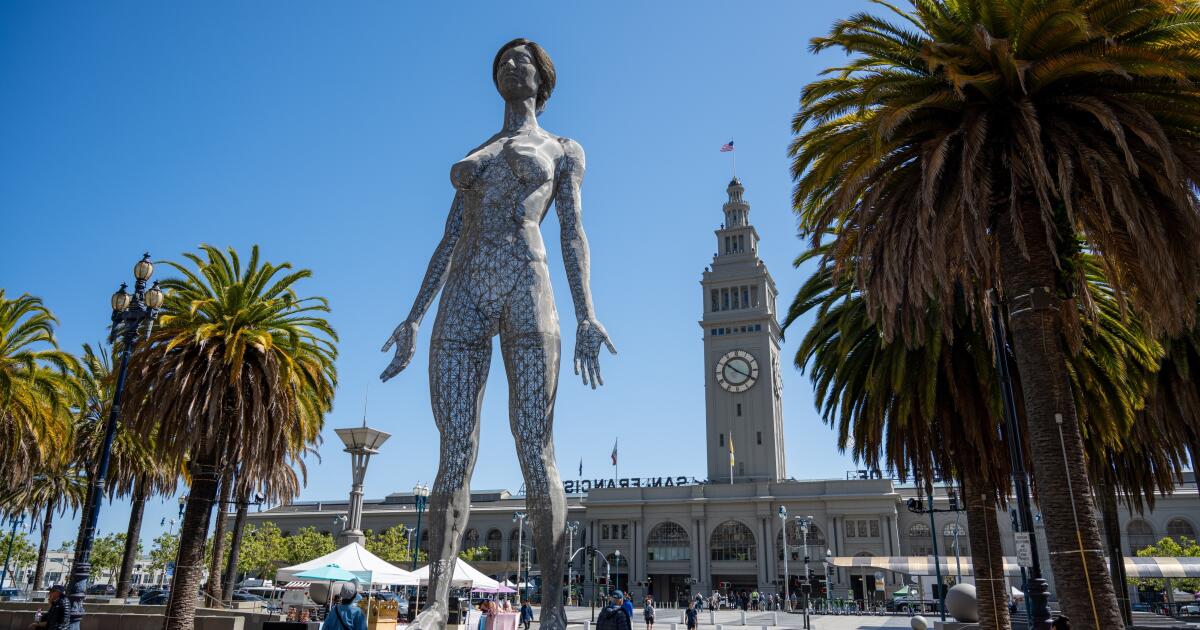
A sculpture of a giant naked woman goes on sale in San Francisco. Bring a crane
-

 Dallas, TX3 hours ago
No ‘straight answer’: Why Pioneer Cemetery is the latest battleground at City Hall
-

 Miami, FL3 hours ago
TSA hosts news conference ahead of World Cup third place match at Miami Stadium

