Connect with us

Science

In Taxicab Geometry, Pi Equals 4 and Circles Aren’t Round

Published

on

In Taxicab Geometry, Pi Equals 4 and Circles Aren’t Round

A red Etch A Sketch toy set against a light purple background displays an animation of a simple line drawing.

Math, Revealed

Advertisement

Welcome to a city where pi equals 4 and circles aren’t round.

Each installment of “Math, Revealed” starts with an object, uncovers the math behind it and follows it to places you wouldn’t expect. Sign up here for the weekly Science Times newsletter for upcoming installments.

Advertisement

A red Etch A Sketch toy set against a light purple background displays an animation of a simple line drawing.

The Etch A Sketch is a marvel of space-age technology. It’s like a sheet of paper, a pencil, a portable table and an eraser all rolled into one.

One knob draws horizontal lines on the screen. The other produces vertical lines.

Advertisement

A red Etch A Sketch screen displays an intricate line drawing resembling Van Gogh’s “Starry Night,” set against a light purple background.

By turning both knobs simultaneously, you can draw diagonal lines, smooth curves or even pay homage to Van Gogh, as in this sketch by Princess Etch:

Advertisement

The Etch A Sketch shakes back and forth and Van Gogh’s “Starry Night” disappears, revealing a clear screen.

From a mathematical perspective, an Etch A Sketch showcases a space in which two directions, horizontal and vertical, are favored above all others.

Advertisement

Map of Manhattan, NY, showing various neighborhoods like Harlem, Upper West Side, Times Square, and Chelsea, with surrounding bodies of water, against a light purple background.

Anyone who has spent time in Manhattan will be familiar with a space like this. The cityscape is organized around two perpendicular directions: uptown/downtown and crosstown.

Advertisement

Zoom into the map of Manhattan, and a small toy yellow taxi moves on top of the map.

Indeed, mathematicians use terms like Manhattan geometry or taxicab geometry to describe spaces like these. Here, the distance between two points is defined commonsensically as the sum of their horizontal and vertical separations.

Advertisement

On the map of Manhattan, two red lines are drawn on the streets to form a right angle. Each of the red lines has a number 1 next to them.

For example, suppose you’re meeting a friend in the city and you have to go a mile crosstown and a mile uptown to get there by cab.

Advertisement

Then it’s natural to say that you have to travel 1 + 1 = 2 miles by taxi to get there.

On the map of Manhattan, red lines forming a triangle are drawn on the streets, with the two perpendicular sides labeled a and b, and the hypotenuse labeled c.

Advertisement

Of course, that’s not how you learned to calculate distances in school.

Back then, you used the Pythagorean theorem, the most important result in Euclidean geometry. It says that in a right triangle, the length c of the hypotenuse satisfies a2 + b2 = c2, where a and b are the lengths of the sides:

On the map of Manhattan, red lines forming a triangle are drawn on the streets, with the two perpendicular sides labeled a and b, and the hypotenuse labeled c.

Advertisement

This math would apply if all directions were equally available to you — say, if you were a crow flying overhead. Then you’d travel a diagonal distance c, equal to the square root of 12 + 12 (or 2), since both a and b equal 1 mile. The square root of 2 is about 1.41 miles — that’s c as the crow flies.

Same red triangle on the Manhattan map, with perpendicular lines labeled a and b, and the hypotenuse labeled c.

Advertisement

But on a grid ruled by taxicab geometry, where the roads are what matter, distance becomes much simpler: a + b = c.

Same red triangle on the Manhattan map, with perpendicular lines labeled a and b, and the hypotenuse labeled c.

Advertisement

That boils down to 1 + 1 = 2 miles traveled by taxi, just as before.

A yellow toy taxi with a checkered roof sits atop a map of Manhattan, positioned over the Times Square and Midtown West areas.

Advertisement

You have to admit: Taxicab geometry has its advantages!

Close-up of a yellow toy taxi, showing checkered stripes, “TAXI” on the roof sign, and a logo with checkered flags on the door, against a purple background.

Advertisement

But it also leads to surprises.

A wooden checkerboard with alternating black and light wood squares, centered on a light purple background.

Advertisement

For instance, what does a circle of radius 3 look like in this grid-based geometry?

Same wooden checkerboard against a light purple background, with four red checkers, equally spaced, forming a diamond shape and one black checker in the center.

Advertisement

To find out, let’s start by drawing four red dots, each 3 units away from a central black dot, as measured horizontally or vertically.

Same wooden checkerboard against a light purple background, with 12 red checkers, equally spaced, forming a diamond shape and one black checker in the center.

Advertisement

Those aren’t the only points that are 3 units away from the center. All the new points shown also qualify since they’re 1 + 2 = 3 units away.

Same wooden checkerboard against a light purple background, with four red lines of equal length forming a diamond.

Advertisement

Points with horizontal plus vertical separations like 1.38 + 1.62 would also work, as long as the two numbers add up to 3.

Connecting all the dots, we discover that a circle in taxicab geometry looks like a diamond. It has corners, and it’s not round. One of my students shouted in protest when she realized this.

Same wooden checkerboard against a light purple background, with a red diamond and red dashes across the center connecting the right and left corners of the diamond.

Advertisement

Even more surprising is the value of pi in this strange, non-Euclidean geometry.

Recall that pi is defined as the ratio of the circumference of a circle to its diameter.

To find the circumference, observe that our circle of radius 3 is composed of four arcs, the four sides of the diamond. Each arc is 6 taxicab units long, since it extends 3 units horizontally and 3 units vertically.

Advertisement

Same wooden checkerboard against a light purple background, with a red diamond and red dashes across the center and two numeral 6s next to one side of the diamond and the center dashed line.

Taken together, those four arcs yield a circle of circumference 4 × 6 = 24. The diameter, for its part, is 6 units long, as shown by the red dashed line. Thus, the circumference divided by the diameter equals 24/6, so pi equals 4 in taxicab geometry.

Advertisement

A wooden checkerboard with alternating black and light wood squares, shown at an angle against a light purple background.

By now, you’re probably wondering why anybody would use this weird geometry. There are at least two reasons.

Advertisement

Same wooden checkerboard on a light purple background, with a small, retro-style toy robot moving across it.

In some real-world settings, taxicab geometry is more convenient, and more relevant, than Euclidean geometry. Engineers use it when planning the most efficient paths for robots to take when navigating a grid of rails in a shipping fulfillment warehouse.

Advertisement

Same wooden checkerboard on a light purple background, with a small, retro-style toy robot moving in a square formation on the board.

In the design of computer chips, taxicab geometry makes it easier to estimate the length of wire connecting electronic components; that’s important for optimizing chip layout. Likewise, in digital image processing, taxicab distance provides the simplest way to measure how far apart pixels are. This is essential for finding outlines and grouping similar parts of the image together.

Advertisement

A red Etch A Sketch screen displays a line drawing of a checkered taxi cab, set against a light purple background.

Beyond its practical uses, taxicab geometry upends our assumptions about space by reimagining circles as angular shapes.

Advertisement

A red Etch A Sketch screen displays a line drawing of a checkered taxi cab, set against a light purple background.

It’s a topsy-turvy take on the Etch A Sketch’s lesson: that a simple toy, seemingly confined to making straight lines, can defy that limitation and produce curves through sheer ingenuity.

Advertisement

In math and in play, the human spirit expresses itself beyond the lines.

Science

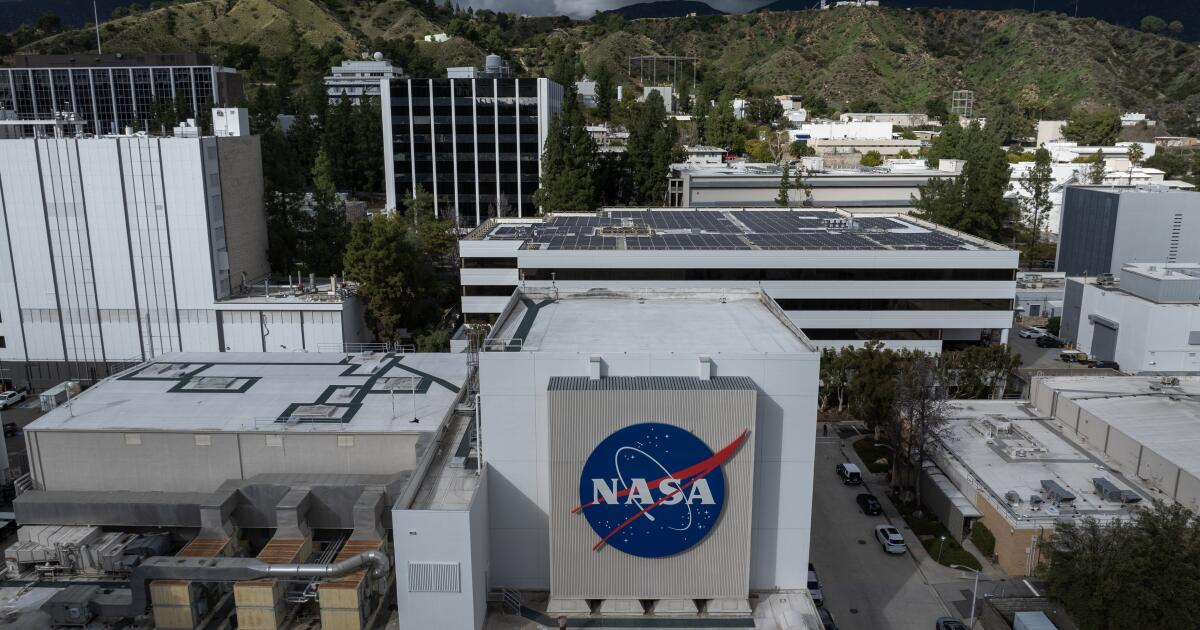
A renewed threat to JPL as the Trump administration tries again to cut NASA

Published

on

A renewed threat to JPL as the Trump administration tries again to cut NASA

NASA recaptured the world’s attention with Artemis II, which took astronauts to the moon and back for the first time in half a century. But the agency’s scientific projects could again be under threat as the Trump administration makes a renewed push to drastically cut their funding — including at the Jet Propulsion Laboratory.

The cuts, proposed in the Trump administration’s 2027 budget request to Congress, would pose further challenges to the already weakened Caltech-managed lab and could be broadly damaging to American efforts to bring back new discoveries from space. They echo last year’s attempt by the administration to slash NASA funding, which Congress rejected.

Though the Artemis project is billed as laying a foundation for a crewed NASA mission to Mars, exploration of the Red Planet is among the endeavors that could be slashed. The rover currently exploring Mars’ ancient river delta and a mission to orbit Venus are among projects with JPL involvement targeted for spending cuts, according to an analysis of the NASA budget proposal by the nonprofit Planetary Society.

“This isn’t [because] they’re not producing good science anymore. There’s no rhyme or reason to it,” said Casey Dreier, chief of space policy at the Planetary Society, which led opposition to the administration’s similar effort to cut NASA funding last year.

Storm clouds hang over the Jet Propulsion Laboratory on Feb. 7, 2024.

Advertisement

(David McNew / Getty Images)

This time, the administration is asking Congress to cut NASA funding by 23% — including a 46% cut to its science programs, which are responsible for developing spacecraft, sending them into outer space to observe and analyzing the data they send back.

The proposal would cancel 53 science missions and reduce funding for others, according to the Planetary Society analysis. The effort to pare down NASA Science comes amid the Trump administration’s broader effort to cut scientific research across federal agencies.

The plan swiftly drew bipartisan criticism from members of Congress, who rejected the administration’s similar 2026 proposal in January. Republican Sen. Jerry Moran of Kansas, who chairs the Senate appropriations subcommittee that oversees NASA, indicated last week that he would work to fund NASA similarly for 2027, saying it would be “a mistake” not to fund science missions.

Advertisement

Moran plans to hold a hearing with NASA Administrator Jared Isaacman before the end of April to review the budget request, a spokesperson for his office said. The president’s budget request is an ask to Congress, which ultimately holds the power to allocate funding.

But until Congress creates its own budget, NASA will use the plan as its road map, which could slow grants and contracts. The proposal “still creates enormous chaos and uncertainty in the meantime for critical missions, the scientific workforce, and long-term research planning,” said Rep. Judy Chu (D-Monterey Park), whose district includes JPL.

A NASA spokesperson declined to comment Friday. In the budget request, Isaacman wrote that NASA was “pursuing a focused and right-sized portfolio” for its space science missions in order to align with Trump’s federal cost-cutting goals.

The budget “reinforces U.S. leadership in space science through groundbreaking missions, completed research, and next-generation observatories,” Isaacman wrote.

Jared Isaacman testifies during his confirmation hearing to be the NASA administrator

Jared Isaacman testifies during his confirmation hearing to be the NASA administrator in the Russell Senate Office Building on Capitol Hill on Dec. 3, 2025.

(Anna Moneymaker / Getty Images)

Advertisement

At JPL — which has for decades led innovation in space science and technology from its La Cañada Flintridge campus — questions had already swirled about the lab’s role in the future of NASA work.

Multiple rounds of layoffs over the last two years, the defunding of its embattled Mars Sample Return mission and a shift by the Trump administration toward lunar exploration and away from the type of scientific work that JPL executes had pushed the lab into a challenging stretch.

It has had a steady stream of employee departures in recent months, and those left have been scrambling to court outside funding from private investors, sell JPL technology to companies and increase productivity in hopes of keeping the lab afloat, according to two former staffers, who requested anonymity to describe the mood inside the lab.

“If we’re not doing science, then what are we doing?” asked one former employee, who recently left JPL after more than a decade there.

Advertisement

A spokesperson for the lab declined to comment, referring The Times to the budget proposal.

The NASA programs marked for cancellation or cutbacks support thousands of jobs at JPL and other centers, said Chu, who has led a push for increased funding for NASA Science. After last year’s layoffs, JPL “cannot afford to lose more of this expertise,” she said in a statement.

Among the JPL projects that appear to be slated for cancellation are two involving Venus, Dreier said. One, Veritas, is early in development and would give work to the lab for the next several years, he said.

The project would be the first U.S. mission to Venus in more than 30 years, Dreier said, and aims to make a high-resolution mapping of the planet’s surface and observe its atmosphere.

The Perseverance rover, which is on Mars collecting rock and soil samples, could face spending reductions. The budget request proposes pulling some funding from Perseverance to fund other planetary science missions and reducing “the pace of operations” for the rover.

Advertisement

Though how the Mars samples might get back to Earth is uncertain, the rover is still being used to explore the planet and search for evidence of whether it could have ever been habitable to life.

Researchers hope the tubes of Martian rock, soil and sediment can eventually be brought back to Earth for study. The team has about a half a dozen more sample tubes to fill and the rover is in good shape, said Jim Bell, a planetary scientist and Arizona State University professor who leads the camera team on Perseverance, which works daily with JPL.

He said NASA’s spending proposal put forth “no plan” for the future of the agency’s work.

“Are people just supposed to walk away from their consoles,” Bell asked, “and let these orbiters around other planets or rovers on other worlds — just let them die?”

The NASA document did not clearly show which programs were targeted for cuts and did not list which projects were targeted for cancellation. The Planetary Society and the American Astronomical Society each analyzed the proposal and found that dozens of projects appeared to be canceled without being named in the document.

Advertisement

Across NASA, other projects slated for cancellation according to the Planetary Society’s analysis include New Horizons, a spacecraft exploring the outer edge of the solar system; the Atmosphere Observing System, a planned project to collect weather, air quality and climate data; and Juno, a spacecraft studying Jupiter.

The administration’s plan also doesn’t prioritize new scientific projects, Bell said, which further jeopardizes long-term job stability and space discovery at centers like JPL.

“We’re going through this long stretch now with very few opportunities to build these spacecrafts,” Bell said. “All of the NASA centers are suffering from the lack of opportunities.”

Last year, the Trump administration proposed to slash NASA’s 2026 funding by nearly half. Instead, Congress approved funding in January that provided $24.4 billion for the agency — a cut of about 29% rather than the proposed 46%. The 2027 budget request asks for $18.8 billion.

Congress kept funding for science missions nearly steady, allocating $7.25 billion for science missions, about a 1% decrease from 2025. The administration had proposed cutting the science investment down to $3.91 billion. This time, the budget requests $3.89 billion.

Advertisement

Under the Trump administration, NASA has put an emphasis on moon exploration, including this month’s successful Artemis II mission. Isaacman, who defended the proposed cuts on CNN last week, touted the agency’s lunar plans, including a project to build a base on the moon.

The agency has indicated commitment to some existing science missions, including the James Webb Space Telescope, the to-be-launched Nancy Grace Roman Space Telescope, the Dragonfly spacecraft set to launch for Saturn’s moon in 2028, and other projects.

“NASA doesn’t have a topline problem, we just need to focus on executing and delivering world-changing outcomes,” Isaacman said on CNN.

Scientists have urged the government not to choose between funding science and exploration but to keep up investment in both.

“It’s ultimately kind of confusing, especially on the heels of the Artemis II mission,” said Roohi Dalal, deputy director for public policy at the American Astronomical Society. “The scientific community … is providing critical services to ensure that the astronauts are able to carry out their mission safely, and yet at the same time, they’re facing this significant cut.”

Advertisement
Continue Reading

Science

What to plant (and what to remove) in California’s new ‘Zone Zero’ fire-safety proposal

Published

on

What to plant (and what to remove) in California’s new ‘Zone Zero’ fire-safety proposal

After years of heated debates among fire officials, scientists and local advocates, California’s Board of Forestry and Fire Protection released new proposed landscaping rules for fire-prone areas Friday that outline what residents can and can’t do within the first 5 feet of their homes.

Many of these proposed rules — designed to reduce the risk of a home burning down amid a wildfire — have wide support (or at least acceptance); however, the most contentious by far has been whether the state would allow healthy plants in the zone.

Many fire officials and safety advocates have essentially argued anything that can burn, will burn and have supported removing virtually anything capable of combustion from this zone within 5 feet of houses, dubbed “Zone Zero.” They point to the string of devastating urban wildfires in recent years as reason to move quickly.

Yet, researchers who study the array of benefits shade and extra foliage can bring to neighborhoods — and local advocates who are worried about the money and labor needed to comply with the regulations — have argued that this approach goes beyond what current science shows is effective. They have, instead, generally been in favor of allowing green, healthy plants within the zone.

The new draft regulations attempt to bridge the gap. They outline more stringent requirements to remove all plants in a new “Safety Zone” within a foot of the house and within a bigger buffer around potential vulnerabilities in a home’s wildfire armor, including windows that can shatter in extreme heat and wooden decks that can easily burst into flames. Everywhere else, the rules would allow residents to maintain some plants, although still with significant restrictions.

Advertisement

The rules generally do not require the removal of healthy trees — instead, they require giving these trees routine haircuts.

Once the state adopts a final version of the rules, homeowners would have three years to get their landscaping in order and up to five years for the bigger asks, including removing all vegetation from the Safety Zone and updating combustible fencing and sheds within 5 feet of the home. New constructions would have to comply immediately.

The rules only apply to areas with notable fire hazard, including urban areas that Cal Fire has determined have “very high” fire hazard and rural wildlands.

Officials with the Board will meet in Calabasas on Thursday from 1 p.m. to 7 p.m. to discuss the new proposal and hear from residents.

Advertisement
  • Share via

Advertisement

Some L.A. residents are championing a proposed fire-safety rule, referred to as “Zone Zero,” requiring the clearance of flammable material within the first five feet of homes. Others are skeptical of its value.

Where is the Safety Zone?

The proposed Safety Zone with stricter requirements to remove all vegetation would extend 1 foot from the exterior walls of a house.

In a few areas with heightened vulnerabilities to wildfires, it extends further.

Advertisement

The Safety Zone covers any land under the overhang of roofs. If the overhang extends 3 feet, so does the Safety Zone in that area. It also extends 2 feet out from any windows, doors and vents, as well as 5 feet out from attached decks.

What plants would be allowed in the Safety Zone?

Generally, nothing that can burn can sit in the Safety Zone. This includes mulch, green grass, bushes and flowers.

What plants would be allowed in the rest of Zone Zero?

Homeowners can keep grasses (and other ground-covers, like moss) in this area, as long as it’s trimmed down to no taller than 3 inches.

The rules also allow small plants — from begonias to succulents — up to 18 inches tall as long as they are spaced out in groups. Residents can also keep spaced-out potted plants under this height, as long as they’re easily movable.

What about fences, trees and gates?

Any sheds or other outbuildings would need noncombustible exterior walls and roofs in Zone Zero — Safety Zone or not.

Advertisement

Residents would have to replace the first five feet of any combustible fencing or gates attached to their house with something made out of a noncombustible material, such as metal.

Trees generally would be allowed in Zone Zero. Homeowners would need to keep any branches one foot away from the walls, five feet above the roof and 10 feet from chimneys.

Residents would also have to remove any branches from the lower third of the tree (or up to 6 feet, whichever is shorter) to prevent fires on the ground from climbing into the canopy.

Some trees with trunks directly up against a house in this 1-foot buffer or under the roof’s overhang might need to go — since keeping branches away from the home could prove difficult (or impossible).

However, the board stressed it wants to avoid the removal of trees whenever feasible and encouraged homeowners to work with their local fire department’s inspectors to find case-by-case solutions.

Advertisement

What’s new and what’s not

Some of the rules discussed in Zone Zero are not new — they’ve been on the books for years, classified as requirements for Zone One, extending 30 feet from the home with generally less strict rules, and Zone Two, extending 100 feet from the house with the least strict rules.

For example, homeowners are already required to remove any dead or dying grasses, plants and trees. They also have to remove leaves, twigs and needles from gutters, and they already cannot keep exposed firewood in piles next to their house.

Residents are also already required to keep grasses shorter than 4 inches; Zone Zero lowers this by an inch.

Advertisement
Continue Reading

Science

Video: Rescuers Mount a Likely Final Push to Save a Stranded Whale

Published

on

Video: Rescuers Mount a Likely Final Push to Save a Stranded Whale

new video loaded: Rescuers Mount a Likely Final Push to Save a Stranded Whale

Rescue crews mounted a likely final push to save a stranded humpback whale off the coast of Northern Germany on Friday. The large mammal, nicknamed “Timmy,” captivated the nation after it was stranded in shallow waters for weeks.

By Jorge Mitssunaga

April 17, 2026

Continue Reading
Advertisement

Trending