Science
How the U.S. Became the World’s Biggest Gas Supplier


Top exporters of liquefied natural gas
Source: S&P Global
Note: Data reflects annual average liquefied natural gas exports by country.
In just eight years, the United States has rocketed from barely selling any gas overseas to becoming the world’s No. 1 supplier, a remarkable shift that has profited oil and gas companies and strengthened American influence abroad. But climate activists worry that soaring exports of liquefied natural gas could make global warming worse.
Last month, the Biden administration said it would pause the permitting process for new facilities that export liquefied natural gas in order to study their impact on climate change, the economy and national security. Even with the pause, the United States is still on track to nearly double its export capacity by 2027 because of projects already permitted and under construction. But any expansions beyond that are now in doubt.
At the core of the debate over whether to allow more exports is a thorny question: With governments across the globe pledging to transition away from fossil fuels, how much more natural gas does the world need?
America’s gas export boom initially caught many policymakers by surprise. In the early 2000s, natural gas was relatively scarce at home, and companies were spending billions of dollars to build terminals to import gas from places like Qatar and Australia.
Fracking changed all that. In the mid-2000s, U.S. drillers perfected methods to unlock vast reserves of cheap natural gas from shale rock. At the same time, natural gas prices began spiking elsewhere in the world, especially after Japan shut down its nuclear plants in the wake of the Fukushima reactor meltdown in 2011 and began demanding more fuel.
That led to a stunning reversal. American companies, led by Cheniere Energy, began spending billions more to convert import terminals into export terminals, and shipments of U.S. gas to other countries began to surge.
‘Major demand growth’
Natural gas is most easily transported by pipeline. To send it across oceans, the gas must be chilled to 260 degrees Fahrenheit below zero, turning it into a liquid. The process of making and shipping liquefied natural gas adds complexity and cost, but if the difference between U.S. natural gas prices and overseas prices is big enough, it is profitable.
“It comes down to economics,” said Kenneth Medlock, senior director at the Center for Energy Studies at Rice University. “Production just keeps growing in the United States, which keeps prices low. And then we keep seeing major demand growth in the rest of the world.”
The export boom has transformed America’s role in energy geopolitics.
Source: Department of Energy Note: Data available through Oct. 2023
Where U.S. liquefied natural gas exports go
Europe has become the biggest importer of American gas in recent years, enabling the continent to slash by more than half its reliance on Russian gas since Russia’s invasion of Ukraine in 2022.
In the future, Europe is expected to curb its appetite for gas by adding more renewable energy sources like wind and solar power. The main growth markets for natural gas are expected to be fast-growing Asian countries such as China, India, Pakistan, Bangladesh and Vietnam that want to use the fuel for electricity, heating or industrial purposes.
But as U.S. exports keep skyrocketing, critics have raised concerns about the climate change impact of transporting and selling more gas around the world.
A complex climate question
The last time the Energy Department studied this issue, in 2019, it concluded that U.S. liquefied natural gas often produced fewer greenhouse gas emissions than other types of coal or gas used around the world. That meant that more exports could actually be beneficial for climate change if U.S. gas replaced those other fossil fuels. (When gas is scarce, some countries like Pakistan and Bangladesh have recently opted to burn more coal instead.)
But some environmentalists have disputed those conclusions, arguing that the analysis didn’t fully account for all the planet-warming methane leaks that can accompany natural gas production, and that it didn’t study whether a glut of gas might displace cleaner renewable energy rather than coal. The Energy Department is expected to study these questions while it puts permits for new projects on hold.
In the meantime, the U.S. gas boom is far from over, even with the permitting pause.
Source: U.S. Energy Information Administration Note: Export capacity shown reflects each facility’s baseload capacity. Start dates are approximate.
U.S. export capacity is set to nearly double, even with a permitting pause
Since 2016, U.S. energy companies have built seven large facilities in Texas, Louisiana, Maryland and Georgia that can export around 11.4 billion cubic feet of liquefied natural gas per day, according to the Energy Information Administration.
Another five projects along the Gulf Coast are already permitted and under construction and will be able to export an additional 9.7 billion cubic feet per day by 2027 — nearly doubling America’s export capacity. Three more facilities are currently being built in Mexico that will receive U.S. gas by pipeline and then ship it abroad.
The pause, however, could affect nearly a dozen proposed projects in the United States and Mexico that, if built, could boost export capacity by another 10 billion cubic feet per day, according to research by Clearview Energy Partners, a consulting firm. Whether those projects ultimately go forward remains to be seen.
With so many projects locked in, experts say it will be crucial to ensure that methane leaks from gas production are kept as low as possible. (The Biden administration has put forward several new regulations on methane.) “This is an area where we can actually deliver an emissions win, maybe more so than delaying or even killing a future supply project,” said Ben Cahill, a senior fellow at the Center for Strategic and International Studies. “Because it’s what we do with the emissions on the projects that we know are with us today.”


For the third year in a row, accidental drug-related overdose and poisoning deaths have dropped in Los Angeles County, a decline officials attribute to ongoing investments in prevention and harm reduction resources countywide.
There were 2,298 accidental drug overdose and poisoning deaths in 2025, down 6%, a relatively small drop from 2,438 the prior year but an overall substantial reduction from the all-time high of 3,220 deaths countywide in 2022, according to a recent report from the Los Angeles County Department of Public Health.
Drug overdoses continue to be the leading cause of accidental deaths countywide — surpassing the deaths due to vehicle crashes and firearms in 2017 combined — with methamphetamine and fentanyl most often involved in the overdoses.
The problem reached a historic high in 2022 when fentanyl surpassed methamphetamine as the most common drug listed as a cause of overdose deaths. At the time, the number of overdoses in general had increased across the board.
However, these accidental deaths have been on a downward trend, with a nearly 30% overall decrease in drug-related overdoses from 2022 to 2025. Fentanyl-related deaths dropped by 40% and methamphetamine-related deaths declined by 25% in that period.
Officials said in the report that the numbers are more modest compared with 2024, when accidental overdose deaths plunged overall by 22%, which they said “demonstrates sustained progress in the County’s efforts to address the overdose crisis.”
“Three consecutive years of fewer overdose deaths in LA County is proof that sustained investments in prevention, harm reduction, treatment, and recovery services saves lives,” Barbara Ferrer, director of the Los Angeles County Department of Public Health, said in a statement.
Ferrer credited the continued reduction to outreach workers and community partners who “are working every day to connect people to treatment, distribute lifesaving naloxone and meet people where they are without judgment.”
The department continues to invest in a coordinated spectrum of community-based overdose prevention efforts that include the Fentanyl Frontline — a multimedia campaign focused on the widespread distribution of naloxone — and ByLAforLA.org, a community-powered platform that connects residents to lifesaving services with an aim to reduce stigma.
The health department report also found:
- Los Angeles County overdose deaths declined across most age groups in 2025 but deaths among adults 65 and older increased by 14%.
- Although older adults accounted for only 11% of all overdose deaths, this increase contrasts with the broader downward trend observed across other age groups, according to the report.
- Those aged 40 to 64 remained the most affected group, accounting for 53% of overdose deaths last year.
- Communities with 30% of residents living below the federal poverty level had a higher rate of drug overdose deaths than areas with less than 10% of families living below the federal poverty level.
- By race, Black residents continued to experience the highest overdose death rates in 2025.
- By gender, a persistent disparity remains, with men accounting for most overdose deaths, nearly 1,800 compared with more than 500 deaths among women.
Nationwide, opioid overdose deaths have been on the decline since mid-2023, driven largely by decreases in fentanyl-related deaths, but the numbers remain above pre-pandemic levels, according to a recent report by KFF, a national health policy organization.
KFF said multiple policy actions have contributed to the decline, including efforts to expand access to treatment as well as overdose-reversal drugs and public awareness campaigns. At the federal level, there have been some efforts to mitigate the crisis including improving fentanyl detection at ports and borders.
“Despite progress, a range of more recent federal policy actions may affect future trends, including federal budget cuts, federal staffing reductions, and cuts to federal grants that support state and local programs; reduced Medicaid and Marketplace coverage; and a shift toward a more enforcement-focused approach, including the designation of illicit fentanyl as a ‘Weapon of Mass Destruction,’” according to the report.
Los Angeles County residents can access assistance for substance-use services 24 hours a day, seven days a week by calling (800) 854-7771, select Option 2 after the language prompt.

Tens of thousands of people in southeast Los Angeles County have been engulfed in a dense cloud of smoke for nearly a week as a fire continues to tear through a massive refrigerated warehouse in Boyle Heights. Toxic air has covered the San Gabriel Valley and beyond at times, as the fire continues to burn and the wind shifts the pall in different directions.
People have reason to be concerned about their loved ones breathing in the plume, experts say.
“There’s no safe level of exposure to particle pollution,” said Will Barrett, assistant vice president for nationwide clean air policy at the American Lung Assn.
Soot can be deadly. The charred microscopic particles can travel deep into a person’s lungs and bloodstream, causing swelling and triggering heart attacks and strokes.
People aren’t just being exposed for hours. They’ve been exposed for days in Boyle Heights, unincorporated East Los Angeles, Maywood, Montebello and Bell, according to the South Coast Air Quality Management District.
“There are some pollutants where just breathing in a little bit of it can cause some serious issues for people,” said Dr. Afif El-Hasan, a pediatrician with Kaiser Permanente. He said he’s most concerned about particles, carbon monoxide, volatile organic compounds and chemical gases from incinerated insulation, plastics and paint in the smoke.
“Those chemicals can cause irritation in the lungs, they can cause long-term lung damage, and sometimes they can even cause cancer,” he said. “I also worry about children, because children breathe in more air per volume of their body than adults do and they tend to be more active.”
“People also need to remember that even if you are healthy, these chemicals are going to put you at risk. It’s not just people who are vulnerable, anyone is in danger.”
The fact that the smoke continues to billow into the sky for a sixth day matters, said Jill Johnston, associate professor of environmental and occupational health at UC Irvine. “The longer the exposure time, the more dose you’re getting, or the more potential chemicals that you’re inhaling. So you’re gonna be increasing a potential risk,” she said.
Pregnant women and their babies in utero are known to be vulnerable to smoke from wildfires, she said. But less is known about city fires. “We see increased risk of low birth weight and preterm birth connected to exposure to wildfire smoke. This isn’t exactly the same composition of smoke, but would anticipate … there could be potentially similar risk.”
A fire like this can leave people with no good choices. They can stay home with an air filter if they have one. But homes need “fresh” air, and a fire can make getting that impossible.
For that reason, some people believe that the official response to the gravity of the fire at Lineage Logistics has been inadequate. Jane Williams, executive director of California Communities Against Toxics, is among several activists who criticized the Los Angeles Fire Department and city officials who appeared to downplay health risks from prolonged smoke, and ultimately decided against evacuating these areas. They think many more people should have been evacuated.
“They always under-warn, they under-evacuate, they bring people back too fast,” Williams said. “I get that there’s a societal desire to return to normalcy.”
Local officials have opened a pair of shelters to house residents who want to temporarily relocate. The Los Angeles Unified School District also canceled summer programming for schools in the smoke-affected communities.
But “there is nothing in the air that is so dangerous that we have to do evacuations or even shelter in place,” LAFD Chief Jaime Moore said. Asked at a recent news conference whether the air was dangerous, Mayor Karen Bass said, “not to the extent that required a mandatory evacuation.”
Yet Williams pointed to the burning chemical-laden insulation foam inside the building, which could release several other highly toxic gases, including hydrogen cyanide, an asphyxiating gas, and isocyanates, chemical vapors that can cause serious lung damage.
“It’s about what you value and who you value,” Williams said. “If you value truth, you cannot sit there in front of a burning building and say the air is safe.”
A Fire Department spokesperson declined to comment when asked why the department considered a shelter-in-place order more appropriate than issuing an evacuation. It’s not clear that evacuation would have been purely a city responsibility. Lineage Logistics sits along the city boundary, with unincorporated Los Angeles County and other cities nearby.
mark! Lopez, a community organizer with East Yard Communities for Environmental Justice, also said the recently lifted shelter-in-place orders were not enough to protect residents from the heavy smoke and potential chemical releases. Residents, he said, have complained about smoke seeping into homes through cracks in doorways and windows, giving them sore throats and breathing problems.
Lopez said many of the smoke-affected communities have long suffered from poor air quality from decades of heavy polluting industrial facilities, highway traffic and rail yards. He said the public statements from Fire Department and elected officials that cast doubt on the risks from smoke were unacceptable.
“This is what happens when the Fire Department says there’s not a threat to human health. … The LAFD, they aren’t public health experts.”
Times staff writer David Zahniser contributed to this report.
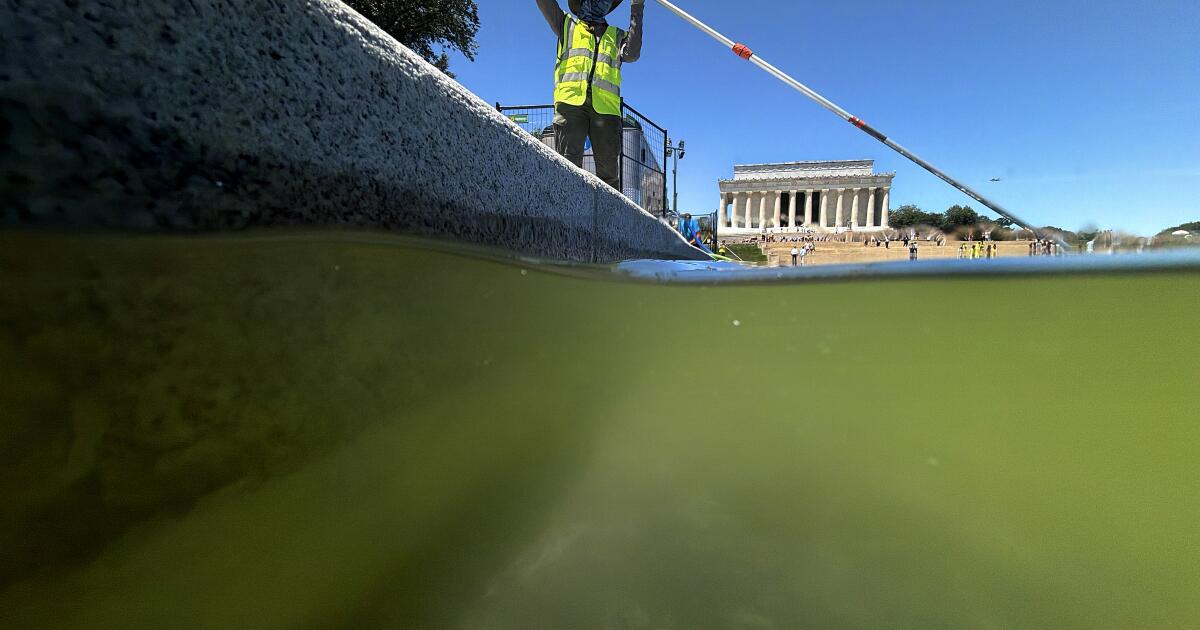
Just days after the Trump administration completed millions of dollars in renovations on the Lincoln Memorial Reflecting Pool to make it American flag-blue, residents and online users noted it had turned a phosphorescent green.
Here’s why:
The calm, still waters of the Reflecting Pool make it an ideal nursery for algae growth. Algae need nitrogen and phosphorus to grow, and the Reflecting Pool is primarily fed by the Potomac River, which gets heavy doses of those nutrients from nearby urban and agricultural lands.
The Potomac also absorbed one of the largest sewage spills in U.S. history earlier this year when a pipe burst five miles upstream of Washington, although that event probably happened too long ago to contribute to the algal bloom today.
Untreated sewage is high in nitrogen and phosphorus. When nutrient levels are high, feasting algae can quickly reproduce.
The Department of the Interior said when the algae first appeared that it was “residual,” from the supply lines to the pool.
Experts also speculate that the darker blue color may be helping the Reflecting Pool absorb more heat. The higher temperatures promote algae growth by allowing their metabolisms to shift into overdrive.
Summer temperatures in D.C. aren’t helping. This week, temperatures are as high as 95 degrees in the city, prompting a heat alert.
The combination probably explains the excessive growth, turning the water surface an opaque green and preventing onlookers from seeing the new blue hue of the concrete basin.
Algae are important and beneficial organisms when the ecosystem is in balance. They’re the base of the aquatic food chain, fed on by herbivores of all shapes and sizes, including shrimp and juvenile fish, which in turn feed organisms higher up the food chain. The single-celled organisms use the power of the sun to produce energy through photosynthesis, similar to houseplants on your balcony.
In an effort combat the algae in the Reflecting Pool, employees of the National Park Service were seen pouring in gallons of hydrogen peroxide, a chemical commonly used in pool maintenance.
The Department of the Interior also is employing a “high-tech nanobubble ozone technology” to destroy the cells of the algae.
Ozone — yes, the same irritant that is in smog — is a gas composed of three oxygen molecules, and the small size of the bubbles allow the most gas transfer into the water, where it can damage algal cells, similar to how it irritates our lungs.
This only treats the symptoms, however. Generally, ozone nanobubbling is effective as a temporary solution for algae blooms. Longer-term fixes would have to address what makes the Reflecting Pool so ideal for algae, such as its depth, darker color and inflow of nitrogen and phosphorus.
In California, ozone nanobubbles also have been used in a project to improve water quality in the Tijuana River. The 120-mile river that runs near the border in northern Mexico and Southern California was the site of a pilot study in 2025. The U.S. section of the International Boundary and Water Commission reported that the nanobubbling reduced “odors and bacteria,” but the project concluded prematurely after a flood swept some of the instrumentation into the river.
-

 Arkansas51 seconds ago
DeGray Lake Resort State Park offers a week’s worth of summer fun in Arkansas
-

 California7 minutes ago
This 1947 adobe home has found a new life as a ‘modern California hacienda’
-

 Colorado14 minutes ago
Colorado Springs police searching for missing 11-year-old
-

 Connecticut17 minutes ago
Opinion: More to do on gun violence prevention in CT
-

 Delaware22 minutes ago
After changing Delaware’s library system forever, she’s stepping away
-

 Florida29 minutes ago
Florida tattoo shop refuses service to military and veterans for being ‘war criminals’
-

 Georgia32 minutes ago
What would it take for Missouri football to stun Georgia in 2026?
-

 Hawaii37 minutes ago
Scientists say major earthquakes feel frequent, but activity is on track

