Science
Dickson Despommier, Who Championed Farming in Skyscrapers, Dies at 84


Dickson Despommier, a microbiologist who proposed that cities should grow food in high-rises, popularizing the term “vertical farming” — an idea that crossed over from the realm of the purely fanciful to become a reality around the globe — died on Feb. 7 in Manhattan. He was 84.
His wife, Marlene Bloom, confirmed the death, in a hospital. He lived in Fort Lee, N.J.
Dr. Despommier (pronounced de-POM-ee-yay), who was a professor for 38 years at Columbia’s School of Public Health, specialized in parasitic diseases, but he gained far wider influence as a guru of vertical farming.
In 2001, he and students in a medical ecology class designed a 30-story building that theoretically could grow food for 50,000 people. Some 100 varieties of fruits and vegetables would be grown on upper floors, with chickens housed lower down. Fish would feed on plant waste.
Dr. Despommier argued that vertical farms would use 70 to 90 percent less water than traditional farms, allowing agricultural land to return to a natural state and helping to remediate climate change. He evangelized at TEDx talks and in a book, “The Vertical Farm: Feeding the World in the 21st Century.”
“When my book came out, in 2010, there were no functioning vertical farms that I was aware of,” he told The New Yorker several years later. “By the time I published a revised edition in 2011, vertical farms had been built in England, Holland, Japan and Korea.”
Tech investors poured money into vertical farming. The operations generally substituted indoor LED lights for sunlight and used watering systems that spritzed plant roots — no soil needed. The farms sprouted in places as varied as downtown Newark and Dubai, on the Persian Gulf.
The Guardian estimated that there were more than 2,000 vertical farms in the U.S. in 2022, raising vegetables and fruits in stacked trays or long columns, some several stories high, some tended by robots. That year, Walmart announced that it would harvest salad greens from a vertical farm in Compton, Calif., to be run by a company named Plenty.
More recently, the industry has stumbled. High interest rates and energy costs have caused many operations to close or declare bankruptcy. They include the one in Compton and the one in Newark, AeroFarms, which The New Yorker featured prominently in its article about Dr. Despommier in 2017. A company with farms in three Eastern states, Bowery Farming, whose investors included Justin Timberlake and Natalie Portman and which was once valued at $2.3 billion, shut down last year.
Critics questioned if vertical farming really lowers carbon emissions and called it a fad. Others said the industry is merely going through a shakeout and will endure.
Dickson Donald Despommier was born on June 5, 1940, in New Orleans to Roland and Beverly (Wood) Despommier. His father was an accountant for a shipping line. His parents divorced when Dickson was young.
He received a B.S. in biology from Fairleigh Dickinson University in 1962, an M.S. in medical parasitology from Columbia in 1964 and a Ph.D. in microbiology from the University of Notre Dame in 1967.
Dr. Despommier joined Columbia’s faculty in 1971 as an assistant professor of microbiology. He taught a required course in parasitic diseases to second-year medical students for three decades. His research focused on tropical diseases; he was co-author of a textbook, “Parasitic Diseases,” and a director of the website “Parasites Without Borders.”
Besides his wife, he is survived by his sister, Duane Despommier Kuykendall; his sons, Bruce and Bradley; a stepdaughter, Molly Bloom; a stepson, Michael Goodwin; four grandchildren; and three great-grandchildren. An earlier marriage, to Judith Forman, ended in divorce.
The idea of vertical farming emerged when students told Dr. Despommier in 2000 that they were bored with his course on medical ecology. He redirected the semester by posing a question, “What will the world be like in 2050?” and a follow-up question, “What would you like the world to be like in 2050?”
The discussion focused on how densely crowded the planet would be in 50 years and how food would have to be grown then with less water and less pollution from chemical fertilizers. Students said New York City should source all its food from close by. They suggested using the city’s rooftops for agriculture. But then they calculated that if every rooftop in all five boroughs were turned into a garden, the growing acreage would feed only about 2 percent of the population.
Dr. Despommier then thought of raising crops in glass and steel skyscrapers, with plants stacked on multiple levels, just like their human inhabitants. He continued to refine designs with each year’s class of ecology students. In 2001, he adopted the term vertical farming.
After he appeared on the Comedy Central late-night show “The Colbert Report” in 2008 to discuss his eggplants-in-the-sky idea, traffic to his website shot up to 400,000 visitors overnight.
Many of the start-ups that turned Dr. Despommier’s vision into a reality built vertical farms that were only two or three stories high, compared with the 30-story behemoths he had proposed. One was attached to a parking garage in Jackson, Wyo. Others were housed in shipping crates.
But the idea traversed the globe, with a nonprofit, the Association for Vertical Farming, starting up in Germany in 2013.
All along, skeptics questioned whether the cost and the carbon footprint of indoor farming was an improvement over the traditional kind practiced by humanity for some 12,000 years.
“It’s such an appealing idea — ‘Press floor 10 for lettuce’ — that people picked up on it right away,” Bruce Bugbee, a professor of crop physiology at Utah State University, told The New York Times in 2016. “The fundamental problem is that plants need a lot of light. It’s free outside. If we’re going to do it inside, it will require the burning of a lot of fossil fuels.”
The industry shakeout has been brutal, with the editor of the news site Vertical Farming Today declaring in 2023 that venture capital investments in vertical farming had fallen by about 90 percent.
Unfazed, Dr. Despommier kept brainstorming about how modern life could thrive in the face of a dangerously changing climate. In his last book, “The New City: How to Build Our Sustainable Urban Future” (2023), he proposed that cities henceforth be built of wood.
The carbon footprint of making concrete and steel, he explained, is enormous, whereas wood is a carbon sink — trees absorb carbon from the air as they grow — and new technologies for engineering timbers allowed very tall buildings to be built.
“It sounds like we’ll be using up all the wood,” he said last year, “but the fact is that, if vertical farming succeeds, there’ll be a lot more land to grow trees.”



Heavier rain is expected to fall across Los Angeles this weekend, bringing wetter weather and a chance for thunderstorms after spring kicked into full bloom.
“This is when the weather gets a little more wild, technically, because we’re starting to see some more differential heating on the Earth,” said Todd Hall, a meteorologist at the National Weather Service.
Parts of Los Angeles will probably see rain after 11 p.m. Saturday, according to a forecast from the National Weather Service. Scattered showers are anticipated on Sunday afternoon before 2, and there is a potential for thunderstorms in some parts of the city.
There’s a 15% to 25% chance of thunderstorms, according to the forecast discussion from the NWS Los Angeles on Saturday. “Any thunderstorms that develop will likely produce brief heavy rain, gusty outflow winds, small hail and potentially waterspouts or weak, short-lived, tornadoes,” the NWS said.
A ridge of high pressure has already moved east, and now a storm system is arriving in the area.
There’s a chance that the storm system will linger across parts of Los Angeles through Monday, Hall said. Snow levels are expected to drop at high elevations, but some places, such as the northern Ventura County mountains, could have wet snow, so drivers should be cautious.
Gusty winds are expected in portions of the Mojave Desert as well.
“Just like in the ocean, we have waves. The atmosphere behaves the same way,” Hall said.
The total rainfall through Sunday night is anticipated to be between 0.50 and 1.50 inches. On average across L.A., temperatures on Sunday are expected to reach a high of 65 degrees — a full 26 degrees lower than the high recorded a week ago.
Dry and warm weather is expected to return after Monday. Temperatures are forecast to climb to more than 75 degrees later in the week and reach nearly 80 degrees next Saturday.
Heavier rain — including some thunderstorms — is expected in other parts of California such as the counties of San Luis Obispo, Santa Barbara and Ventura, the National Weather Service Los Angeles said Saturday afternoon on X.
Wind gusts north of Point Conception in Santa Barbara County could come with risks such as downed trees or powerlines. Major flooding and debris flows are unlikely, the social media post said.
Up north, the San Francisco Bay Area has already been experiencing the severe weather. Heavy rain hammered the region Saturday, and wind gusts were expected to reach up to 28 mph. The National Weather Service was advising people to allow extra time for travel because of the slippery roads.
In Southern California, the National Weather Service suggested that people be ready to adjust plans and monitor the situation.

The Artemis II astronauts safely splashed down off the coast of San Diego at 5:07 p.m. Friday. After their historic 10-day mission around the moon, the crew and NASA officials are finally breathing a sigh of relief.
“I’m still at a loss for words. The childhood Jared right now can’t believe what I just saw,” said NASA Administrator Jared Isaacman, standing aboard a Navy warship assisting with recovering the four returned astronauts in the Pacific Ocean.
Isaacman was born more than a decade after the last time humans walked on the moon.
“I’ve almost been waiting my whole lifetime to see this, and then as NASA administrator, I just couldn’t be more proud of the entire workforce,” he said.
The return mission was highly anticipated and attracted rapt viewers from across the nation. The Empire State Building was lit up in red, white and blue to welcome the crew home. Multiple MLB stadiums displayed footage of the landing on their scoreboards.
NASA regarded the high-energy reentry — streaking through the atmosphere in a nearly 5,000-degree-Fahrenheit fireball at more than 32 times the speed of sound — as one of the riskiest moments of the mission.
-
Share via
Space agency officials’ blood pressure was further elevated as experts closely watched the performance of the craft’s heat shield, which astronauts rely on to slow them down and keep temperatures livable.
During the crew-less 2022 Artemis I test mission, the heat shield unexpectedly chipped in more than 100 spots. NASA determined that any astronauts aboard would have been unscathed, but noted the problem posed an increased risk to future crews. Instead of redesigning the heat shield — which NASA will do for future missions — the agency opted to bring the capsule in on a steeper trajectory intended to inflict less stress on the materials.
After splashdown, multiple minor snafus delayed Navy divers as they tried to bring the astronauts out of the capsule.
First, the divers struggled to contact the astronauts inside — though both parties could still reach Mission Control. After the Navy crew opened the hatch, ocean currents hindered their ability to deploy inflatable devices around the capsule to stabilize it and help the astronauts exit.
Eventually, nearly an hour and a half after splashdown, the team helped the astronauts out of the toasty Orion capsule, to the cheers of dozens of flight controllers in Mission Control.
The Navy team then airlifted the astronauts by helicopter to the USS John P. Murtha Navy warship, about 1.5 miles away, for medical evaluation.
Crews will continue to work into the night securing the capsule and guiding it back to the Murtha, which is expected to reach Naval Base San Diego early Saturday.
For many NASA scientists and engineers across the country, the work to analyze every bit of data from the capsule has just begun.
“We’re going to want to definitely take a look at the thermal protection system,” Isaacman said. “We’re going to want to download all the data they couldn’t transmit back to us and use that to inform Artemis III.”
The Artemis Program, an international collaboration spearheaded by NASA, aims to put boots back on the moon for the first time in more than 50 years. The space agency hopes to establish a lunar base as a testing grounds for future missions to Mars.
Artemis II, a flyby mission around the moon that lifted off on April 1, was focused on testing out life support systems and practice piloting the spacecraft to make the journey a smoother ride for future crews who will be focused on the complex challenge of actually landing on the lunar surface.
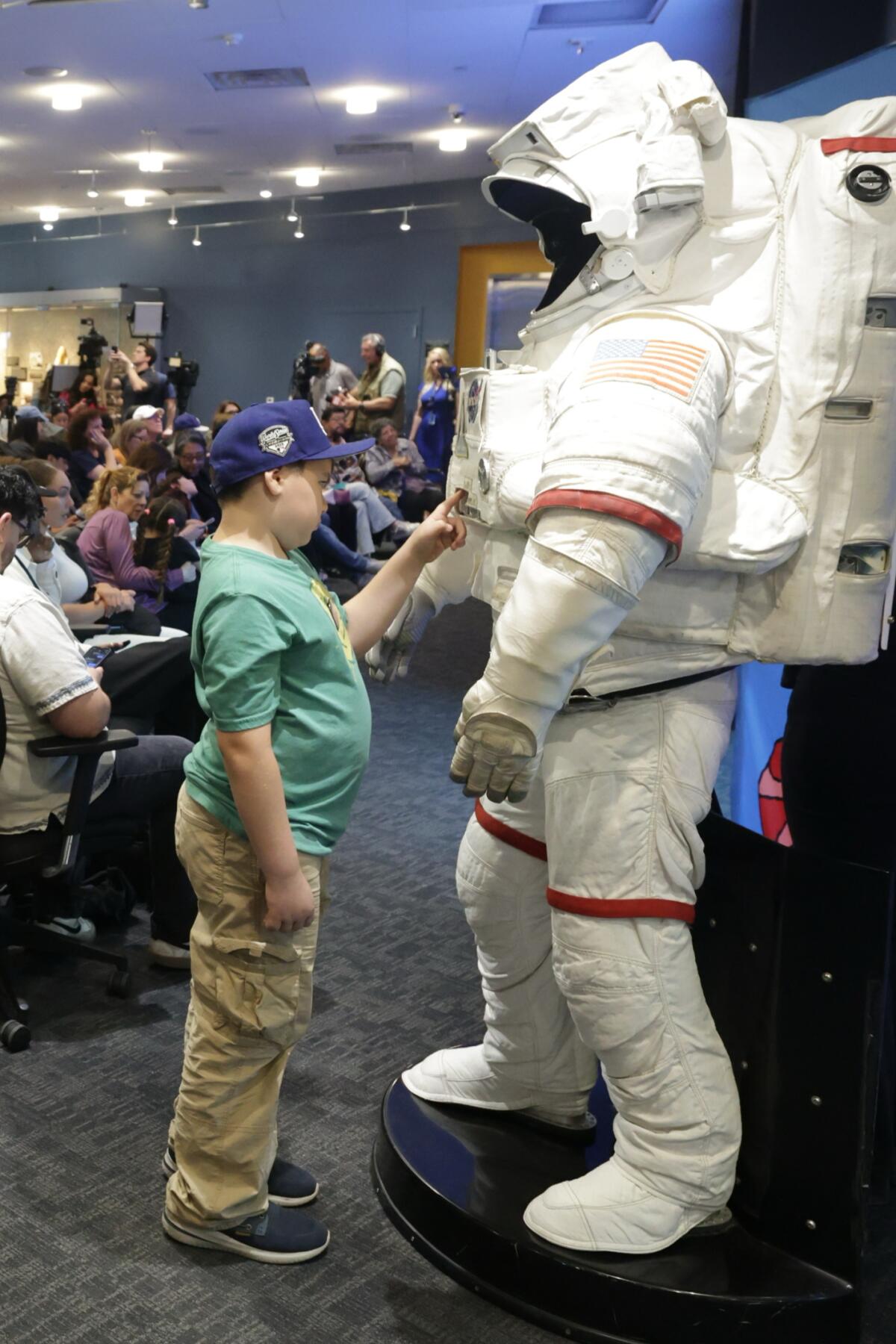
Christian Ramirez, Jr., 8, checks out an astronaut suit while waiting for the Artemis II Landing Watch Party featuring a live broadcast of the splashdown on a large screen at the Columbia Memorial Space Center in Downey on Friday.
(Myung J. Chun / Los Angeles Times)
They worked out problems with the capsule’s space toilet (multiple times), piloted the spacecraft by hand, and tested procedures such as sheltering from solar radiation in the cargo locker.
Yet Monday’s flyby — the first time humans had reached the moon since 1972 — held emotional significance for the crew and space enthusiasts beyond the mission’s technical objectives.
While in space, the crew spoke of the surreal sights of our dusty, rugged natural satellite, appearing about the size of a bowling ball at arm’s length, suspended in nothingness. The astronauts couldn’t help but feel a renewed appreciation for our home planet.
“Maybe the distance we are from you makes you think what we’re doing is special,” Artemis II pilot and Southern California native Victor Glover said on Easter while on his way to the moon. “But we’re the same distance from you, and — I’m trying to tell you, just trust me — you are special. In all of this emptiness — this is a whole bunch of nothing, this thing we call the universe — you have this oasis, this beautiful place that we get to exist, together.”
About 25 minutes before the crew splashed back down on our oasis, Artemis II Cmdr. Reid Wiseman radioed Mission Control.
“We have a great view of the moon out window two,” he said. “Looks a little smaller than yesterday.”
“Guess we’ll have to go back,” Mission Control replied.

new video loaded: Artemis Astronauts Splash Down After Historic Lunar Flyby
transcript
transcript
Artemis Astronauts Splash Down After Historic Lunar Flyby
The four astronauts aboard Artemis II splashed down at 8:07 p.m. Eastern time in the Pacific Ocean near San Diego on Friday, concluding their historic 10-day mission, the first to send humans to the moon in more than 50 years.
-
“Houston, Integrity splashdown. Sending post-landing command now.” “Splashdown confirmed.” “Copy splashdown. Waiting on V.L.D.R.” “Splashdown confirmed at 7:07 p.m. Central time.” “All four crew members now out of Integrity.”

By Jackeline Luna
April 10, 2026

Kevin McGonigle crushes 1st MLB home run for Detroit Tigers

President Trump terminates Presidio Trust

Running Back Remains a Sneaky Need For Dallas Cowboys in 2026 NFL Draft

Hawks sitting all usual starters against Miami

Brewers Rally Late to Defeat Red Sox 8-6 – Boston Today

Florida High School Football Rankings: Top 25 teams – Oct. 21

How old is Bo Nix? What to know about Oregon quarterback ahead of 2024 NFL Draft

Cleary's 21 help Le Moyne down Central Connecticut State 69-64 in OT

99th annual Pony Swim held in Virginia

Indiana Members Credit Union announced as new anchor tenant at Bottleworks District

Carney casts himself as NATO defender amid Trump beef, despite Canada missing key benchmark for decades

‘Enough of war!’ says Pope Leo XIV who grows increasingly frustrated
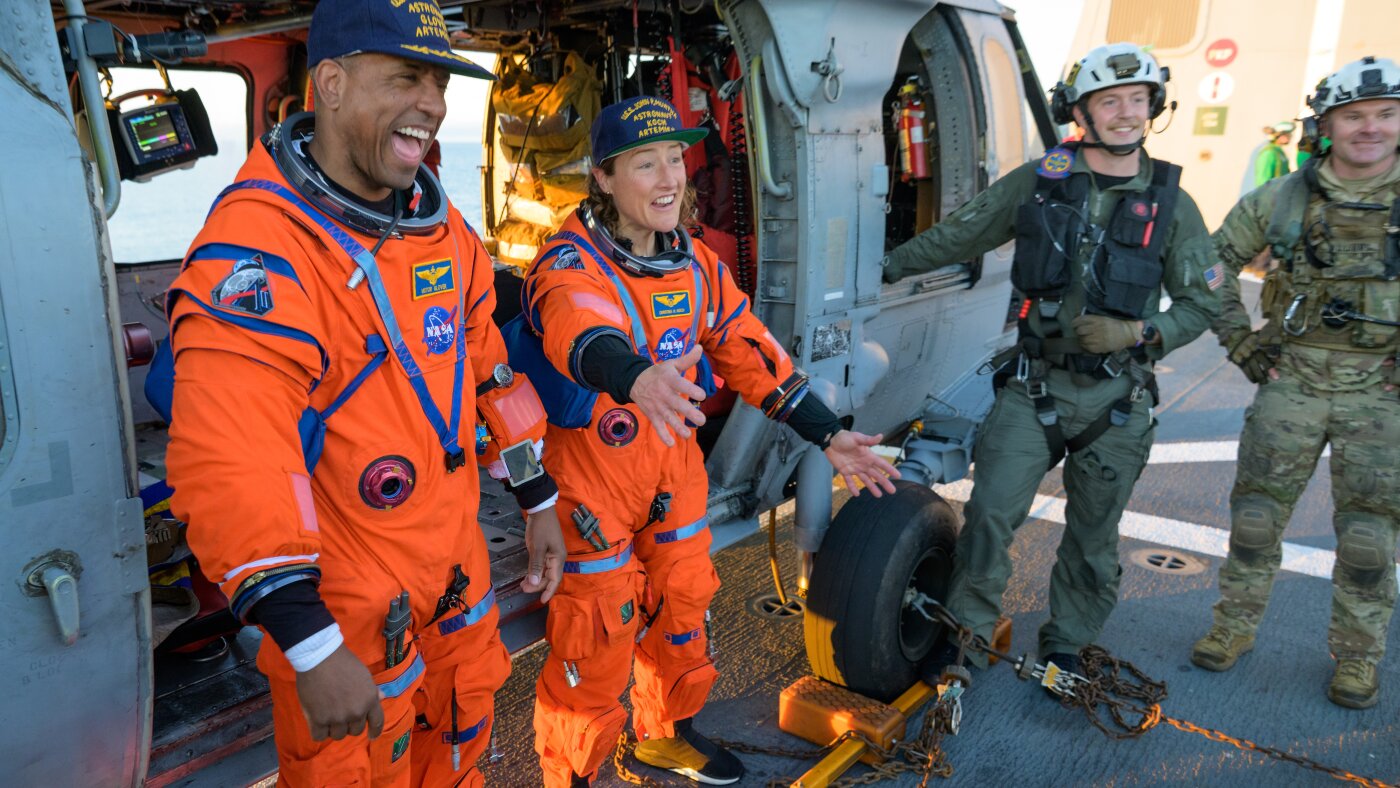
Artemis II splashdown captures nationwide attention

Video: Police Fatally Shoot Man After Stabbings at Grand Central Subway Station

Trump blasts Spanberger ahead of Virginia meetings, says state faces tax base exodus like New York, California
-

 Atlanta, GA1 week ago
1 teenage girl killed, another injured in shooting at Piedmont Park, police say
-

 Georgia5 days ago
Georgia House Special Runoff Election 2026 Live Results
-

 Pennsylvania6 days ago
Parents charged after toddler injured by wolf at Pennsylvania zoo
-

 Arkansas2 days ago
Arkansas TV meteorologist Melinda Mayo retires after nearly four decades on air
-
 Milwaukee, WI6 days ago
Potawatomi Casino Hotel evacuated after fire breaks out in rooftop HVAC system
-

 Indianapolis, IN1 week ago
Fighting Illini begin Final Four preparations in Indianapolis
-

 Technology1 week ago
Anthropic essentially bans OpenClaw from Claude by making subscribers pay extra
-

 Austin, TX5 days ago
ABC Kite Fest Returns to Austin for Annual Celebration – Austin Today