Politics
With hopes for asylum in U.S. dashed, migrants in Tijuana ponder next moves


Haitian migrants are among those staying at the Albergue Assabil shelter in Tijuana. Many Haitians, who fled gang violence in their homeland, have been in limbo, living at the shelter since the U.S. immigration crackdown.
TIJUANA — When the Russian man arrived at the U.S.-Mexico border on March 1, he knew he was too late. Still, he held on to hope that even with President Trump in office he could be let into the United States to seek asylum.
Slavik, a 37-year-old engineer, said he fled Russia after being beaten by security forces for supporting the opposing political party. He had hoped to meet U.S. immigration officials to apply for asylum, he said, and has friends willing to sponsor him.

Alicia Ayala, with Agape For All Nations Ministries International, shaves the head of Russian migrant Slavik, 37, at the Albergue Assabil shelter in Tijuana.
Instead, he spent weeks at a shelter for migrants in Tijuana as he mulled over what to do next.
“I just tried to do by rules and wait,” said Slavik, who asked to be identified by his nickname for fear of retribution. “There is nothing else now. All immigration will be illegally.”
In Tijuana, thousands of migrants such as Slavik had tried to secure an appointment with immigration officials through a Biden administration phone application, but Trump canceled the program, in effect blocking access to asylum. Many have since left the region.
With no way to legally enter the U.S., the mood among migrants still in Tijuana has shifted from cautious optimism to hopelessness. Shelters are no longer full, and directors say those who remain are among the most vulnerable.
Making matters worse, funding cuts by the Trump administration to the U.S. Agency for International Development, or USAID, have brought some shelters to the brink of closure, tightened others’ budgets and significantly reduced migrant healthcare services. Enduring organizations now struggle to fill the gaps.
“As lawyers, we want to give people solutions, but there are none now,” said Lindsay Toczylowski, co-founder and chief executive of the Los Angeles-based Immigrant Defenders Law Center. She visits Tijuana shelters a few times a month. “It’s them asking a lot of questions and us saying, ‘I’m so sorry.’”

Haitian migrants stay at the Albergue Assabil shelter in Tijuana. The center serves mostly Muslim migrants but also people from all over the world.
Although illegal border crossings are down to a trickle, Toczylowski and other advocates believe they will eventually begin to increase.
Slavik fled his homeland in 2022, first living in Turkey and Georgia before realizing that, as Russian allies, those countries weren’t safe.
He can’t go back to Russia, where he would be considered a terrorist sponsor for donating to the campaign of Alexei Navalny, President Vladimir Putin’s biggest political rival, who died under suspicious circumstances last year.
But staying in Mexico or elsewhere in Latin America would be difficult, Slavik said, because he doesn’t speak Spanish. He speaks basic English and has considered going to Canada, but friends told him it’s difficult as well to obtain asylum there.
Now Slavik is starting to feel like he has no other choice but to try to get into the U.S. illegally.
“Maybe this is one chance,” he said. “If a lot of people do it, then maybe I can do it.”
Slavik stayed at Albergue Assabil, a shelter that serves mostly Muslim migrants. Director Angie Magaña said half of the 130 people living there before the U.S. presidential election in the fall have since left. Many went back to their home countries — including Russia, Haiti, Congo, Tajikistan and Afghanistan — despite the dangers they could face. Others went to Panama, she said.
On a recent Friday, the shelter was bustling. Haircuts were being offered in the courtyard. A truck pulled up outside, and residents helped carry in cases of donated bottled water. Inside the community center, those having breakfast and tea cleared the tables as members of a humanitarian organization arrived to play games with the children.

Angie Magaña, left, director of the Albergue Assabil shelter in Tijuana, waits for a delivery of donated items.
Magaña said she’s frank with those who remain: “Most people have the hope that something will happen. I tell them their best bet is to get asylum here” in Mexico.
Toczylowski said this administration differs substantially from Trump’s first term, when she could seek humanitarian entry for particularly desperate cases, such as a woman fleeing a dangerous relationship. Now whenever a woman says her abuser has found her and she asks Toczylowski what she can do, “it’s the first time in my career that we can say, ‘There’s no option that exists for you.’”
In the weeks after the phone app for border appointments was eliminated, Toczylowski brought vulnerable families, including those with children who have disabilities, to the San Ysidro port of entry.
She said a Border Patrol agent told them there was no process to seek asylum and turned them away.
The U.S. military has added layers of concertina wire to six miles of the border fence near San Ysidro.
“Ideally, it deters them from crossing” illegally, said Jeffrey Stalnaker, acting chief patrol agent of the Border Patrol’s San Diego sector. “We would rather have them enter at a port of entry, where it’s much safer, and hopefully this guides them in that direction.”
He did not address the fact that the government has essentially stopped considering asylum requests at ports of entry. Toczylowski said that in her experience, limited exceptions have been made for unaccompanied children.

Migrant Haitians stay at the Albergue Assabil shelter in Tijuana. Many Haitians, who fled gang violence in Haiti, have been in limbo, living at this Muslim shelter since the U.S. immigration crackdown.
The halting of USAID funds is also transforming life at the border. On his first day in office, Jan. 20, Trump signed an executive order freezing U.S. foreign aid payments for 90 days, pending a review of efficiency and alignment with foreign policy. The order says foreign aid is “not aligned with American interests and in many cases antithetical to American values.”
An April 3 report by the nonpartisan Migration Policy Institute found that up to $2.3 billion in migration-related grants appear on leaked lists shared with Congress of terminated foreign aid from USAID and the State Department. Among the funding — which provided humanitarian assistance, countered human trafficking and enabled refugee resettlement — was $200 million focused specifically on deterring migration from Central America.
The fallout from the cuts has already begun, the report states. For instance, the government of Ecuador used the withdrawal of foreign aid to justify rescinding amnesty for Venezuelan migrants, which could have dissuaded some from continuing north toward the United States.
In Tijuana, Trump’s order led to the closure of a health and social services clinic called Comunidad AVES. A longtime shelter called Casa del Migrante is now on the brink of closure after USAID-funded organizations scaled back their support, leaving its leaders on a desperate search for replacement funding.
Midwife Ximena Rojas and her team of two doulas run a birthing center and offer sexual and reproductive care to migrants.

Midwives Xanic Zamudio, left, and Ximena Rojas sit with Rojas’ children next to a birthing tub they use in Rojas’ home in Tijuana. Since healthcare services for migrants have shut down, the midwives have been overwhelmed with requests for services such as prenatal care, family planning and pregnancy tests.
Rojas sees 20 patients a day, three days a week. Her services are crucial: Many of the women she sees have never had a Pap smear and some were sexually assaulted on the migration route.
With the closure of AVES and concerns about Casa del Migrante — which has a partnership with the Tijuana government for weekly doctor visits — Rojas said the pressure is mounting on her small operation to somehow expand its reach.
“We are at max capacity,” she said. “We need an army.”
Rojas said she’s considering opening a food bank for migrants to make up for the loss of U.S.-government supported assistance.
“Our goal is to diminish infant death, also maternal death. The best way to do it is with nutrition,” Rojas said. “I give them a prenatal vitamin every day, but if they are eating [only] a banana a day, it’s like, a vitamin can only do so much.”
Many shelters counted on funds from the International Organization for Migration for groceries. At Espacio Migrante, the money paid for imported ingredients that allowed families from countries such as Russia and Uzbekistan to cook religiously or culturally appropriate meals.
At La Casita de Union Trans, a shelter for transgender women, the 6,000 pesos the facility got each month (about $300) went toward basic necessities — eggs, cooking oil and milk.

Susy Barrales is the director of La Casita de Union Trans, a shelter for transgender women in Tijuana. The shelter is currently houses five transgender migrants.
(Genaro Molina / Los Angeles Times)
But director Susy Barrales said U.S. politics won’t stop trans women from seeking safety, or the shelter trying to support them.
“I want the girls to study, to obtain a profession, so they can confront anything that comes their way — because I’ve done it,” said Barrales, who is studying for a social work license. “We are going to keep striving.”
Shelter residents include Miranda Torres, 31, a hairstylist who fled Venezuela in July after she was raped by strangers and police refused to investigate. She said the assault infected her with HIV. Venezuela’s ongoing economic collapse meant she had no access to treatment.
Torres said she walked north through the Darien Gap, a dangerous 60-mile stretch of jungle that straddles the border dividing Colombia and Panama, where she was sexually assaulted again.

Venezuelan migrant Miranda Torres, 31, cries as she recalls the violence she endured while traveling from her homeland to Tijuana. She has been staying at La Casita de Union Trans.
In Oaxaca, Mexico, she was diagnosed with lymphatic cancer and went through surgery and chemotherapy. She now bears a round scar on her neck and covers her bald head with a wig.
After taking time to recover, Torres finally arrived in Tijuana in December, where she slept atop a cardboard box on the street while making repeated and increasingly dangerous attempts to enter the U.S.
Unable to secure an appointment through the phone app, she went to the San Ysidro port of entry, waiting outside for four days to speak with an agent. She was turned away and then detained by Mexican immigration officials before being released because of her health conditions.
Torres said men belonging to a criminal group began to target her, saying they would harm her if she didn’t cross the border. So she attempted to climb the border fence but was too weak to hoist herself up. Then they told her to swim around the fence that extends into the Pacific Ocean. She nearly drowned.
Now, Torres has given up on the U.S. and is applying for asylum in Mexico.
“My dreams are in my head, not in any particular country,” she said, seated on a bunk bed in one of La Casita’s two bedrooms while Chappell Roan’s hit “Pink Pony Club” played from someone’s phone in the living room.
“If they’re not possible in the U.S., I’ll make them happen here.”
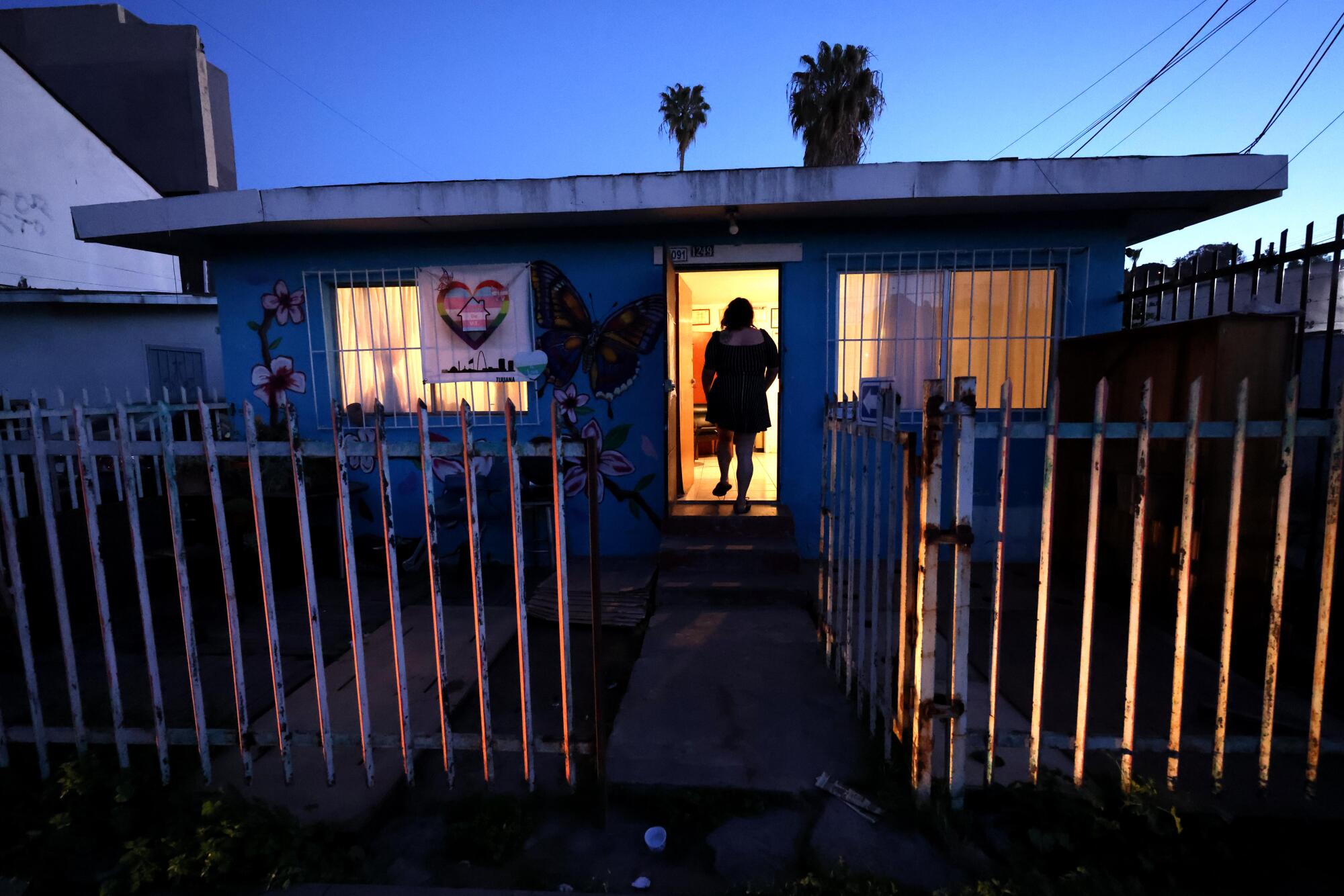
Dessire López walks back inside La Casita de Union Trans in Tijuana. López is a health advocate at the shelter.



Construction workers unfurled a large printed tarp to cover scaffolding installed at the White House’s front entrance. Doug Burgum, the interior secretary, said President Trump had ordered the repairs after noticing damage to columns.
Politics
WATCH: Trump’s Energy chief reveals what escalating Iran tensions could mean for gas prices

NEWYou can now listen to Fox News articles!
Energy Secretary Chris Wright is telling Americans not to be concerned about the possibility of another surge of sharp increases in gasoline prices as tensions with Iran have started to escalate once again.
Asked whether Americans should worry about higher prices at the pump and how the Trump administration is preparing to keep the economy stable if the conflict continues to worsen, Wright told Fox News Digital: “It has not been any good behavior from Iran that’s allowed oil to flow. It’s been the United States military.”
“That’s not changing,” he assured, speaking from the Great American State Fair on the National Mall this week.
US CLAWS BACK KEY CONCESSION TO IRAN AFTER FRESH ATTACKS ON COMMERCIAL SHIPS IN STRAIT OF HORMUZ
(Mario Tama/Getty Images) (Mario Tama/Getty Images)
With Iran striking three commercial vessels transiting the Strait of Hormuz on Monday and Tuesday, Wright doubled down in urging citizens to not credit Iran for the U.S. military’s work to ensure oil shipments continue flowing through the strait.
“Look, the U.S. Military has been the key asset here,” he said. “They have assured the flow of oil and gas through the Strait of Hormuz throughout. Not at the beginning of this conflict, but through the last six weeks.”
Wright said the administration is closely monitoring global oil supplies as the tentative ceasefire with Iran seemingly came to come to a halt, with President Donald Trump telling Secretary-General Mark Rutte the call for peace with Iran is “over” at the NATO Summit in Turkey on Wednesday.
But, he pointed to the continued shipping through the Strait as evidence that markets should remain stable.
TRUMP SAYS IRAN CEASEFIRE IS ‘OVER’ AFTER IRANIAN ATTACKS TRIGGER MASSIVE US RESPONSE
President Donald Trump speaks at the White House on Tuesday, April 22. (AP/Alex Brandon)
“We’re of course constantly watching the supply of oil, the supply of refined products and what’s going on there,” Wright said. “And I think still all positive trends.”
Beyond geopolitical concerns, Wright also praised the new chain of discounted gas stations across Pennsylvania and New Jersey, Freedom Fuel, which promises customers prices below the national average.
The Trump administration, though not involved with the network, has heavily endorsed the new chain and its 25 locations.
“We love it,” Wright said when asked about Freedom Fuel. “I mean, look, any mechanism we can to lower energy costs for Americans of all kinds, we’re all in on.”
“With Freedom Fuels, they’re just lowering it down to their wholesale price of gasoline,” Wright said. “So they’re not making any money selling gasoline, but they’ve got convenience stores. That’s how most gas stations make money.”
NEWSOM UNDER FIRE AS CALIFORNIA GAS TAX HIKE SENDS PUMP PRICES EVEN HIGHER
Gasoline costs are a known concern for many Americans, and amid surging prices there has been a considerable increase in those opting to purchase electric vehicles to save money long-term at the pump — with Tesla dominating the market for these types of models.
Wright argued one of the benefits to living in America is having the option to choose what type of vehicle you drive.
CLICK HERE TO DOWNLOAD THE FOX NEWS APP
“We just want people to buy what they would prefer,” he told Fox News Digital when asked his thoughts on increasing calls for support of the electrification of cars. “Consumer choice — you wanna buy an electric car, you wanna buy a gas powered car, diesel powered car, buy a big truck. That’s the choice.”
“That’s why you live in America. You get the choice of all those.”

In 2023, California regulators levied more than $100,000 in fines against the private operator of a federal immigration facility, kicking off a three-year battle over whether detainees who do work at the facilities should be considered employees.
The question went beyond semantics: If considered employees, the detainees would be subject to state worker protection laws.
A legal settlement announced this week now affirms that private immigrant detention facilities are subject to California’s workplace safety and health requirements.
“Every worker deserves a safe and healthy workplace and should be able to report workplace hazards without fear of retaliation,” said Denisse Gómez, spokesperson for the California Division of Occupational Safety and Health or Cal/OSHA.
“Individuals who perform work in these facilities are entitled to workplace safety protections, and this settlement reinforces Cal/OSHA’s commitment to enforcing those protections and safeguarding vulnerable workers,” she added.
Under the settlement between California and the GEO Group, a Florida-based private prison company, the company recently withdrew its legal challenges and agreed to pay more than $100,000 in the fines.
The GEO Group did not respond to requests for comment.
Back in 2023, Cal/OSHA issued $104,510 in fines against the GEO Group. The agency had found six violations of state code by the company after detainees complained about a lack of protective equipment and proper training while cleaning the facility for $1 per day.
Detainees alleged they routinely wiped black mold off shower walls at the facility, saw black dust spew from air vents and used cleaning solutions that lacked instructions during the COVID-19 pandemic.
The biggest fine levied against the GEO Group was for failure to establish and maintain “effective written procedures to reduce employee risk of exposure to aerosol transmissible disease.”
Advocates viewed Cal/OSHA’S recognition of the detainees as workers as a victory that could pave the way for future labor rights fights at other detention centers in the state.
But the GEO Group appealed, arguing that detainees participating in ICE’s voluntary work program make their own schedules and aren’t employees, so hazard exposure couldn’t be “as a result of assigned duties,” as California law states. Plus, the company argued, there wasn’t enough evidence that detainees were exposed to any hazard.
Early last year, the state’s Occupational Safety and Health Appeals Board rejected the GEO Group’s argument and found that detainees should be considered “affected employees.”
The GEO Group sued, but three days before a California Superior Court hearing in May, the company and Cal/OSHA reached the settlement.
Along with paying the fines, the GEO Group agreed to draft plans for avoiding aerosol transmissions at 12 secure and reentry facilities in California, including five detention centers that hold immigrants.
“GEO ensures detainees are afforded the necessary tools, equipment, and personal protective equipment … to safely and effectively perform any necessary tasks,” the settlement states.
Gómez said the settlement also leaves intact the appeals board’s ruling that civil immigration detainees who participate in work programs can participate in proceedings anonymously, “acknowledging the potential for retaliation when individuals raise workplace safety concerns.”
But the question of whether detainees are employees and deserve certain protections isn’t entirely resolved — at least not for the federal government.
Last month, U.S. Immigration and Customs Enforcement released new standards for detention facilities across the country. The revised guidelines “emphasize that detainee volunteers participating in the voluntary work program are not considered facility and/or government employees” and thus not entitled to labor regulations.
Attorney Mariel Villarreal said the timing of the new detention standards made her question whether the GEO Group had asked ICE to specify in its standards that detainees are not workers in response to its battle with Cal/OSHA.
“To me, it’s a reaction to this very settlement,” she said. Villarreal works for the California Collaborative for Immigrant Justice, which filed the original complaint on behalf of detainees who said they worked in unsafe conditions.
Villarreal pointed to a Washington Post report that GEO Group executives privately asked ICE to specify that detainees are not employees of the facilities where they work. Two top Trump administration officials, border czar Tom Homan and acting ICE director David Venturella, previously worked for the GEO Group.
New versions of ICE detention standards take effect as contracts are established or modified, so this year’s rules won’t immediately apply to every facility.
An ICE spokesperson did not comment about the settlement. The spokesperson, who did not provide their name in an emailed statement Wednesday, said the agency has begun transitioning detention facilities to meet the 2026 standards, “building on its longstanding commitment to safe, secure, and professional detention operations.”
“ICE has consistently implemented many of these best practices independently, reinforcing its role as the leader in detention operations,” the spokesperson added.
The GEO Group and other immigrant detention center operators have faced other legal battles over workers’ rights, including lawsuits in Washington, Colorado and California over the $1-per-day payment.
Villarreal said she’s confident that the Cal/OSHA settlement would continue to hold even if California facilities incorporated the new standards. But she said she believes the statements are an attempt by the GEO Group to “sidestep responsibility” and avoid the possibility of being fined under similar circumstances in other states.
“These statements in the new standards are a way for them to try and preserve profits as much as possible,” she said. “GEO and ICE are so intertwined at this point that they have the same motives.”
-

 Dallas, TX1 minute ago
FC Dallas Forward Logan Farrington Inks Contract Extension
-

 Boston, MA9 minutes ago
Red Sox face lengthy travel issues ahead of series vs. Mets
-

 Denver, CO16 minutes ago
What’s going on with the Nuggets? Unpacking an NBA offseason on hold
-

 Seattle, WA19 minutes ago
Seattle Kraken Sign Goaltender Victor Östman and Defenseman Ville Ottavainen to One-Year Deals | Seattle Kraken
-

 San Diego, CA24 minutes ago
An executive shuffle at San Diego’s Sempra
-
Milwaukee, WI31 minutes ago
Survey finds less than half of Jews in Milwaukee identify as Zionists | The Jerusalem Post
-

 Atlanta, GA34 minutes ago
Atlanta Hawks Showing Interest In Denver’s Peyton Watson, But Is The Price Too High?
-

 Minneapolis, MN39 minutes ago
Uptown businesses push to delay Lyndale Avenue project

