Politics
What to know about the Arizona Supreme Court's reinstatement of an 1864 near-total abortion ban


- The Arizona Supreme Court has given the go-ahead to enforce a law that bans almost all abortions.
- The long-dormant law, which predates Arizona’s statehood, allows abortions only if the mother’s life is in jeopardy.
- Democratic Gov. Katie Hobbs has called for a repeal of the ban.
PHOENIX (AP) — The Arizona Supreme Court has delivered a landmark decision in giving the go-ahead to enforce a long-dormant law that bans nearly all abortions, drastically altering the legal landscape for terminating pregnancies in the state.
The law predating Arizona’s statehood provides no exceptions for rape or incest and allows abortions only if the mother’s life is in jeopardy. Arizona’s highest court suggested doctors can be prosecuted under the 1864 law, though the opinion written by the court’s majority didn’t explicitly say that.
ARIZONA SUPREME COURT UPHOLDS NEAR-TOTAL ABORTION BAN
The Tuesday decision threw out an earlier lower-court decision that concluded doctors couldn’t be charged for performing abortions in the first 15 weeks of pregnancy.
This file photo shows Celina Washburn at a protest on Sept. 23, 2022, outside the Arizona Capitol in Phoenix to voice her opposition to an abortion ruling. The Arizona Supreme Court ruled Tuesday, April 9, 2024, that the state can enforce its long-dormant law criminalizing all abortions except when a mother’s life is at stake. (AP Photo/Matt York)
HOW WE GOT HERE
The law was enacted decades before Arizona became a state on Feb. 14, 1912. A court in Tucson had blocked its enforcement shortly after the U.S. Supreme Court issued its 1973 Roe v. Wade decision guaranteeing the constitutional right to an abortion.
After the U.S. Supreme Court overturned the landmark Roe decision in June 2022, then-Arizona Attorney General Mark Brnovich, a Republican, successfully requested that a state judge lift an injunction that blocked enforcement of the 1864 ban.
The state Court of Appeals suspended the law as Brnovich’s Democratic successor, Attorney General Kris Mayes, urged the state’s high court to uphold the appellate court’s decision.
WHO CAN BE PROSECUTED UNDER THE 1864 LAW?
The law orders prosecution for “a person who provides, supplies or administers to a pregnant woman, or procures such woman to take any medicine, drugs or substance, or uses or employs any instrument or other means whatever, with intent thereby to procure the miscarriage of such woman, unless it is necessary to save her life.”
The Arizona Supreme Court suggested in its ruling Tuesday that physicians can be prosecuted, though justices didn’t say that outright.
“In light of this Opinion, physicians are now on notice that all abortions, except those necessary to save a woman’s life, are illegal” the ruling said. The justices noted additional criminal and regulatory sanctions may apply to abortions performed after 15 weeks of pregnancy.
The law carries a sentence of two to five years in prison upon conviction. Lawyers for Planned Parenthood Arizona said they believe criminal penalties will apply only to doctors.
The high court said enforcement won’t begin for at least two weeks. However, plaintiffs say it could be up to two months, based on an agreement in a related case to delay enforcement if the justices upheld the pre-statehood ban.
POLITICS OF THE PRESIDENTIAL RACE
The ruling puts the issue of abortion access front and center in a battleground state for the 2024 presidential election and partisan control of the U.S. Senate.
Democrats immediately pounced on the ruling, blaming former President Donald Trump for the loss of abortion access because he appointed the justices who formed the majority that ended the national right to abortion.
President Joe Biden and his allies are emphasizing efforts to restore abortion rights, while Trump has avoided endorsing a national abortion ban and warned that the issue could lead to Republican losses. The decision will give Arizona the strictest abortion law of the top-tier battleground states.
Staunch Trump ally and abortion opponent Kari Lake is challenging Democratic Rep. Ruben Gallego for the U.S. Senate seat now held by Sen. Kyrsten Sinema, who isn’t seeking a second term.
WHAT’S NEXT?
Arizona Gov. Katie Hobbs called on the state Legislature to repeal the ban.
“They could do that today,” she said Wednesday in an interview on “CBS Mornings.”
“They could gavel in today and make a motion to repeal this ban,” Hobbs said. “And they should do that. I’m hopeful that they will because this will have devastating consequences for Arizona.”
Under a near-total ban, the number of abortions in Arizona is expected to drop drastically from about 1,100 monthly, as estimated by a survey for the Society of Family Planning.
This past summer, abortion rights advocates began a push to ask Arizona voters to create a constitutional right to abortion. If proponents collect enough signatures, Arizona would become the latest state to put the question of reproductive rights directly before voters.
The proposed constitutional amendment would guarantee abortion rights until a fetus could survive outside the womb, typically around 24 weeks. It also would allow later abortions to save the mother’s life, or to protect her physical or mental health.


WASHINGTON — Democrats are making a growing effort to adopt a pragmatic focus as they campaign on affordability in the midterms, as some within the party push for moving away from ideological arguments.
Across the country, Democratic candidates are trying to win over voters by talking about real-life scenarios, framing other platform issues in economic terms and, strategists say, aiming to shift a perception that Democrats deal in the abstract.
They see an opening created by voters’ focus on the economy and their ability as the party not in power to leverage affordability as the key midterms issue as Trump’s economic approval remains low. Trump has dismissed the issue, calling affordability a “hoax” by Democrats while also promising economic improvements.
“There has been a learning process in being able to take what Trump and the Republicans are doing and make sure that [candidates] are coming back to the real-world economic implications of whatever that might be,” Democratic strategist Alex Jacquez, who served in the Biden White House. “That’s where maybe [Democrats] haven’t always, in the recent past, made the full connection all the way through.”
Now, “the moment is ripe,” he suggested, for the party to shift its image.
The Democrats’ concentration on affordability and the economy has defined their midterm messaging, playing off elevated inflation, the effects of Trump’s tariffs and high gas prices caused by the war in Iran. The party is attempting to capture enough swing voters to win a House majority in November, and some believe the Senate could also be within reach.
Polling shows pessimism about the economy has increased among all Americans and most believe the country is in an affordability crisis. Americans most frequently mention government leadership and economic issues as the country’s most important problems in Gallup polling.
Voters also increasingly disapprove of Trump’s handling of the economy, including working-class white voters who make up a key part of his base. In an NPR/PBS News/Marist Poll last month, Americans gave the president his lowest-ever approval rating on the economy at 33%.
Speaking in Pennsylvania on Thursday, Trump said of affordability: “That’s a fake word that they use. They caused the affordability problem. It’s called high prices.”
Rep. Adam Gray, a Democrat who represents a purple Central Valley district and is a member of the center-left Blue Dog Coalition in Congress, said he believes voters have grown frustrated by the failure of Washington lawmakers to pay attention to what the people want out from government.
He pointed to Central Valley growers whose business has been affected, he said, by the rising price of fuel and fertilizer, the squeeze on the labor market caused by immigration enforcement and changes to federal programs.
“How regular people experience politics, it’s not the kind of ideological debates we have in Washington,” Gray said. “It’s the experience of doing something, whether that’s shopping for groceries or going to the lake to go boating with your family and realizing the price of gas is through the roof or the road to the lake is in disrepair.”
At a time when Democrats have debated how to embrace a party identity beyond opposing Trump and intra-party fights between progressive and moderate candidates have drawn attention, some believe the “practical” tactic may offer one key to the party’s path forward.
In Texas, Democratic candidates are pointing to the impact of data centers on water supply or the consequences of the state’s abortion ban, said Matt Angle, director of Lone Star Project, a political research organization that works to help get Democrats elected.
“The fact that Corpus Christi is running out of water … [or] you have women who have died because they were denied abortion services,” Angle said. “It’s very important that those things not be talked about in ideological terms but in practical terms. I think Democrats are doing a better job of that than ever before.”
“Real life is happening on the ground,” Angle added. “I think Democrats see that.”
Republicans pursued a similar strategy successfully in 2024, and their attacks on Democrats for focusing on cultural issues may have been successful in pushing Democrats away from that messaging, said Republican strategist Brittany Martinez.
“They have made it clear that’s the direction in which they’re trying to go,” she said of Democrats. “I also think you have outliers of the party that sometimes suck all the oxygen out of the room and maybe derail that message.”
National Republican Congressional Committee spokesperson Christian Martinez said Democrats’ economic record, including in California under Gov. Gavin Newsom, demonstrates a failure to prioritize working families.
“It’s laughable that Democrats are trying to make kitchen-table issues their brand,” he said. “It only proves their political brand is broken, while Californians continue living every day with the receipts from Democrats’ failed agenda.”
Republican National Committee Chair Joe Gruters said Thursday at a summit convened by the Washington-based news outlet the Hill that he was confident the party would retain the House and Senate and projected optimism about the economy.
“He’s going to bat for the American worker every single day,” Gruters said of Trump. “He’s going to continue to do everything he can to get the nose of the economy in this country up and to get prices down.”
But as Trump appears to prioritize other issues, Martinez said, Republicans are facing their own uphill battle to win over swing voters.
“When the president has mocked affordability, said it’s not a crisis, I don’t think that helps [Republicans],” Martinez said. “Democrats have an opportunity to capitalize on that right now.”
Both moderate and progressive Democrats see the moment as a chance to define what the party stands for beyond opposing Trump, and both have seized on real-life arguments, though the approaches differ.
Progressives have long framed a spectrum of issues in economic terms, said Usamah Andrabi, spokesperson for the progressive caucus Justice Democrats.
“That has always been the progressive economic playbook, and I think it’s about time that the other wings of the Democratic Party catch up to us,” Andrabi said.
That also means, he said, not backing away from other issues, such as abortion, foreign wars and healthcare.
“It has always been the right that has sought to divide our communities on these so-called culture war issues,” Andrabi said. “Our vision forward should be one that includes everyone… That does not mean simply ignoring some people’s most urgent crises to focus on something else, because these are interconnected.”
Climate advocates, for instance, are “effectively connecting” climate to top midterm issues, including including gas and utility costs, AI data centers and the Iran war, said Jamie Henn, executive director of nonprofit communications lab Fossil Fuel Media, and have encouraged Democratic candidates to do the same.
“Climate, like many issues, doesn’t win itself on its own merits. It’s in the ways that you talk about it and connect it to kitchen-table issues,” Henn said. “Do it in the right way – it’s not a science lecture on global warming, it’s a story about how clean energy can reduce your bills.”
Still, getting more candidates to pick up those messages can be a steep climb, he said. Advocates in some spaces, including climate, have worried about their issues being sidelined.
“There are Democrats that could be threading this needle who aren’t,” Henn said. “We know the issues that climate needs to be connected to, but [politicians] need… to do a better job to clearly articulate the messages.”

NEWYou can now listen to Fox News articles!
President Donald Trump accused members of the U.S. intelligence community Thursday night of operating a “shadow government” to allegedly conceal evidence of China’s efforts to influence U.S. elections, seizing on newly declassified emails that he says reveal a bitter internal dispute about how Beijing’s activities should be characterized.
Trump did not claim China changed votes or altered election results. Instead, he argued Beijing engaged in an influence campaign aimed at shaping U.S. public perceptions.
Trump claimed intelligence officials kept significant reporting out of his presidential briefings and highlighted an email in which a National Security Agency analyst allegedly wrote, “We have deliberately massaged our one pending (presidential daily brief) to avoid any direct links to the election.”
TRUMP RELEASES DECLASSIFIED ELECTION INTELLIGENCE, SAYS IT REVEALS ‘SHOCKING VULNERABILITIES’
“Those responsible for sounding the alarm instead kept the information secret and hidden,” Trump claimed. “They did not disclose (it) to me as president or to anyone else.”
Trump gives an address to the nation about elections on July 16, 2026. (Saul Loeb/Pool via Reuters)
Trump used the disclosures to press Congress to pass the SAVE America Act, casting the newly released intelligence as evidence that lawmakers must tighten federal election rules before the midterms.
“Most importantly, addressing this crisis of election security demands that Congress must pass the SAVE America Act,” Trump said. “These reforms are urgently needed to stop the vulnerabilities that I’ve mentioned.”
The SAVE America Act passed the House in February but stalled in the Senate in March, when a 53–47 vote fell short of the 60 votes needed to advance it. Trump urged Americans to call their senators and representatives and demand its passage “without delay.”
President Donald Trump used the disclosures to press Congress to pass the SAVE America Act, casting the newly released intelligence as evidence that lawmakers must tighten federal election rules before the midterms. (Kylie Cooper/Reuters )
REPUBLICAN SAYS TRUMP’S TOP ELECTION PRIORITY ‘DEAD’ IN SENATE AS GOP FRACTURES AHEAD OF MIDTERMS
The legislation would require documentary proof of citizenship to register for federal elections, photo identification to vote and ongoing state efforts to identify and remove noncitizens from voter rolls. Absentee voters would be required to submit a copy of an eligible photo ID when requesting a ballot and again when returning it.
Trump also called for eliminating mail-in voting except in cases of illness, disability, military deployment or travel. The current text of the SAVE America Act does not include that prohibition — it permits absentee voting subject to identification requirements.
Trump urged Americans to call their representatives and demand the bill’s passage “without delay.”
The newly released emails show that analysts disagreed over whether any alleged Chinese influence operations and intelligence collection should be explicitly linked to elections. After the NSA analyst described “massaging” the President’s Daily Brief, other intelligence officials questioned the decision, with one writing that “the mind boggles” and another calling the approach “highly irregular.”
Sen. Mark Warner, D-Va., said in response to the address: “Americans heard the president once again repeat claims about our elections that have been investigated for years and repeatedly rejected by the Intelligence Community.”
One official alleged the intelligence community was “deliberately avoiding mentioning a connection to elections for non-substantive reasons,” according to a November 2020 email. That official sought to reconnect the intelligence to the election-security assessment and prevent what another described as an “analytic objectivity mistake.”
The documents, however, do not establish Trump’s broader allegation of a politically motivated conspiracy. Instead, they portray competing intelligence assessments over whether China’s actions amounted to an effort to influence the presidential contest or a broader campaign focused on U.S. policies, public opinion and issues important to Beijing.
Trump went further Thursday, claiming an FBI official wrote that she was running a “shadow government” to prevent the China intelligence from becoming public.
China denied any interference in U.S. elections.
“China has all along adhered to the principle of non-interference in other’s internal affairs,” Chinese embassy spokesperson Liu Chang told Fox News Digital. “The U.S. election is an internal matter of the U.S. Its outcome is determined by the votes of the American people. China has never and will never interfere in the presidential elections of the U.S.”
Trump is still expected to meet with Chinese President Xi Jinping in September, a senior White House official told Fox News.
CLICK HERE TO DOWNLOAD THE FOX NEWS APP
Trump directed the Office of the Director of National Intelligence, Justice Department, FBI and CIA Thursday to investigate why the intelligence was withheld, fire anyone found to have participated in a cover-up and pursue criminal charges “if appropriate.”
Sen. Mark Warner, D-Va., said in response to the address: “Americans heard the president once again repeat claims about our elections that have been investigated for years and repeatedly rejected by the Intelligence Community.”
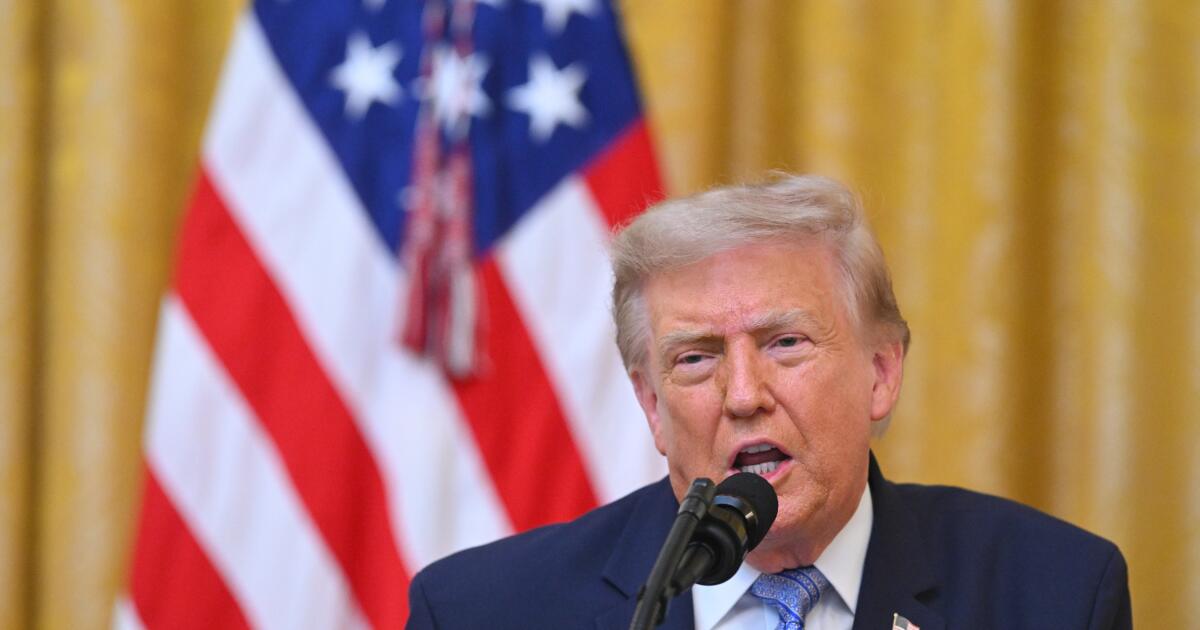
WASHINGTON — President Trump used a rare prime-time address Thursday night to renew his attacks on the security of U.S. elections, telling Americans that the nation’s voting system is “so broken” that “no one can possibly defend it,” a striking effort by a sitting president to undermine public confidence in domestic elections.
Trump asserted that the U.S. election system was “dangerously” exposed to potential foreign hacking, including by China, and said he had directed the White House to release a tranche of heavily redacted documents that purport to show “vulnerabilities” in the nation’s voting system.
But many of his claims, which echo his assertions after losing the 2020 election, have been debunked by investigations, audits or court proceedings. His warnings that the nation’s elections could be vulnerable to foreign influence have long been made by members of both parties, and he made no claims Thursday that foreign actors had changed vote counts or hacked election systems.
Trump amplified his assertions in an apparent effort to cast fresh doubt over what he said was a “stolen” and “rigged” election and renew calls for Congress to pass a federal voting law ahead of the November election.
“This evidence shows that the election system we have dangerously exposes and really exposes levels never thought possible to hacking, exploitation, and foreign interference,” Trump claimed.
The 26-minute address to the nation — a platform traditionally reserved for rare moments of national importance — comes after a series of steps by Trump in his second term to assert more federal control over elections before the November midterm elections, which are less than four months away.
Last week, Trump fired all remaining members of the bipartisan U.S. Elections Assistance Commission, a federal agency that helps states improve their voting systems and distributed election security grants to help protect state elections from foreign and domestic cyberattacks, among other things.
The Justice Department has also attempted to force states to turn over their voter rolls, an effort that more than a dozen courts have now ruled against, and said it would send election monitors to some states. Trump claimed states are refusing to turn over their voter rolls because he alleged noncitizens are registered to vote in their elections.
The president used California, a favorite target, to hint that Democrats were cheating. He cast doubt on California’s vote count in June’s primary election, saying, “It took a month to count the votes. I wonder what they were doing.”
The state’s vote count takes multiple weeks under the current system; it is not a sign of fraud.
Trump delivered the address with his approval rating stagnating at 37%, according to a Washington Post-Ipsos poll released Thursday, and with weakening enthusiasm among Republicans.
Democrats swiftly condemned Trump’s claims as baseless and a rehash of ideas that have little to do with actual election administration.
“Donald Trump is releasing unverified, meaningless documents to appease his own delusions about an election he lost resoundingly, all while continuing to withhold 3 million pages of the Epstein files,” Senate Minority Leader Chuck Schumer said on X.
Multiple reviews of the 2020 election have concluded that Joe Biden won legitimately, and election experts say there is no evidence that widespread fraud affected the outcome of the election. Trump’s own attorney general in his first term, William Barr, said at the time that his department found no evidence of widespread voter fraud that could have changed the outcome of the election.
“It’s been more than half a decade, with numerous audits, recounts, and more than 60 court cases, each finding no evidence of widespread voter fraud,” Sen. Alex Padilla (D-Calif.) said of the 2020 election in a statement. “Clearly, this is no longer about an election Donald Trump lost six years ago. It’s about him laying the groundwork to try to ‘take over the voting’ in the upcoming midterm elections.”
Sue Gordon, who served as principal deputy director of national intelligence during Trump’s first term, said most of the data Trump will release has already been assessed by the intelligence community.
“Since 2016, the intelligence community has been saying that foreign actors intended to influence our election for the purpose of undermining democracy — not undermining a president, undermining democracy,” Gordon told CNN’s Kaitlan Collins after the address.
“This is not a new threat. It was one he certainly knew of. He had an entire term to deal with it,” Gordon said, “and I don’t know how you can believe that the same community who told him about it … then somehow didn’t tell him about further attempts.”
Major broadcast networks declined to air Trump’s speech in full, instead reporting on it. Trump complained about NBC and ABC as he spoke, saying they should lose their broadcasting licenses. He falsely claimed that “they and others in the media are part of a plot” to “continue this fraud.”
In his remarks, Trump alleged China carried out what is believed to be the “largest compromise of election data history” starting during the 2020 election cycle and claimed that “members of the deep state” in the American intelligence community covered it up.
Trump said China had accessed voter data of 220 million people in 18 states, but that information is generally publicly available and does not contain information that would allow a bad actor to change votes or hack into an election system.
He directed the FBI, the director of national intelligence and other agencies led by some of his loyalists to investigate and prosecute the people responsible for the alleged cover-up.
Foreign adversaries have made known attempts to influence election outcomes, but there is no evidence that adversaries have ever breached voting systems or altered votes, something that would be extraordinarily difficult to do without notice, elections experts told The Times this week.
Trump did not mention Russia, which has made attempts to influence U.S. elections through social media or disinformation. In 2016, Russia interfered in the presidential election in an attempt to sway the contest in Trump’s favor, multiple U.S. assessments found in the years following the election.
China was not found to have interfered with election processes or infrastructure in an intelligence report released in March 2021, and the information Trump provided Thursday did not appear to contradict that.
The idea that China may have attempted to influence voters via social media or public statements is not new. In April 2020, an intelligence assessment determined that Chinese intelligence officials analyzed voter registration data from multiple states, according to a report that was declassified in 2022.
After the 2020 election, whether China attempted influence was the subject of debate. The intelligence report concluded it had only considered trying to influence voters, but the national intelligence officer for cyber issues took a “minority view” in the report, assessing that China took “at least some steps to undermine” Trump’s reelection chance.
“Trump’s shocking ‘bombshells’ about China are totally bogus,” Sen. Mark Warner (D-Va.), vice chairman of the Senate Intelligence Committee, said on X. “The fact is our intelligence agencies unanimously agreed that China did not even try to change a single vote in the 2020 election.”
Obtaining a list of voter data alone does not enable someone to change votes, said David Becker, executive director of the nonpartisan Center for Election Innovation and Research. The data are largely public and often used by campaigns and researchers; a bad actor would have to take further steps to affect an election.
“If anyone got into our voter databases and altered data on a scale that could change the election outcome, it would be obvious … because we would get reports of tens or hundreds of thousands of people having trouble voting,” Becker said.
The president also used the address to pressure Republican lawmakers to pass a voter ID law that has stalled in Congress and that voting rights advocates have warned could make it harder for millions of Americans to register to vote or cast a ballot. Democrats oppose the legislation, but it also has not gained enough support among Senate Republicans to pass.
“Addressing this crisis of elections security demands that Congress will pass the SAVE America Act,” Trump said. “How easy is that to do? Unless you want to cheat.”
Some congressional Republicans praised Trump on social media and echoed his claims to pass the legislation.
“It is more important than ever to crush foreign election interference,” Rep. Mike Lee (R-Utah) said on X. “It is more important than ever to pass the SAVE AMERICA ACT.”
Ahead of the speech, elections and democracy experts had cautioned that the president may attempt to sow doubt about the security of the nation’s election system or bolster debunked fraud claims.
Some experts said Thursday’s address could be interpreted as a sign that Trump is running out of moves in the lead-up to the midterm elections, where Republican control of the House is at stake.
“The fact that they’re throwing everything up on the walls at this point demonstrates panic,” Becker said. “They are not operating from strength right now. They are operating from weakness.”
-
 Business15 seconds ago
Environmental groups press to halt Imperial Valley lithium venture
-
 Entertainment6 minutes ago
Netflix stock plunges to 52-week low following mixed earnings report
-
 Lifestyle12 minutes ago
L.A. Affairs: After losing our spouses, we found love again. But were we cheating on our children?
-
Politics18 minutes ago
A new piece of Democrats’ midterm strategy: Being ‘practical’
-
 Science24 minutes ago
After wildfires destroyed 95% of this California tribe’s forests, members uncovered 1,200 ancestral sites
-
 Sports30 minutes ago
World Cup championship and third-place game: Start times and how to watch
-

 World42 minutes ago
Rule of Law in Hungary shows ‘radical change’ under Magyar, EU says
-

 News1 hour ago
Where Wildfire Smoke Is The Worst Right Now—And What To Do About It

