
Politics
Video: Project 2025, Explained


Democrats’ Hasan Piker Problem
Democrats rally around Hasan Piker as the emerging thought leader of the party. Senate candidate Adam Schwarze joins the progrum to make his case for Minnesota. #hasanpiker #MinnesotaPolitics #2026Election
NEWYou can now listen to Fox News articles!
Marxist political influencer Hasan Piker is lashing out over a federal inquiry into his recent trip to communist Cuba, calling it an “intimidation tactic” prompted by his harsh stance on Israel and the U.S.
The response by Piker — echoed by other leaders from Democratic Socialists of America and pro-communist and anti-Israel leaders — illustrates how quickly the Cuba “solidarity” movement, pro-communist influencers and anti-Israel activist networks converged online to frame the federal inquiry not as a sanctions or foreign influence investigation, but as political repression aimed at broader anti-capitalist, anti-Western, anti-Israel activist movements.
Piker told followers during a livestream on Twitch Sunday afternoon that he is being targeted for being a “loudmouth” and “rabble-rouser,” criticizing Israel and the “fascist” United States.
Fox News Digital reported Saturday that the Treasury Department’s Office of Foreign Assets Control has sent administrative subpoenas to Piker and leftist CodePink co-founder Medea Benjamin to get documents about the financial, logistical and communications details of their March trips to Cuba, in possible violation of laws and regulations about doing business with the government of Cuba.
“It’s not great,” Piker told his followers in the early minutes of his livestream on Sunday afternoon. “The news is not great, okay? Um, I mean, it’s bulls—. But still not great…I mean it’s bulls— but still not great that they’re after your boy. They’re up my a–.”
Piker didn’t respond to requests for comment, although he acknowledged receiving the queries as he spoke to his followers during his livestream. He said that he got his trip cleared by the Office of Foreign Assets Control, saying, “Everything we did was cleared by Treasury.”
The Treasury Department’s Office of Foreign Assets Control didn’t respond to a request for comment.
By the end of his segment on the federal inquiry, Piker pivoted from the Cuba sanctions inquiry to argue that the scrutiny was really driven by backlash to his comments on Israel.
“A lot of this, by the way, does still have a lot to do with Israel,” he said, charging that his critics “don’t like that I talk s— about Israel” and “don’t like that I am a loudmouth, a rabble-rouser.”
He claimed the investigation was not “just about Cuba” but also about his role in boosting anti-Israel voters and candidates.
“They recognize that Democrats and young people are against Israel” and see him “campaigning with candidates who are anti-Israel, and they are winning their races,” he said.
FEDS SUBPOENA HASAN PIKER, MEDEA BENJAMIN OVER CUBA TRIPS
Marxist political influencer Hasan Piker stands outside his home in West Hollywood, Calif., on May 12, 2026, pointing silently to his dog Kaya to direct her back into his home. (MB/Splash for Fox News Digital)
Piker’s response followed a pattern that has become common among online activist influencers under scrutiny: reframing a legal or regulatory inquiry as political persecution while broadening the issue into a sweeping ideological struggle. Rather than focus narrowly on the sanctions questions surrounding the Cuba trip, Piker repeatedly cast himself as the victim of a coordinated campaign by “Israel first” Democrats, pro-Israel activists, mainstream media figures and the “fascist” Trump administration.
He frequently shifted the conversation away from the specifics of Treasury’s inquiry and toward a larger narrative in which the federal government is allegedly criminalizing anti-Israel activism, anti-capitalist politics and opposition to U.S. foreign policy. He sought to portray the investigation as evidence that powerful political and media institutions are targeting dissenting voices who challenge establishment positions on Israel, Cuba and American foreign policy.
At one point, Piker said he created a mini-documentary about life in Cuba during his March trip, saying he was serving as a journalist. In other moments, he has described the mission as a “humanitarian” effort, framing his trip as providing “humanitarian aid” to the people of Cuba.
Piker also characterized the controversy using language increasingly emerging from socialist, communist and anti-capitalist movements online, where activists have used the phrase “Epstein class” as shorthand for wealthy elites and the supposed moral corruption of American capitalism. The rhetoric repeats the propaganda of U.S. adversaries, including Cuba, China, the Islamic Republic of Iran and Russia.
He read a comment from a fan, who wrote, “We’ll free you, my brother.”
POWER COUPLE OF CHAOS: HOW A TYCOON AND ACTIVIST BUILT A ‘REVOLUTIONARY BASE’ AT THE HOUSE OF SINGHAM
Hasan Piker, a Democratic Socialists of America member, and CodePink co-founder Jodie Evans meet in Havana, Cuba, as part of a “United Front” supporting the communist regime. (CodePink via Storyful)
Piker responded, “I’m seemingly going to be made an example of…in America’s galloping toward fascism.”
He batted away suspicions that Elon Musk made a “boss call” to subpoena Piker after he did an interview yesterday with Ashley St. Clair, the mother of a baby with Musk. The two are going through a custody dispute.
“I haven’t gotten anything yet,” said Piker.
“Yes, I’ll get lawyered up,” he said, in response to a follower.
He said he needed a lawyer with expertise on the First Amendment and “knowledgeable on OFAC.”
“I haven’t had anything happen to me yet,” he said. “And it’s not like anything I’ve done.”
Saturday evening, Piker posted on X that “the American govt would rather try to criminalize delivering aid to a country we’d starved, than punish the Epstein class.”
MEDIA TAPS TWITCH STAR WHO TOLD VIEWERS TO ‘KILL’ REPUBLICANS FOR COMMENT ON CHARLIE KIRK’S ASSASSINATION
CodePink co-founder Medea Benjamin arrives home in Washington, D.C., on May 11, 2026, with her partner TIghe Barry. (LG for Fox News Digital)
At 10:51 p.m., CodePink’s Benjamin posted: “Taking medical supplies to pediatric hospitals in Cuba is now a crime? Saving the lives of babies is a crime? The administration is beyond grotesque.”
Benjamin repeated the movement’s broader framing of the Cuba trips as “humanitarian” missions, even as organizers and participants repeatedly paired the aid campaigns with overt political rhetoric condemning the Trump administration, U.S. sanctions policy and what activists described as “imperialism” and “settler colonialism” in Cuba and Latin America.
Piker’s uncle, far-left commentator Cenk Ugyur, the co-founder of Justice Democrats, a socialist organization that helped elect Ilhan Omar, Rashida Talib and Alexandria Ocasio-Cortez to Congress in 2018, defended him online Saturday night.
“Government apparently sent some bullshit subpoena to Hasan,” Ugyur wrote. “They’re tightening the noose on speech. Remember, they’ll always have an excuse or some technicality. It’s not like they’re going to tell you, ‘We did it because we don’t like what you’re saying.’”
Uygur then linked the investigation to broader left-wing claims about suppression of pro-Palestinian and anti-Israel speech, arguing the government was using legal and procedural mechanisms to target political dissent rather than directly censoring viewpoints.
WHO IS HASAN PIKER? MEET THE FAR-LEFT STREAMER WHO IS STIRRING UP CONTROVERSY ONLINE AND DIVIDING DEMOCRATS
Piker called CodePink co-founder Jodie Evans a “wonderful person.” He took a photo in Havana with Evans, which she shared on her Instagram account from Cuba.
A little after 3 p.m., one hour and 12 minutes into his livestream, Piker acknowledged, “I would much rather not have to deal with this.”
Half an hour later, he insisted that he was being targeted for his strong opposition to the existence of the state of Israel, playing a clip of Rep. Mike Lawler, R-N.Y., Rep. Josh Gottheimer, D-N.J., as they spoke about the growing tide of anti-semitism, including from Piker.
At one point, Piker scoffed as the two lawmakers discussed increasing reports of antisemitism in the U.S.
Piker later moved on to a segment supporting the the Islamic Republic of Iran in its talks with the U.S. and Israel to end the war in Iran, mocking the Israel delegation’s “chirping,” critiquing U.S. foreign policy for allegedly letting “Israel take control over our entire Middle East policy” and moving the focus of his monologue to a critique of the “Zionist” state of Israel and the “rogue” United States.
Fox News Digital’s Sophia Compton contributed to this report.
CLICK HERE TO DOWNLOAD THE FOX NEWS APP

WASHINGTON — In the 2024 election, hundreds of social media influencers were credentialed for the first time to attend the Democratic and Republican conventions. They have been invited to holiday parties in the Pennsylvania governor’s mansion, to political rallies in Texas and to events at the White House by both the Biden and Trump administrations.
The role of influencers is surging as candidates and groups across the political spectrum see their social media feeds and personas as a pathway to younger audiences and harder-to-reach groups of voters.
“You have that sense of authenticity, like a friend is talking to you,” said Emma Briant, a professor at Notre Dame University’s Lucy Family Institute for Data & Society who studies propaganda.
That’s exactly what campaigns are hoping to harness when they partner with influencers, she said.
But the nature of that partnership has come into question in California’s hotly contested gubernatorial race after it emerged that a number of content creators — some with millions of followers, others with only a handful — had taken payments from the campaign of Democratic candidate Tom Steyer and not disclosed that they were paid to create those posts.
Some popular content creators have felt the need to explain themselves to their audience. Others have questioned how common such under-the-table payments might be, since there are no disclosure requirements for paid content at the federal level and few jurisdictions have any rules mandating it.
Some campaign finance advocates are concerned that voters could increasingly be influenced by social media posts that they don’t know are sponsored.
“The problem is that it doesn’t look like an ad,” said Saurav Ghosh, a former enforcement attorney at the Federal Election Commission. “It ends up really getting people at a place where they’re not skeptical and not able to tell the difference between what’s voluntary and where the influencer is acting as a paid spokesperson.”
Ghosh is now the director of campaign finance reform at the nonprofit Campaign Legal Center, which has filed a petition asking the FEC to require disclaimers on paid content created by influencers.
Roughly 1 in 5 Americans said they regularly got news from social media influencers in 2024, according to the Pew Research Center, and that number was nearly double for younger adults between the ages of 18 and 29.
Working with social media creators can be an easy way for candidates to try to boost their image, particularly with a younger audience.
“If they don’t have big personalities, maybe partnering with some influencers who seem cool and fun can make you seem cool and fun also through association,” said Link Lauren, a political influencer and podcaster who served as a communications advisor for Robert F. Kennedy Jr.’s presidential campaign in 2024.
California is one of the few places that requires disclosure of sponsored social media posts, but the 2023 law that created those rules hadn’t gotten much of a workout before the issue was raised in this contest through a series of dueling complaints with California’s Fair Political Practices Commission. The commission has yet to weigh in on the various accusations.
Under the law, influencers are required to provide disclosure that a post was sponsored and say who paid for it. Political groups are required to notify paid creators of the requirement.
Even if the commission finds that violations have occurred, the penalties are not especially harsh.
Violation of the law carries no civil, criminal or administrative penalties. The FPPC can take alleged violators to court and ask a judge to force compliance. And violations can be penalized with a fine of up to $5,000 per instance.
Influencers reporting influencers
In the gubernatorial race, the issue of compliance was raised, naturally, by a pair of influencers.
Beatrice Gomberg has built up a following of more than 180,000 followers on TikTok, where she posts under the handle antiplasticlady. Her side gig of creating nonplastic children’s cups and lunch boxes became her main gig after she lost her human resources job at Macy’s during the COVID-19 pandemic.
“I started doing social media because I didn’t want to hire a marketing company,” Gomberg said.
Gomberg’s posts were initially largely focused on research related to plastic, but have become increasingly political over time. When campaigns put out the call for influencers to meet with candidates, Gomberg answered.
She interviewed Katie Porter, she met with Xavier Becerra. And it was at a Becerra event in April when she met Kaitlyn Hennessy, another influencer focused on politics.
They found that the world of online influencers can be isolating. “We stare in front of our phones,” Hennessy said. “You don’t want to see our screen time.”
As they scrolled through social media posts about the governor’s race, they found a cause to unite them.
They kept seeing videos posted by social media accounts espousing similar messages in support of Tom Steyer. Hennessy wondered at first if they were actually created by artificial intelligence.
They found that the posts seemed to be created by a network of women who, in some cases, had created several different profiles to promote a variety of products.
They pored over Steyer’s campaign disclosures and saw that the campaign listed payments to several prominent influencers — including one with the handle Zay Dante, with 1.8 million followers on TikTok — who had not disclosed creating paid content for the campaign.
The pair filed a complaint laying out their allegations, which the Steyer campaign has called “baseless.”
In the wake of their complaint, Steyer defended his campaign’s use of paid influencers, writing on Substack that his campaign believed content creators should be paid for their work and that the campaign had been transparent about disclosing those payments.
In a separate post, influencer Carlos Eduardo Espina said he had been paid $400,000 for work he has done for the Steyer campaign. Espina, who has more than 14 million followers on TikTok, is an advisor to the campaign, which was publicly announced.
“You will never see anything on my channels that I don’t believe in, or that I think goes against the best interest of my community. No one buys my opinion. But I also think it’s fair to be compensated for my work,” he wrote on Substack.
Not everyone is ready to accept payment for posts.
Lauren, the influencer who advised Kennedy’s campaign, said that while he doesn’t begrudge other influencers accepting sponsorship, he chooses not to.
“A passive viewer might think you really believe this,” he said. “I have a strong connection with my audience. I really consider them my family.”
Lauren said he favors disclosure requirements.
Briant, the propaganda researcher, said she is concerned about the possibility of foreign actors trying to influence Americans through paid posts.
In 2024, for example, federal prosecutors filed an indictment alleging that Russian state media employees had paid nearly $10 million to a Tennessee company that paid popular right-wing social media influencers to unwittingly produce pro-Russia content.
Briant said she believes that the only way to counteract increased manipulation through social media influencers is to impose harsh penalties when paid content is not disclosed.
“Ultimately, it’s a wild west at the moment if there are no repercussions for not doing it,” she said.

A man who was already known to the U.S. Secret Service approached the White House complex on Saturday evening, took a gun out of a bag and opened fire before being shot and fatally wounded by Secret Service police officers.
A bystander was also struck by gunfire, the Secret Service said in a statement, though it did not give details on the nature or severity of the injuries. It was unclear who fired the shot that struck the bystander.
The gunman, who was identified by two officials with knowledge of the investigation as Nasire Best, 21, was taken to a nearby hospital, where he was pronounced dead. No officers were injured, the Secret Service said.
In a social media post early Sunday, President Trump thanked the Secret Service and law enforcement officers involved in the shooting, and described the gunman as having “a violent history” and a “possible obsession” with the White House.
The shooting took place a little after 6 p.m. near 17th Street and Pennsylvania Avenue, at the northwestern corner of the White House grounds.
Mr. Trump, who was in the building at the time, had made it known on Friday that he would be spending the long holiday weekend at the White House.
In his social media post, Mr. Trump also appeared to renew his push for a proposed ballroom and security expansion at the White House, saying the episode underscored the need for “the most safe and secure space of its kind ever built in Washington.”
Within the last month, two people have been arrested after opening fire in the vicinity of top U.S. officials.
On April 25, a man from California who was armed with a shotgun, handgun and several knives charged past a security checkpoint at the White House Correspondents’ Association dinner, where Mr. Trump was due to speak, before being subdued by Secret Service agents.
On May 4, a man from Texas was wounded during an exchange of gunfire with Secret Service officers near the Washington Monument, accused of making vulgar statements about the White House afterward, as he was being taken to a hospital in an ambulance.
Mr. Best had been arrested last July for walking into a restricted area on the White House grounds, ignoring signs and commands to stop. At that time, according to an affidavit filed in D.C. Superior Court, Mr. Best had already been known to Secret Service personnel “for walking around the White House complex inquiring how to gain access at various entry posts.”
He had briefly been involuntarily held that June for blocking a vehicle entry on the east side of the White House, the affidavit said. At the time of that arrest, on a misdemeanor charge of unlawful entry, he had no pending warrants. He told officers at the scene that “he was Jesus Christ and that he wanted to get arrested.”
Court records show that a judge issued a “stay away order” the day of his arrest, apparently barring him from the area around the White House. After he did not show up for a hearing in August, a bench warrant was issued.
On Saturday evening, the flurry of gunfire prompted a brief White House lockdown, and rattled the reporters who were gathered on the North Lawn.
Selina Wang, a senior White House correspondent for ABC News, posted a video on social media of her recording a report when what sounds like gunfire can be heard in the background.
She was about three seconds into the recording when the noises are heard, and she dropped to the floor for cover.
“I was in the middle of taping on my iPhone for a social video from the White House North Lawn when we heard the shots,” she wrote on X. “It sounded like dozens of gunshots. We were told to sprint to the press briefing room where we are holding now.”
Allison Robbert, a photographer for The New York Times, said that about 20 to 30 gunshots were heard from the north lawn of the White House.
“Journalists heard it from outside the press room and were ushered inside by Secret Service,” she said in a text message.
Christopher Mele and Mark Walker contributed reporting.
-

 Politics3 minutes ago
‘After your boy’: Hasan Piker lashes out over fed probe into Cuba trip
-

 Health9 minutes ago
5 common walking mistakes that could hurt your progress, according to an expert
-

 Sports15 minutes ago
Victor Wembanyama scores 33 as Spurs dominate Thunder in Game 4 to even Western Conference Finals
-

 Technology21 minutes ago
Fake CAPTCHA scam can hack your computer
-
 Business27 minutes ago
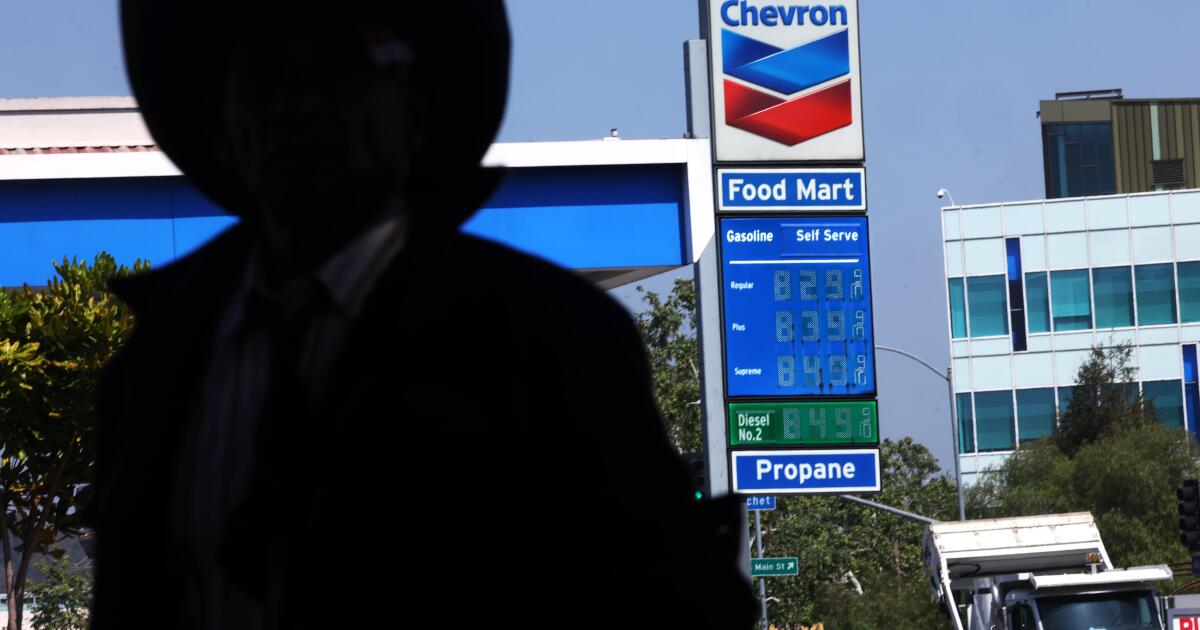
Newsom blames Chevron for California’s gas-price problem
-
 Entertainment33 minutes ago
Good night and good luck and goodbye — CBS News Radio signs off after nearly 100 years
-
 Lifestyle39 minutes ago
L.A. Times Concierge: ‘Where can I buy the best celebration cake for a dear friend?’
-
Politics45 minutes ago
As influencers rise in politics, some call for tighter regulations on payments

