Politics
Under Trump, Texas firm pushes to restart Santa Barbara oil drilling. Is it skirting California laws?


More than 50 years ago, a catastrophic oil spill along Santa Barbara’s coastline served to galvanize the modern environmental movement and also helped to usher in one of the state’s strongest conservation laws: the California Coastal Act.
Now, as the Trump administration seeks to encourage oil and gas production within federal lands and waters, that watershed conservation law is being tested along the same stretch of coastline — and in a way it never has before.
For months, a Texas-based oil company has rebuffed the authority of the California Coastal Commission — the body tasked with enforcing the act — and has instead pushed forward with controversial plans to revive oil production off the Gaviota Coast.
Ten years after another spill brought oil production here to a halt, Sable Offshore Corp. has begun repairing and upgrading the network of oil pipelines responsible for that 2015 spill, without Coastal Commission approval and ignoring the commission’s repeated demands to stop its work, officials say.
Crews bag oiled sand and kelp at Refugio State Beach in May 2015, after a ruptured pipeline near Santa Barbara leaked an estimated 140,000 gallons of crude oil.
(Al Seib / Los Angeles Times)
“This is the first time in the agency’s history that we’ve had a party blatantly ignore a cease and desist order like this and refuse to submit a permit application,” Cassidy Teufel, deputy director of the California Coastal Commission, told a packed town hall recently.

Aggressive and impactful reporting on climate change, the environment, health and science.
Sable has accused the commission of “overreach” and insists that it has acquired the necessary approvals for its work.
The company intends to revive operations at three oil platforms known as the Santa Ynez Unit, which connects to pipelines that have been the focus of the ongoing repair work after a corroded section of those pipes ruptured near Refugio State Beach in 2015. That pipeline failure, which occurred under different ownership, spewed an estimated 140,000 gallons of crude oil, harmed hundreds of miles of coastline and cost millions to clean up.
In a new report, Coastal Commission staff allege that Sable’s activities — which include excavation, grading, removing vegetation and placing cement bags on the seafloor — “have adversely impacted, and continue to adversely impact, coastal resources as a result of Sable’s outright refusal to comply with the Coastal Act.”
The report recommends that commissioners fine Sable almost $15 million, issue another cease and desist order for all development along the pipelines and require restoration work.

The requested sanctions will be considered next week at a public hearing — one of the first such venues for citizens to weigh in on reactivation of the offshore oil rigs and how that could affect the local environment, which has long concerned Santa Barbara residents and climate activists.
Sable insists it does not need to comply with the latest Coastal Commission requests.
“The repair and maintenance work done to ensure the safe condition of the Santa Ynez Unit and onshore pipelines was fully authorized by coastal development permits previously approved by the California Coastal Commission and Santa Barbara County,” Steve Rusch, Sable’s vice president of environmental and governmental affairs, said in a prepared statement. “Commission staff’s unreasonable overreach is an attempt to exert influence over the planned restart of the Santa Ynez Unit oil production operations.”
In a statement of defense submitted to the Coastal Commission, Sable noted that due to updated requirements, “this pipeline will meet more stringent environmental and safety requirements than any other pipeline in the state.”
The company called the commission’s findings on environmental impacts exaggerated, and noted that it has “implemented several construction best management practices to limit impacts to coastal resources, biological resources, and archaeological resources,” Sable wrote.
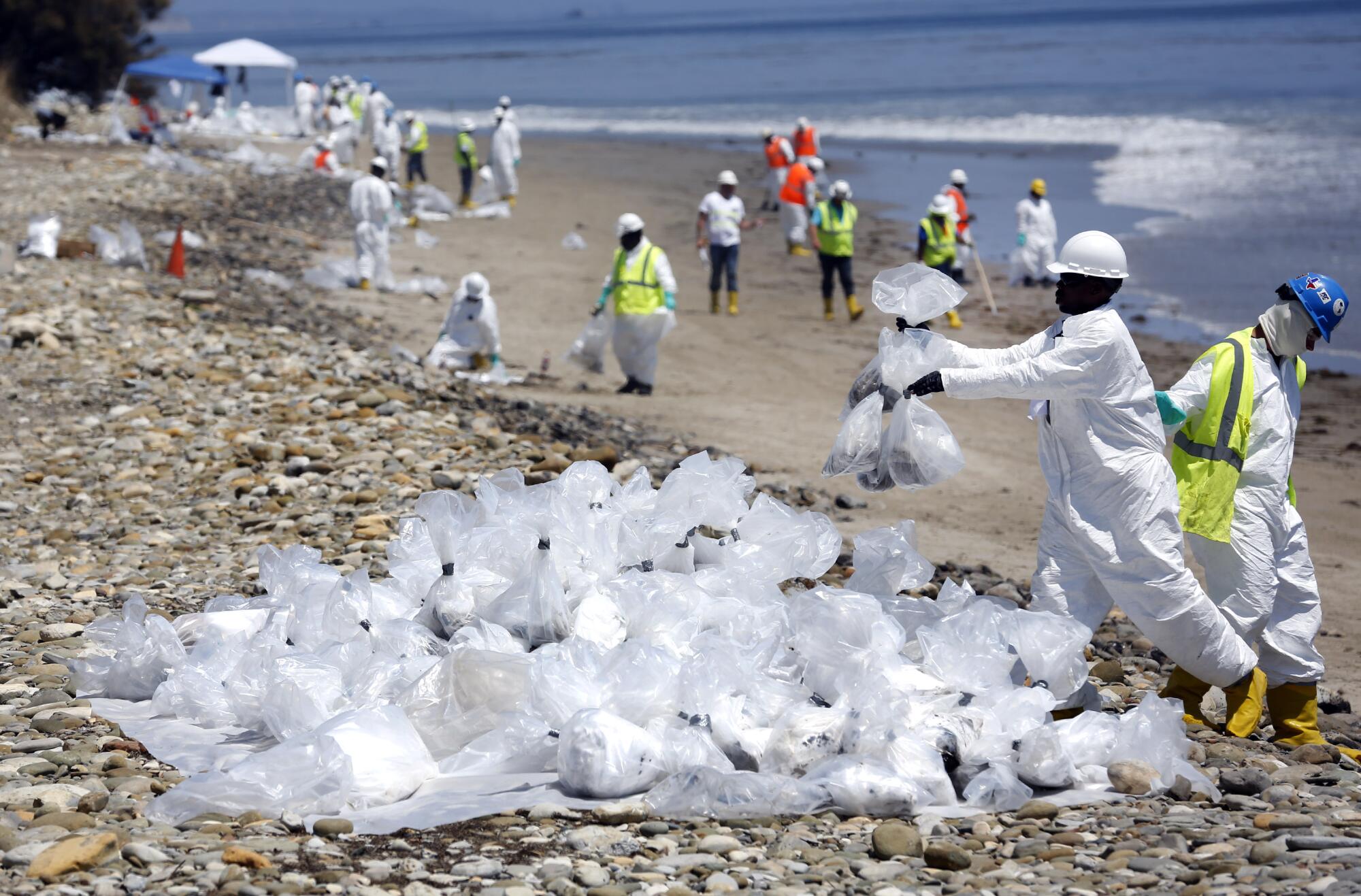
Cleanup workers pile bags of oil-soaked sand at Refugio State Beach in Goleta after a 2015 oil pipeline rupture.
(Mel Melcon / Los Angeles Times)
So who’s in charge of such projects?
If Sable succeeds in restarting operations, it would mark a surprising reversal for California’s oil and gas industry in recent years, as climate-focused policies have slowly reduced the state’s production of fossil fuels.
The Houston-based company estimates that once the Santa Ynez Unit is fully online, it could produce an estimated 28,000 barrels of oil a day, according to an investor presentation.
The unit has three offshore platforms — Hondo, Harmony and Heritage — located in federal waters a few miles off the coast. These platforms are connected to the Las Flores Canyon processing facility, inland from El Capitan State Beach, and other distribution lines that run onshore. The 2015 Refugio oil spill was caused by the rupture of a buried onshore pipeline.
Sable has said it anticipates restarting offshore oil production in the second quarter this year, but the company acknowledges that some regulatory and oversight hurdles remain. Most notably, its restart plan must be approved by the state fire marshal.

Though Sable has already cleared some of that agency’s major regulatory steps, State Fire Marshal Daniel Berlant has said the company’s final restart plan wouldn’t be approved without agreement from a handful of other state agencies, including the Coastal Commission.
“Before we would ever sign off on a pipeline, [we will make] sure that each of these departments has agreed that all of the rules have been followed,” Berlant said at the March town hall.
Berlant also assured Santa Barbarans that since the 2015 spill, the fire marshal’s office has implemented more stringent standards for oil infrastructure, which are part of Sable’s plan. He said his office requires 67 new conditions focused on safety and corrosion protection, stricter and more frequent monitoring and repair standards.
Sable, however, has most heavily relied on recent approval from Santa Barbara County Planning & Development, which in October said the company could proceed with its corrosion repair work under the pipeline’s original county permit from the 1980s. The company contends it is still relevant because its work is only repairing and maintaining an existing pipeline, not constructing new infrastructure.
After concern from the Coastal Commission and environmental groups, county officials confirmed its position in February, concluding that Sable’s repair work on the corroded pipeline “is authorized by the existing permits … [and] was analyzed in the prior Environmental Impact Report/Environmental Impact Statement.”

A worker cleans oil from the rocks and beach at Refugio State Beach in Goleta, Calif. in 2015.
(Mark Ralston/AFP via Getty Images)
Coastal Commission staff have questioned how a permit from nearly 40 years ago can adequately take into account current technology, requirements to remedy corrosion issues and environmental conditions.
“The removal of the pipeline’s insulation and implementation of this new strategy for managing corrosion risk represents such a fundamental shift in the pipeline’s design and operation that resuming operations under this new system would not be consistent with the existing permit,” the staff report said. It also argues that old permits don’t take into account current habitats or sensitive species in the area, including those newly considered endangered or threatened, such as the steelhead, the tidewater goby and the California red-legged frog.
Ultimately, the matter may be determined in court. In February, Sable sued the Coastal Commission claiming it doesn’t have the authority to oversee its work.
“Sable’s representatives have told us that they’ll only stop if a court makes them, so we’ve been working with the attorney general’s office for the past month to move in that direction,” Teufel said at a town hall last month in Santa Barbara. The event drew hundreds of attendees — clearly divided between those donning Sable hats and others holding signs that read, “No polluting pipeline” and “No coastal permit, no restart.”
But as of yet, California Atty. Gen. Rob Bonta hasn’t weighed in. A spokesperson for the office declined to respond to questions from The Times, referring inquiries to the Coastal Commission.
A controversial legacy
Since 1969, when the blowout of on an offshore oil platform spewed more than 3 million gallons of crude oil into the Santa Barbara Channel and devastated the coastline, environmentalists have fought to shut down offshore oil rigs along the Gaviota Coast. In their view, Sable’s behavior has been beyond the pale.
“So far this has been happening with no environmental review,” said Alex Katz, the executive director of the the Environmental Defense Center, which was founded after the 1969 spill. “For a project that’s this big and has this much risk, it’s very strange.”
At the same time, other residents see economic value in oil extraction.
1

2

3

1. Men in boats and on shore gather in straw being used to soak up oil in Santa Barbara Harbor. A boom helps contain the worst of the oil slick, which has stained 30 miles of coastline. This photo was published in the Feb. 10, 1969 Los Angeles Times. The Santa Barbara oil spill of 1969 (Don Cormier/Los Angeles Times) 2. Cormorant’s bill is held by rubber band during bath to remove oil after the Santa Barbara oil spill. This photo was published in the Feb. 10, 1969 Los Angeles Times. (Mary Frampton/Los Angeles Times) 3. Workman Dave Kirkwood sprays live steam rocks at the harbor at Santa Barbara breakwater to clear oil smears. This photo was published in the Feb. 10, 1969 Los Angeles Times. The Santa Barbara oil spill of 1969 (Don Cormier/Los Angeles Times)
Santa Barbara County Supervisor Bob Nelson has called much of the concern around the pipeline “political theater.” He said he generally agrees that Sable has the necessary permits to restart oil production, and noted that local oil is better than the alternative, especially when there’s still demand for such fuel.
“If you really cared about climate change, you’d want to use this oil,” Nelson said in an interview, arguing that it’s better to use local resources than oil shipped from around the world, where there are likely fewer environmental regulations and no local tax revenue or jobs. Sable has reported it expects the project to initially generate $5 million a year in new taxes for the county and, upon restart, would support an additional 300 jobs.
At the town hall last month, Assemblymember Gregg Hart (D-Santa Barbara) called on California’s attorney general to get involved in this process to uphold the state’s environmental laws, noting that there are clear risks, as with any offshore drilling project.
“It is a false choice to say we have to choose between protecting our environment and growing our economy,” Hart said at the packed hearing that included representatives from at least eight state agencies.. “We have experience here in this community of the tragedies that come from companies that don’t operate responsibly. … We have some serious concerns about what’s being proposed with the Sable pipeline.”
Some of those state agencies, including the California Department of Fish and Wildlife, the State Water Resources Control Board and the California Department of Parks and Recreation, have also raised concerns about Sable’s work. The regional water board in December issued Sable a noncompliance notice for unauthorized discharge into waterways, while wildlife officials alerted the company of a potential Fish and Game Code violation. Sable’s response to those issues remain under review.
Yet, the full extent of completed or possible environmental damage from this project remains unclear, the Coastal Commission argues, because Sable hasn’t shared detailed plans or applied for permits. And that’s a precedent that should be concerning for all Californians, said Linda Krop, chief counsel for the Environmental Defense Center.
“This is the biggest threat to the California coast,” Krop said. “They should not be allowed to operate when they’re violating state laws.”
Staff writer Tony Briscoe contributed to this report.

Construction workers unfurled a large printed tarp to cover scaffolding installed at the White House’s front entrance. Doug Burgum, the interior secretary, said President Trump had ordered the repairs after noticing damage to columns.
Politics
WATCH: Trump’s Energy chief reveals what escalating Iran tensions could mean for gas prices

NEWYou can now listen to Fox News articles!
Energy Secretary Chris Wright is telling Americans not to be concerned about the possibility of another surge of sharp increases in gasoline prices as tensions with Iran have started to escalate once again.
Asked whether Americans should worry about higher prices at the pump and how the Trump administration is preparing to keep the economy stable if the conflict continues to worsen, Wright told Fox News Digital: “It has not been any good behavior from Iran that’s allowed oil to flow. It’s been the United States military.”
“That’s not changing,” he assured, speaking from the Great American State Fair on the National Mall this week.
US CLAWS BACK KEY CONCESSION TO IRAN AFTER FRESH ATTACKS ON COMMERCIAL SHIPS IN STRAIT OF HORMUZ
(Mario Tama/Getty Images) (Mario Tama/Getty Images)
With Iran striking three commercial vessels transiting the Strait of Hormuz on Monday and Tuesday, Wright doubled down in urging citizens to not credit Iran for the U.S. military’s work to ensure oil shipments continue flowing through the strait.
“Look, the U.S. Military has been the key asset here,” he said. “They have assured the flow of oil and gas through the Strait of Hormuz throughout. Not at the beginning of this conflict, but through the last six weeks.”
Wright said the administration is closely monitoring global oil supplies as the tentative ceasefire with Iran seemingly came to come to a halt, with President Donald Trump telling Secretary-General Mark Rutte the call for peace with Iran is “over” at the NATO Summit in Turkey on Wednesday.
But, he pointed to the continued shipping through the Strait as evidence that markets should remain stable.
TRUMP SAYS IRAN CEASEFIRE IS ‘OVER’ AFTER IRANIAN ATTACKS TRIGGER MASSIVE US RESPONSE
President Donald Trump speaks at the White House on Tuesday, April 22. (AP/Alex Brandon)
“We’re of course constantly watching the supply of oil, the supply of refined products and what’s going on there,” Wright said. “And I think still all positive trends.”
Beyond geopolitical concerns, Wright also praised the new chain of discounted gas stations across Pennsylvania and New Jersey, Freedom Fuel, which promises customers prices below the national average.
The Trump administration, though not involved with the network, has heavily endorsed the new chain and its 25 locations.
“We love it,” Wright said when asked about Freedom Fuel. “I mean, look, any mechanism we can to lower energy costs for Americans of all kinds, we’re all in on.”
“With Freedom Fuels, they’re just lowering it down to their wholesale price of gasoline,” Wright said. “So they’re not making any money selling gasoline, but they’ve got convenience stores. That’s how most gas stations make money.”
NEWSOM UNDER FIRE AS CALIFORNIA GAS TAX HIKE SENDS PUMP PRICES EVEN HIGHER
Gasoline costs are a known concern for many Americans, and amid surging prices there has been a considerable increase in those opting to purchase electric vehicles to save money long-term at the pump — with Tesla dominating the market for these types of models.
Wright argued one of the benefits to living in America is having the option to choose what type of vehicle you drive.
CLICK HERE TO DOWNLOAD THE FOX NEWS APP
“We just want people to buy what they would prefer,” he told Fox News Digital when asked his thoughts on increasing calls for support of the electrification of cars. “Consumer choice — you wanna buy an electric car, you wanna buy a gas powered car, diesel powered car, buy a big truck. That’s the choice.”
“That’s why you live in America. You get the choice of all those.”

In 2023, California regulators levied more than $100,000 in fines against the private operator of a federal immigration facility, kicking off a three-year battle over whether detainees who do work at the facilities should be considered employees.
The question went beyond semantics: If considered employees, the detainees would be subject to state worker protection laws.
A legal settlement announced this week now affirms that private immigrant detention facilities are subject to California’s workplace safety and health requirements.
“Every worker deserves a safe and healthy workplace and should be able to report workplace hazards without fear of retaliation,” said Denisse Gómez, spokesperson for the California Division of Occupational Safety and Health or Cal/OSHA.
“Individuals who perform work in these facilities are entitled to workplace safety protections, and this settlement reinforces Cal/OSHA’s commitment to enforcing those protections and safeguarding vulnerable workers,” she added.
Under the settlement between California and the GEO Group, a Florida-based private prison company, the company recently withdrew its legal challenges and agreed to pay more than $100,000 in the fines.
The GEO Group did not respond to requests for comment.
Back in 2023, Cal/OSHA issued $104,510 in fines against the GEO Group. The agency had found six violations of state code by the company after detainees complained about a lack of protective equipment and proper training while cleaning the facility for $1 per day.
Detainees alleged they routinely wiped black mold off shower walls at the facility, saw black dust spew from air vents and used cleaning solutions that lacked instructions during the COVID-19 pandemic.
The biggest fine levied against the GEO Group was for failure to establish and maintain “effective written procedures to reduce employee risk of exposure to aerosol transmissible disease.”
Advocates viewed Cal/OSHA’S recognition of the detainees as workers as a victory that could pave the way for future labor rights fights at other detention centers in the state.
But the GEO Group appealed, arguing that detainees participating in ICE’s voluntary work program make their own schedules and aren’t employees, so hazard exposure couldn’t be “as a result of assigned duties,” as California law states. Plus, the company argued, there wasn’t enough evidence that detainees were exposed to any hazard.
Early last year, the state’s Occupational Safety and Health Appeals Board rejected the GEO Group’s argument and found that detainees should be considered “affected employees.”
The GEO Group sued, but three days before a California Superior Court hearing in May, the company and Cal/OSHA reached the settlement.
Along with paying the fines, the GEO Group agreed to draft plans for avoiding aerosol transmissions at 12 secure and reentry facilities in California, including five detention centers that hold immigrants.
“GEO ensures detainees are afforded the necessary tools, equipment, and personal protective equipment … to safely and effectively perform any necessary tasks,” the settlement states.
Gómez said the settlement also leaves intact the appeals board’s ruling that civil immigration detainees who participate in work programs can participate in proceedings anonymously, “acknowledging the potential for retaliation when individuals raise workplace safety concerns.”
But the question of whether detainees are employees and deserve certain protections isn’t entirely resolved — at least not for the federal government.
Last month, U.S. Immigration and Customs Enforcement released new standards for detention facilities across the country. The revised guidelines “emphasize that detainee volunteers participating in the voluntary work program are not considered facility and/or government employees” and thus not entitled to labor regulations.
Attorney Mariel Villarreal said the timing of the new detention standards made her question whether the GEO Group had asked ICE to specify in its standards that detainees are not workers in response to its battle with Cal/OSHA.
“To me, it’s a reaction to this very settlement,” she said. Villarreal works for the California Collaborative for Immigrant Justice, which filed the original complaint on behalf of detainees who said they worked in unsafe conditions.
Villarreal pointed to a Washington Post report that GEO Group executives privately asked ICE to specify that detainees are not employees of the facilities where they work. Two top Trump administration officials, border czar Tom Homan and acting ICE director David Venturella, previously worked for the GEO Group.
New versions of ICE detention standards take effect as contracts are established or modified, so this year’s rules won’t immediately apply to every facility.
An ICE spokesperson did not comment about the settlement. The spokesperson, who did not provide their name in an emailed statement Wednesday, said the agency has begun transitioning detention facilities to meet the 2026 standards, “building on its longstanding commitment to safe, secure, and professional detention operations.”
“ICE has consistently implemented many of these best practices independently, reinforcing its role as the leader in detention operations,” the spokesperson added.
The GEO Group and other immigrant detention center operators have faced other legal battles over workers’ rights, including lawsuits in Washington, Colorado and California over the $1-per-day payment.
Villarreal said she’s confident that the Cal/OSHA settlement would continue to hold even if California facilities incorporated the new standards. But she said she believes the statements are an attempt by the GEO Group to “sidestep responsibility” and avoid the possibility of being fined under similar circumstances in other states.
“These statements in the new standards are a way for them to try and preserve profits as much as possible,” she said. “GEO and ICE are so intertwined at this point that they have the same motives.”
-

 Austin, TX5 minutes ago
Texas Has One Trait Almost Every National Champion Shares
-

 Alabama12 minutes ago
Final 2026 MLB mock draft projections for Alabama’s Justin Lebron
-
 Alaska15 minutes ago
Watch My Buddy Matt Not Get Eaten by Bears in Alaska
-

 Arizona20 minutes ago
Roller derby still has a home in Arizona despite myriad obstacles
-

 Arkansas27 minutes ago
Freshman OL Tucker Young never wavered through Arkansas football coaching changes | Whole Hog Sports
-

 California30 minutes ago
Northern California high school graduation shooting suspect arrested in Texas
-

 Colorado35 minutes ago
Colorado to weigh daily hunting limits, ban on fur sales for wildlife hunted for fur
-

 Connecticut42 minutes ago
Woman arrested, accused of murdering man in Farmington in March

