Politics
Under Trump, Texas firm pushes to restart Santa Barbara oil drilling. Is it skirting California laws?


More than 50 years ago, a catastrophic oil spill along Santa Barbara’s coastline served to galvanize the modern environmental movement and also helped to usher in one of the state’s strongest conservation laws: the California Coastal Act.
Now, as the Trump administration seeks to encourage oil and gas production within federal lands and waters, that watershed conservation law is being tested along the same stretch of coastline — and in a way it never has before.
For months, a Texas-based oil company has rebuffed the authority of the California Coastal Commission — the body tasked with enforcing the act — and has instead pushed forward with controversial plans to revive oil production off the Gaviota Coast.
Ten years after another spill brought oil production here to a halt, Sable Offshore Corp. has begun repairing and upgrading the network of oil pipelines responsible for that 2015 spill, without Coastal Commission approval and ignoring the commission’s repeated demands to stop its work, officials say.
Crews bag oiled sand and kelp at Refugio State Beach in May 2015, after a ruptured pipeline near Santa Barbara leaked an estimated 140,000 gallons of crude oil.
(Al Seib / Los Angeles Times)
“This is the first time in the agency’s history that we’ve had a party blatantly ignore a cease and desist order like this and refuse to submit a permit application,” Cassidy Teufel, deputy director of the California Coastal Commission, told a packed town hall recently.

Aggressive and impactful reporting on climate change, the environment, health and science.
Sable has accused the commission of “overreach” and insists that it has acquired the necessary approvals for its work.
The company intends to revive operations at three oil platforms known as the Santa Ynez Unit, which connects to pipelines that have been the focus of the ongoing repair work after a corroded section of those pipes ruptured near Refugio State Beach in 2015. That pipeline failure, which occurred under different ownership, spewed an estimated 140,000 gallons of crude oil, harmed hundreds of miles of coastline and cost millions to clean up.
In a new report, Coastal Commission staff allege that Sable’s activities — which include excavation, grading, removing vegetation and placing cement bags on the seafloor — “have adversely impacted, and continue to adversely impact, coastal resources as a result of Sable’s outright refusal to comply with the Coastal Act.”
The report recommends that commissioners fine Sable almost $15 million, issue another cease and desist order for all development along the pipelines and require restoration work.

The requested sanctions will be considered next week at a public hearing — one of the first such venues for citizens to weigh in on reactivation of the offshore oil rigs and how that could affect the local environment, which has long concerned Santa Barbara residents and climate activists.
Sable insists it does not need to comply with the latest Coastal Commission requests.
“The repair and maintenance work done to ensure the safe condition of the Santa Ynez Unit and onshore pipelines was fully authorized by coastal development permits previously approved by the California Coastal Commission and Santa Barbara County,” Steve Rusch, Sable’s vice president of environmental and governmental affairs, said in a prepared statement. “Commission staff’s unreasonable overreach is an attempt to exert influence over the planned restart of the Santa Ynez Unit oil production operations.”
In a statement of defense submitted to the Coastal Commission, Sable noted that due to updated requirements, “this pipeline will meet more stringent environmental and safety requirements than any other pipeline in the state.”
The company called the commission’s findings on environmental impacts exaggerated, and noted that it has “implemented several construction best management practices to limit impacts to coastal resources, biological resources, and archaeological resources,” Sable wrote.
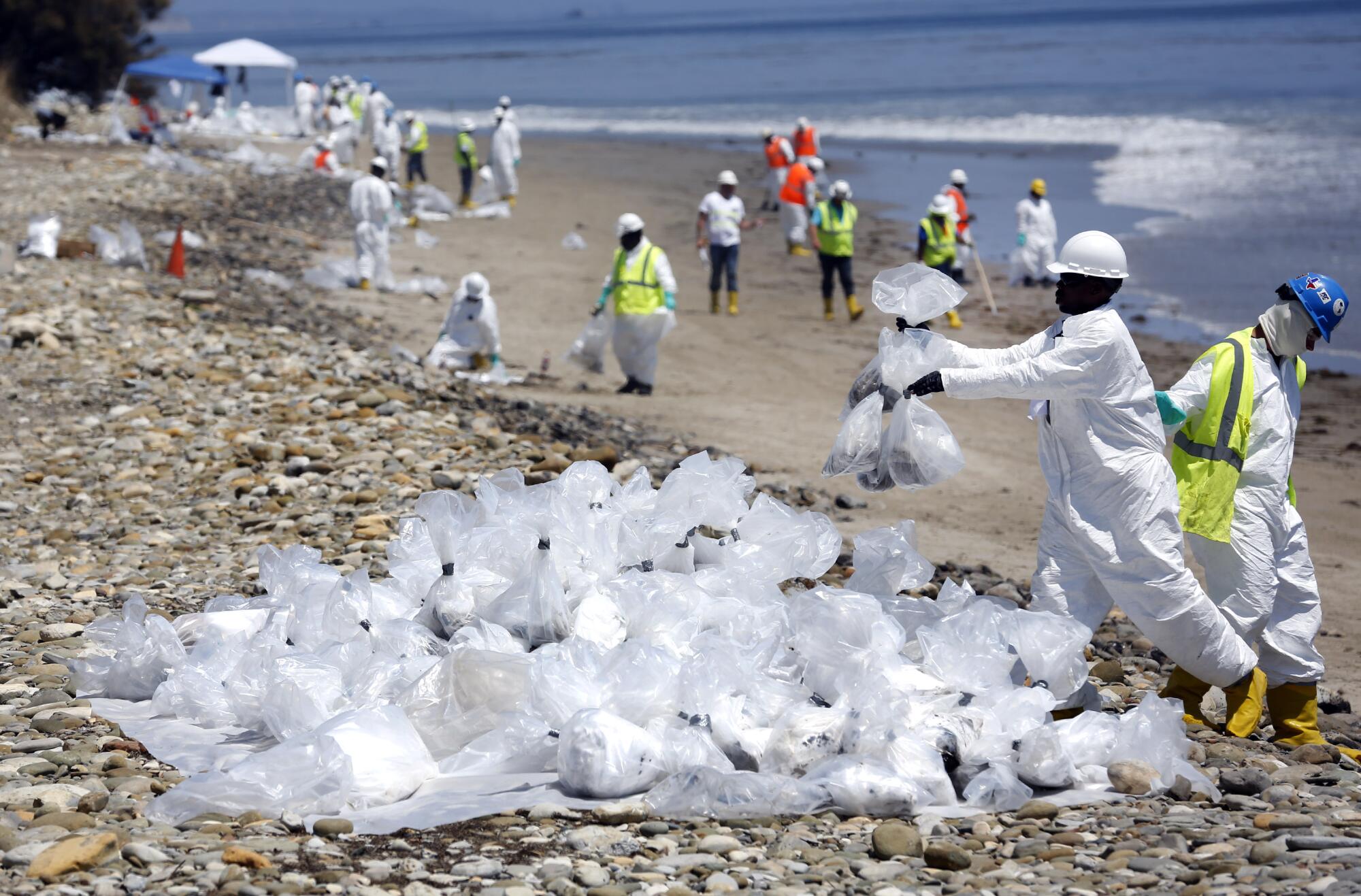
Cleanup workers pile bags of oil-soaked sand at Refugio State Beach in Goleta after a 2015 oil pipeline rupture.
(Mel Melcon / Los Angeles Times)
So who’s in charge of such projects?
If Sable succeeds in restarting operations, it would mark a surprising reversal for California’s oil and gas industry in recent years, as climate-focused policies have slowly reduced the state’s production of fossil fuels.
The Houston-based company estimates that once the Santa Ynez Unit is fully online, it could produce an estimated 28,000 barrels of oil a day, according to an investor presentation.
The unit has three offshore platforms — Hondo, Harmony and Heritage — located in federal waters a few miles off the coast. These platforms are connected to the Las Flores Canyon processing facility, inland from El Capitan State Beach, and other distribution lines that run onshore. The 2015 Refugio oil spill was caused by the rupture of a buried onshore pipeline.
Sable has said it anticipates restarting offshore oil production in the second quarter this year, but the company acknowledges that some regulatory and oversight hurdles remain. Most notably, its restart plan must be approved by the state fire marshal.

Though Sable has already cleared some of that agency’s major regulatory steps, State Fire Marshal Daniel Berlant has said the company’s final restart plan wouldn’t be approved without agreement from a handful of other state agencies, including the Coastal Commission.
“Before we would ever sign off on a pipeline, [we will make] sure that each of these departments has agreed that all of the rules have been followed,” Berlant said at the March town hall.
Berlant also assured Santa Barbarans that since the 2015 spill, the fire marshal’s office has implemented more stringent standards for oil infrastructure, which are part of Sable’s plan. He said his office requires 67 new conditions focused on safety and corrosion protection, stricter and more frequent monitoring and repair standards.
Sable, however, has most heavily relied on recent approval from Santa Barbara County Planning & Development, which in October said the company could proceed with its corrosion repair work under the pipeline’s original county permit from the 1980s. The company contends it is still relevant because its work is only repairing and maintaining an existing pipeline, not constructing new infrastructure.
After concern from the Coastal Commission and environmental groups, county officials confirmed its position in February, concluding that Sable’s repair work on the corroded pipeline “is authorized by the existing permits … [and] was analyzed in the prior Environmental Impact Report/Environmental Impact Statement.”

A worker cleans oil from the rocks and beach at Refugio State Beach in Goleta, Calif. in 2015.
(Mark Ralston/AFP via Getty Images)
Coastal Commission staff have questioned how a permit from nearly 40 years ago can adequately take into account current technology, requirements to remedy corrosion issues and environmental conditions.
“The removal of the pipeline’s insulation and implementation of this new strategy for managing corrosion risk represents such a fundamental shift in the pipeline’s design and operation that resuming operations under this new system would not be consistent with the existing permit,” the staff report said. It also argues that old permits don’t take into account current habitats or sensitive species in the area, including those newly considered endangered or threatened, such as the steelhead, the tidewater goby and the California red-legged frog.
Ultimately, the matter may be determined in court. In February, Sable sued the Coastal Commission claiming it doesn’t have the authority to oversee its work.
“Sable’s representatives have told us that they’ll only stop if a court makes them, so we’ve been working with the attorney general’s office for the past month to move in that direction,” Teufel said at a town hall last month in Santa Barbara. The event drew hundreds of attendees — clearly divided between those donning Sable hats and others holding signs that read, “No polluting pipeline” and “No coastal permit, no restart.”
But as of yet, California Atty. Gen. Rob Bonta hasn’t weighed in. A spokesperson for the office declined to respond to questions from The Times, referring inquiries to the Coastal Commission.
A controversial legacy
Since 1969, when the blowout of on an offshore oil platform spewed more than 3 million gallons of crude oil into the Santa Barbara Channel and devastated the coastline, environmentalists have fought to shut down offshore oil rigs along the Gaviota Coast. In their view, Sable’s behavior has been beyond the pale.
“So far this has been happening with no environmental review,” said Alex Katz, the executive director of the the Environmental Defense Center, which was founded after the 1969 spill. “For a project that’s this big and has this much risk, it’s very strange.”
At the same time, other residents see economic value in oil extraction.
1

2

3

1. Men in boats and on shore gather in straw being used to soak up oil in Santa Barbara Harbor. A boom helps contain the worst of the oil slick, which has stained 30 miles of coastline. This photo was published in the Feb. 10, 1969 Los Angeles Times. The Santa Barbara oil spill of 1969 (Don Cormier/Los Angeles Times) 2. Cormorant’s bill is held by rubber band during bath to remove oil after the Santa Barbara oil spill. This photo was published in the Feb. 10, 1969 Los Angeles Times. (Mary Frampton/Los Angeles Times) 3. Workman Dave Kirkwood sprays live steam rocks at the harbor at Santa Barbara breakwater to clear oil smears. This photo was published in the Feb. 10, 1969 Los Angeles Times. The Santa Barbara oil spill of 1969 (Don Cormier/Los Angeles Times)
Santa Barbara County Supervisor Bob Nelson has called much of the concern around the pipeline “political theater.” He said he generally agrees that Sable has the necessary permits to restart oil production, and noted that local oil is better than the alternative, especially when there’s still demand for such fuel.
“If you really cared about climate change, you’d want to use this oil,” Nelson said in an interview, arguing that it’s better to use local resources than oil shipped from around the world, where there are likely fewer environmental regulations and no local tax revenue or jobs. Sable has reported it expects the project to initially generate $5 million a year in new taxes for the county and, upon restart, would support an additional 300 jobs.
At the town hall last month, Assemblymember Gregg Hart (D-Santa Barbara) called on California’s attorney general to get involved in this process to uphold the state’s environmental laws, noting that there are clear risks, as with any offshore drilling project.
“It is a false choice to say we have to choose between protecting our environment and growing our economy,” Hart said at the packed hearing that included representatives from at least eight state agencies.. “We have experience here in this community of the tragedies that come from companies that don’t operate responsibly. … We have some serious concerns about what’s being proposed with the Sable pipeline.”
Some of those state agencies, including the California Department of Fish and Wildlife, the State Water Resources Control Board and the California Department of Parks and Recreation, have also raised concerns about Sable’s work. The regional water board in December issued Sable a noncompliance notice for unauthorized discharge into waterways, while wildlife officials alerted the company of a potential Fish and Game Code violation. Sable’s response to those issues remain under review.
Yet, the full extent of completed or possible environmental damage from this project remains unclear, the Coastal Commission argues, because Sable hasn’t shared detailed plans or applied for permits. And that’s a precedent that should be concerning for all Californians, said Linda Krop, chief counsel for the Environmental Defense Center.
“This is the biggest threat to the California coast,” Krop said. “They should not be allowed to operate when they’re violating state laws.”
Staff writer Tony Briscoe contributed to this report.





Politics
400 million barrels of oil to be released from strategic reserves as Iran targets commercial ships

Attacks on multiple commercial ships in the waters around Iran on Wednesday increased global energy concerns, pushed nations to unleash strategic oil reserves and sparked fresh critiques of the Trump administration’s readiness for a war it started.
As Trump administration and U.S. military officials continued to claim increasing success and advantage in the conflict, leaders around the world scrambled to respond to the latest attacks and the International Energy Agency’s call for the largest ever release of strategic oil reserves by its members to help stem energy price spikes.
In an address Wednesday morning, IEA Executive Director Fatih Birol said energy shipments through the Strait of Hormuz had “all but stopped” amid the conflict, driving massive global competition for oil and gas in wealthier countries and fuel rationing in poorer nations.
He said the IEA’s 32 member nations have brought a “sense of urgency and solidarity” to recent discussions on the matter, and had unanimously agreed to “launch the largest ever release of emergency oil stocks in our agency’s history,” making 400 million barrels of oil available.
However, he said the most needed change is the “resumption of traffic through the Strait of Hormuz.”
A vendor pumps petrol from Iranian fuel oil tankers for resale near the Bashmakh border crossing between Iraq and Iran.
(Ozan Kose / AFP/Getty Images)
Several countries, including Germany, Austria and Japan, had already confirmed their plans to release reserves.
The White House did not immediately respond to a request for comment on any U.S. plans to release its strategic reserves, or how much would be released. The U.S. is an IEA member.
However, U.S. Interior Secretary Doug Burgum backed the idea of releasing oil reserves in a Fox News interview.
“Certainly these are the kinds of moments that these reserves are used for, because what we have here is not a shortage of energy in the world; we’ve got a transit problem, which is temporary,” Burgum said. “When you have a temporary transit problem that we’re resolving militarily and diplomatically — which we can resolve and will resolve — this is the perfect time to think about releasing some of those, to take some pressure off of the global price.”
Burgum said that while Iran is “holding the entire world hostage economically by threatening to close the strait,” President Trump has made the consequences of such actions “very clear,” and “there’s a lot of options between ourselves and our allies in the region, including our Arab friends in the region, to make sure that those straits keep open and that energy keeps flowing for the global economy.”
While some tankers believed linked to Iran were still getting through the Strait of Hormuz, which under normal circumstances carries 20% of the world’s oil and natural gas, Iranian officials threatened attacks on other vessels — saying they would not allow “even a single liter of oil” tied to the U.S., Israel or their allies through the channel, which connects to the Persian Gulf.
Trump has repeatedly claimed that the U.S. and its powerful Navy would support commercial vessels and ensure the strait remains open to oil shipments, but that has not been the case.

Tankers wait off the Mediterranean coast of southern France on Wednesday.
(Thibaud Moritz / AFP/Getty Images)
The United Kingdom Maritime Trade Operations center, run by the British military, has reported at least three ships struck in the region Wednesday — including ships off the United Arab Emirates and a cargo ship that was struck by a projectile in the strait just north of Oman, setting it ablaze.
The Trump administration and the U.S. military, meanwhile, have been pushing out messaging about wiping out Iran’s ability to plant mines in the strait — posting dramatic videos of major strikes on tiny boats on small docks.
Adm. Brad Cooper, the leader of U.S. Central Command, said in a video posted to X on Wednesday morning that “in short, U.S. forces continue delivering devastating combat power against the Iranian regime.”
“I’ve said this before, but it bears repeating: U.S. combat power is building, Iranian combat power is declining,” he said.
The U.S. has struck more than 60 Iranian ships, and just “took out the last of four Soleimani-class warships,” he said. “That’s an entire class of Iranian ships now out of the fight.”
Cooper said Iranian ballistic missile and drone attacks have “dropped drastically” since the start of the war, though “it’s worth pointing out that Iranian forces continue to target innocent civilians in gulf countries, while hiding behind their own people as they launch attacks from highly populated cities in Iran.”
He also addressed the attacks on commercial shipping in the region directly, saying that “for years, the Iranian regime has threatened commercial shipping and U.S. forces in international waters,” and that the U.S. military’s “mission is to end their ability to project power and harass shipping in the Strait of Hormuz.”
Other U.S. leaders called the U.S. war plan — and specifically its approach to protecting the Strait of Hormuz — into question.
In a series of posts to X late Tuesday, which he said followed a two-hour classified briefing on the war, Sen. Chris Murphy (D-Conn.) slammed the administration’s plans as “incoherent and incomplete.”
Murphy wrote that the administration’s goals for the war seemed to be focused primarily on “destroying lots of missiles and boats and drone factories,” and without a clear plan for what to do when Iran — still led by “a hardline regime” — begins rebuilding that infrastructure, other than to continue bombing them. “Which is, of course, endless war,” he wrote.
Murphy also specifically criticized the administration’s plan for the Strait of Hormuz — which he said simply doesn’t exist.
“And on the Strait of Hormuz, they had NO PLAN,” he wrote. “I can’t go into more detail about how Iran gums up the Strait, but suffice it say, right now, they don’t know how to get it safely back open. Which is unforgiveable, because this part of the disaster was 100% foreseeable.”
Politics
EXCLUSIVE: ICE says El Paso detention facility will stay open under new contractor after $1.2B deal scrapped

NEWYou can now listen to Fox News articles!
EXCLUSIVE: Immigration and Customs Enforcement (ICE) said Camp East Montana in El Paso, Texas will remain open and is undergoing an operational upgrade, Fox News Digital has learned.
“Camp East Montana is NOT closing, quite the opposite,” an ICE spokesperson exclusively told Fox News Digital Tuesday.
“Rather, ICE has contracted with a new provider following Secretary Noem’s termination of the old contract inherited from the Department of War. ICE is always looking at ways to improve our detention facilities to ensure we are providing the best care to illegal aliens in our custody.”
Camp East Montana is photographed Friday, March 6, 2026, in El Paso, Texas. (Omar Ornelas/El Paso Times / USA TODAY NETWORK via Imagn Images)
BLUE-STATE GOVERNORS MOVE TO KEEP HEAT ON NOEM AS DHS FIRES BACK
The spokesperson said the new contract will allow the facility to maintain what the agency described as the “highest detention standards” while expanding oversight.
According to ICE, the new contractor will also provide increased on-site medical care, additional staffing and a “PRECISE quality assurance surveillance plan.”
The agency said the updated agreement also strengthens ICE’s direct oversight of operations at the El Paso-area facility.
“Far from closing, Camp East Montana is upgrading,” the spokesperson said.
El Paso immigration facility faces scrutiny but ICE says Camp East Montana is upgrading, not closing, after the $1.2 billion contract termination. (Omar Ornelas/El Paso Times / USA TODAY NETWORK via Imagn Images)
FOUR ILLEGAL IMMIGRANTS LINKED TO MS-13 INDICTED FOR ALLEGEDLY MURDERING 14-YEAR-OLD BOY IN MARYLAND PARK
The news that the facility will remain open comes after The Washington Post reported that the facility could face closure amid scrutiny over operations.
A document was distributed to ICE staff, the Post reports, indicated that the agency was drafting a letter to terminate the facility’s $1.2 billion contract at an unspecified date.
ICE officials, however, characterized the contract termination as a deliberate effort by Noem to raise standards and improve services.
Download
Image
Headline:
Syndication: El Paso Times Caption:
Camp East Montana is photographed Friday, March 6, 2026, in El Paso, Texas, as a bus enters the detention center. (Omar Ornelas/El Paso Times / USA TODAY NETWORK via Imagn Images)
CLICK HERE TO DOWNLOAD THE FOX NEWS APP
The facility, located at Fort Bliss in Texas, has been used to house thousands of detainees as part of the Trump administration’s immigration enforcement efforts.
ICE did not immediately provide details on the identity of the new contractor or the timeline for full implementation.

WASHINGTON — Russia is emerging as one of the few early economic beneficiaries of the war with Iran, as disruptions to energy infrastructure drive up demand for Russian exports and the world casts its gaze to the Middle East and away from Moscow’s war in Ukraine.
The U.S. and its European counterparts slapped severe sanctions on Russia in March 2022, barely a month into Russian President Vladimir Putin’s full-scale invasion of Ukraine. The effect was a stranglehold on Russia’s exports, depriving Putin’s war effort of at least $500 billion, experts say. But over the last week, as President Trump’s war in the Middle East choked energy markets worldwide, the White House began easing its restrictions on Moscow.
“It is traitorous conduct for you to help Russia,” California Rep. Ted Lieu (D-Torrance) said on X, demanding the Trump administration reverse course. “Russia is giving intelligence info to Iran that helps Iran target American forces.”
Crude droplets rained over Tehran after Israeli airstrikes decimated oil depots, draping the Iranian capital in a dense smog. Iranian counterattacks have also targeted refineries and oil fields in Saudi Arabia and Bahrain. Crude oil prices have surged, and traffic through the Strait of Hormuz has all but ceased, sending energy importers in search of alternate sources.
Those spikes are giving Russia, one of the world’s largest oil and gas exporters, a rare advantage. After spending a decade as the world’s most sanctioned nation over his aggression in Ukraine, Putin is finally starting to regain some leverage in global markets.
“In the current economic situation, if we refocus now on those markets that need increased supplies, we can gain a foothold there,” Putin said at a meeting at the Kremlin on Monday, according to Russian state media. “It’s important for Russian energy companies to take advantage of the current situation.”
On March 4, the Treasury Department issued a temporary 30-day waiver allowing Indian refiners to purchase Russian oil. The appeal by the Trump administration was described as a way to ease demand for Mideast oil, but was criticized as a reversal of sanctions placed against Putin meant to deny him the capital needed to fund his occupation of eastern Ukraine.
Now, Moscow is poised to press that advantage further, after Trump said Monday he will further lift sanctions on oil-producing countries to ease the trade friction and reintroduce additional oil and gas supplies. The only countries with U.S. oil sanctions are Russia, Iran and Venezuela.
“So, we have sanctions on some countries. We’re going to take those sanctions off until this straightens out,” Trump said at a news conference at his golf club in Doral, Fla. “Then, who knows, maybe we won’t have to put them on — they’ll be so much peace.”
The surprise concession to Moscow comes as reports suggest Russia is assisting Iran in targeting U.S. personnel.
Trump’s announcement followed an unscheduled hourlong call with Putin about the situation in the Middle East.
The war has also set the stage for Russia to make gains in Ukraine, as hostilities draw the global spotlight away from Kyiv and its struggle to hold back the bigger Russian army. U.S.-brokered talks between the two adversaries have been sidelined as Washington shifts focus to its war in Iran.
“At the moment, the partners’ priority and all attention are focused on the situation around Iran,” Ukrainian President Volodymyr Zelensky said on X. “We see that the Russians are now trying to manipulate the situation in the Middle East and the Gulf region to the benefit of their aggression.”
Putin is unlikely to intervene militarily on Iran’s behalf, according to Robert English, an international foreign policy expert at USC. Instead, Putin is expected to play his position carefully, reap the economic rewards, and keep focused firmly on Ukraine at a time when key air defense systems are diverted from Ukraine to the Persian Gulf.
“Russia is winning the Iran-U.S.-Israel war, at least so far. Oil and natural gas prices have soared, filling Putin’s Ukraine war chest,” he said. “Russia is gathering forces for a big spring offensive in Eastern Ukraine, and it’s not even front-page news.”
Ukraine has dispatched drone interceptors and ordered its anti-drone experts to pivot from their war with Russia to help Western allies help intercept Iranian attacks. Zelensky’s allegiance may not pay off, English said.
“When will Ukraine see the benefits of helping the U.S. with anti-drone technology? No time soon, apparently,” he said.
Even several weeks of interruption in Gulf energy supplies could bring the largest windfall to Russia, the Associated Press reported, citing energy analysts.
The economic turmoil caused by the war has exposed vulnerabilities in Europe’s energy system, particularly its lingering dependence on Russian fuel.
Despite sanctions, the European Union remains a major purchaser of Russian natural gas and crude oil. Russian gas accounted for approximately 19% of E.U. gas imports in 2025. Allied Europeans have agreed to completely stop importing Russian liquefied natural gas, oil and pipeline gas by late 2027.
Putin expressed no desire Monday to rescue the European market now that U.S.-Israeli escalations and Iranian retaliation have choked oil production and shipping. The Russian president instead proposed to divert volumes away from the European market “to more promising areas” like the Asia-Pacific region, Slovakia and Hungary, which he said were “reliable counterparties.”
European leaders have been criticized for being “stunned, sidelined, and disunited” since hostilities began in late February. Excluded from the initial military planning by the U.S. and Israel, Europe entered the conflict with gas storage at only 30% capacity, the lowest levels in years. Instead of bold action, English said, European leaders have quarreled over internal divisions and rivalries.
“Sky-high energy prices are the underlying cause of many of these frictions, as Europe struggles now more than ever to find affordable alternatives to the cheap Russian petroleum,” English said.
Antonio Costa, president of the European Council, told European leaders in Brussels on Tuesday that rising energy prices and the world’s shifting attention risk strengthening the Kremlin at a critical moment in the war in Ukraine.
“So far, there is only one winner in this war,” Costa said. “Russia.”
400 million barrels of oil to be released from strategic reserves as Iran targets commercial ships

Nearly 40% of California produce contains PFAS pesticides, report finds

Jessica Pegula’s commitment to hard work every day has turned her into a leader

Not ‘a litre of oil’ to pass Strait of Hormuz, expect $200 price tag: Iran

Tornadoes hit Illinois, Indiana and Texas as severe storms sweep US

Florida High School Football Rankings: Top 25 teams – Oct. 21

Cleary's 21 help Le Moyne down Central Connecticut State 69-64 in OT

How old is Bo Nix? What to know about Oregon quarterback ahead of 2024 NFL Draft

99th annual Pony Swim held in Virginia

Indiana Members Credit Union announced as new anchor tenant at Bottleworks District
Not ‘a litre of oil’ to pass Strait of Hormuz, expect $200 price tag: Iran
Tornadoes hit Illinois, Indiana and Texas as severe storms sweep US

EXCLUSIVE: ICE says El Paso detention facility will stay open under new contractor after $1.2B deal scrapped

Von der Leyen ‘acting outside of competence,’ Araud tells Euronews

Wheelchair curler Steve Emt’s path from drunk driver to three-time Paralympian
-

 Wisconsin1 week ago
Setting sail on iceboats across a frozen lake in Wisconsin
-

 Massachusetts1 week ago
Massachusetts man awaits word from family in Iran after attacks
-

 Detroit, MI5 days ago
U.S. Postal Service could run out of money within a year
-

 Pennsylvania6 days ago
Pa. man found guilty of raping teen girl who he took to Mexico
-

 Miami, FL7 days ago
City of Miami celebrates reopening of Flagler Street as part of beautification project
-

 Sports7 days ago
Keith Olbermann under fire for calling Lou Holtz a ‘scumbag’ after legendary coach’s death
-

 Virginia7 days ago
Giants will hold 2026 training camp in West Virginia
-

 Culture1 week ago
Try This Quiz on the Real Locations in These Magical and Mysterious Novels