Politics
U.S. hopes Hamas leader's death will end Gaza war. Israel may have other ideas

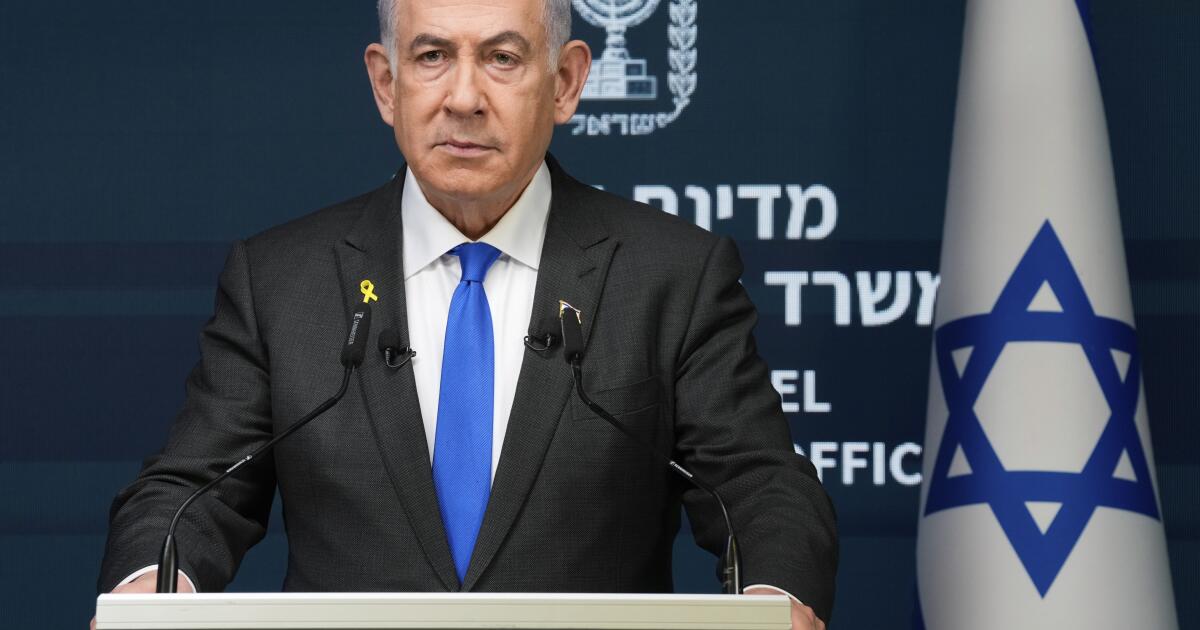
President Biden and his senior leadership hailed Israel’s killing of Hamas leader Yahya Sinwar as an “opportunity” to end the yearlong war that has devastated the Gaza Strip and killed thousands of Palestinians.
Speaking Friday in Germany, Biden said he telephoned Israeli Prime Minister Benjamin Netanyahu and told him the elimination of the radical “terror mastermind” Sinwar meant it was time to find peace.
But is this milestone moment really an opportunity to finally enact a cease-fire? Or will Netanyahu intensify military operations and fight ahead, vindicated — in his view — that his hard-line and uncompromising offensive has proved to be the correct strategy?
“The war is not over,” Netanyahu declared triumphantly in a televised address when he confirmed Sinwar’s killing by an Israeli army unit in a building in the city of Rafah in southern Gaza.
And 24 hours later, Hamas was equally defiant. Sinwar’s “banner will not fall,” the militant organization said in a statement Friday that praised the exploits of its dead leader.
And to those who hoped Sinwar’s death might lead to the release of Israeli hostages who remain in Hamas captivity, the statement said the men and women would only be freed when Israeli troops withdraw from the Gaza Strip and Palestinian prisoners are released from Israeli jails.
It seemed likely that neither Israel nor Hamas would significantly change its battlefield operations any time soon.
Israel’s next steps will largely depend on Netanyahu’s own political calculations and those of his ultra-right coalition government, some members of which want to reoccupy Gaza and expel large numbers of Palestinians.
Sinwar’s death “gives Israel sort of the ladder to climb down from the total victory tree and say, ‘OK, we have won the war.’ We can … move toward a different reality on the ground in Gaza,” said Shira Efron, a former Rand Corp. fellow and Israel-based analyst with the Israel Policy Forum in Washington.
But it could also go the other way, she said. Netanyahu can conclude he is on a roll, Hamas is irreparably crippled, and “we should double down on fighting and continue this endless war.”
It is also difficult to predict Hamas’ next actions — defiant rhetoric aside. Much will depend on who succeeds Sinwar and what kind of game plan, if any, he left behind. Few Hamas figures today have the same popular appeal, credibility and tactical, political and strategic chops that Sinwar had.
“You now have a series of unknowns,” said Lucy Kurtzer-Ellenbogen, head of the Israeli-Palestinian program at the U.S. Institute of Peace.
Just over a year ago, Hamas-led militants invaded southern Israel, killed 1,200 people and took about 250 hostage, the deadliest single day for Jews since the Holocaust. In response, Israel launched a brutal war on Gaza that has killed more than 42,000 people, according to Gaza health officials, and destroyed around 70% of buildings and structures and displaced nearly 2 million people.
Throughout it all, the Biden administration, with allies Egypt and Qatar, engaged in tortuous talks to reach a cessation of hostilities. Israel and Hamas took turns at being the impediment to agreement, each at one time or another moving the goal post, mediators say.
Perhaps even more problematic, the negotiations often revealed a disconnect between Israel and its strongest ally in the world, Washington.
It became increasingly clear that Netanyahu and his government repeatedly ignored U.S. advice, or agreed to it but then didn’t follow through. This included entreaties to allow more food, water and medicine into a starving Gaza Strip and minimizing civilian casualties.
Bruce Hoffman, an insurgency expert at the Council on Foreign Relations, said Israel often disregarded U.S. military advice because “Israel was looking for a new status quo, not a return to the status quo ante … which I’m not sure was understood in Washington.”
The pattern continued as Israel expanded its war effort into Lebanon to confront Hezbollah, the militant and political faction in southern Lebanon that has been firing rockets into northern Israel for months. Similarly, U.S. officials called on Israel to limit its invasion into Lebanon that started Oct. 1 and then its bombardment of Beirut and other crowded population centers. Although there have been occasional pauses, Israel has not withdrawn its troops and bombings continue. More than 2,000 Lebanese have been killed.
“The conventional wisdom is that Sinwar’s death is a potential offramp for Netanyahu, but that assumes he wants one,” Khaled Elgindy, senior fellow at the Middle East Institute think tank in Washington, said in an interview. “He just doesn’t have the same calculations and intentions” as the Americans. “Trying to align American rhetoric with Israeli action has led to total contradiction.”
As much as the United States has misread Israel, both the U.S. and Israel have repeatedly misread Hamas and Palestinians.
Late Thursday, Israel released a video of Sinwar’s dying moments. He sat in an armchair in a destroyed building, covered in dust and debris, an arm apparently amputated by mortar fire. A drone moves in to observe him. He uses his last strength to shakily hurl a pole at the drone.
Israelis celebrated these images as a final humiliation to a man whom they saw as evil. But for Palestinians, the video sealed a kind of folk-hero status for the dying Hamas leader, who was seen as defiant to the end, fighting on the front lines.
Longtime observers of the Middle East say that assuming the death of Sinwar would end the war underestimates, or mischaracterizes, the goals of both Israel and Hamas.
Hamas seeks its survival as a governing force, something Israel, the U.S. and many Arab and European allies reject.
Israel’s designs for Gaza have raised concerns as it renewed large-scale attacks in northern Gaza and cut off almost all humanitarian aid into the area where Palestinians faced starvation. Some Israeli officials have voiced support for emptying the area of Palestinians as a way to form a buffer zone. The U.S. staunchly opposes such a plan.
“Ending the war has gone beyond Sinwar staying alive or not,” said Qusay Hamed, a political science professor at the Al Quds Open University in the occupied West Bank city of Ramallah.
Times staff writer Nabih Bulos in Beirut contributed to this report.



NEWYou can now listen to Fox News articles!
President Donald Trump said on Thursday that he plans to meet with Venezuelan opposition leader Maria Corina Machado in Washington next week.
During an appearance on Fox News’ “Hannity,” Trump was asked if he intends to meet with Machado after the U.S. struck Venezuela and captured its president, Nicolás Maduro.
“Well, I understand she’s coming in next week sometime, and I look forward to saying hello to her,” Trump said.
Venezuelan opposition leader Maria Corina Machado waves a national flag during a protest called by the opposition on the eve of the presidential inauguration, in Caracas on January 9, 2025. (JUAN BARRETO/AFP via Getty Images)
This will be Trump’s first meeting with Machado, who the U.S. president stated “doesn’t have the support within or the respect within the country” to lead.
According to reports, Trump’s refusal to support Machado was linked to her accepting the 2025 Nobel Peace Prize, which Trump believed he deserved.
But Trump later told NBC News that while he believed Machado should not have won the award, her acceptance of the prize had “nothing to do with my decision” about the prospect of her leading Venezuela.
Politics
California sues Trump administration over ‘baseless and cruel’ freezing of child-care funds

California is suing the Trump administration over its “baseless and cruel” decision to freeze $10 billion in federal funding for child care and family assistance allocated to California and four other Democratic-led states, Atty. Gen. Rob Bonta announced Thursday.
The lawsuit was filed jointly by the five states targeted by the freeze — California, New York, Minnesota, Illinois and Colorado — over the Trump administration’s allegations of widespread fraud within their welfare systems. California alone is facing a loss of about $5 billion in funding, including $1.4 billion for child-care programs.
The lawsuit alleges that the freeze is based on unfounded claims of fraud and infringes on Congress’ spending power as enshrined in the U.S. Constitution. The White House did not immediately respond to a request for comment.
“This is just the latest example of Trump’s willingness to throw vulnerable children, vulnerable families and seniors under the bus if he thinks it will advance his vendetta against California and Democratic-led states,” Bonta said at a Thursday evening news conference.
The $10-billion funding freeze follows the administration’s decision to freeze $185 million in child-care funds to Minnesota, where federal officials allege that as much as half of the roughly $18 billion paid to 14 state-run programs since 2018 may have been fraudulent. Amid the fallout, Gov. Tim Walz has ordered a third-party audit and announced that he will not seek a third term.
Bonta said that letters sent by the U.S. Department of Health and Human Services announcing the freeze Tuesday provided no evidence to back up claims of widespread fraud and misuse of taxpayer dollars in California. The freeze applies to the Temporary Assistance for Needy Families program, the Social Services Block Grant program and the Child Care and Development Fund.
“This is funding that California parents count on to get the safe and reliable child care they need so that they can go to work and provide for their families,” he said. “It’s funding that helps families on the brink of homelessness keep roofs over their heads.”
Bonta also raised concerns regarding Health and Human Services’ request that California turn over all documents associated with the state’s implementation of the three programs. This requires the state to share personally identifiable information about program participants, a move Bonta called “deeply concerning and also deeply questionable.”
“The administration doesn’t have the authority to override the established, lawful process our states have already gone through to submit plans and receive approval for these funds,” Bonta said. “It doesn’t have the authority to override the U.S. Constitution and trample Congress’ power of the purse.”
The lawsuit was filed in federal court in Manhattan and marked the 53rd suit California had filed against the Trump administration since the president’s inauguration last January. It asks the court to block the funding freeze and the administration’s sweeping demands for documents and data.

new video loaded: Trump Says ‘Only Time Will Tell’ How Long U.S. Controls Venezuela
transcript
transcript
Trump Says ‘Only Time Will Tell’ How Long U.S. Controls Venezuela
President Trump did not say exactly how long the the United states would control Venezuela, but said that it could last years.
-
“How Long do you think you’ll be running Venezuela?” “Only time will tell. Like three months. six months, a year, longer?” “I would say much longer than that.” “Much longer, and, and —” “We have to rebuild. You have to rebuild the country, and we will rebuild it in a very profitable way. We’re going to be using oil, and we’re going to be taking oil. We’re getting oil prices down, and we’re going to be giving money to Venezuela, which they desperately need. I would love to go, yeah. I think at some point, it will be safe.” “What would trigger a decision to send ground troops into Venezuela?” “I wouldn’t want to tell you that because I can’t, I can’t give up information like that to a reporter. As good as you may be, I just can’t talk about that.” “Would you do it if you couldn’t get at the oil? Would you do it —” “If they’re treating us with great respect. As you know, we’re getting along very well with the administration that is there right now.” “Have you spoken to Delcy Rodríguez?” “I don’t want to comment on that, but Marco speaks to her all the time.”
January 8, 2026

Opinion: Three things CT must do to up its food game

MERR responds to dead humpback whale washed up near Bethany Beach

Flying taxis? They could be coming to Florida by the end of the year

Meet the 30-somethings aiming to remake Georgia’s congressional delegation

Hawaii Pacific basketball teams split with Menlo | Honolulu Star-Advertiser

Florida High School Football Rankings: Top 25 teams – Oct. 21

Cleary's 21 help Le Moyne down Central Connecticut State 69-64 in OT

How old is Bo Nix? What to know about Oregon quarterback ahead of 2024 NFL Draft

99th annual Pony Swim held in Virginia

Video: ‘It Didn’t Have to Happen This Way:’ U.Va. Faculty Call for Review of Police Response to Protests

Trump plans to meet with Venezuela opposition leader Maria Corina Machado next week

Trump says meeting Iran’s ‘Crown Prince’ Pahlavi would not be appropriate

Federal immigration agents shoot 2 people in Portland, Oregon, police say

Video: What Trump Told Us About the ICE Shooting

Trump calls for $1.5T defense budget to build ‘dream military’
-

 Detroit, MI5 days ago
2 hospitalized after shooting on Lodge Freeway in Detroit
-

 Technology3 days ago
Power bank feature creep is out of control
-

 Dallas, TX4 days ago
Defensive coordinator candidates who could improve Cowboys’ brutal secondary in 2026
-

 Health5 days ago
Viral New Year reset routine is helping people adopt healthier habits
-

 Nebraska2 days ago
Oregon State LB transfer Dexter Foster commits to Nebraska
-

 Iowa3 days ago
Pat McAfee praises Audi Crooks, plays hype song for Iowa State star
-
 Nebraska3 days ago
Nebraska-based pizza chain Godfather’s Pizza is set to open a new location in Queen Creek
-
 Entertainment2 days ago
Spotify digs in on podcasts with new Hollywood studios