Politics
Trump’s transactional diplomacy is reshaping the U.S.-Taiwan relationship

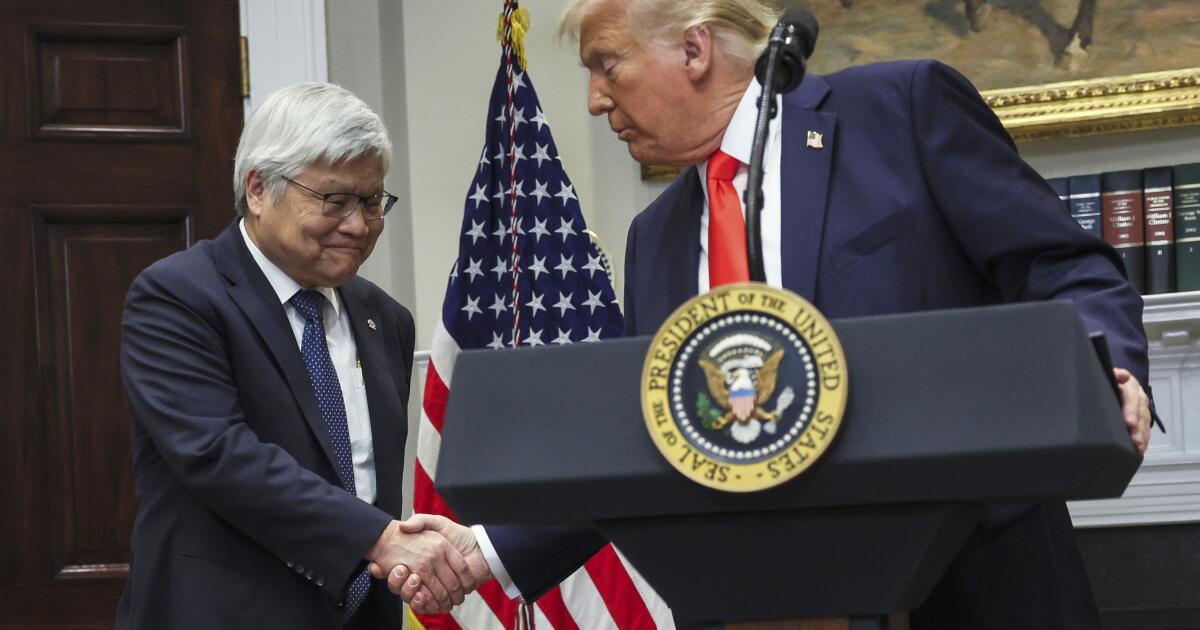
TAIPEI, Taiwan — For decades, the U.S. has played an important role in maintaining the delicate relationship between Taiwan and China, which considers Taiwan to be a part of its territory and has vowed to pursue unification by force, if necessary. But President Trump’s “America First” ideology and use of tariffs as an economic weapon suggest the administration may be rewriting the rules of the U.S.-China-Taiwan playbook to suit his transactional style.
As is true in much of the world, long-held understandings, meant to preserve peace, are suddenly up for negotiation. Although the U.S. does not recognize Taiwan as an independent nation, it has been contractually obligated to support the island’s defense program with weapons sales for years. It’s part of an official policy known as “strategic ambiguity,” intended to deter China from launching an attack and Taiwan from formally declaring independence.
Trump has not said whether the U.S. will defend Taiwan in the future, but he has complained about the relationship, and his administration has said that Taiwan should raise its defense budget to 10% of its gross domestic product.
Taiwanese President William Lai, right, listens to a briefing about a U.S.-made F-16V fighter during a visit to a military base on Jan. 21.
(Chiang Ying-ying / Associated Press)
Trump has also criticized Taiwan’s cutting-edge semiconductor industry for “stealing” U.S. business and threatened tariffs on Taiwanese chips. Then, on March 3, he announced a $100-billion investment from Taiwan Semiconductor Manufacturing Co., or TSMC, maker of the world’s most advanced microchips, to build five new facilities in the United States. The move has some people in Taiwan wondering how much the island democracy can count on the U.S., and what the U.S. might expect in return.
Chieh-ting Yeh, director of the think tank US Taiwan Watch, said that since Trump took office, his conversations have shifted from a focus on shared values such as democracy and human rights to bargaining ability.
“Privately everybody is thinking, ‘OK, if it’s going to be a transactional type of relationship, how do we play that game?’” Yeh said. “In the short term, I just don’t think anybody can say for sure what’s going to happen.”
The news about TSMC, which has a reputation as Taiwan’s “silicon shield,” has sparked heated debate over whether the company’s plan to build in the United States could undermine national security.
Former Taiwanese President Ma Ying-jeou attacked current President William Lai for supporting the deal: “Let’s not forget, U.S. President Donald Trump is a businessman, and profit comes first to him. Is selling one TSMC enough? What else will be sold next, and what more is left to sell?” Ma wrote in a Facebook post that garnered more than 70,000 likes.
In a news conference last week with TSMC Chairman C.C. Wei, Lai denied that the investment was a result of U.S. pressure and noted that Trump had affirmed his commitment to regional stability in a joint statement with Japanese Prime Minister Shigeru Ishiba in February.
Lai has also said Taiwan will aim to increase defense spending to 3% of GDP this year from about 2.4% the year before. While that figure falls far short of what the Trump administration has called for, experts in Taiwan said increasing the budget to 10% of GDP would be impossible.
In the meantime, Taiwan’s opposition-backed legislature wants to cut defense spending, criticizing the current administration for wasteful spending, corruption and a combative approach to China that it believes is driving the island closer to war.

President Trump castigated Ukraine’s President Volodymyr Zelensky in a meeting at the White House on Feb. 28. In Taiwan, fears of U.S. abandonment have been underscored by the U.S. about-face under Trump on the war in Ukraine.
(Saul Loeb / AFP/Getty Images)
“Taiwan is taking it with a grain of salt. I think there’s an understanding that nice, big, round numbers create bargaining positions, but may not be the final numbers that are agreed on,” said Wen-ti Sung, a political scientist at Australia National University who specializes in cross-strait relations.
Fears of American abandonment have been underscored by the U.S. about-face under Trump on the war in Ukraine, which Taiwan has watched closely as a barometer of U.S. reliability. “Values as well as longer-standing friendships are not by themselves sufficient safeguards for maintaining U.S. support,” Sung said.
Since taking office, Trump has called Ukrainian President Volodymyr Zelensky a “dictator” and suspended — and then agreed to resume — U.S. military aid to Ukraine. When a meeting between the two leaders, intended to sign a deal granting the U.S. a stake in Ukrainian minerals in exchange for continued financial support, dissolved into shouting, some in Taiwan took it as a worrisome sign.
The slogan of “Today Ukraine, Tomorrow Taiwan,” popularized by the ruling party after Russia invaded Ukraine in 2022, resurfaced on social media in Taiwan after the fallout. One user on Threads commented under a post about Zelensky, “Taiwan needs to follow America’s lead, since we can only rely on them for military support.” Another responded, “Haven’t you seen what happened to Ukraine? Do you still think the U.S. is reliable?”
Others have speculated that if America turns away from Ukraine and Europe, there could be more resources and willingness to support its allies in Asia and counter China: “Comparing Ukraine to Taiwan is a completely flawed analogy,” James Hsieh, a Taiwanese political commentator, wrote on social media. “Personally, I hope the Russia-Ukraine war ends quickly so that the U.S. can fully prepare for the Indo-Pacific.”
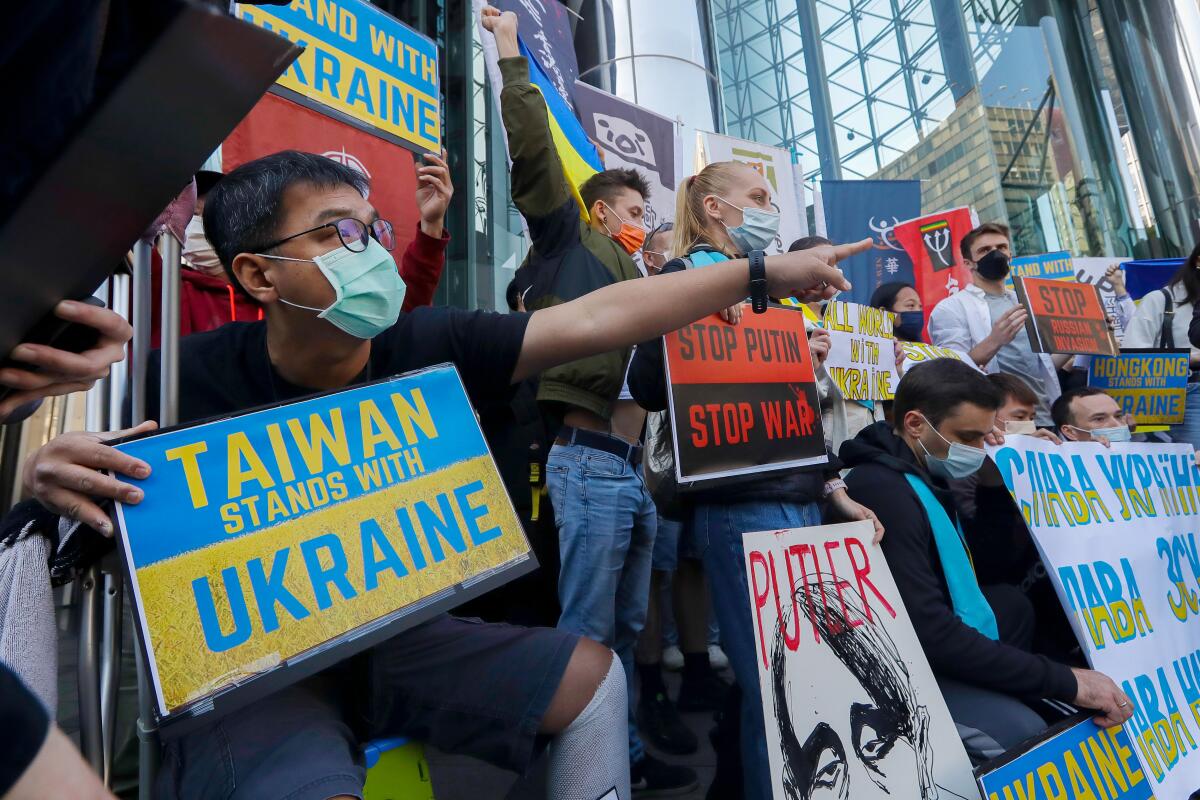
Ukrainians and their supporters hold signs in Taipei, Taiwan, as they protest Russia’s invasion.
(Chiang Ying-ying / Associated Press)
Elbridge Colby, Trump’s nominee to be undersecretary of Defense for policy, recently reiterated the call for Taiwan to increase its defense spending in a confirmation hearing. But he also said that the U.S. should focus on combating China’s growing military influence, and that losing Taiwan to China “would be a disaster for American interests.”
“What can Taiwan learn from this?” asked William Chih-tung Chung, an assistant research fellow at Taiwan’s Institute for National Defense and Security Research. “First, don’t clash with Trump directly. Second, delay and wait for change. In the meantime, we just have to engage with him and negotiate.”
Chung points out that this isn’t the first time Taiwan has faced losing U.S. support. In 1979, the U.S. severed diplomatic ties with Taiwan as it pursued a closer relationship with China.
But the deterioration of U.S.-China relations in the last decade has enhanced the importance of Taiwan, which he believes will continue to play an important role as a defensive stronghold in the Asia-Pacific region and a leader in chip technology, a role that cannot be erased in the next four years.
“As long as the U.S. maintains a negative stance toward China, Taiwan remains a crucial bargaining chip for the U.S.,” Chung said. “Of course there’s a lot of uncertainty with Trump, and everyone is anxiously waiting. But I think there’s no need to be overly pessimistic or overly optimistic — what matters is that we find a strong connection with the Trump administration’s global strategy.”



NEWYou can now listen to Fox News articles!
President Donald Trump has signed an executive order blocking U.S. courts from seizing Venezuelan oil revenues held in American Treasury accounts.
The order states that court action against the funds would undermine U.S. national security and foreign policy objectives.
CLICK HERE TO DOWNLOAD THE FOX NEWS APP
President Donald Trump is pictured signing two executive orders on Sept. 19, 2025, establishing the “Trump Gold Card” and introducing a $100,000 fee for H-1B visas. He signed another executive order recently protecting oil revenue. (Andrew Harnik/Getty Images)
Trump signed the order on Friday, the same day that he met with nearly two dozen top oil and gas executives at the White House.
The president said American energy companies will invest $100 billion to rebuild Venezuela’s “rotting” oil infrastructure and push production to record levels following the capture of Venezuelan dictator Nicolás Maduro.
The U.S. has moved aggressively to take control of Venezuela’s oil future following the collapse of the Maduro regime.
This is a developing story. Please check back for updates.

One of the most important political stories in American history — one that is particularly germane to our current, tumultuous time — unfolded in Los Angeles some 65 years ago.
Sen. John F. Kennedy, a Catholic, had just received his party’s nomination for president and in turn he shunned the desires of his most liberal supporters by choosing a conservative out of Texas as his running mate. He did so in large part to address concerns that his faith would somehow usurp his oath to uphold the Constitution. The last time the Democrats nominated a Catholic — New York Gov. Al Smith in 1928 — he lost in a landslide, so folks were more than a little jittery about Kennedy’s chances.
“I am fully aware of the fact that the Democratic Party, by nominating someone of my faith, has taken on what many regard as a new and hazardous risk,” Kennedy told the crowd at the Memorial Coliseum. “But I look at it this way: The Democratic Party has once again placed its confidence in the American people, and in their ability to render a free, fair judgment.”
The most important part of the story is what happened before Kennedy gave that acceptance speech.
While his faith made party leaders nervous, they were downright afraid of the impact a civil rights protest during the Democratic National Convention could have on November’s election. This was 1960. The year began with Black college students challenging segregation with lunch counter sit-ins across the Deep South, and by spring the Student Nonviolent Coordinating Committee had formed. The Rev. Martin Luther King Jr. was not the organizer of the protest at the convention, but he planned to be there, guaranteeing media attention. To try to prevent this whole scene, the most powerful Black man in Congress was sent to stop him.
The Rev. Adam Clayton Powell Jr. was also a warrior for civil rights, but the House representative preferred the legislative approach, where backroom deals were quietly made and his power most concentrated. He and King wanted the same things for Black people. But Powell — who was first elected to Congress in 1944, the same year King enrolled at Morehouse College at the age of 15 — was threatened by the younger man’s growing influence. He was also concerned that his inability to stop the protest at the convention would harm his chance to become chairman of a House committee.
And so Powell — the son of a preacher, and himself a Baptist preacher in Harlem — told King that if he didn’t cancel, Powell would tell journalists a lie that King was having a homosexual affair with his mentor, Bayard Rustin. King stuck to his plan and led a protest — even though such a rumor would not only have harmed King, but also would have undermined the credibility of the entire civil rights movement. Remember, this was 1960. Before the March on Washington, before passage of the Voting Rights Act, before the dismantling of the very Jim Crow laws Powell had vowed to dismantle when first running for office.
That threat, my friends, is the most important part of the story.
It’s not that Powell didn’t want the best for the country. It’s just that he wanted to be seen as the one doing it and was willing to derail the good stemming from the civil rights movement to secure his own place in power. There have always been people willing to make such trade-offs. Sometimes they dress up their intentions with scriptures to make it more palatable; other times they play on our darkest fears. They do not care how many people get hurt in the process, even if it’s the same people they profess to care for.
That was true in Los Angeles in 1960.
That was true in Washington, D.C., on Jan. 6, 2021.
That is true in the streets of America today.
Whether we are talking about an older pastor who is threatened by the growing influence of a younger voice or a president clinging to office after losing an election: To remain king, some men are willing to burn the entire kingdom down.
YouTube: @LZGrandersonShow
Politics
Federal judge blocks Trump from cutting childcare funds to Democratic states over fraud concerns

NEWYou can now listen to Fox News articles!
A federal judge Friday temporarily blocked the Trump administration from stopping subsidies on childcare programs in five states, including Minnesota, amid allegations of fraud.
U.S. District Judge Arun Subramanian, a Biden appointee, didn’t rule on the legality of the funding freeze, but said the states had met the legal threshold to maintain the “status quo” on funding for at least two weeks while arguments continue.
On Tuesday, the U.S. Department of Health and Human Services (HHS) said it would withhold funds for programs in five Democratic states over fraud concerns.
The programs include the Child Care and Development Fund, the Temporary Assistance for Needy Families program, and the Social Services Block Grant, all of which help needy families.
USDA IMMEDIATELY SUSPENDS ALL FEDERAL FUNDING TO MINNESOTA AMID FRAUD INVESTIGATION
On Tuesday, the U.S. Department of Health and Human Services said it would withhold funds for programs in five Democratic states over fraud concerns. (AP Photo/Jose Luis Magana, File)
“Families who rely on childcare and family assistance programs deserve confidence that these resources are used lawfully and for their intended purpose,” HHS Deputy Secretary Jim O’Neill said in a statement on Tuesday.
The states, which include California, Colorado, Illinois, Minnesota and New York, argued in court filings that the federal government didn’t have the legal right to end the funds and that the new policy is creating “operational chaos” in the states.
U.S. District Judge Arun Subramanian at his nomination hearing in 2022. (Tom Williams/CQ-Roll Call, Inc via Getty Images)
In total, the states said they receive more than $10 billion in federal funding for the programs.
HHS said it had “reason to believe” that the programs were offering funds to people in the country illegally.
‘TIP OF THE ICEBERG’: SENATE REPUBLICANS PRESS GOV WALZ OVER MINNESOTA FRAUD SCANDAL
The table above shows the five states and their social safety net funding for various programs which are being withheld by the Trump administration over allegations of fraud. (AP Digital Embed)
New York Attorney General Letitia James, who is leading the lawsuit, called the ruling a “critical victory for families whose lives have been upended by this administration’s cruelty.”
New York Attorney General Letitia James, who is leading the lawsuit, called the ruling a “critical victory for families whose lives have been upended by this administration’s cruelty.” (Win McNamee/Getty Images)
CLICK HERE TO DOWNLOAD THE FOX NEWS APP
Fox News Digital has reached out to HHS for comment.

Service door of Crans-Montana bar where 40 died in fire was locked from inside, owner says

IU dominated but then ‘it was just turnovers’ to blow 16-point lead vs Nebraska

State police union official on Nevada Wild

5-year-old injured in New Year’s day Manchester, New Hampshire apartment building fire dies

Isolated snow showers, wind gusts up to 35 mph in N.J. forecast for Sunday

Florida High School Football Rankings: Top 25 teams – Oct. 21

Cleary's 21 help Le Moyne down Central Connecticut State 69-64 in OT

How old is Bo Nix? What to know about Oregon quarterback ahead of 2024 NFL Draft

99th annual Pony Swim held in Virginia

Video: ‘It Didn’t Have to Happen This Way:’ U.Va. Faculty Call for Review of Police Response to Protests

Video: Raising a Baby in Altadena’s Ashes

Trump signs order to protect Venezuela oil revenue held in US accounts
What Canada, accustomed to extreme winters, can teach Europe

New video shows fatal Minnesota ICE shooting from officer’s perspective

Federal judge blocks Trump from cutting childcare funds to Democratic states over fraud concerns
-

 Detroit, MI7 days ago
2 hospitalized after shooting on Lodge Freeway in Detroit
-

 Technology4 days ago
Power bank feature creep is out of control
-

 Dallas, TX5 days ago
Defensive coordinator candidates who could improve Cowboys’ brutal secondary in 2026
-

 Dallas, TX2 days ago
Anti-ICE protest outside Dallas City Hall follows deadly shooting in Minneapolis
-

 Iowa4 days ago
Pat McAfee praises Audi Crooks, plays hype song for Iowa State star
-

 Delaware1 day ago
MERR responds to dead humpback whale washed up near Bethany Beach
-

 Health6 days ago
Viral New Year reset routine is helping people adopt healthier habits
-

 Nebraska4 days ago
Oregon State LB transfer Dexter Foster commits to Nebraska