Politics
Trump’s transactional diplomacy is reshaping the U.S.-Taiwan relationship

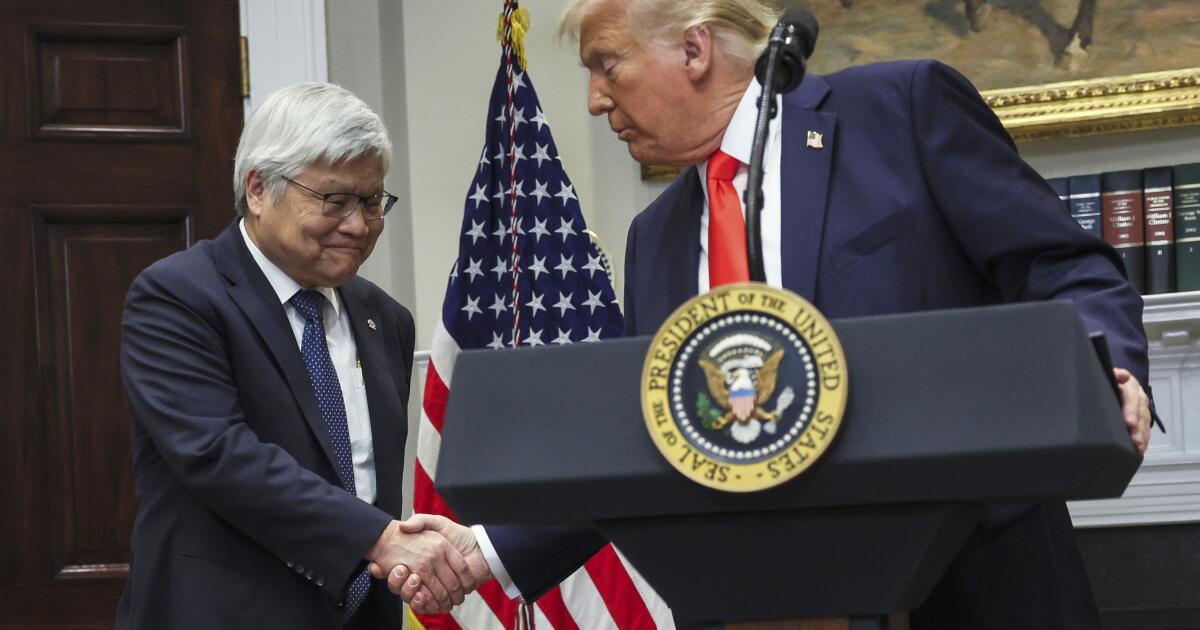
TAIPEI, Taiwan — For decades, the U.S. has played an important role in maintaining the delicate relationship between Taiwan and China, which considers Taiwan to be a part of its territory and has vowed to pursue unification by force, if necessary. But President Trump’s “America First” ideology and use of tariffs as an economic weapon suggest the administration may be rewriting the rules of the U.S.-China-Taiwan playbook to suit his transactional style.
As is true in much of the world, long-held understandings, meant to preserve peace, are suddenly up for negotiation. Although the U.S. does not recognize Taiwan as an independent nation, it has been contractually obligated to support the island’s defense program with weapons sales for years. It’s part of an official policy known as “strategic ambiguity,” intended to deter China from launching an attack and Taiwan from formally declaring independence.
Trump has not said whether the U.S. will defend Taiwan in the future, but he has complained about the relationship, and his administration has said that Taiwan should raise its defense budget to 10% of its gross domestic product.
Taiwanese President William Lai, right, listens to a briefing about a U.S.-made F-16V fighter during a visit to a military base on Jan. 21.
(Chiang Ying-ying / Associated Press)
Trump has also criticized Taiwan’s cutting-edge semiconductor industry for “stealing” U.S. business and threatened tariffs on Taiwanese chips. Then, on March 3, he announced a $100-billion investment from Taiwan Semiconductor Manufacturing Co., or TSMC, maker of the world’s most advanced microchips, to build five new facilities in the United States. The move has some people in Taiwan wondering how much the island democracy can count on the U.S., and what the U.S. might expect in return.
Chieh-ting Yeh, director of the think tank US Taiwan Watch, said that since Trump took office, his conversations have shifted from a focus on shared values such as democracy and human rights to bargaining ability.
“Privately everybody is thinking, ‘OK, if it’s going to be a transactional type of relationship, how do we play that game?’” Yeh said. “In the short term, I just don’t think anybody can say for sure what’s going to happen.”
The news about TSMC, which has a reputation as Taiwan’s “silicon shield,” has sparked heated debate over whether the company’s plan to build in the United States could undermine national security.
Former Taiwanese President Ma Ying-jeou attacked current President William Lai for supporting the deal: “Let’s not forget, U.S. President Donald Trump is a businessman, and profit comes first to him. Is selling one TSMC enough? What else will be sold next, and what more is left to sell?” Ma wrote in a Facebook post that garnered more than 70,000 likes.
In a news conference last week with TSMC Chairman C.C. Wei, Lai denied that the investment was a result of U.S. pressure and noted that Trump had affirmed his commitment to regional stability in a joint statement with Japanese Prime Minister Shigeru Ishiba in February.
Lai has also said Taiwan will aim to increase defense spending to 3% of GDP this year from about 2.4% the year before. While that figure falls far short of what the Trump administration has called for, experts in Taiwan said increasing the budget to 10% of GDP would be impossible.
In the meantime, Taiwan’s opposition-backed legislature wants to cut defense spending, criticizing the current administration for wasteful spending, corruption and a combative approach to China that it believes is driving the island closer to war.

President Trump castigated Ukraine’s President Volodymyr Zelensky in a meeting at the White House on Feb. 28. In Taiwan, fears of U.S. abandonment have been underscored by the U.S. about-face under Trump on the war in Ukraine.
(Saul Loeb / AFP/Getty Images)
“Taiwan is taking it with a grain of salt. I think there’s an understanding that nice, big, round numbers create bargaining positions, but may not be the final numbers that are agreed on,” said Wen-ti Sung, a political scientist at Australia National University who specializes in cross-strait relations.
Fears of American abandonment have been underscored by the U.S. about-face under Trump on the war in Ukraine, which Taiwan has watched closely as a barometer of U.S. reliability. “Values as well as longer-standing friendships are not by themselves sufficient safeguards for maintaining U.S. support,” Sung said.
Since taking office, Trump has called Ukrainian President Volodymyr Zelensky a “dictator” and suspended — and then agreed to resume — U.S. military aid to Ukraine. When a meeting between the two leaders, intended to sign a deal granting the U.S. a stake in Ukrainian minerals in exchange for continued financial support, dissolved into shouting, some in Taiwan took it as a worrisome sign.
The slogan of “Today Ukraine, Tomorrow Taiwan,” popularized by the ruling party after Russia invaded Ukraine in 2022, resurfaced on social media in Taiwan after the fallout. One user on Threads commented under a post about Zelensky, “Taiwan needs to follow America’s lead, since we can only rely on them for military support.” Another responded, “Haven’t you seen what happened to Ukraine? Do you still think the U.S. is reliable?”
Others have speculated that if America turns away from Ukraine and Europe, there could be more resources and willingness to support its allies in Asia and counter China: “Comparing Ukraine to Taiwan is a completely flawed analogy,” James Hsieh, a Taiwanese political commentator, wrote on social media. “Personally, I hope the Russia-Ukraine war ends quickly so that the U.S. can fully prepare for the Indo-Pacific.”
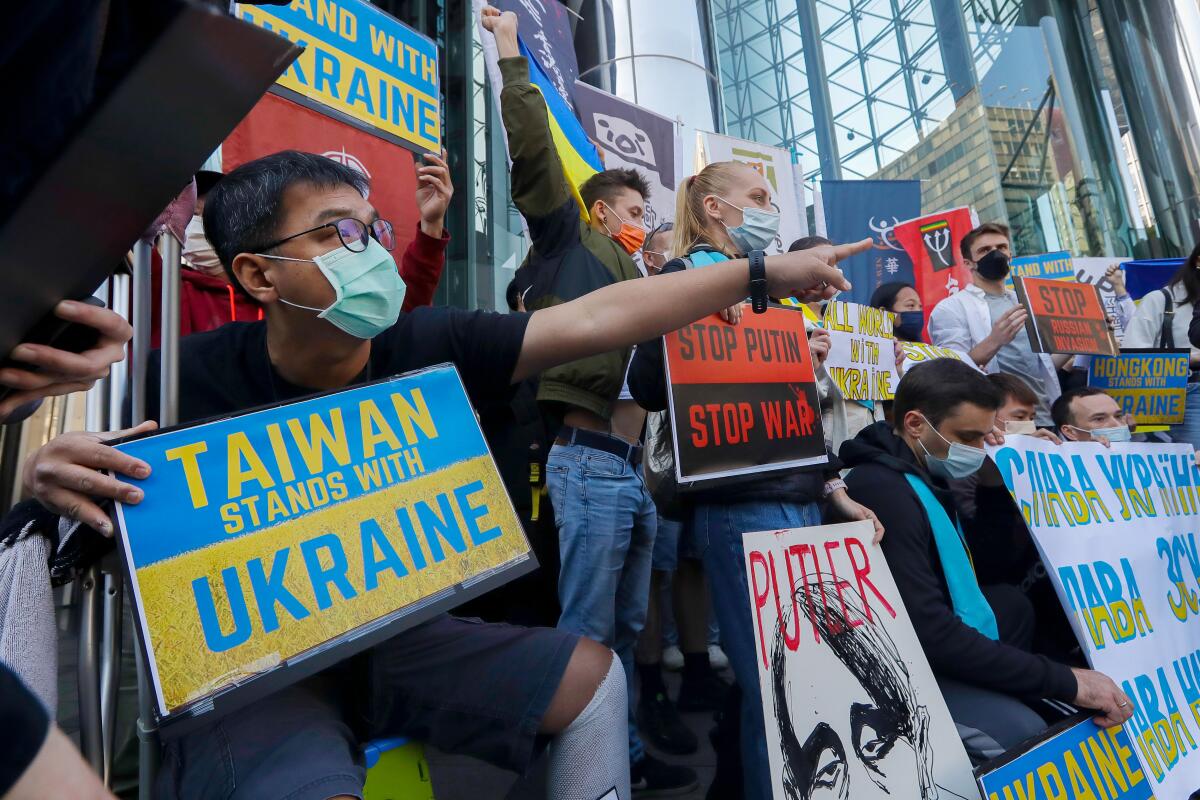
Ukrainians and their supporters hold signs in Taipei, Taiwan, as they protest Russia’s invasion.
(Chiang Ying-ying / Associated Press)
Elbridge Colby, Trump’s nominee to be undersecretary of Defense for policy, recently reiterated the call for Taiwan to increase its defense spending in a confirmation hearing. But he also said that the U.S. should focus on combating China’s growing military influence, and that losing Taiwan to China “would be a disaster for American interests.”
“What can Taiwan learn from this?” asked William Chih-tung Chung, an assistant research fellow at Taiwan’s Institute for National Defense and Security Research. “First, don’t clash with Trump directly. Second, delay and wait for change. In the meantime, we just have to engage with him and negotiate.”
Chung points out that this isn’t the first time Taiwan has faced losing U.S. support. In 1979, the U.S. severed diplomatic ties with Taiwan as it pursued a closer relationship with China.
But the deterioration of U.S.-China relations in the last decade has enhanced the importance of Taiwan, which he believes will continue to play an important role as a defensive stronghold in the Asia-Pacific region and a leader in chip technology, a role that cannot be erased in the next four years.
“As long as the U.S. maintains a negative stance toward China, Taiwan remains a crucial bargaining chip for the U.S.,” Chung said. “Of course there’s a lot of uncertainty with Trump, and everyone is anxiously waiting. But I think there’s no need to be overly pessimistic or overly optimistic — what matters is that we find a strong connection with the Trump administration’s global strategy.”

Construction workers unfurled a large printed tarp to cover scaffolding installed at the White House’s front entrance. Doug Burgum, the interior secretary, said President Trump had ordered the repairs after noticing damage to columns.
Politics
WATCH: Trump’s Energy chief reveals what escalating Iran tensions could mean for gas prices

NEWYou can now listen to Fox News articles!
Energy Secretary Chris Wright is telling Americans not to be concerned about the possibility of another surge of sharp increases in gasoline prices as tensions with Iran have started to escalate once again.
Asked whether Americans should worry about higher prices at the pump and how the Trump administration is preparing to keep the economy stable if the conflict continues to worsen, Wright told Fox News Digital: “It has not been any good behavior from Iran that’s allowed oil to flow. It’s been the United States military.”
“That’s not changing,” he assured, speaking from the Great American State Fair on the National Mall this week.
US CLAWS BACK KEY CONCESSION TO IRAN AFTER FRESH ATTACKS ON COMMERCIAL SHIPS IN STRAIT OF HORMUZ
(Mario Tama/Getty Images) (Mario Tama/Getty Images)
With Iran striking three commercial vessels transiting the Strait of Hormuz on Monday and Tuesday, Wright doubled down in urging citizens to not credit Iran for the U.S. military’s work to ensure oil shipments continue flowing through the strait.
“Look, the U.S. Military has been the key asset here,” he said. “They have assured the flow of oil and gas through the Strait of Hormuz throughout. Not at the beginning of this conflict, but through the last six weeks.”
Wright said the administration is closely monitoring global oil supplies as the tentative ceasefire with Iran seemingly came to come to a halt, with President Donald Trump telling Secretary-General Mark Rutte the call for peace with Iran is “over” at the NATO Summit in Turkey on Wednesday.
But, he pointed to the continued shipping through the Strait as evidence that markets should remain stable.
TRUMP SAYS IRAN CEASEFIRE IS ‘OVER’ AFTER IRANIAN ATTACKS TRIGGER MASSIVE US RESPONSE
President Donald Trump speaks at the White House on Tuesday, April 22. (AP/Alex Brandon)
“We’re of course constantly watching the supply of oil, the supply of refined products and what’s going on there,” Wright said. “And I think still all positive trends.”
Beyond geopolitical concerns, Wright also praised the new chain of discounted gas stations across Pennsylvania and New Jersey, Freedom Fuel, which promises customers prices below the national average.
The Trump administration, though not involved with the network, has heavily endorsed the new chain and its 25 locations.
“We love it,” Wright said when asked about Freedom Fuel. “I mean, look, any mechanism we can to lower energy costs for Americans of all kinds, we’re all in on.”
“With Freedom Fuels, they’re just lowering it down to their wholesale price of gasoline,” Wright said. “So they’re not making any money selling gasoline, but they’ve got convenience stores. That’s how most gas stations make money.”
NEWSOM UNDER FIRE AS CALIFORNIA GAS TAX HIKE SENDS PUMP PRICES EVEN HIGHER
Gasoline costs are a known concern for many Americans, and amid surging prices there has been a considerable increase in those opting to purchase electric vehicles to save money long-term at the pump — with Tesla dominating the market for these types of models.
Wright argued one of the benefits to living in America is having the option to choose what type of vehicle you drive.
CLICK HERE TO DOWNLOAD THE FOX NEWS APP
“We just want people to buy what they would prefer,” he told Fox News Digital when asked his thoughts on increasing calls for support of the electrification of cars. “Consumer choice — you wanna buy an electric car, you wanna buy a gas powered car, diesel powered car, buy a big truck. That’s the choice.”
“That’s why you live in America. You get the choice of all those.”

In 2023, California regulators levied more than $100,000 in fines against the private operator of a federal immigration facility, kicking off a three-year battle over whether detainees who do work at the facilities should be considered employees.
The question went beyond semantics: If considered employees, the detainees would be subject to state worker protection laws.
A legal settlement announced this week now affirms that private immigrant detention facilities are subject to California’s workplace safety and health requirements.
“Every worker deserves a safe and healthy workplace and should be able to report workplace hazards without fear of retaliation,” said Denisse Gómez, spokesperson for the California Division of Occupational Safety and Health or Cal/OSHA.
“Individuals who perform work in these facilities are entitled to workplace safety protections, and this settlement reinforces Cal/OSHA’s commitment to enforcing those protections and safeguarding vulnerable workers,” she added.
Under the settlement between California and the GEO Group, a Florida-based private prison company, the company recently withdrew its legal challenges and agreed to pay more than $100,000 in the fines.
The GEO Group did not respond to requests for comment.
Back in 2023, Cal/OSHA issued $104,510 in fines against the GEO Group. The agency had found six violations of state code by the company after detainees complained about a lack of protective equipment and proper training while cleaning the facility for $1 per day.
Detainees alleged they routinely wiped black mold off shower walls at the facility, saw black dust spew from air vents and used cleaning solutions that lacked instructions during the COVID-19 pandemic.
The biggest fine levied against the GEO Group was for failure to establish and maintain “effective written procedures to reduce employee risk of exposure to aerosol transmissible disease.”
Advocates viewed Cal/OSHA’S recognition of the detainees as workers as a victory that could pave the way for future labor rights fights at other detention centers in the state.
But the GEO Group appealed, arguing that detainees participating in ICE’s voluntary work program make their own schedules and aren’t employees, so hazard exposure couldn’t be “as a result of assigned duties,” as California law states. Plus, the company argued, there wasn’t enough evidence that detainees were exposed to any hazard.
Early last year, the state’s Occupational Safety and Health Appeals Board rejected the GEO Group’s argument and found that detainees should be considered “affected employees.”
The GEO Group sued, but three days before a California Superior Court hearing in May, the company and Cal/OSHA reached the settlement.
Along with paying the fines, the GEO Group agreed to draft plans for avoiding aerosol transmissions at 12 secure and reentry facilities in California, including five detention centers that hold immigrants.
“GEO ensures detainees are afforded the necessary tools, equipment, and personal protective equipment … to safely and effectively perform any necessary tasks,” the settlement states.
Gómez said the settlement also leaves intact the appeals board’s ruling that civil immigration detainees who participate in work programs can participate in proceedings anonymously, “acknowledging the potential for retaliation when individuals raise workplace safety concerns.”
But the question of whether detainees are employees and deserve certain protections isn’t entirely resolved — at least not for the federal government.
Last month, U.S. Immigration and Customs Enforcement released new standards for detention facilities across the country. The revised guidelines “emphasize that detainee volunteers participating in the voluntary work program are not considered facility and/or government employees” and thus not entitled to labor regulations.
Attorney Mariel Villarreal said the timing of the new detention standards made her question whether the GEO Group had asked ICE to specify in its standards that detainees are not workers in response to its battle with Cal/OSHA.
“To me, it’s a reaction to this very settlement,” she said. Villarreal works for the California Collaborative for Immigrant Justice, which filed the original complaint on behalf of detainees who said they worked in unsafe conditions.
Villarreal pointed to a Washington Post report that GEO Group executives privately asked ICE to specify that detainees are not employees of the facilities where they work. Two top Trump administration officials, border czar Tom Homan and acting ICE director David Venturella, previously worked for the GEO Group.
New versions of ICE detention standards take effect as contracts are established or modified, so this year’s rules won’t immediately apply to every facility.
An ICE spokesperson did not comment about the settlement. The spokesperson, who did not provide their name in an emailed statement Wednesday, said the agency has begun transitioning detention facilities to meet the 2026 standards, “building on its longstanding commitment to safe, secure, and professional detention operations.”
“ICE has consistently implemented many of these best practices independently, reinforcing its role as the leader in detention operations,” the spokesperson added.
The GEO Group and other immigrant detention center operators have faced other legal battles over workers’ rights, including lawsuits in Washington, Colorado and California over the $1-per-day payment.
Villarreal said she’s confident that the Cal/OSHA settlement would continue to hold even if California facilities incorporated the new standards. But she said she believes the statements are an attempt by the GEO Group to “sidestep responsibility” and avoid the possibility of being fined under similar circumstances in other states.
“These statements in the new standards are a way for them to try and preserve profits as much as possible,” she said. “GEO and ICE are so intertwined at this point that they have the same motives.”
-

 World3 minutes ago
Belgium to introduce new road tax in 2027, even for transiting drivers
-
 News28 minutes ago
Graham Platner makes it official in Maine, submitting paperwork to leave Senate race
-

 Los Angeles, Ca2 hours ago
Knee irritation forces Shohei Ohtani out of Friday start, All‑Star game
-

 Detroit, MI2 hours ago
Detroit Evening Report: Waymo cars blocking first responders – WDET 101.9 FM
-

 San Francisco, CA2 hours ago
San Francisco Mayor Daniel Lurie Blocks Vacant Grocery Store Tax Proposal | KQED
-

 Miami, FL2 hours ago
Oregon Battling Miami, Mario Cristobal for Four-Star EDGE Recruit
-

 Dallas, TX2 hours ago
FC Dallas Forward Logan Farrington Inks Contract Extension
-

 Boston, MA3 hours ago
Red Sox face lengthy travel issues ahead of series vs. Mets

