Politics
Trump’s top federal prosecutor in L.A. faces challenge over ‘acting’ status

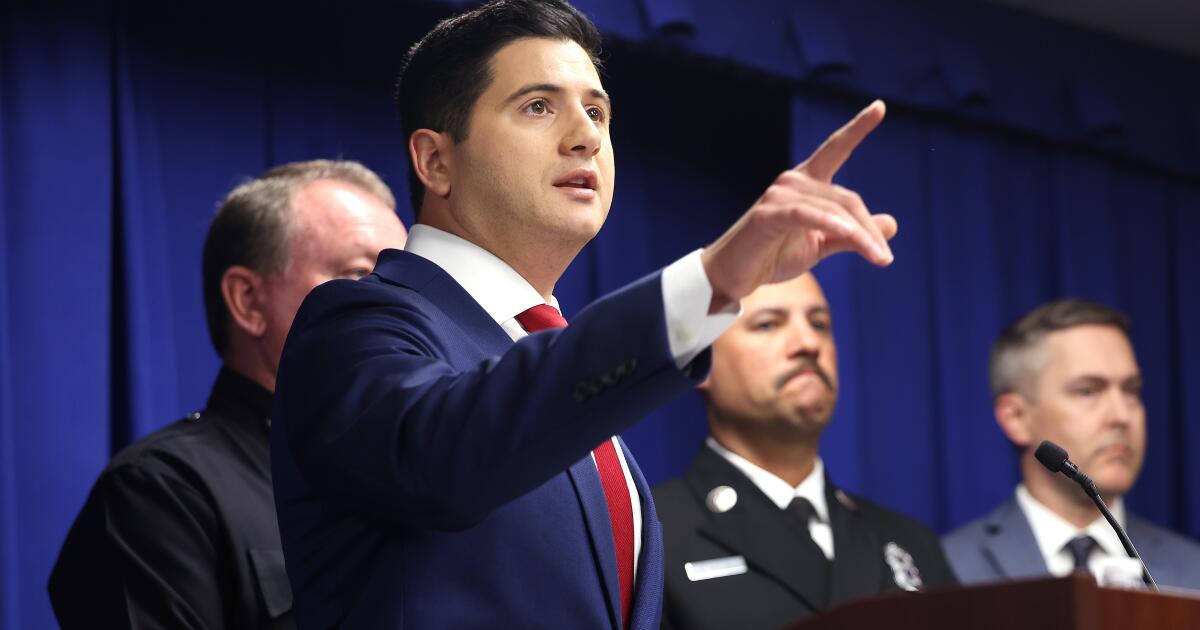
A federal judge heard arguments Tuesday to decide whether maneuvers used by the Trump administration to install Bill Essayli as acting United States attorney in Los Angeles are improper — and, if so, what should be done about it.
During a Tuesday hearing in downtown L.A., Senior Judge J. Michael Seabright — who flew in from Hawaii for the proceeding — wondered how to proceed after defense attorneys sought to dismiss indictments against three clients and to disqualify Essayli “from participating in criminal prosecutions in this district.”
Essayli, a former Riverside County assemblyman, was appointed as the region’s interim top federal prosecutor by U.S. Atty. Gen. Pam Bondi in April.
His term was set to expire in late July unless he was confirmed by the U.S. Senate or a panel of federal judges. But the White House never moved to nominate him to a permanent role, instead opting to use an unprecedented legal maneuver to shift his title to “acting,” extending his term for an additional nine months without any confirmation process.
Seabright was selected from the District of Hawaii after L.A.’s federal judges recused themselves from the proceedings. He questioned the consequences of dismissing any charges over Essayli’s title.
“If I did this for your client, I’ll have to do it for every single defendant who was indicted when Mr. Essayli was acting under the rubric of acting U.S. attorney, correct?” Seabright said to a deputy federal public defender.
“I don’t think you will,” replied James A. Flynn. “This is a time-specific, case-specific analysis and the court doesn’t need to go so far as to decide that a dismissal would be appropriate in all cases.”
“Why not? You’re asking for a really draconian remedy here,” Seabright said, before questioning how many indictments had been made since Essayli was designated acting U.S. attorney at the end of July.
“203, your honor,” Assistant U.S. Atty. Alexander P. Robbins responded.
In a court filing ahead of the hearing Tuesday, lawyers bringing the challenge against Essayli called the government’s defense of his status a handbook for circumventing the protections that the Constitution and Congress built against the limitless, unaccountable handpicking of temporary officials.”
During the nearly two-hour hearing, Flynn cited similar legal challenges that have played out elsewhere. A federal judge ruled in August that Alina Habba has been illegally occupying the U.S. attorney post in New Jersey, although that order was put on hold pending appeal. Last month, a federal judge disqualified Nevada’s top federal prosecutor, Sigal Chattah, from several cases, concluding she “is not validly serving as acting U.S. attorney.”
The judges who ruled on the Nevada and New Jersey cases did not dismiss the charges against defendants, instead ordering that those cases not be supervised by Habba or Chattah.
Flynn argued that the remedies in other states “have not been effective to deter the conduct.”
“This court has the benefit of additional weeks and has seen the government’s response to that determination that their appointments were illegal and I submit the government hasn’t gotten the message,” Flynn said.
Flynn said another option could be a dismissal without prejudice, which means the government could bring the case against their clients again. He called it a “weaker medicine” than dismissal with prejudice, “but would be a stronger one than offered in New Jersey and Nevada.”
The hearing grew testy at times, with Seabright demanding that Assistant U.S. Atty. Robbins tell him when Essayli’s term will end. Robbins told the judge the government believes it will end on Feb. 24 and that afterward the role of acting U.S. attorney will remain vacant.
Robbins noted that Essayli has also been designated as first assistant U.S. attorney, essentially allowing him to remain in charge of the office if he loses the “acting” title.
Bondi in July also appointed him as a “special attorney.” Robbins told the judge that “there’s no developed challenge to Mr. Essayli’s appointment as a special attorney or his designation as a first assistant.”
“The defense challenge here, the stated interest that they have, is Bill Essayli cannot be acting,” Robbins said. “But they don’t have a compelling or strong response to Bill Essayli is legitimately in the office and he can be the first assistant … he can supervise other people in the office.”
Seabright asked both sides to brief him by Thursday on “whatever hats you believe [Essayli’s] wearing now” and “whether I were to say he wasn’t legitimately made acting U.S. attorney … what hats does he continue to wear.”
“If I understand the government’s proposed remedy correctly … it would essentially be no remedy at all, because they would be re-creating Mr. Essayli as the acting United States attorney, he’d just be wearing a first assistant hat,” Flynn said.
A spokesperson for the U.S. attorney’s office in L.A. did not immediately respond to a request for comment.
When asked by a Times reporter last month about the motion to disqualify him, Essayli said “the president won the election.”
“The American people provided him a mandate to run the executive branch, including the U.S. attorney’s office and I look forward to serving at the pleasure of the president,” he said during a news conference.
Since taking office, Essayli has doggedly pursued Trump’s agenda, championing hard-line immigration enforcement in Southern California, often using the president’s language verbatim at news conferences. His tenure has sparked discord in the office, with dozens of prosecutors quitting.



NEWYou can now listen to Fox News articles!
Republican Rep. Nancy Mace of South Carolina has introduced legislation that would make illegal immigrants who engage in animal cruelty inadmissible to the United States and subject to deportation.
The measure is called the “Illegal Alien Animal Abuser Removal Act of 2026.”
“If you come here illegally, you’re already a criminal. Add animal cruelty to the list and you’re on the next flight back to where you came from,” Mace said, according to a press release.
NANCY MACE RIPS TRANS ATHLETE’S ATTORNEY FOR REFUSING TO DEFINE SEX AT SCOTUS WOMEN’S SPORTS HEARING
Nancy Mace holds a dog on Jan. 5, 2023 in Washington, D.C. (Chip Somodevilla/Getty Images)
“We have a duty to protect the voiceless from torture and abuse. Animal cruelty is a proven red flag for violence against people. These criminals escalate. Our bill makes it crystal clear: commit these sick acts and you’re deported. Immediately. No second chances,” she added.
Mace, who has served in the House since 2021, is currently running for South Carolina governor.
REP NANCY MACE SLAPS DOWN EARLY RETIREMENT RUMOR: ‘BIG FAT NO FROM ME’
Nancy Mace holds a dog as she casts her vote to adjourn in the House Chamber during the third day of elections for Speaker of the House at the U.S. Capitol Building on Jan. 5, 2023 in Washington, D.C. (Chip Somodevilla/Getty Images)
“The message is clear: abuse animals, get deported. America will not be a sanctuary for animal abusers, especially ones who broke into our country illegally in the first place. Pack your bags,” she noted, according to the release.
Under the legislation, an alien convicted under state, tribal or local laws related to animal cruelty, abuse or animal fighting would be deemed inadmissible and deportable. The bill also specifies that convictions under certain federal animal welfare statutes would carry the same immigration consequences.
‘TR*NSGENDER ANTIFA’ EXTREMIST CHARGED WITH ATTEMPTED MURDER AFTER SKATING ON DEATH THREAT, REP MACE SAYS
Rep. Nancy Mace, R-S.C., and her dog Liberty are seen in the U.S. Capitol on Wednesday, May 24, 2023. (Tom Williams/CQ-Roll Call, Inc via Getty Images)
The proposal further states that an alien who admits to committing acts that constitute such offenses could also be deemed inadmissible.
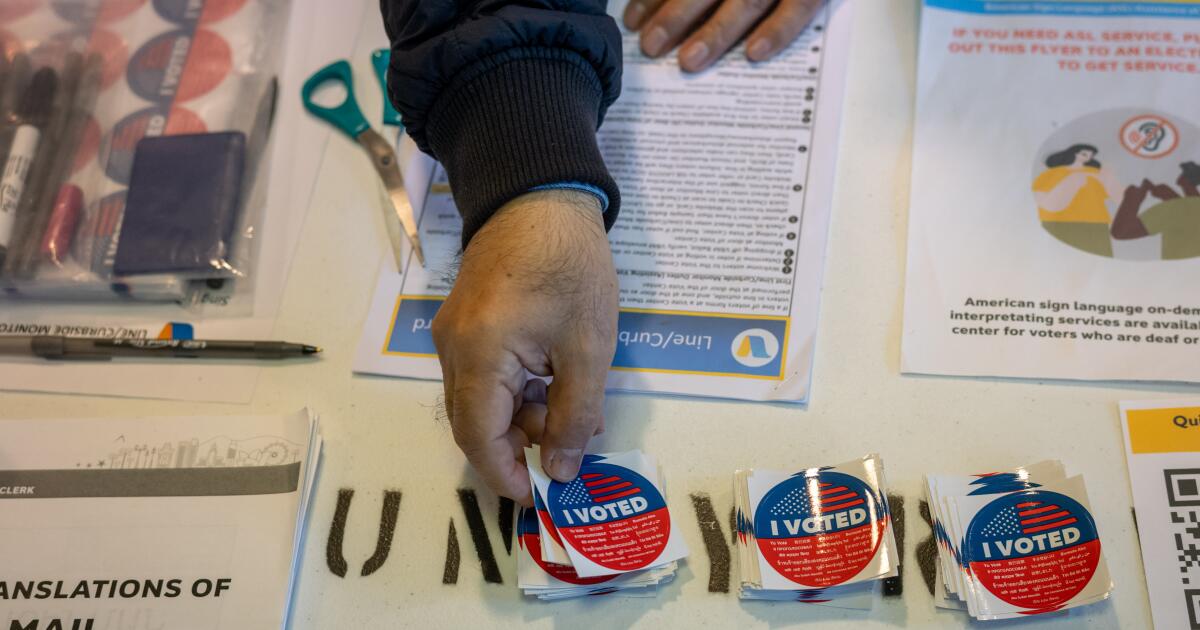
President Trump and his allies are questioning ballot security. Democrats are warning of unconstitutional federal intervention. Experts and others are raising concerns about partisan redistricting and federal immigration agents intimidating people at the polls.
Voter trust in the upcoming midterm elections, meanwhile, has dropped off sharply, and across party lines, according to new research by the UC San Diego Center for Transparent and Trusted Elections.
Out of 11,406 eligible voters surveyed between mid-December and mid-January, just 60% said they were confident that midterm votes will be counted fairly — down from 77% who held such confidence in vote counting shortly after the 2024 presidential election.
Shifts in voter confidence are common after elections, with voters in winning parties generally expressing more confidence and voters in losing parties expressing less, said Thad Kousser, one of the center’s co-directors. However, the new survey found double-digit, across-the-board declines in confidence in the last year, he said.
According to voting experts, such drops in confidence and fears about voter intimidation are alarming — and raise serious questions about voter turnout in a pivotal midterm election that could radically reshape American politics.
While 82% of Republicans expressed at least some confidence in vote counting after Trump’s 2024 win, just 65% said they felt that way in the latest survey. Among Democrats, confidence dropped from 77% to 64%, and among independents from 73% to 57%, the survey found.
“Everyone — Democrats, Republicans, independents alike — have become less trusting of elections over the last year,” Kousser said, calling it a “parallel movement in this polarized era.”
Of course, what is causing those declines differs greatly by party, said Kousser’s co-director Lauren Prather, with distrust of mail ballots and noncitizens voting cited by half of Republicans, and concerns about eligible voters being unable to cast ballots because of fear or intimidation cited by nearly a quarter of Democrats.
Trump and other Republicans have repeatedly alleged that mail ballots contribute to widespread fraud and that noncitizen voting is a major problem in U.S. elections, despite neither claim being supported by evidence.
Dean C. Logan, Registrar-Recorder/County Clerk, oversees the registering of voters, maintaining voter files, administering federal, state, local and special elections and verifying initiatives, referenda and recall petitions.
(Gary Coronado / For The Times)
Many Democratic leaders and voting experts have raised concerns about disenfranchisement and intimidation of eligible voters, in part based on Republican efforts to enforce stricter voter ID and proof of citizenship requirements, and Trump suggesting his party should “take over” elections nationwide.
Others in Trump’s orbit have suggested Immigration and Customs Enforcement agents will be deployed to polling stations, and the FBI recently raided and seized ballots from Fulton County, Ga., long a target of Trump’s baseless claims of 2020 election fraud.
Prather said that research has long showed that “elite cues” — or messaging from political leaders — matter in shaping public perception of election security and integrity, so it is no surprise that the concerns being raised by Trump and other party elites are being echoed by voters.
But the survey also identified more bipartisan concerns, she said.
Voters of all backgrounds — including 51% of Democrats, 48% of independents and 34% of Republicans — said they do not trust that congressional districts are drawn to fairly reflect what voters want. They primarily blamed the opposing party for the problem, but nearly a quarter of both Democrats and Republicans also expressed dissatisfaction with their own party leaders, the survey found.
Various states have engaged in unprecedented mid-decade redistricting to win more congressional seats for their party, with Republicans seizing advantage in states such as Texas and Democrats seizing it in states such as California.
Voters of all backgrounds — including 44% of Democrats, 34% of independents and 30% of Republicans — also said they believe it is likely that ICE agents will be present at voting locations in their area, though they did not all agree on the implications.
Half of Democrats said such a presence would make them feel less confident that votes in their area would be counted accurately, compared with fewer than 14% who said it would make them more confident. Among Republicans, 48% said it would make them more confident, and about 8% less confident. Among independents, 19% said more confident, 32% less confident.
Perceptions of ICE at polling locations also varied by race, with 42% of Asian American voters, 38% of Hispanic voters, 29% of white voters and 28% of Black voters saying it would make them feel less confident, while 18% of Asian American voters, 24% of Hispanic voters, 27% of white voters and 21% of Black voters said it would make them feel more confident.
Among both Black and Hispanic voters, 46% said they expect to face intimidation while voting, compared with 35% of Asian American voters and just 10% of white voters. Meanwhile, 31% of Hispanic and Asian American voters, 21% of Black voters and 8% of white voters said they are specifically worried about being questioned by ICE agents at the polls.

A man waits in line to vote at Compton College in November.
(Michael Blackshire / Los Angeles Times)
Kousser said voters’ lack of confidence this cycle reflects a remarkable moment in American politics, when political rhetoric has caused widespread distrust not just in the outcome of elections, but in the basic structure and fairness of how votes are collected and counted — despite those structures being tested and proven.
“We’re at this moment now where there are people on both sides who are questioning what the objective conditions will be of the election — whether people will be able to freely make it to the polls, what the vote counting mechanisms will be — and that’s true sort of left, right, and center in American politics today,” he said.
Prather said research in other countries has shown that distrust in elections over time can cause voters to stop voting, particularly if they think their vote won’t be fairly counted. She does not think the U.S. has reached that point, as high turnout in recent elections has shown, but it is a longer-term risk.
What could have a more immediate effect are ICE deployments, “especially among groups that have worries about what turning out could mean for them if they expect ICE or federal agents to be there,” Prather said.
Election experts said voters with concerns should take steps to ensure their vote counts, including by double-checking they are registered and making a plan to vote early, by mail or with family and friends if they are worried about intimidation.
What voters should not do if they are worried about election integrity is decide to not vote, they said.
“The No. 1 thing on my list is and always will be: Vote,” said Sean Morales-Doyle, director of the Voting Rights and Elections Program at the Brennan Center for Justice at New York University Law. “That sounds maybe trite or simple, but the only way we hold on to our democracy is if people continue to participate and continue to trust it and put their faith in it.”

Registrar voter staff members process ballots at the Orange County Registrar of Voters in Santa Ana in November.
(Christina House / Los Angeles Times)
“Now is the time to buckle down and figure out how to fortify our protections for fair elections, and not to give into the chaos and believe it’s somehow overwhelming,” said Rick Hasen, an election law expert and director of the Safeguarding Democracy Project at UCLA Law.
“I don’t want people to feel like nothing is working, it’s all overwhelming and they are just being paralyzed by all the news of these attacks, these threats,” said Sophia Lin Lakin, director of the Voting Rights Project at the ACLU. “There are a huge range of folks who are working to ensure that these elections go as smoothly as possible, and that if anything comes up, we are ready to respond.”
Mike Madrid, a Republican political consultant in California, said the erosion of confidence in U.S. elections was “a deliberate strategy” pushed by Trump for years to explain away legitimate election losses that embarrassed him, and facilitated by Republicans in Congress unwilling to check Trump’s lies to defend U.S. election integrity.
However, Democrats have added to the problem and become “the monster they are fighting” by gerrymandering blue states through redistricting measures such as California’s Proposition 50, which have further eroded American trust in elections, Madrid said.
Madrid said that he nonetheless expects high turnout in the midterms, because many voters have “the sense that the crisis is existential for the future, that literally everything is on the line,” but that the loss of trust is a serious issue.
“Without that trust, a form of government like democracy — at least the American form of democracy — doesn’t work,” he said.
Trump — who in a post Friday called Democrats “horrible, disingenuous CHEATERS” for opposing voter ID laws that most Americans support — has long called on his supporters to turn out and vote in massive numbers to give him the largest possible margin of victory, as a buffer against any election cheating against him. One of his 2024 campaign slogans was “Too Big to Rig.”
In recent days, some of Trump’s fiercest critics — including Sen. Adam Schiff (D-Calif.) — have made a similar pitch to Democrats.
In an interview with The Times, Schiff said that he is “deeply concerned” about the midterms given all of Trump’s threats, but that voters should understand that “the remedy here is to become more involved, not less.”
“The very best protection we’ll have is the most massive voter turnout we’ve ever had,” he said. “It’s going to be those with the most important title in our system — the voters — who end up saving this country.”

NEWYou can now listen to Fox News articles!
The Department of War on Sunday transported a next-generation nuclear reactor aboard a C-17 from California to Utah, advancing President Donald Trump’s executive order to modernize America’s nuclear energy infrastructure and strengthen U.S. national security.
The reactor was flown from March Air Reserve Base in California to Hill Air Force Base in Utah and is expected to be transported to the Utah San Rafael Energy Lab in Orangeville for testing and evaluation – a key step in assessing how advanced nuclear systems could support military installations and remote defense operations.
The Department of War shared images on X showing the reactor loaded onto the C-17 aircraft.
“We’re advancing President Trump’s executive order on nuclear energy,” the post read. “Moments from now, we will airlift a next-generation nuclear reactor.”
TRUMP ADMIN POURS $1B INTO MASSIVE EFFORT TO RESTART NUCLEAR REACTOR AT HISTORIC MELTDOWN SITE
The Department of War said the successful delivery and installation of the reactor will open new possibilities for energy resilience and strategic independence for the nation’s defense, highlighting what officials described as an agile, innovative and commercial-first approach to addressing critical infrastructure challenges.
“By harnessing the power of advanced nuclear technology, we are not only enhancing our national security but championing a future of American energy dominance,” the agency said in a press release. “This event is a testament to the ingenuity of the American spirit and a critical advancement in securing our nation’s freedom and strength for generations to come.”
Fox News Digital has reached out to the Department of War for additional comment.
THREE MILE ISLAND NUCLEAR PLANT MAKES COMEBACK WITH $1B IN FEDERAL BACKING TO MEET INCREASING ENERGY DEMANDS
The Department of War airlifted a next-generation nuclear reactor to Utah, advancing President Trump’s push to modernize U.S. energy and strengthen national security. (U.S. Department of War X)
In May, President Donald Trump signed several executive orders aimed at expanding domestic nuclear energy development. At the time, Interior Secretary Doug Burgum said America led the postwar world on “all things nuclear” until it “stagnated” and was “choked with overregulation.”
War Secretary Pete Hegseth added that the U.S. was “going to have the lights on and AI operating when others are not because of our nuclear capabilities.”
One of Trump’s nuclear directives called for reforming Energy Department research and development, accelerating reactor testing at national laboratories and establishing a pilot program for new construction.
ENERGY SECRETARY REVEALS HOW US NUCLEAR TESTS WILL WORK
Nuclear energy, the White House said in the order, “is necessary to power the next generation technologies that secure our global industrial, digital, and economic dominance, achieve energy independence, and protect our national security.”
The nuclear expansion effort is part of a broader administration push to reinforce domestic energy production and grid reliability across multiple sectors.
Days later, Trump signed another executive order directing the Department of War to work directly with coal-fired power plants on new long-term power purchasing agreements, arguing the move would ensure “more reliable power and stronger and more resilient grid power.”
The order, “Strengthening United States National Defense with America’s Beautiful Clean Coal Power Generation Fleet,” states, “The United States must ensure that our electric grid … remains resilient and reliable, and not reliant on intermittent energy sources,” calling the grid “the foundation of our national defense as well as our economic stability.”
CLICK HERE TO DOWNLOAD THE FOX NEWS APP
“It is the policy of the United States that coal is essential to our national and economic security,” the order adds.
Fox News Digital’s Jasmine Baehr and Charles Creitz contributed to this report.

Exclusive: FBI captures longtime fugitive in Honduras in connection with 2000 killing of Philadelphia girl

Mutiny Tiki Bar in southwest Detroit to close, owners say

Flooding closes portions of highways near Sonoma

Massive Dallas-area warehouse will not be used as an ICE detention center, developer says

Miami Dolphins make roster moves

Florida High School Football Rankings: Top 25 teams – Oct. 21

Cleary's 21 help Le Moyne down Central Connecticut State 69-64 in OT

How old is Bo Nix? What to know about Oregon quarterback ahead of 2024 NFL Draft

99th annual Pony Swim held in Virginia

Indiana Members Credit Union announced as new anchor tenant at Bottleworks District

Video: We Tracked All the Lawsuits Against the Second Trump Administration

Nancy Mace proposes bill to make aliens deportable, inadmissible for animal cruelty

Ukraine team heads for Geneva talks as Moscow, Kyiv build military pressure

Europeans push back at US over claim they face ‘civilizational erasure’

Department of War transports next-generation reactor in nuclear energy milestone
-

 Alabama1 week ago
Geneva’s Kiera Howell, 16, auditions for ‘American Idol’ season 24
-

 Illinois1 week ago
2026 IHSA Illinois Wrestling State Finals Schedule And Brackets – FloWrestling
-

 Technology1 week ago
Apple might let you use ChatGPT from CarPlay
-

 Culture7 days ago
Try This Quiz on Passionate Lines From Popular Literature
-
 News1 week ago
Hate them or not, Patriots fans want the glory back in Super Bowl LX
-

 Technology1 week ago
We found 20 Verge-approved gifts on sale ahead of Valentine’s Day
-

 Politics1 week ago
Virginia Dems take tax hikes into overtime, target fantasy football leagues
-

 Politics1 week ago
West Virginia worked with ICE — 650 arrests later, officials say Minnesota-style ‘chaos’ is a choice