Politics
Trump’s Pattern of Sowing Election Doubt Intensifies in 2024


Former President Donald J. Trump has baselessly and publicly cast doubt about the fairness of the 2024 election about once a day, on average, since he announced his candidacy for president, according to an analysis by The New York Times.
Though the tactic is familiar — Mr. Trump raised the specter of a “rigged” election in the 2016 and 2020 cycles, too — his attempts to undermine the 2024 contest are a significant escalation.
A line chart shows the number of times Donald J. Trump cast doubt on the fairness or integrity of the election during the 2016, 2020, and 2024 election cycles. The line for 2024 shows that Trump started casting doubt months earlier during this election cycle and has made hundreds more statements than in past elections. Three videos on the chart show early instances of Trump casting doubt, in 2016, 2019 and 2022.
Mr. Trump first raised questions about the 2016 election in August of that year, about 100 days before the election. He did so earlier — and more frequently — before the 2020 election.
But in the 2024 cycle, the falsehoods have been baked in since Mr. Trump announced his candidacy, almost two years before Election Day. They show no signs of subsiding.
Mr. Trump’s refusal to accept the results of the 2020 election had historic consequences. The so-called “Big Lie” — Mr. Trump’s false claim that the election was stolen from him — led to the Jan. 6, 2021, insurrection at the United States Capitol and two of four criminal indictments against Mr. Trump, as well as his second impeachment.
But Mr. Trump had planted seeds of doubt among his followers long before Election Day, essentially setting up a no-lose future for himself: Either he would prevail, or the election would be rigged.
He has never given up that framing, which no evidence supports, even well after the end of his presidency. And as he seeks to return to the White House, the same claim has become the backbone of his campaign.
Long before announcing his candidacy, Mr. Trump and his supporters had been falsely claiming that President Biden was “weaponizing” the Justice Department to target him. But it took until March of last year for Mr. Trump to settle on a new accusation: that the multiple legal challenges related to Mr. Trump’s business and political activities constituted a “new way of cheating” in order to “interfere” in the 2024 election. He has made versions of that accusation more than 350 times.
“This is a rigged deal, just as the 2020 election was rigged, and we can’t let them get away with it,” Mr. Trump said on Nov. 18, 2022, three days after announcing his 2024 candidacy. His comments were in response to Attorney General Merrick B. Garland’s appointment of a special counsel to supervise the Justice Department’s criminal investigations related to the events leading up to the Jan. 6 riot and Mr. Trump’s decision to keep classified documents at his Florida resort.
By last summer, Mr. Trump had honed the language and made it a staple of his stump speech: “They rigged the presidential election of 2020, and we’re not going to allow them to rig the presidential election of 2024.”
The Times has documented more than 500 campaign events, social media posts and interviews during the 2024 cycle in which Mr. Trump falsely accused Democrats or others of trying to “rig,” “cheat,” “steal” or otherwise “influence” the next election — or of having done so in 2020.
‘Election interference’ is Trump’s choice accusation in 2024 cycle
Mr. Trump has adapted the specifics of his accusations with each of the three election cycles. But in each case, his pattern of discourse has followed the same contours. He sows doubt about the legitimacy of the election, and then begins to capitalize on that doubt by alluding to not necessarily accepting the election results — unless, of course, he wins.
This rhetorical strategy — heads, I win; tails, you cheated — is a beloved one for Mr. Trump that predates even his time as a presidential candidate. He called the Emmy Awards “a con game” after his television show “The Apprentice” failed to win in 2004 and 2005. And before he officially became the Republican presidential nominee in 2016, he began to float the possibility that the primary contest was, as he said, “rigged and boss controlled.”
By May of that year, Mr. Trump spoke plainly about why he had stashed the argument away. “You’ve been hearing me say it’s a rigged system,” he said, “but now I don’t say it anymore because I won.”
Late that summer, with his sights set on the November general election, Mr. Trump tested out a new line, contending that “the media” was “rigging” the election in favor of Hillary Clinton, the Democratic nominee. His assertions intensified in October after a recording surfaced of him speaking in vulgar terms about women.
“I will totally accept the results of this great and historic presidential election — if I win,” Mr. Trump said at a rally in 2016, three weeks before Election Day. And though he would end up winning the Electoral College and the presidency, his failure to secure the popular vote led him to form a Presidential Advisory Commission on Election Integrity to “prove” that rampant voter fraud was to blame.
In December 2019, well into Mr. Trump’s re-election campaign, the Democratic-led U.S. House of Representatives impeached him, saying he used the levers of government to solicit election assistance from Ukraine in the form of investigations to discredit Mr. Biden. Mr. Trump subsequently said that Democrats were using the “impeachment hoax” to “interfere” in the election.
The Covid-19 pandemic gave him a new rallying cry, centered on election integrity: Mail-in ballots were “dangerous,” “fraught with fraud” and were being used to “steal” and “rig” the election, he said.
About six weeks before Election Day in 2020, Mr. Trump refused to commit to a peaceful transfer of power. “We want to make sure that the election is honest, and I’m not sure that it can be,” Mr. Trump said.
This time, it was half a year before Election Day 2024 — and after more than a year of pushing the “election interference” line about the criminal charges against him and repeatedly warning that Democrats are “cheating” — that Mr. Trump again placed conditions on his acceptance of election results.
“If everything’s honest, I’ll gladly accept the results,” he said in a May 1 interview with The Milwaukee Journal Sentinel. “If it’s not, you have to fight for the right of the country.”



new video loaded: Hillary Clinton Denies Ever Meeting Jeffrey Epstein
transcript
transcript
Hillary Clinton Denies Ever Meeting Jeffrey Epstein
The former first lady, senator and secretary of state, Hillary Clinton, told congressional members in a closed-door deposition that she had no dealings with Jeffrey Epstein.
-
“I don’t know how many times I had to say I did not know Jeffrey Epstein. I never went to his island. I never went to his homes. I never went to his offices. So it’s on the record numerous times.” “This isn’t a partisan witch hunt. To my knowledge, the Clintons haven’t answered very many questions about everything.” “You’re sitting through an incredibly unserious clown show of a deposition, where members of Congress and the Republican Party are more concerned about getting their photo op of Secretary Clinton than actually getting to the truth and holding anyone accountable.” “What is not acceptable is Oversight Republicans breaking their own committee rules that they established with the secretary and her team.” “As we had agreed upon rules based on the fact that it was going to be a closed hearing at their demand, and one of the members violated that rule, which was very upsetting because it suggested that they might violate other of our agreements.”

By Jackeline Luna
February 26, 2026
Politics
Vulnerable House Dem lashes out at Trump’s ‘racist’ SOTU challenge: ‘That was uncomfortable’

NEWYou can now listen to Fox News articles!
Rep. Janelle Bynum, D-Ore., called a challenge from President Donald Trump at the 2026 State of the Union “racist” when he asked listeners to stand if they agreed the U.S. should prioritize the safety of its own citizens over illegal aliens.
“If you agree with this statement, then stand up and show your support,” Trump said.
“The first duty of the American government is to protect American citizens, not illegal aliens.”
Democrats remained seated for over a minute and a half as the Republican side of the chamber burst into prolonged applause.
President Donald Trump pictured ahead of his 2026 State of the Union Address on Feb. 24, 2026. (Kenny Holston-Pool/Getty Images)
After the address, Bynum, who is on the National Republican Congressional Committee’s list of vulnerable Dem incumbents, said the moment made her uneasy.
“I think you can agree with the ‘what’ — like standing up for American citizens,” Bynum said. “But I disagree with the ‘how.’”
“There’s thinly veiled racist language, anti-immigrant language in what he was asking, and that was uncomfortable,” Bynum said.
Bynum’s office did not immediately respond to a request for comment on how Trump’s challenge had asked lawmakers to discriminate on the basis of race.
TRUMP SHAMES DEMOCRATS IN VIRAL STATE OF THE UNION CHALLENGE ON MIGRANT CRIME: ‘FIRST DUTY’
Trump’s remarks to Democrats on Tuesday came as a partial government shutdown drags on over demands Democrats have made to reform the agency at the heart of Trump’s immigration crackdown.
Rep. Janelle Bynum, D-Ore., left, pictured alongside President Donald Trump, right. (Bill Clark/CQ-Roll Call, Inc via Getty Images; Craig Hudson For The Washington Post via Getty Images)
Democrats are demanding a set of 10 enforcement reforms for Immigration and Customs Enforcement (ICE) and won’t vote to fund the Department of Homeland Security (DHS) until Republicans meet their demands.
DHS, which oversees ICE, went into a shutdown on Feb. 14.
DHS SHUTDOWN DRAGS INTO WEEK TWO AS IRAN THREAT, SOTU CLASH COMPLICATE HILL TALKS
Among other changes, Democrats are looking for a ban on masks, an end to roaming patrols, visible identification and stiffer warrant requirements for arresting illegal aliens in public.
Republicans have dismissed those demands, arguing that Democrats must first pass legislation to restrict “sanctuary cities” — local communities that have instructed their law enforcement not to cooperate with federal agents on immigration apprehensions and deportations.
DHS Agents in Charlotte, North Carolina on a mission. (Ryan Murphy/Getty Images)
CLICK HERE TO DOWNLOAD THE FOX NEWS APP
In a press release after the State of the Union, Bynum, who voted against DHS earlier this year, listed Trump’s framing of his immigration crackdown among her many critiques of the address.
“Tonight, I watched President Trump spend the majority of his speech lying about the state of our economy, demonizing immigrants and spewing more of the same divisive BS. I can’t say I’m surprised,” she wrote.
Related Article

Politics
Trump’s State of the Union address draws 32.6 million viewers, marking smallest audience yet
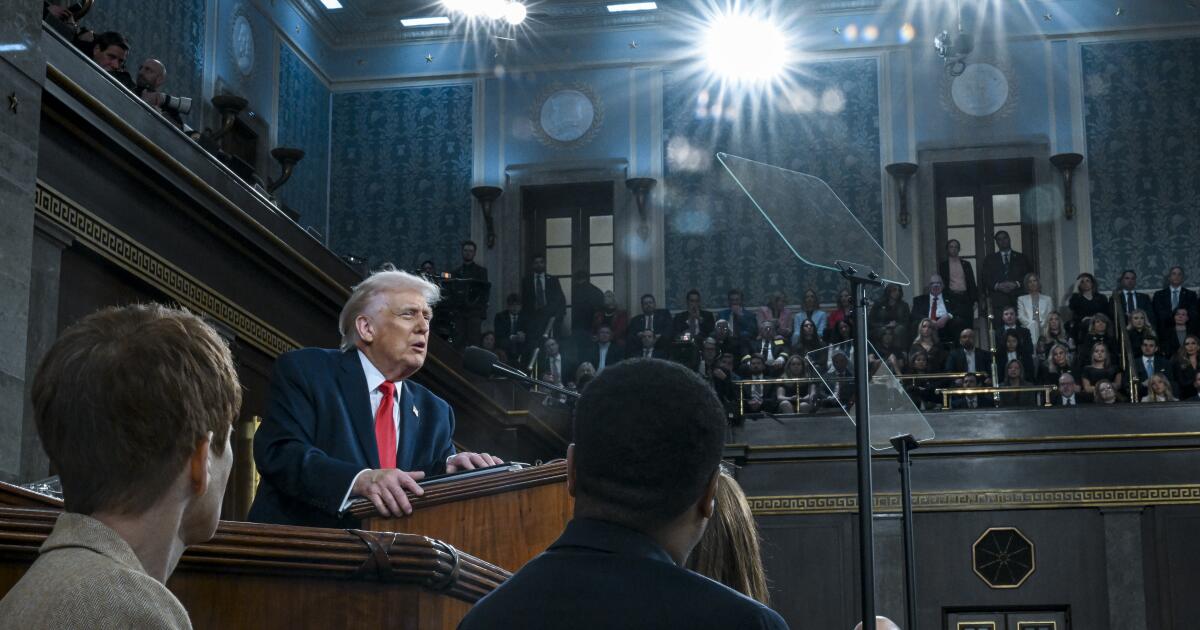
Over 32.6 million viewers watched President Trump address the nation on Tuesday night, according to Nielsen data.
It’s both the smallest audience Trump has received for the annual speech to a joint session of Congress, and the longest State of the Union address in recent history.
This was the president’s first State of the Union address of his second term. Previously, his addresses scored 45.5 million in 2018, 46.8 million in 2019 and 37.1 million in 2020, the Nielsen data show.
This year’s speech clocked in at 107 minutes, topping the record set by President Clinton in 2000.
Facing low approval ratings, Trump played up positive economic numbers, some of which were misstated, and the administration’s aggressive crackdown on undocumented immigrants, drawing polarized reactions in the chamber.
Trump also recognized the Men’s Olympic hockey team, which won its first gold medal since 1980 on Sunday with its victory against Canada, and a number of other guests attended the address, including the widow of right-wing activist Charlie Kirk and Paramount Skydance’s CEO David Ellison.
The U.S. Olympic men’s ice hockey team arrives for the State of the Union address .
(Kenny Holston / Pool, Getty Images)
There were 15 networks that televised the speech. Fox News had the largest audience with 9.1 million viewers. ABC was second with 5.1 million, followed by NBC‘s 3.6 million, CBS’ 3.3 million, MS NOW’s 2.4 million, CNN’s 2.2 million, and the Fox broadcast network’s 2.1 million.

Robert ‘Fish’ Jenkins helped Detroit students soar in sports and life

San Francisco court clerks strike for better staffing, training

Mavericks vs Kings Final Score: Dallas falls to Sacramento, 130-121

Red Sox insider hints Boston may have Pablo Sandoval problem with Masataka Yoshida

David Fountaine Black Obituary | The Denver Post

Florida High School Football Rankings: Top 25 teams – Oct. 21

Cleary's 21 help Le Moyne down Central Connecticut State 69-64 in OT

How old is Bo Nix? What to know about Oregon quarterback ahead of 2024 NFL Draft

99th annual Pony Swim held in Virginia

Indiana Members Credit Union announced as new anchor tenant at Bottleworks District

Read Judge Schiltz’s Order

Vulnerable House Dem lashes out at Trump’s ‘racist’ SOTU challenge: ‘That was uncomfortable’

Italy calls for suspension of EU carbon market

Chicagoans pay respects to Jesse Jackson as cross-country memorial services begin

DHS shutdown triggers TSA ‘emergency measures’ as lawmaker warns airports could feel economic pain
-

 World1 day ago
Exclusive: DeepSeek withholds latest AI model from US chipmakers including Nvidia, sources say
-

 Massachusetts2 days ago
Mother and daughter injured in Taunton house explosion
-

 Montana1 week ago
2026 MHSA Montana Wrestling State Championship Brackets And Results – FloWrestling
-

 Oklahoma1 week ago
Wildfires rage in Oklahoma as thousands urged to evacuate a small city
-

 Louisiana4 days ago
Wildfire near Gum Swamp Road in Livingston Parish now under control; more than 200 acres burned
-

 Technology6 days ago
YouTube TV billing scam emails are hitting inboxes
-

 Denver, CO2 days ago
10 acres charred, 5 injured in Thornton grass fire, evacuation orders lifted
-

 Technology6 days ago
Stellantis is in a crisis of its own making