Politics
Trump posted a fake Taylor Swift image. AI and deepfakes are only going to get worse this election cycle

The patriotic image shows megastar Taylor Swift dressed up like Uncle Sam, falsely suggesting she endorses Republican presidential nominee Donald Trump.
“Taylor Wants You To Vote For Donald Trump,” the image, which appears to be generated by artificial intelligence, says.
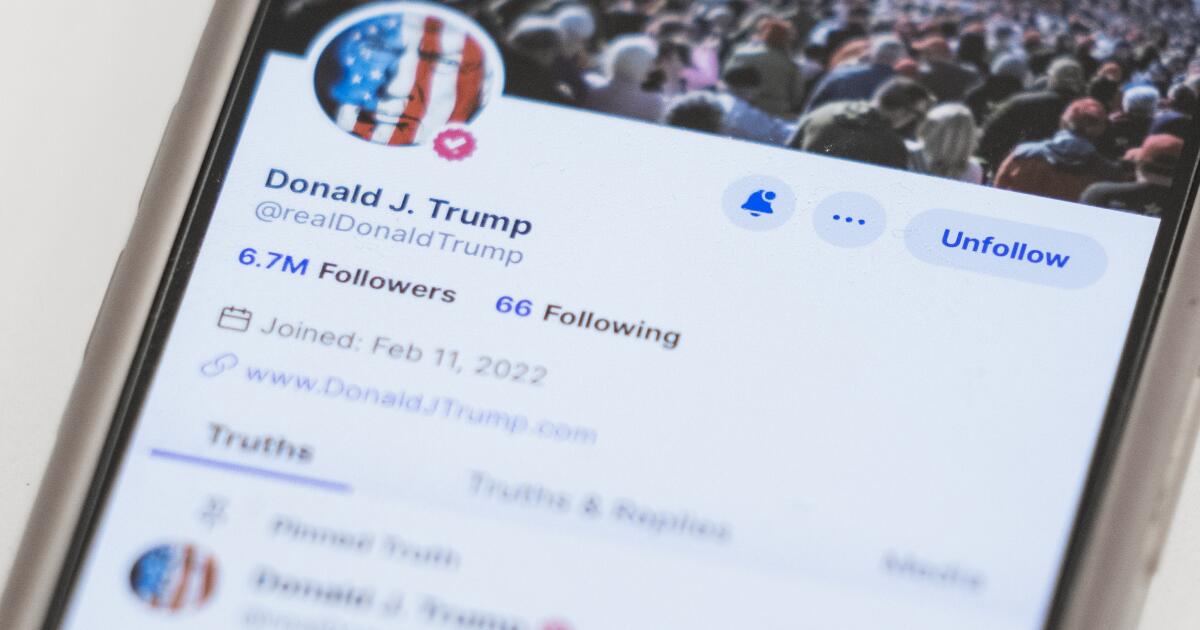
Over the weekend, Trump amplified the lie when he shared the image along with others depicting support from Swift fans to his 7.6 million followers on his social network Truth Social.
Deception has long played a part in politics, but the rise of artificial intelligence tools that allow people to rapidly generate fake images or videos by typing out a phrase adds another complex layer to a familiar problem on social media. Known as deepfakes, these digitally-altered images and videos can make it appear someone is saying or doing something they aren’t.
As the race between Trump and Democratic nominee Kamala Harris intensifies, disinformation experts are sounding the alarm about generative AI’s risks.
“I’m worried as we move closer to the election, this is going to explode,” said Emilio Ferrara, a computer science professor at USC Viterbi School of Engineering. “It’s going to get much worse than it is now.”
Platforms such as Facebook and X, formerly known as Twitter, have rules against manipulated images, audio and videos, but they’ve struggled to enforce these policies as AI-generated content floods the internet. Faced with accusations they’re censoring political speech, they’ve focused more on labeling content and fact checking, rather than pulling posts down. And there are exceptions to the rules, such as satire, that allow people to create and share fake images online.
“We have all the problems of the past, all the myths and disagreements and general stupidity, that we’ve been dealing with for 10 years,” said Hany Farid, a UC Berkeley professor who focuses on misinformation and digital forensics. “Now we have it being supercharged with generative AI and we are really, really partisan.”
Amid the surging interest in OpenAI, the maker of popular generative AI tool ChatGPT, tech companies are encouraging people to use new AI tools that can generate text, images and videos.
Farid, who analyzed the Swift images that Trump shared, said they appear to be a mix of both real and fake images, a “devious” way to push out misleading content.
People share fake images for various reasons. They might be doing it to just go viral on social media or troll others. Visual imagery is a powerful part of propaganda, warping people’s views on politics including about the legitimacy of the 2024 presidential election, he said.
On X, images that appear to be AI-generated depict Swift hugging Trump, holding his hand or singing a duet as the Republican strums a guitar. Social media users have also used other methods to falsely claim Swift endorsed Trump.
X labeled one video that falsely claimed Swift endorsed Trump as “manipulated media.” The video, posted in February, uses footage of Swift at the 2024 Grammys and makes it appear as if she’s holding a sign that says, “Trump Won. Democrats Cheated!”
Political campaigns have been bracing for AI’s impact on the election.
Vice President Harris’ campaign has an interdepartmental team “to prepare for the potential effects of AI this election, including the threat of malicious deepfakes,” said spokeswoman Mia Ehrenberg in a statement. The campaign only authorizes the use of AI for “productivity tools” such as data analysis, she added.
Trump’s campaign didn’t respond to a request for comment.
Part of the challenge in curbing fake or manipulated video is that the federal law that guides social media operations doesn’t specifically address deepfakes. The Communications Decency Act of 1996 does not hold social media companies liable for hosting content, as long as they do not aid or control those who posted it.
But over the years, tech companies have come under fire for what’s appeared on their platforms and many social media companies have established content moderation guidelines to address this such as prohibiting hate speech.
“It’s really walking this tightrope for social media companies and online operators,” said Joanna Rosen Forster, a partner at law firm Crowell & Moring.
Legislators are working to address this problem by proposing bills that would require social media companies to take down unauthorized deepfakes.
Gov. Gavin Newsom said in July that he supports legislation that would make altering a person’s voice with the use of AI in a campaign ad illegal. The remarks were a response to a video billionaire Elon Musk, who owns X, shared that uses AI to clone Harris’ voice. Musk, who has endorsed Trump, later clarified that the video he shared was parody.
The Screen Actors Guild-American Federation of Television and Radio Artists is one of the groups advocating for laws addressing deepfakes.
Duncan Crabtree-Ireland, SAG-AFTRA’s national executive director and chief negotiator, said social media companies are not doing enough to address the problem.
“Misinformation and outright lies spread by deepfakes can never really be rolled back,” Crabtree-Ireland said. “Especially with elections being decided in many cases by narrow margins and through complex, arcane systems like the electoral college, these deepfake-fueled lies can have devastating real world consequences.”
Crabtree-Ireland has experienced the problem firsthand. Last year, he was the subject of a deepfake video circulating on Instagram during a contract ratification campaign. The video, which showed false imagery of Crabtree-Ireland urging members to vote against a contract he negotiated, got tens of thousands of views. And while it had a caption that said “deepfake,” he received dozens of messages from union members asking him about it.
It took several days before Instagram took the deepfake video down, he said.
“It was, I felt, very abusive,” Crabtree-Ireland said. “They shouldn’t steal my voice and face to make a case that I don’t agree with.”
With a tight race between Harris and Trump, it’s not surprising both candidates are leaning on celebrities to appeal to voters. Harris’ campaign embraced pop star Charli XCX’s depiction of the candidate as “brat” and has used popular tunes such as Beyoncé’s “Freedom” and Chappell Roan’s “Femininomenon” to promote the Democratic Black and Asian American female presidential nominee. Musicians Kid Rock, Jason Aldean and Ye, formerly known as Kanye West, have voiced their support for Trump, who was the target of an assassination attempt in July.
Swift, who has been the target of deepfakes before, hasn’t publicly endorsed a candidate in the 2024 presidential election, but she’s criticized Trump in the past. In the 2020 documentary “Miss Americana,” Swift says in a tearful conversation with her parents and team that she regrets not speaking out against Trump during the 2016 election and slams Tennessee Republican Marsha Blackburn, who was running for U.S. Senate at the time, as “‘Trump in a wig.”
Swift’s publicist, Tree Paine, did not respond to a request for comment.
AI-powered chatbots from platforms such as Meta, X and OpenAI make it easy for people to create fictitious images. While news outlets have found that X’s AI chatbot Grok can generate election fraud images, other chatbots are more restrictive.
Meta AI’s chatbot declined to create images of Swift endorsing Trump.
“I can’t generate images that could be used to spread misinformation or create the impression that a public figure has endorsed a particular political candidate,” Meta AI’s chatbot replied.
Meta and TikTok cited their efforts to label AI-generated content and partner with fact checkers. For example, TikTok said an AI-generated video falsely depicting a political endorsement of a public figure by an individual or group is not allowed. X didn’t respond to a request for comment.
When asked how Truth Social moderates AI-generated content, the platform’s parent company Trump Media and Technology Group Corp. accused journalists of “demanding more censorship.” Truth Social’s community guidelines has rules against posting fraud and spam but doesn’t spell out how it handles AI-generated content.
With social media platforms facing threats of regulation and lawsuits, some misinformation experts are skeptical that social networks want to properly moderate misleading content.
Social networks make most of their money from ads so keeping users on the platforms for a longer time is “good for business,” Farid said.
“What engages people is the absolute, most conspiratorial, hateful, salacious, angry content,” he said. “That’s who we are as human beings.”
It’s a harsh reality that even Swifties won’t be able to shake off.
Staff writer Mikael Wood contributed to this report.



new video loaded: U.S. ‘Accelerating’ Military Assault in Iran, Hegseth Says
By Christina Kelso
March 4, 2026

NEWYou can now listen to Fox News articles!
A U.S. submarine sank a prized Iranian warship by torpedo, the first such sinking of an enemy ship since World War II, Secretary of War Pete Hegseth said Wednesday morning.
Hegseth joined Chairman of the Joint Chiefs of Staff Gen. Dan Caine at the Pentagon to provide an update to reporters on “Operation Epic Fury” in Iran.
“An American submarine sunk an Iranian warship that thought it was safe in international waters,” Hegseth said. “Instead, it was sunk by a torpedo. Quiet death. The first sinking of an enemy ship by a torpedo since World War Two. Like in that war, back when we were still the War Department. We are fighting to win.”
Caine said that an Iranian vessel was “effectively neutralized” in a Navy “fast attack” using a single Mark 48 torpedo. He added that the U.S. Navy achieved “immediate effect, sending the warship to the bottom of the sea.”
WATCH HEGSETH’S ANNOUNCEMENT:
Hegseth said that the U.S. Navy sank the Iranian warship, the Soleimani. The flagship was named for Qasem Soleimani, an Iranian military officer who served in the Islamic Revolutionary Guard Corps who the U.S. killed in a January 2020 drone strike during President Donald Trump’s first term.
“The Iranian Navy rests at the bottom of the Persian Gulf. Combat ineffective, decimated, destroyed, defeated. Pick your adjective,” Hegseth said. “In fact, last night we sunk their prize ship, the Soleimani. Looks like POTUS got him twice. Their navy, not a factor. Pick your adjective. It is no more.”
This map shows U.S. and Israeli strikes against Iranian naval forces as of March 1. (Fox News)
Hegseth also told reporters at the briefing that the U.S. and Israel will soon achieve “complete control” over Iranian airspace after Iran’s missile capabilities were drastically diminished in the four days of fighting.
US ‘WINNING DECISIVELY’ AGAINST IRAN, WILL ACHIEVE ‘COMPLETE CONTROL’ OF AIRSPACE WITHIN DAYS, HEGSETH SAYS
“More bombers and more fighters are arriving just today and now, with complete control of the skies, we will be using 500 pound, one thousand pound and 2,000 pound laser-guided precision gravity bombs, of which we have a nearly unlimited stockpile,” he said.
The war has killed more than 1,000 people in Iran and dozens in Lebanon, while U.S. officials said six American troops were killed in a fatal drone strike in Kuwait.
Thousands of travelers have been left stranded across the Middle East.
This map shows security and travel updates for Americans regarding countries in the Middle East region. (Fox News)
CLICK HERE TO DOWNLOAD THE FOX NEWS APP
Caine told reporters that the U.S. military is helping thousands of Americans stranded in the Middle East after the U.S. State Department urged citizens to leave more than a dozen countries.
Fox News Digital’s Ashley Carnahan contributed to this report.
Related Article


Sen. Alex Padilla (D-Calif.) is preparing for President Trump to declare a national emergency in order to seize control of this year’s midterm elections from the states, including by bracing his Senate colleagues for a vote in which they would be forced to either co-sign on the power grab or resist it.
In the wake of reporting last week that conservative activists with connections to the White House were circulating such an order, Padilla sent a letter to his Senate colleagues Friday stating that any such order would be “wildly illegal and unconstitutional,” and would no doubt face “extremely strict scrutiny” in the courts.
“Nevertheless, if the President does escalate his unprecedented assault on our democracy by declaring an election-related emergency, I will swiftly introduce a privileged resolution [and] force a vote in the Senate to terminate the fake emergency,” wrote Padilla, the ranking Democrat on the Senate Committee on Rules and Administration.
Padilla wrote that such an order — which could possibly “include banning mail-in voting, eliminating major voting registration methods, voter purges, and/or new document barriers for registering to vote and voting” — would clearly go beyond Trump’s authority.
“Put simply, no President has the power under the Constitution or any law to take over elections, and no declaration or order can create one out of thin air,” Padilla wrote.
The same day Padilla sent his letter, Trump was asked whether he was considering declaring a national emergency around the midterms. “Who told you that?” he asked — before saying he was not considering such an order.
The White House referred The Times to that exchange when asked Tuesday for comment on Padilla’s letter.
If Trump did declare such an emergency, a “privileged resolution,” as Padilla proposed, would require the full Senate to vote on the record on whether or not to terminate it — forcing any Senate allies of the president to own the policy politically, along with him.
Experts say there is no evidence that U.S. elections are significantly affected or swung by widespread fraud or foreign interference, despite robust efforts by Trump and his allies for years to find it.
Nonetheless, Trump has been emphatic that such fraud is occurring, particularly in blue states such as California that allow for mail-in ballots and do not have strict voter ID laws. He and others in his administration have asserted, again without evidence, that large numbers of noncitizen residents are casting votes and that others are “harvesting” ballots out of the mail and filling them out in bulk.
Soon after taking office, Trump issued an executive order purporting to require voters to show proof of U.S. citizenship before registering and barring the counting of mail-in ballots received after election day, but it was largely blocked by the courts.
Trump’s loyalist Justice Department sued red and blue states across the country for their full voter rolls, but those efforts also have largely been blocked, including in California. The FBI also raided an elections office in Georgia that has been the focus of Trump’s baseless claims that the 2020 presidential election was stolen from him.
Trump is also pushing for the passage of the SAVE Act, a voter ID bill passed by the House, but it has stalled in the Senate.
In recent weeks, Trump has expressed frustration that his demands around voting security have not translated into changes in blue state policies ahead of the upcoming midterm elections, where his shrinking approval could translate into major gains for Democrats.
Last month, Trump wrote on his Truth Social platform, “I have searched the depths of Legal Arguments not yet articulated or vetted on this subject, and will be presenting an irrefutable one in the very near future. There will be Voter I.D. for the Midterm Elections, whether approved by Congress or not!”
Then, last week, the Washington Post reported that a draft executive order being circulated by activists with ties to Trump suggests that unproven claims of Chinese interference in the 2020 election could be used as a pretext to declare an elections emergency granting Trump sweeping authority to unilaterally institute the changes he wants to see in state-run elections.
Election experts said the Constitution is clear that states control and run elections, not with the executive branch.
Democrats have widely denounced any federal takeover of elections by Trump. And some Republicans have expressed similar concerns, including Sen. Mitch McConnell (R-Ky.), who chairs the Senate rules committee.
In the Wall Street Journal last year, McConnell warned against Trump or any Republican president asserting sweeping authority to control elections, in part because Democrats would then be empowered to claim similar authority if and when they retake power.
McConnell’s office referred The Times to that Journal opinion piece when asked about the circulating emergency order and Padilla’s resolution.
Padilla’s office said his resolution would be introduced in response to an emergency declaration by Trump, but hoped it wouldn’t be necessary.
“Instead of trying to evade accountability at the ballot box,” Padilla wrote, “the President should focus on the needs of Americans struggling to pay for groceries, health care, housing and other everyday needs and put these illegal and unconstitutional election orders in the trash can where they belong.”

Colorado breweries warn new tax hike bills could lead to more small business closures, job losses

Connecticut Launches New Era for Community Hospital Care – UConn Today

Some Delaware lawmakers question Education Department program cuts

Georgia Lt. Gov. candidate releases controversial ‘Sharia law’ video

The Places Visitors Love Most In Hawaii Just Hit Their Limit

Florida High School Football Rankings: Top 25 teams – Oct. 21

Cleary's 21 help Le Moyne down Central Connecticut State 69-64 in OT

How old is Bo Nix? What to know about Oregon quarterback ahead of 2024 NFL Draft

99th annual Pony Swim held in Virginia

Indiana Members Credit Union announced as new anchor tenant at Bottleworks District

US submarine sinks Iranian warship by torpedo in a first since World War II

Which oil and gas facilities in the Gulf have been attacked?

Mojtaba Khamenei, son of former supreme leader, tipped to become Iran’s next head of state

Video: Senators Question Kristi Noem on ICE Immigration Tactics

Combustible Republican Senate primary in Texas heading into overtime
-

 World7 days ago
Exclusive: DeepSeek withholds latest AI model from US chipmakers including Nvidia, sources say
-

 Massachusetts1 week ago
Mother and daughter injured in Taunton house explosion
-

 Denver, CO7 days ago
10 acres charred, 5 injured in Thornton grass fire, evacuation orders lifted
-

 Louisiana1 week ago
Wildfire near Gum Swamp Road in Livingston Parish now under control; more than 200 acres burned
-

 Florida4 days ago
Florida man rescued after being stuck in shoulder-deep mud for days
-

 Wisconsin3 days ago
Setting sail on iceboats across a frozen lake in Wisconsin
-

 Maryland4 days ago
AM showers Sunday in Maryland
-

 Oregon5 days ago
2026 OSAA Oregon Wrestling State Championship Results And Brackets – FloWrestling