Politics
Trump immediately flexes presidential powers: 1,500 pardons and a raft of executive orders

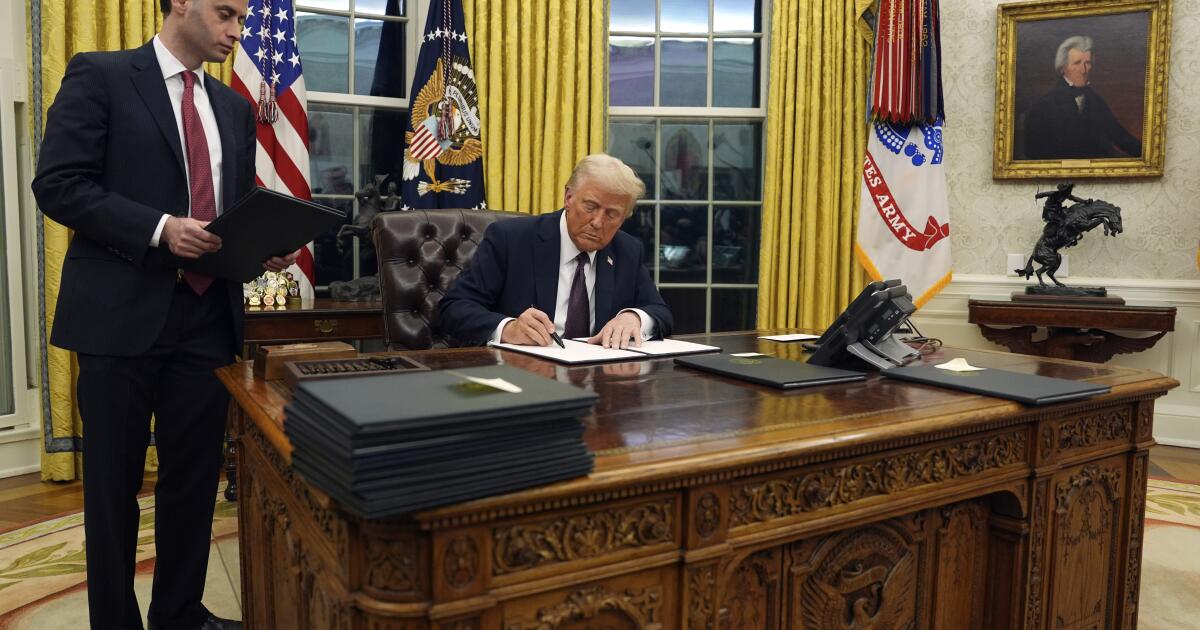
President Trump quickly flexed the sweeping powers of the presidency following his second inauguration at the Capitol on Monday, signing a slate of executive orders that would radically alter U.S. policy if allowed to stand.
He also pardoned or commuted the sentences of all of his loyalists — more than 1,500 people — who stormed the same Capitol building in a failed attempt to illegitimately keep him in power four years prior, repeatedly referring to them as “hostages.”
“We hope they come out tonight, frankly,” Trump said during an evening signing ceremony at the Oval Office — a reference to the fact that many of those defendants were in prison for serious offenses such as assaulting police officers.
Trump’s orders reflected an aggressive start to the conservative agenda he promised on the campaign trail, aimed at reining in illegal immigration, strengthening U.S. manufacturing and the broader economy, rolling back LGBTQ+ rights, reinforcing American dominance abroad and bending the sprawling federal bureaucracy to his will.
At an evening rally in Washington, D.C., that was held in lieu of an outdoor parade because of frigid temperatures, Trump sat at a desk and used black markers to sign nine orders.
The first, he said, undid about 80 “destructive, radical actions” made by President Biden — having to do with issues including immigration, the COVID-19 pandemic, voting rights, “diversity, equity and inclusion” initiatives, protections for LGBTQ+ people, the operation of prisons by private entities, tackling climate change and other environmental protections.
The other orders withdrew the U.S. from the Paris Climate Agreement and informed the United Nations of that decision; placed freezes on new federal regulations and most federal hiring while his administration gets into place; mandated federal workers return to in-person work full time; and sent directives to federal agencies to protect free speech, end the “weaponization of government” for political purposes, and find ways to decrease inflation and high costs for average Americans.
Trump said he also would later sign other orders — such as one mandating that agencies preserve all records pertaining to his own prosecution on various federal charges under the Biden administration. And he renewed campaign promises to take other actions, such as ending federal taxes on tipped wages.
Trump concluded the event by tossing the markers he’d used to sign the orders into the crowd, to big cheers from his supporters.
Soon after, Trump was back in the Oval Office signing more orders and the pardons. One order announced the withdrawal of the U.S. from the World Health Organization, while another purported to end the long-established constitutional guarantee of U.S. citizenship for anyone born on U.S. soil, regardless of their parents’ immigration status.
Trump commuted the sentences of 14 people — including some of the highest-profile Jan. 6 defendants — to time served, and granted full pardons to everyone else convicted of offenses from that day. The Justice Department recently estimated that it had charged more than 1,500 people, including 590 with assaulting, resisting, impeding or obstructing law enforcement.
As of November, nearly 1,000 had pleaded guilty, more than 200 had been found guilty at trial, and more than 600 had been sentenced to time behind bars.
Trump’s pardons followed a last-minute decision by Biden to flex the same power on his way out of the White House by pardoning members of Congress and their staffers who had investigated the Jan. 6, 2021, attack on the Capitol, as well as other former U.S. officials who have drawn Trump’s ire for having challenged his authority in the past.
The orders, which Trump also described in some detail in his inaugural speech Monday morning, reflected just how starkly divided the nation has become politically — and the degree to which Trump feels emboldened to shirk tradition and legal precedent as the first president to win a nonconsecutive second term in the White House in the last 132 years.
While promising the return of a “golden age of America” under his watch, Trump declared two national emergencies — one to do with southern border crossings, and the other to do with energy independence. He promised several measures to address each, including closing the border entirely to asylum seekers — in part by reinstating his “Remain in Mexico” policy and sending military troops to the border — and by clearing away federal energy regulations so that oil and gas producers can “drill, baby, drill.”
In an early sign of the policies being implemented, immigrants with asylum claims at the southern border were told Monday that scheduled interviews they had with U.S. Customs and Border Protection had been canceled.
Trump said he would declare that there are only “two genders” — a swipe at transgender people that echoed attacks by Trump’s campaign — and revoke regulations intended to transition the nation toward electric vehicles. He said he would institute many new tariffs on foreign goods, launch a new “external revenue service” to collect the associated revenue, and launch a new Department of Government Efficiency to reduce waste — the last of which would be led by Elon Musk, the owner of X and Tesla and the world’s richest man.
Trump also said he would rename the Gulf of Mexico as the Gulf of America, and take the Panama Canal from Panama.
“With these actions, we will begin the complete restoration of America and the revolution of common sense,” Trump said during his inauguration speech in the Capitol Rotunda. “It’s all about common sense.”
Whether Trump’s directives will survive and how quickly they will be implemented remains unclear. Survival of the most controversial and legally dubious decrees will depend on the courts, experts said. Implementation will depend in part on how quickly Trump can get his Cabinet appointments confirmed by the Senate and stand up his new government, they said.
Advocates for immigrants, LGBTQ+ people and other targeted groups joined liberal leaders — including in California — in promising to fight back against Trump’s agenda, including in court if necessary.
California Atty. Gen. Rob Bonta said last week that his office would be watching what Trump does Monday and responding in kind — including with the help of pre-written legal briefs anticipating certain actions that the state will argue in court are illegal.
San Francisco City Atty. David Chiu said Monday that Trump had delivered a “dark, dangerous and authoritarian vision for our country,” and that his office would be analyzing Trump’s executive orders in coming days and weeks and “will do everything in our power to protect San Francisco and our residents from illegal federal action.”
The Jan. 6 pardons could result in swifter action, and less resistance — given that a president’s pardon powers are generally unquestioned.
Attorneys for some of the imprisoned defendants said before the inauguration that they were watching Trump’s actions closely and would be poised to respond with legal motions seeking their clients’ immediate release.
In addition to the House committee that investigated the Jan. 6 attack, Biden also pardoned Dr. Anthony Fauci, former director of the National Institute of Allergy and Infectious Diseases who helped lead the nation’s response to the COVID-19 pandemic, and Mark A. Milley, a former chairman of the Joint Chiefs of Staff who has called out Trump’s handling of the insurrection.
All had been threatened with potential criminal charges and investigation by Trump and his supporters. Biden called them public servants who “have served our nation with honor and distinction and do not deserve to be the targets of unjustified and politically motivated prosecutions.”
Trump called Biden’s pardons “unfortunate” and “disgraceful.”
Rep. Bennie Thompson (D-Miss.), the former chair of the Jan. 6 committee, issued a statement on behalf of the committee’s former members, in which he said they were grateful to Biden.
“We have been pardoned today not for breaking the law,” Thompson said, “but for upholding it.”
One of the committee members, Sen. Adam B. Schiff of California, said he was proud of the committee’s work and believed Biden’s grant of pardons to its members was “unnecessary, and because of the precedent it establishes, unwise.”
However, Schiff — one of Trump’s favorite targets for derision — said he also understood why Biden had issued the pardons “in light of the persistent and baseless threats issued by Donald Trump and individuals who are now some of his law enforcement nominees.”
The exercise of presidential powers on a new president’s first day in office — or his last, in Biden’s case — is not new.
Presidents have often issued pardons on their way out of office, and they have always fought to meet campaign promises and show policy results quickly.
The notion that a president should be judged by their accomplishments within their first “100 days” in office has been a “touchstone” of American politics since at least the administration of President Franklin D. Roosevelt, Congressional Research Service analyst Ben Wilhelm wrote in a formal analysis of executive orders and presidential transitions last year.
However, in recent decades, the number of executive orders issued early on in new administrations has increased, under both Democratic and Republican presidents, Wilhelm noted. That is in part as incoming presidents have issued orders undoing the orders of their predecessors.
Biden did it to undo orders by Trump. On Monday, Trump did it to undo orders by Biden.
Trump on Monday suggested his “Day 1” actions were especially warranted. He said he had been saved by God from assassination attempts during the campaign so that he could “make America great again,” and repeatedly cited a “mandate” from voters to carry out his agenda — suggesting his victory over Biden in November was monumental.
Trump did amass a sizable victory in the electoral college, and swept to victories across the nation’s swing states. However, his popular vote margins — both as a percentage of overall votes and by raw votes — were historically small.
Out of more than 152 million votes cast, Trump won by just over 2 million. And he won fewer than 50% of the total vote — at 49.9%, compared to 48.4% won by Vice President Kamala Harris, according to the Associated Press. That means that while Trump does enjoy massive support for his agenda, there are also nearly as many Americans who voted against him and that agenda.



NEWYou can now listen to Fox News articles!
President Donald Trump warned that Iran is working to build missiles that could “soon reach the United States of America,” elevating concerns about a weapons program that already places U.S. forces across the Middle East within range.
Iran does not currently possess a missile capable of striking the U.S. homeland, officials say. But its existing ballistic missile arsenal can target major American military installations in the Gulf, and U.S. officials say the issue has emerged as a key sticking point in ongoing nuclear negotiations.
Here’s what Iran can hit now — and how close it is to reaching the U.S.
What Iran can hit right now
A map shows what is within range of ballistic missiles fired from Iran. (Fox News)
Iran is widely assessed by Western defense analysts to operate the largest ballistic missile force in the Middle East. Its arsenal consists primarily of short- and medium-range ballistic missiles with ranges of up to roughly 2,000 kilometers — about 1,200 miles.
That range places a broad network of U.S. military infrastructure across the Gulf within reach.
Among the installations inside that envelope:
IRAN SIGNALS NUCLEAR PROGRESS IN GENEVA AS TRUMP CALLS FOR FULL DISMANTLEMENT
- Al Udeid Air Base in Qatar, forward headquarters for U.S. Central Command.
- Naval Support Activity Bahrain, home to the U.S. 5th Fleet.
- Camp Arifjan in Kuwait, a major Army logistics and command hub.
- Ali Al Salem Air Base in Kuwait, used by U.S. Air Force units.
- Prince Sultan Air Base in Saudi Arabia.
- Al Dhafra Air Base in the United Arab Emirates.
- Muwaffaq Salti Air Base in Jordan, which hosts U.S. aircraft.
U.S. forces have drawn down from some regional positions in recent months, including the transfer of Al Asad Air Base in Iraq back to Iraqi control earlier in 2026. But major Gulf installations remain within the range envelope of Iran’s current missile inventory.
Israel’s air defense targets Iranian missiles in the sky of Tel Aviv in Israel, June 16, 2025. (MATAN GOLAN/Middle East Images/AFP via Getty Images)
Multiple U.S. officials told Fox News that staffing at the Navy’s 5th Fleet headquarters in Bahrain has been reduced to “mission critical” levels amid heightened tensions. A separate U.S. official disputed that characterization, saying no ordered departure of personnel or dependents has been issued.
At the same time, the U.S. has surged significant naval and air assets into and around the region in recent days.
The USS Abraham Lincoln Carrier Strike Group is operating in the Arabian Sea alongside multiple destroyers, while additional destroyers are positioned in the eastern Mediterranean, Red Sea and Persian Gulf.
The USS Gerald R. Ford Carrier Strike Group is also headed toward the region. U.S. Air Force fighter aircraft — including F-15s, F-16s, F-35s and A-10s — are based across Jordan, Saudi Arabia and Bahrain, supported by aerial refueling tankers, early warning aircraft and surveillance platforms, according to a recent Fox News military briefing.
Iran has demonstrated its willingness to use ballistic missiles against U.S. targets before.
In January 2020, following the U.S. strike that killed Islamic Revolutionary Guard Corps Gen. Qassem Soleimani, Iran launched more than a dozen ballistic missiles at U.S. positions in Iraq. Dozens of American service members were later diagnosed with traumatic brain injuries.
That episode underscored the vulnerability of forward-deployed forces within reach of Iran’s missile arsenal.
Can Iran reach Europe?
Most publicly known Iranian missile systems are assessed to have maximum ranges of around 2,000 kilometers.
Depending on launch location, that could place parts of southeastern Europe — including Greece, Bulgaria and Romania — within potential reach. The U.S. has some 80,000 troops stationed across Europe, including in all three of these countries.
Iran is widely assessed by Western defense analysts to operate the largest ballistic missile force in the Middle East. (Majid Saeedi/Getty Images)
Reaching deeper into Europe would require longer-range systems than Iran has publicly demonstrated as operational.
Can Iran hit the US?
IRAN NEARS CHINA ANTI-SHIP SUPERSONIC MISSILE DEAL AS US CARRIERS MASS IN REGION: REPORT
Iran does not currently field an intercontinental ballistic missile (ICBM) capable of striking the U.S. homeland.
To reach the U.S. East Coast, a missile would need a range of roughly 10,000 kilometers — far beyond Iran’s known operational capability.
However, U.S. intelligence agencies have warned that Iran’s space launch vehicle program could provide the technological foundation for a future long-range missile.
In a recent threat overview, the Defense Intelligence Agency stated that Iran “has space launch vehicles it could use to develop a militarily-viable ICBM by 2035 should Tehran decide to pursue the capability.”
That assessment places any potential Iranian intercontinental missile capability roughly a decade away — and contingent on a political decision by Tehran.
U.S. officials and defense analysts have pointed in particular to Iran’s recent space launches, including rockets such as the Zuljanah, which use solid-fuel propulsion. Solid-fuel motors can be stored and launched more quickly than liquid-fueled rockets — a feature that is also important for military ballistic missiles.
Space launch vehicles and long-range ballistic missiles rely on similar multi-stage rocket technology. Analysts say advances in Iran’s space program could shorten the pathway to an intercontinental-range missile if Tehran chose to adapt that technology for military use.
For now, however, Iran has not deployed an operational ICBM, and the U.S. homeland remains outside the reach of its current ballistic missile arsenal.
US missile defenses — capable but finite
The U.S. relies on layered missile defense systems — including Terminal High Altitude Area Defense (THAAD), Patriot and ship-based interceptors — to protect forces and allies from ballistic missile threats across the Middle East.
These systems are technically capable, but interceptor inventories are finite.
During the June 2025 Iran-Israel missile exchange, U.S. forces reportedly fired more than 150 THAAD interceptors — roughly a quarter of the total the Pentagon had funded to date, according to defense analysts.
The economics also highlight the imbalance: open-source estimates suggest Iranian short-range ballistic missiles can cost in the low hundreds of thousands of dollars apiece, while advanced U.S. interceptors such as THAAD run roughly $12 million or more per missile.
Precise inventory levels are classified. But experts who track Pentagon procurement data warn that replenishing advanced interceptors can take years, meaning a prolonged, high-intensity missile exchange could strain stockpiles even if U.S. defenses remain effective.
Missile program complicates negotiations
The ballistic missile issue has also emerged as a key fault line in ongoing diplomatic efforts between Washington and Tehran.
Secretary of State Marco Rubio has said Iran’s refusal to negotiate limits on its ballistic missile program is “a big problem,” signaling that the administration views the arsenal as central to long-term regional security.
While current negotiations are focused primarily on Iran’s nuclear program and uranium enrichment activities, U.S. officials have argued that delivery systems — including ballistic missiles — cannot be separated from concerns about a potential nuclear weapon.
CLICK HERE TO DOWNLOAD THE FOX NEWS APP
Iranian officials, however, have insisted their missile program is defensive in nature and not subject to negotiation as part of nuclear-focused talks.
As diplomacy continues, the strategic reality remains clear: Iran cannot currently strike the U.S. homeland with a ballistic missile. But U.S. forces across the Middle East remain within range of Tehran’s existing arsenal — and future capabilities remain a subject of intelligence concern.
Related Article


At a time when so many forces seem to be dividing us as a nation, it is tragic that President Trump seeks to co-opt or destroy whatever remaining threads unite us.
I refer, of course, to the U.S. men’s Olympic hockey team winning gold: the kind of victory that normally causes Americans to forget their differences and instead focus on something wholesome, like chanting “USA” while mispronouncing the names of the European players we defeated before taking on Canada.
This should have been pure civic oxygen. Instead, we got video of Kash Patel pounding beers with the players — which is not illegal, but does make you wonder whether the head of the Federal Bureau of Investigation has a desk somewhere with neglected paperwork that might hold the answers to the D.B. Cooper mystery.
Then came the presidential phone call to the men’s team, during which Trump joked about having to invite the women’s team to the State of the Union, too, or risk impeachment — the sort of sexist humor that lands best if you’re a 79-year-old billionaire and not a 23-year-old athlete wondering whether C-SPAN is recording. (The U.S. women’s hockey team also brought home the gold this year, also after beating Canada. The White House invited the women to the State of the Union, and they declined.)
It’s hard to blame the players on the men’s team who were subjected to Trump’s joke. They didn’t invite this. They’re not Muhammad Ali taking a principled stand against Vietnam, or Tommie Smith and John Carlos raising fists for Black power at the Olympics in 1968, or even Colin Kaepernick protesting police brutality by kneeling during the national anthem. They’re just hockey bros who survived a brutal game and were suddenly confronted with two of the most powerful figures in the federal government — and a cooler full of beer.
When the FBI director wants to hang, you don’t say, “Sorry, sir, we have a team curfew.” And when the president calls, you definitely don’t say, “Can you hold? We’re trying to remain serious, bipartisan and chivalrous.” Under those circumstances, most agreeable young men would salute, smile and try to skate past it.
But symbolism matters. If the team becomes perceived as a partisan mascot, then the victory stops belonging to the country and starts belonging to a faction. That would be bad for everyone, including the team, because politics is the fastest way to turn something fun into something divisive.
And Trump’s meddling with the medal winners didn’t end after his call. It continued during Tuesday night’s State of the Union address, when Trump spent six minutes honoring the team, going so far as to announce that he would award the Presidential Medal of Freedom to goalie Connor Hellebuyck.
To be sure, presidents have always tried to bask in reflected glory. The main difference with Trump, as always, is scale. He doesn’t just associate himself with popular institutions; he absorbs them in the popular mind.
We’ve seen this dynamic play out with evangelical Christianity, law enforcement, the nation of Israel and various cultural symbols. Once something gets labeled as “Trump-adjacent,” millions of Americans are drawn to it. However, millions of other Americans recoil from it, which is not healthy for institutions that are supposed to serve everyone. (And what happens to those institutions when Trump is replaced by someone from the opposing party?)
Meanwhile, our culture keeps splitting into niche markets. Heck, this year’s Super Bowl necessitated two separate halftime shows to accommodate our divided political and cultural worldviews. In the past, this would have been deemed both unnecessary and logistically impossible.
But today, absent a common culture, entertainment companies micro-target via demographics. Many shows code either right or left — rural or urban. The success of the western drama “Yellowstone,” which spawned imitators such as “Ransom Canyon” on Netflix, demonstrates the success of appealing to MAGA-leaning viewers. Meanwhile, most “prestige” TV shows skew leftward. The same cultural divides now exist among comedians and musicians and in almost every aspect of American life.
None of this was caused by Trump — technology (cable news, the internet, the iPhone) made narrowcasting possible — but he weaponized it for politics. And whereas most modern politicians tried to build broad majorities the way broadcast TV once chased ratings — by offending as few people as possible — Trump came not to bring peace but division.
Now, unity isn’t automatically virtuous. North Korea is unified. So is a cult. Americans are supposed to disagree — it’s practically written into the Constitution. Disagreement is baked into our national identity like free speech and complaining about taxes.
But a functioning republic needs a few shared experiences that aren’t immediately sorted into red and blue bins. And when Olympic gold medals get drafted into the culture wars, that’s when you know we’re running out of common ground.
You might think conservatives — traditionally worried about social cohesion and anomie — would lament this erosion of a mainstream national identity. Instead, they keep supporting the political equivalent of a lawn mower aimed at the delicate fabric of our nation.
So here we are. The state of the union is divided. But how long can a house divided against itself stand?
We are, as they say, skating on thin ice.
Matt K. Lewis is the author of “Filthy Rich Politicians” and “Too Dumb to Fail.”

new video loaded: Hillary Clinton Denies Ever Meeting Jeffrey Epstein
transcript
transcript
Hillary Clinton Denies Ever Meeting Jeffrey Epstein
The former first lady, senator and secretary of state, Hillary Clinton, told congressional members in a closed-door deposition that she had no dealings with Jeffrey Epstein.
-
“I don’t know how many times I had to say I did not know Jeffrey Epstein. I never went to his island. I never went to his homes. I never went to his offices. So it’s on the record numerous times.” “This isn’t a partisan witch hunt. To my knowledge, the Clintons haven’t answered very many questions about everything.” “You’re sitting through an incredibly unserious clown show of a deposition, where members of Congress and the Republican Party are more concerned about getting their photo op of Secretary Clinton than actually getting to the truth and holding anyone accountable.” “What is not acceptable is Oversight Republicans breaking their own committee rules that they established with the secretary and her team.” “As we had agreed upon rules based on the fact that it was going to be a closed hearing at their demand, and one of the members violated that rule, which was very upsetting because it suggested that they might violate other of our agreements.”

By Jackeline Luna
February 26, 2026

Ohio woman sentenced in $775,000 Medicaid scheme

Oklahoma lawmakers vote to rename turnpike in honor of Toby Keith

2026 OSAA Oregon Wrestling State Championship Results And Brackets – FloWrestling

Affordable Housing Centers of Pennsylvania Helps Homeowners Protect Their Investment Across Generations » NCRC

Man killed in RI shooting; suspect involved in Mass. car crash that killed 2 others

Florida High School Football Rankings: Top 25 teams – Oct. 21

Cleary's 21 help Le Moyne down Central Connecticut State 69-64 in OT

How old is Bo Nix? What to know about Oregon quarterback ahead of 2024 NFL Draft

99th annual Pony Swim held in Virginia

Indiana Members Credit Union announced as new anchor tenant at Bottleworks District

Where Iran’s ballistic missiles can reach — and how close they are to the US

Has India’s influence in Afghanistan grown under the Taliban?

Bill Clinton to testify before House committee investigating Epstein links

Read Judge Schiltz’s Order

Vulnerable House Dem lashes out at Trump’s ‘racist’ SOTU challenge: ‘That was uncomfortable’
-

 World2 days ago
Exclusive: DeepSeek withholds latest AI model from US chipmakers including Nvidia, sources say
-

 Massachusetts2 days ago
Mother and daughter injured in Taunton house explosion
-

 Montana1 week ago
2026 MHSA Montana Wrestling State Championship Brackets And Results – FloWrestling
-

 Oklahoma1 week ago
Wildfires rage in Oklahoma as thousands urged to evacuate a small city
-

 Louisiana4 days ago
Wildfire near Gum Swamp Road in Livingston Parish now under control; more than 200 acres burned
-

 Technology6 days ago
YouTube TV billing scam emails are hitting inboxes
-

 Denver, CO2 days ago
10 acres charred, 5 injured in Thornton grass fire, evacuation orders lifted
-

 Technology6 days ago
Stellantis is in a crisis of its own making