Politics
Swalwell suspends campaign for governor amid allegations of sexual assault, nude photos

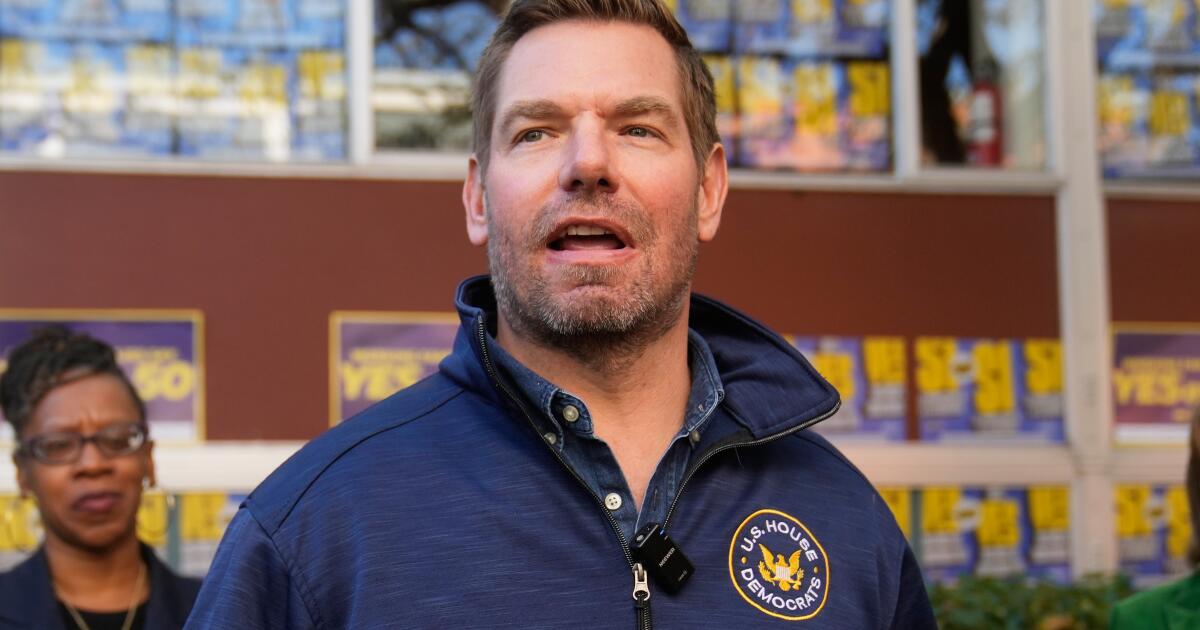
SACRAMENTO — Embattled Rep. Eric Swalwell suspended his campaign for California governor on Sunday but continued to deny accusations that he sexually assaulted a former staff member.
His campaign to succeed Gov. Gavin Newsom had all but collapsed as key Democratic supporters, including Rep. Nancy Pelosi and Sen. Adam Schiff, abandon him.
“To my family, staff, friends, and supporters, I am deeply sorry for mistakes in judgment I’ve made in my past,” Swalwell wrote Sunday on social media.
“I will fight the serious, false allegations that have been made — but that’s my fight, not a campaign’s.”
Swalwell’s gubernatorial campaign had been gaining momentum up until the scandal, with recent polls showing him in the top of the crowded Democratic field of candidates. His abrupt departure throws the race into chaos less than two months before the June 2 primary.
Two reports published Friday allege that Swalwell forced himself on a young, onetime staffer, while other women described the congressman sending them photos of his penis and sexually inappropriate messages.
Swalwell has remained defiant and threatened to sue some of those making the accusations.
House ethics rules bar members from having sex with a subordinate, and House Democratic leader Rep. Hakeem Jeffries of New York is seeking an investigation into the allegations.
More fallout could come: Rep. Anna Paulina Luna (R-Fla.) announced plans to force a House vote to expel Swalwell, a motion supported by some House Democrats, including Reps. Teresa Leger Fernández of New Mexico and Pramila Jayapal of Washington.
Rep. Jared Huffman, a Democrat representing Northern California, also called on Swalwell to resign.
NBC News reported Sunday that there was growing “bipartisan steam” to remove Swalwell, along with Rep. Tony Gonzales (R-Texas), who has admitted to having an affair with a staffer who later killed herself. The expulsions could take place as soon as this week.
At the same time, the Manhattan district attorney’s office has opened an investigation into sexual assault allegations against Swalwell by the former staffer. A representative for the Alameda County district attorney’s office on Saturday said it was in the process of evaluating “whether any alleged criminal conduct occurred” in the agency’s Bay Area jurisdiction.
A former senior advisor to Swalwell’s campaign said the congressman held a Zoom call with his staff Friday morning after reporters contacted them about allegations of sexual impropriety.
Swalwell became emotionless and “dead in the face” when asked about the allegations. He assured staff the accusations were false and asked them to “fight” for him, said the advisor, who asked not to be named so they could speak candidly.
“It’s so disconnected from reality,” the advisor said.
The advisor and others quit immediately after learning later Friday about the details of sexual assault allegations.
The 45-year-old Democratic candidate established himself as a front-runner in the governor’s race despite not having a broad base of supporters in California.
A onetime member of the House Intelligence Committee and a savvy social media user and frequent guest on cable news shows, Swalwell relished his role as a foil to President Trump, using his many platforms to attack and taunt the twice-impeached, criminally convicted president.
He previously worked as a criminal prosecutor and was elected to Congress in 2012 after he defeated Rep. Pete Stark, a fellow Democrat.
He cast himself as a centrist middle-class guy and featured his wife and three young children prominently in his campaign for governor. In an interview with The Times last year, he talked about his decision to continue in politics despite the toll on his family.
Reports in the San Francisco Chronicle and CNN offered a stark contrast to Swalwell’s wholesome image, alleging that he forced himself on a young staffer.
CNN also reported on another woman’s account of an alleged sexual encounter with Swalwell that involved fending off his advances over drinks, and then waking up in his hotel room with no memory of how she got there.
Swalwell and his team threatened legal action against several individuals, the lawmaker’s attorney Elias Dabaie confirmed to The Times.
Swalwell took to social media on Friday night and called the allegations “lies” intended to hurt him in the race.
His close friend, real estate developer Stephen Cloobeck, told The Times on Sunday that Swalwell spent part of the weekend with him at his Beverly Hills home.
“I had a very serious talk with him, and I told him how disappointed I am,” Cloobeck said, adding that the lawmaker apologized.
Cloobeck was among the many Democrats running for California governor. In November he dropped out of the race and endorsed Swalwell. Cloobeck said he had contributed about $1 million to an independent political committee backing Swalwell’s campaign, donations he now deeply regrets.
“I’m literally disgusted and disturbed that my money was taken and other people’s money,” he said.
Since the news reports, campaign staffers have resigned, his fundraising website has gone offline and even his self-described “best friend” in Congress, Sen. Ruben Gallego of Arizona, has withdrawn his endorsement.
Powerful labor groups, including the California Labor Federation, Service Employees International Union California and the California Police Chiefs Assn., withdrew their support.
That union support, along with endorsements from Schiff and other prominent California Democrats, had helped propel Swalwell’s campaign in a race devoid of a clear front-runner. The race to lead the nation’s largest state remains up for grabs, with seven prominent Democrats and two Republicans jockeying to finish in first or second place in the primary and advance to the November election.
Swalwell was among the leading Democrats with the support of 13% of likely voters in a recent UC Berkeley poll co-sponsored by the Los Angeles Times. He was tied for first place among Democrats with former Orange County Rep. Katie Porter, with billionaire Tom Steyer not far behind.
Other Democrats in the race include state Supt. of Public Instruction Tony Thurmond, former U.S. Health and Human Services Secretary Xavier Becerra, San José Mayor Matt Mahan, former Los Angeles Mayor Antonio Villaraigosa, and former state Controller Betty Yee.
The GOP gubernatorial candidates are Steve Hilton, a former Fox News commentator, and Riverside County Sheriff Chad Bianco.



Politics
Trump renews bridge, power plant threat against Iran in push for deal, mocks ‘tough guy’ IRGC

NEWYou can now listen to Fox News articles!
President Donald Trump mocked the Islamic Revolutionary Guard on Sunday morning for staking claim to a Strait of Hormuz “blockade” the U.S. military had already put in place.
“Iran recently announced that they were closing the Strait, which is strange, because our BLOCKADE has already closed it,” Trump wrote on Truth Social. “They’re helping us without knowing, and they are the ones that lose with the closed passage, $500 Million Dollars a day! The United States loses nothing.
“In fact, many Ships are headed, right now, to the U.S., Texas, Louisiana, and Alaska, to load up, compliments of the IRGC, always wanting to be ‘the tough guy!’”
Trump declared Saturday’s IRGC fire was “a total violation” of the ceasefire.
“Iran decided to fire bullets yesterday in the Strait of Hormuz — A Total Violation of our Ceasefire Agreement!” his post began.
“Many of them were aimed at a French Ship, and a Freighter from the United Kingdom. That wasn’t nice, was it? My Representatives are going to Islamabad, Pakistan — They will be there tomorrow evening, for Negotiations.”
Trump remains hopeful about diplomacy, but is not ruling out a return to force, where he once warned about ending “civilation” in Iran as they know it.
“We’re offering a very fair and reasonable DEAL, and I hope they take it because, if they don’t, the United States is going to knock out every single Power Plant, and every single Bridge, in Iran,” Trump’s stern warning continued.
“NO MORE MR. NICE GUY!
“They’ll come down fast, they’ll come down easy and, if they don’t take the DEAL, it will be my Honor to do what has to be done, which should have been done to Iran, by other Presidents, for the last 47 years. IT’S TIME FOR THE IRAN KILLING MACHINE TO END!”

Judge Troy Nunley was fed up.
Federal immigration officials had once again flouted his authority by keeping a man locked up in a California City detention center after Nunley ordered him released. When he was finally set free, the man was booted onto the street with no passport, driver’s license or other personal effects. The judge’s demand that the items be returned were met with silence.
And so on Tuesday, Nunley, the chief judge of the Eastern District of California, slapped Department of Justice attorney Jonathan Yu with an official sanction and a $250 fine.
In a scathing order, Nunley laid out why he was compelled to take such a rare step. The fine may have been less than some traffic tickets, but it’s nearly unheard for a judge to formally admonish a government lawyer.
By Yu’s own admission, he was drowning in work. In his order, Nunley recounted the attorney’s claim he’d been assigned more than 300 nearly identical cases in the last three months, all of immigrants in detention who argued they were being held without cause.
Court filings show many California cases involve longtime U.S. residents unexpectedly hauled off to jail after routine check-ins with immigration officials. One was an Afghan who’d helped the American war effort. Another a Cambodian grandmother of eight who fled Pol Pot’s killing fields as a girl nearly 50 years ago.
Until last year, most would have fought deportation on bond after a brief hearing with an immigration judge. Now, their only hope of release is to file a petition for writ of habeas corpus — a legal maneuver once typically reserved for death row inmates and suspected terrorists — inundating the country’s busiest federal courts with thousands of emergency suits.
The Trump administration attorney said he was trying to “triage” the situation, but Nunley found he repeatedly failed to comply, leaving people with the right to walk free stuck behind bars.
“The Court is not persuaded,” he wrote, issuing the sanctions.
The order came days after Nunley took the unusual step of announcing a “judicial emergency” in the district, which covers nearly half of California, stretching from the Oregon border to the Mojave Desert in the inland part of the state, including Fresno, Bakersfield and Sacramento.
In the last year, the Eastern District has received more petitions from immigration detainees than almost any other jurisdiction in the United States: More than 2,700 since January, compared to fewer than 500 last year and just 18 in 2024. Similar crises are playing out elsewhere, with federal courts in Minnesota briefly paralyzed amid the Trump administration’s enforcement blitz there last winter.
People detained are seen behind fences at an ICE detention facility in Adelanto, California on July 10, 2025.
(Patrick T. Fallon/AFP via Getty Images)
In an interview with The Times, Nunley said dealing with the surge of activity since last summer has been “like being hit over the head with a bat.”
“We’re up all night doing these cases,” he said.
So far this year, the Eastern District’s six active judges have ordered almost people 2,000 freed.
“The majority of the cases that we see are cases where people should not be detained,” Nunley said. “They should be receiving hearings to determine whether or not they are to remain in this country, and until they receive those hearings, they should be free.”
Since last July, the Department of Homeland Security has ordered that all immigrants it arrests are subject to “mandatory detention” — a policy that had previously only applied to those caught at the border.
The change came four days after President Trump signed a spending bill that earmarked $45 billion to expand the federal network of immigrant lockups.
“This has been a sea change in the way the government has read the law,” said My Khanh Ngo, a senior staff attorney at the ACLU Immigrants’ Rights Project. “Almost every judge who has looked at this has agreed these people should get bond, and yet thousands of people are still sitting in detention.”

Elizabeth Vega, 15, right, and Darlene Rumualdo, 15, from Torres High School join labor organizers, clergy leaders and immigrant rights groups to protest immigration raids nationwide at La Placita Olvera in downtown Los Angeles on January 23, 2026.
(Genaro Molina/Los Angeles Times)
Longtime U.S. residents who might once have fought removal from home — where they can more easily gather evidence to support their case and confer with lawyers — are instead being held indefinitely.
Many have no criminal record. Some have been in the U.S. so long that the countries they came from no longer exist.
“People are locked up in the same facilities as people accused of crimes, people who’ve been convicted of crimes … and then you’re telling people, you have no shot of getting out,” Ngo said. “Detaining people and not giving them the chance to get out of detention is a way of coercing people to give up their claims.”
The habeas process can take weeks or months depending on the judge and the district.
“When the immigration cases dropped on our district, we got hit harder than any other outside West Texas,” Nunley said. “Initially we had more cases than anyone else.”
Today, data compiled by ProPublica and legal activist groups including the Immigration Justice Transparency Initiative show almost a quarter of the roughly 30,000 active habeas petitions in the United States are in California courts. Nunley’s own tabulations show half the California cases are in his district, where a perfect storm of stepped-up enforcement, a large population of immigrant workers and a concentration of detention centers produced a flash flood of habeas petitions.
The cases rely on the Constitution’s guarantee of due process before being deprived of life, liberty or property. But according to court filings, in some instances the government has argued “the Fifth Amendment does not apply” to detained immigrants.
DOJ lawyers responding to the bids for freedom now regularly complain they’re being crushed under paperwork.
Judges accustomed to having government lawyers comply with their orders have been left fuming.
In California’s Central District, which includes L.A. and surrounding areas, Judge Sunshine Sykes wrote a fiery decision earlier this year that said the Trump administration is inflicting “terror against noncitizens.”
Sykes is one of several federal judges across the country that have tried to compel the government to resume bond hearings. The 9th U.S. Circuit Court of Appeals blocked that decision in March, leaving the habeas system in place for now. But with challenges or recent decisions across multiple circuits, experts say the fight is fated for the Supreme Court.
“ICE has the law and the facts on its side, and it adheres to all court decisions until it ultimately gets them shot down by the highest court in the land,” a Homeland Security spokesperson said in an email to The Times.

A woman holds a “ICE not welcome here!” sign at a vigil in San Pedro in January.
(Gina Ferazzi/Los Angeles Times)
The lawyers fighting to free those jailed under the Trump administration’s mandatory detention policy say they were not initially equipped for these legal battles because they used to be exceedingly rare.
Most federal judges had only seen a handful of habeas petitions before last summer — then suddenly they had hundreds of requests for urgent relief, according to Jean Reisz, co-director of the USC Immigration Clinic.
Reisz said there are efforts to get pro bono law groups trained on how to effectively argue habeas cases, “but it takes a while to get up to speed.”

A federal agent asks residents to move back after a shooting during an immigration enforcement operation in Willowbrook on January 21, 2026.
(Genaro Molina/Los Angeles Times)
At the same time, Reisz said, lawyers are pushing judges who oversee the cases to act swiftly, since interminable procedural delays ensure people remain incarcerated.
“Most of the habeas petitions include a motion for temporary restraining orders, and that requires emergency decisions from the courts, which requires the courts to act very fast,” Reisz said.
In California’s federal district courts, the backlog remains thousands deep. Nunley said the system is struggling to keep up with the crush of cases.
“There’s nothing that says that noncitizens should not be entitled to due process,” Nunley said. “These are our people, they reside in our district. They’re entitled to the same due process that you and I are entitled to.”

NEWYou can now listen to Fox News articles!
Secretary of State Marco Rubio announced Saturday that the Trump administration is sanctioning a senior Nicaraguan official over alleged human rights violations.
Rubio said the U.S. is designating Vice Minister of the Interior Luis Roberto Cañas Novoa for his role in “gross violations of human rights” under the government of President Daniel Ortega and Vice President Rosario Murillo, marking what he said was the latest effort to hold the regime accountable.
“The Trump administration continues to hold the Murillo-Ortega dictatorship accountable for brutal human rights violations against Nicaraguans,” Rubio said in a post on X. “I’m designating Nicaraguan Vice Minister of the Interior Luis Roberto Cañas Novoa for his role in human rights violations.”
RUBIO TESTIFIES IN TRIAL OF EX-FLORIDA CONGRESSMAN ALLEGEDLY HIRED BY MADURO GOVERNMENT TO LOBBY FOR VENEZUELA
Secretary of State Marco Rubio speaks at the State Department, April 14, 2026. The U.S. announced sanctions on a Nicaraguan official tied to alleged human rights abuses under the Ortega-Murillo government. (Andrew Harnik/Getty Images)
The designation was made under Section 7031(c), which allows the State Department to bar foreign officials and their immediate family members from entering the United States due to involvement in significant corruption or human rights abuses.
The State Department has said the Ortega-Murillo government has engaged in arbitrary arrests, torture and extrajudicial killings following mass protests that began in April 2018.
“Nearly eight years ago, the Rosario Murillo and Daniel Ortega dictatorship unleashed a brutal wave of repression against Nicaraguans who courageously stood against the regime’s increased tyranny, corruption, and abuse,” the statement reads.
The State Department said that the sanction marked the anniversary of the 2018 protests, after which more than 325 protesters were murdered in the aftermath.
A panel of U.N.-backed human rights experts previously accused Nicaragua’s government of systematic abuses “tantamount to crimes against humanity,” following an investigation into the country’s crackdown on political dissent, according to The Associated Press.
The experts said the repression intensified after mass protests in 2018 and has since expanded across large parts of society, targeting perceived opponents of the government.
TRUMP ADMIN ANNOUNCES EXPANSION OF VISA RESTRICTION POLICY IN WESTERN HEMISPHERE
Nicaragua President Daniel Ortega delivers a speech during a ceremony to mark the 199th Independence Day anniversary, in Managua, Nicaragua Sept. 15, 2020. (Nicaragua’s Presidency/Cesar Perez/Handout via Reuters)
Nicaragua’s government has rejected those findings.
The designation follows a series of recent U.S. actions targeting the Ortega-Murillo government. In February, the State Department sanctioned five senior Nicaraguan officials tied to repression, citing arbitrary detention, torture, killings and the targeting of clergy, media and civil society.
Earlier this week, the department also announced sanctions on individuals and companies linked to Nicaragua’s gold sector, including two of Ortega and Murillo’s sons, accusing the regime of using the industry to generate foreign currency, launder assets and consolidate power within the ruling family.
The State Department said the move is part of ongoing efforts to hold the Nicaraguan government accountable for its actions.
Fox News Digital reached out to the Nicaraguan government and its embassy in Washington for comment but did not immediately receive a response.
CLICK HERE TO DOWNLOAD THE FOX NEWS APP
A man waves a Nicaraguan flag during a demonstration to commemorate Nicaragua’s national Day of Peace, which is celebrated in the country on April 19, and to protest against the government of Nicaraguan President Daniel Ortega in San Jose, Costa Rica on April 16, 2023. (Jose Cordero/AFP)
The Trump administration has taken an increasingly aggressive posture in the Western Hemisphere in recent months, including a Jan. 3, 2026, operation that resulted in the capture of Venezuelan leader Nicolás Maduro and his wife, Cilia Flores.
The U.S. has also carried out a series of strikes targeting suspected drug-trafficking vessels in the region, part of a broader crackdown tied to regional security and narcotics enforcement efforts.
-

 Detroit, MI2 hours ago
Game 21: Tigers at Red Sox, Garrett Crochet battles both Detroit and the weather
-

 San Francisco, CA2 hours ago
Why do gray whales keep dying in San Francisco’s waters?
-

 Dallas, TX2 hours ago
Dallas Mavericks Owners Might Be Making Big Mistake in Search for New GM
-

 Miami, FL2 hours ago
Defense dominates, Mensah flashes in Miami’s spring game – The Miami Hurricane
-
Boston, MA2 hours ago
A crowd scientist is helping the Boston Marathon manage a growing field of 30,000-plus runners
-

 Denver, CO3 hours ago
Denver Nuggets Altitude broadcasts now being offered in Spanish for first time ever
-

 Seattle, WA3 hours ago
Need to shred? Free drive-up/ride-up shredding Wednesday at Village Green West Seattle
-

 San Diego, CA3 hours ago
Game 21: San Diego Padres at Los Angeles Angels