Politics
Supreme Court to rule on clearing homeless encampments in California and the West

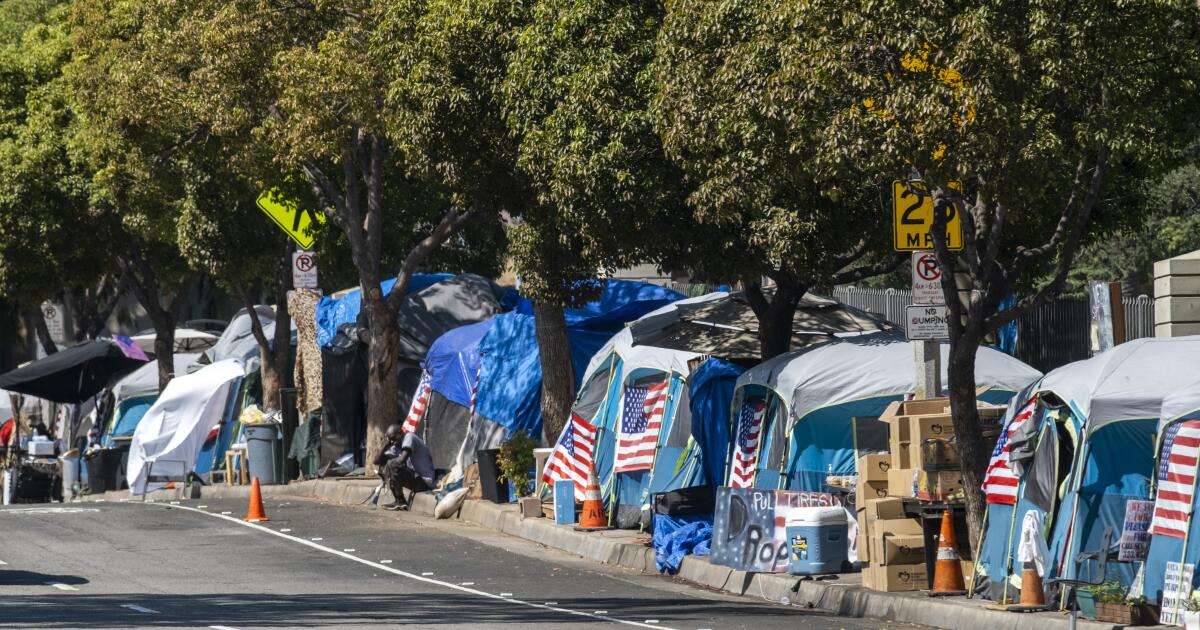
The Supreme Court agreed Friday to decide whether homeless people have a constitutional right to camp on public property when they have no other place to sleep.
Acting on appeals from city officials in California and the West, the court will review decisions of the U.S. 9th Circuit Court of Appeals, which held it was cruel and unusual punishment for cities to deny homeless people a place to sleep.
As a result of the 9th Circuit rulings, public officials in California and the eight other Western states under its jurisdiction face greater scrutiny and legal challenges when they move to clear encampments or relocate homeless people.
California Gov. Gavin Newsom and city attorneys from Los Angeles, San Francisco, San Diego and Phoenix were among two dozen government and business groups that urged the high court to restore their authority over sidewalks and parks, or at least to clarify the law.
City attorneys said it remains unclear whether encampments may be removed from sidewalks or parks if the people living on the street refuse an offer to move into temporary shelter.
They blame the 9th Circuit rulings — in cases from Boise, Idaho and Grants Pass, Ore. — for the worsening homelessness crisis in West Coast states. California alone is “home to half of the nation’s unsheltered population,” they said in their appeal in Grants Pass vs. Johnson.
The court said it would hear arguments in the case in April and issue a ruling by the end of June.
Newsom welcomed the court’s decision to hear the case.
“California has invested billions to address homelessness, but rulings from the bench have tied the hands of state and local governments to address this issue,” he said. “The Supreme Court can now correct course and end the costly delays from lawsuits that have plagued our efforts to clear encampments and deliver services to those in need.”
Theane Evangelis, the Los Angeles attorney who represents the city of Grants Pass, said she hopes the high court will agree the 9th Circuit’s rulings “are legally wrong and have tied the hands of local governments as they work to address the urgent homelessness crisis.”
But an Oregon attorney who sued on behalf of several homeless people in Grants Pass argued that cities have not been denied all authority to regulate encampments.
“The issue before the court is whether cities can punish homeless residents simply for existing without access to shelter,” said Ed Johnson, director of litigation at the Oregon Law Center. “Nevertheless, some politicians and others are cynically and falsely blaming the judiciary for the homelessness crisis to distract the public and deflect blame for years of failed policies.”
In the past, the 8th Amendment’s bar against inflicting “cruel and unusual punishments” has been applied by the Supreme Court to limit how the government deals with those convicted of crimes.
Advocates for the homeless point to a 1962 ruling that limited what can be considered a crime.
In Robinson vs. California, the Supreme Court struck down part of a California law that made it a crime to be addicted to narcotics. Lawrence Robinson had been arrested by Los Angeles police officers, who said his arm was discolored by “numerous needle marks.” He was tried, convicted and sentenced to 90 days in jail.
The Supreme Court later reversed his conviction and ruled it was cruel and unusual to punish someone, not for using or selling drugs, but for the “illness” of “narcotics addiction.”
In 2006, that ruling was cited by 9th Circuit judges to strike down a Los Angeles sidewalk ordinance that authorized police to arrest people who “lie or sleep” on the streets. The three-judge panel said homeless people were being punished simply because they had nowhere to sleep.
Rather than appeal to the Supreme Court, the city settled the case and agreed not to enforce its ordinance during overnight hours.
The 9th Circuit issued a broader ruling in 2018 that struck down ordinances in Boise, Idaho, that authorized police to arrest or fine people who were sleeping or camping on public property.
The judges said the Supreme Court’s Robinson decision established the “principle that the 8th Amendment prohibits the state from punishing an involuntary act or condition if it is the unavoidable consequence of one’s status or being.”
Grants Pass, a city of 38,000 people in southern Oregon, was estimated to have between 50 and 600 people who were homeless. In response to a suit by homeless advocates, a federal judge and 9th Circuit panel struck down its anti-camping ordinance because the city did not have “adequate shelter” for all of them.
“We affirm the district court’s ruling that the city of Grants Pass cannot, consistent with the 8th Amendment, enforce its anti-camping ordinances against homeless persons for the mere act of sleeping outside with rudimentary protection from the elements, or for sleeping in their car at night, when there is no other place in the city for them to go,” said Judge Roslyn Silver, who wrote the lower court opinion.
When the court’s conservatives moved to have the full 9th Circuit reconsider that ruling, they fell short by a 14-13 vote.
In their appeal to the Supreme Court, lawyers for the city emphasized the practical problems of homelessness.
“Across the West,” they said, “hundreds of thousands of people camp in public, their tents and belongings overtaking sidewalks, parks, and trails. Cities want to help those in encampments get the services they need while ensuring that our communities remain safe, but they find themselves hamstrung in responding to public encampments and the drug overdoses, murders, sexual assaults, diseases, and fires that inevitably accompany them.”
The closest the Supreme Court has come to ruling on the issue came in 1982. A group called the Community for Creative Non-Violence sought a permit for a demonstration in Lafayette Square across the street from the White House.
Their request included a “symbolic tent city” where about 50 people would sleep.
The Park Service approved the permit to demonstrate, but refused the request for sleeping in the park. The advocates sued, contending the ban on camping violated the 1st Amendment’s protection for free speech. They lost before a federal judge, won in the U.S. appeals court and finally lost 7 to 2 in the Supreme Court in 1984.
Writing for the court, Justice Byron White said the 1st Amendment permits reasonable limits on the “time, place and manner” of demonstrations. “We have very little trouble concluding that the Park Service may prohibit overnight sleeping in the parks involved here,” he wrote.



NEWYou can now listen to Fox News articles!
Rep. Tony Gonzales, R-Texas, abruptly announced his decision to resign from Congress Monday evening amid calls for him to step aside after admitting to sexual misconduct with a staffer earlier this year.
The embattled lawmaker was facing an anticipated expulsion vote that could have occurred as early as this week.
“There is a season for everything and God has a plan for us all. When Congress returns tomorrow, I will file my retirement from office,” Gonzales wrote on social media. “It has been my privilege to serve the great people of Texas.”
It is currently unclear when Gonzales will formally resign. A spokesperson for Gonzales did not immediately respond to a request for comment.
His announcement came just an hour after Rep. Eric Swalwell, D-Calif., said he planned to resign after facing allegations of sexual misconduct and rape.
This is a developing story. Check back for updates.
Politics
Commentary: Trump says in his social media post he was a doctor, not Jesus. A Catholic school alum weighs in
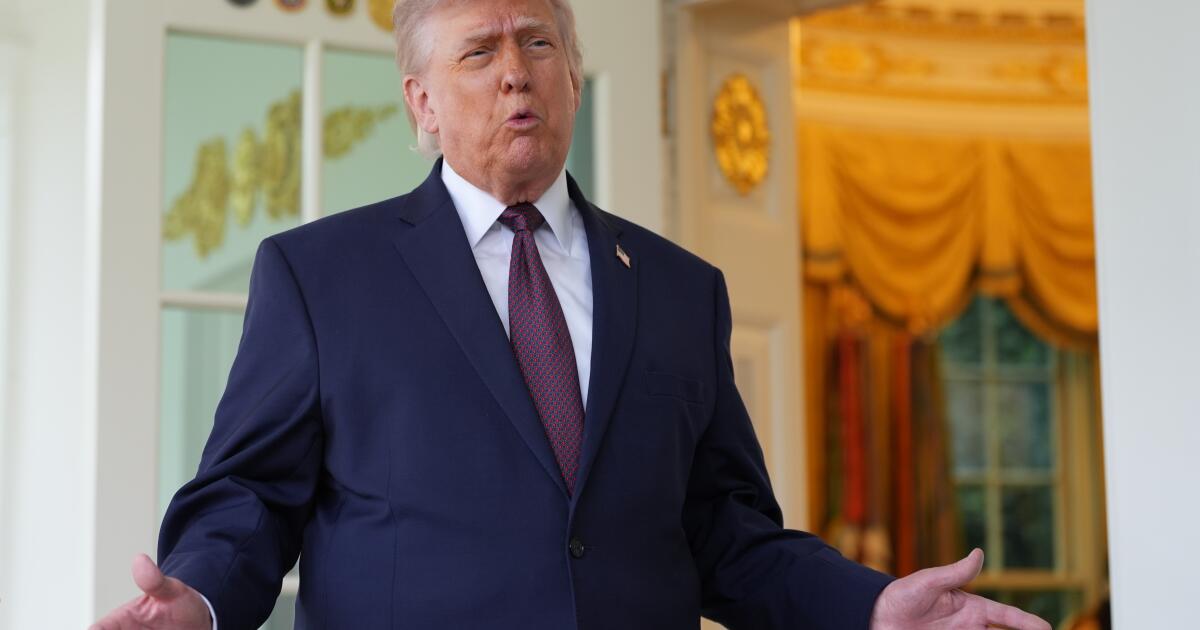
The general consensus is that President Trump’s social media post of himself dressed in robes, after a busy weekend in which he blasted Pope Leo and attended a prizefight while an Iran peace plan fell apart, was an attempt to cast himself as a Jesus-like figure.
But Trump says we have it wrong.
“It’s supposed to be me as a doctor, making people better,” he said.
As a graduate of St. Peter Martyr grade school in the San Francisco East Bay area, and as someone who has seen a lot of doctors for various ailments, I feel uniquely qualified to weigh in.
In Catholic school, holy cards are a big deal. You’ve seen a couple hundred of them by the time you hit second or third grade, so you become familiar with the muted ethereal glow, the heavenly gaze and the look of piety. A standard feature is the halo, a clearly defined sphere that sits like a buttered bonnet on the head of the saint.
Let the record show that in his post on his very own Truth Social, which is not always truthful, Trump does not have a halo.
So in total fairness, it’s possible the president was not lying when he said he was supposed to be a doctor.
On the other hand, having seen a good number of cardiologists and surgeons and orthopedic specialists, I don’t recall any doctors who wore flowing robes while bathed in heavenly light, with a flock of eagles coming out of their ears and a team of Navy SEALs busting through the hospital ceiling.
And then there’s the fireball emanating from Trump’s right hand. All of which poses the question: If Trump thinks this is what a doctor looks like, what ailment is he being treated for, and shouldn’t the public be advised?
There’s also the question of creation — not of human life but of the very existence of a social media post like this from the president of the United States in wartime. It was described as an AI-generated image, but who was at the computer?
Did the president sit down at the end of a long day and churn out an image of himself playing doctor, if not Jesus Christ? Or does he have a team of staffers who do this sort of thing, and if so, how could Elon Musk have missed them when he said the government was bloated and set out to fire half the federal workforce?
You’d at least hope the president would have the courage of his convictions. But as criticism of his post mounted, Trump deleted it Monday morning.
I think he should have stuck with the story — he was portraying himself as a doctor because he’s a healer. The next day, he could have been in a New York Jets uniform and told us he’s a quarterback. Then he could have released an image of himself in the Artemis space capsule and told us he’s an astronaut and he’s thinking of building a string of Trump hotels on the moon. Ask yourself this: Would anyone have been surprised?
A guy who only knows how to go for broke, and always doubles down when things go wrong, has to stick to his guns or the whole shtick unravels. I’d have respected Trump more if he had traipsed around the White House with a stethoscope for a week or two, or maybe performed brain surgery on Pete Hegseth, just to see what’s going on in there.
What’s going on in Trump’s head, if I might volunteer a bit of armchair psychoanalysis, is that failure triggers a sense of grandeur rather than humility.
Things are not going well at the moment, so he’s lashing out. The prices of things were supposed to come down on Day One, but thanks to his upheaval of the world economy, prices went up, and now they’re soaring because he helped start a war that made no sense.
A war that has been criticized by Pope Leo, who has pointed out that while the Trump administration has ascribed a religious imperative to the assault on Iran, and Trump promised to blow the country all the way back to the “Stone Ages,” Jesus would probably not be on board.
Trump, who said last year that he wants to “try and get to heaven, if possible,” now realizes he’s not going to get an endorsement from the pontiff.
And so the man who once issued a national call to prayer, said the Bible was his favorite book, joked after the death of Pope Francis that he wanted to be the next pontiff, and has now issued his own holy card, has attacked Pope Leo for being too liberal as well as “weak on crime and terrible for foreign policy.” He has, in effect, anointed himself as holier than the pope himself.
Even staunch supporters of Trump have worked themselves into a lather over this. They’re lashing out at Trump, as if his criticism of the pope and depiction of himself as Jesus Christ are shocking.
My fellow Americans, certain words have been rendered meaningless in describing the current state of affairs. Among them are shocking, surreal, unbelievable, unprecedented and unexpected.
If indeed Trump thinks he’s Jesus, let his penance begin with 100 Our Fathers, 500 Hail Marys and 1,000 Acts of Contrition.
If indeed he thinks he’s a doctor:
Physician, heal thyself.
steve.lopez@latimes.com

new video loaded: Eric Swalwell Suspends Campaign for California Governor
transcript
transcript
Eric Swalwell Suspends Campaign for California Governor
In a social media post, Representative Eric Swalwell announced that he was suspending his campaign for California governor after two news outlets published accusations of sexual assault and misconduct against him.
-
I do not suggest to you in any way that I’m perfect or that I’m a saint. I have certainly made mistakes in judgment in my past, but those mistakes are between me and my wife, and to her, I apologize deeply for putting her in this position. I also apologize to you if in any way you have doubted your support for me.
By Monika Cvorak
April 13, 2026

ATVs and dirt bikes roar down Delaware Ave., lawmakers search for solutions

Florida teenager charged with sexually assaulting and killing stepsister Anna Kepner on cruise ship

Georgia man charged with trafficking 17-year-old girl for sex in McDuffie County, AG says

Man, 26, dies after jumping off cliff at ‘End of the World’ | Honolulu Star-Advertiser

IDFG brings early-season fishing to Southwest Idaho community ponds

Florida High School Football Rankings: Top 25 teams – Oct. 21

How old is Bo Nix? What to know about Oregon quarterback ahead of 2024 NFL Draft

Cleary's 21 help Le Moyne down Central Connecticut State 69-64 in OT

99th annual Pony Swim held in Virginia

Indiana Members Credit Union announced as new anchor tenant at Bottleworks District

Embattled Rep Tony Gonzales announces plans to resign amid sexual misconduct allegations

UN experts slam attacks on Gaza shelters, forced displacement in West Bank

DOJ fires at least 4 prosecutors involved in FACE Act cases during Biden administration

Melania Trump’s Epstein remarks turn up the heat on DOJ, Acting AG Todd Blanche to do more
Newsletter: Cautious optimism in Brussels as Orbán ousted in landslide Hungarian opposition win
-

 Atlanta, GA1 week ago
1 teenage girl killed, another injured in shooting at Piedmont Park, police say
-

 Georgia7 days ago
Georgia House Special Runoff Election 2026 Live Results
-

 Arkansas4 days ago
Arkansas TV meteorologist Melinda Mayo retires after nearly four decades on air
-

 Pennsylvania1 week ago
Parents charged after toddler injured by wolf at Pennsylvania zoo
-
 Milwaukee, WI1 week ago
Potawatomi Casino Hotel evacuated after fire breaks out in rooftop HVAC system
-

 Technology1 week ago
Anthropic essentially bans OpenClaw from Claude by making subscribers pay extra
-

 Austin, TX6 days ago
ABC Kite Fest Returns to Austin for Annual Celebration – Austin Today
-

 World1 week ago
Zelenskyy warns US-Iran war could divert critical aid from Ukraine