Politics
Schiff takes narrow lead in Senate race; tight contest for second, new poll shows

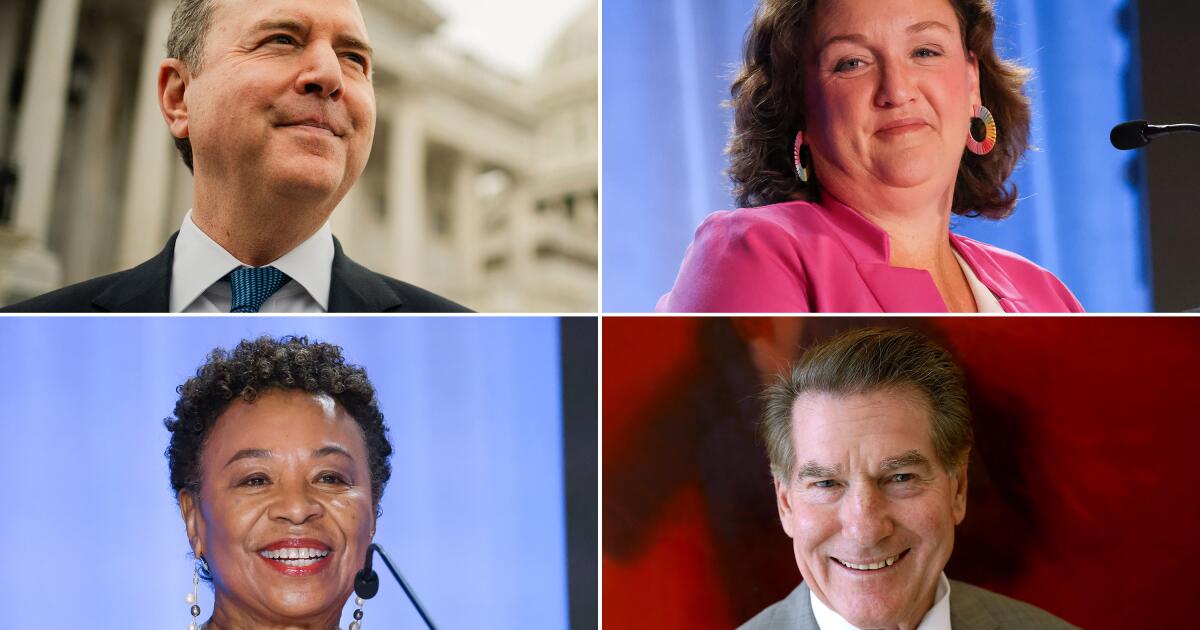
The fight for second place in California’s U.S. Senate race between Rep. Katie Porter and former Dodgers star Steve Garvey appears volatile as the March 5 primary approaches, according to the latest UC Berkeley Institute of Governmental Studies poll co-sponsored by The Times.
Democratic Rep. Adam B. Schiff of Burbank leads the field by 4 percentage points in a race that thus far has lacked much sizzle, though that could change now that the candidates have launched political ad campaigns and are set to clash in a trio of televised debates over the next two months.
According to the survey, Porter (D-Irvine) trails slightly behind Schiff and holds a narrow lead for second place over Garvey, the top Republican in the race.
Schiff is backed by 21% of likely voters, compared with 17% supporting Porter and 13% for Garvey. Schiff and Porter were essentially tied in Berkeley’s poll in October.
The other top Democrat in the race, Rep. Barbara Lee of Oakland, was supported by 9% of likely voters, the poll found. About a fifth of the voters surveyed picked one of the 23 other candidates on the crowded ballot, and the remainder said they were undecided
The top two vote-getters, regardless of party and share of the vote, will compete against each other in November. Given the Democrats’ huge registration advantage in the state, if Garvey advanced to the general election he’d be at a sizable disadvantage.
The poll also showed how divisions among voters over the war between Israel and Hamas in Gaza are having an effect on the contest.
Voters will be asked to vote on two separate Senate elections on the March ballot — one for the full six-year Senate term starting in January and the other for the remaining months of the term of the late Sen. Dianne Feinstein.
In that second race, only seven candidates are listed, and the poll found tighter margins. Schiff still leads among likely voters with 21% support. Porter has 18%, Garvey has 17%, Lee has 12% and Republican Eric Early has 11%.
The contrast between the two races shows that when the number of candidates — particularly Republicans — consolidates, Garvey’s support grows, said Mark DiCamillo, director of the Institute of Governmental Studies poll and a longtime California pollster.
That offers evidence that Garvey has the opportunity to finish in the top two in the March primary and qualify for the November general election, rather than having two Democrats meeting in the fall, DiCamillo said.
“The open question really is who’s going to be second, and our poll is showing Katie Porter still ahead of Garvey, although there has been movement toward Garvey in each of our polls,” he said.
“There’s an opportunity for him to coalesce the Republican votes to come his way, certainly. I think the debate will help in that regard.”
Garvey’s support has nearly doubled since Berkeley’s poll in August, while Porter’s numbers have remained about the same.
The poll found that of the four top candidates, Schiff and Porter were the only candidates whom a majority of likely voters knew enough about to have an impression. Schiff, a ubiquitous guest on cable news shows, captured the national spotlight when he led the first impeachment trial of then-President Trump.
About 43% of likely voters had a favorable view and 31% an unfavorable view of Schiff. He’s popular among Democrats (67% have a favorable view) and unpopular among Republicans (68% have an unfavorable view).
Porter is less well known but still popular, with 39% of likely voters saying they had a favorable impression of her. Just 16% said they had an unfavorable impression of her. The rest (45%) had no opinion.
Garvey, who officially entered the race in October, wants to leverage his fame among older sports fans. The 75-year-old played for the Dodgers and the San Diego Padres, but he hasn’t taken the field since the 1980s. He’s viewed favorably among 24% of likely voters and unfavorably by 21%.The rest had no opinion of him.
Schiff’s small lead is fueled in part by his ability over the last few months to increase his backing in voter-rich Los Angeles County. In the October poll, Porter led by 4 percentage points on Schiff’s turf (22%-18%); now he is up by the same margin in the county (23%-19%). Schiff also leads by large margins in the Bay Area, Central Valley and Sacramento regions.
Porter is up by 12 percentage points (24%-12%) at home in Orange County, while the two are essentially tied in the Inland Empire and the San Diego region.
The most potent political issue of the moment — the Israel-Hamas war— shows the very different coalitions backing each of the major candidates. Schiff has been a vocal backer of Israel and President Biden’s strategy in the region. Both Schiff and Garvey say that the United States should continue military aid to Israel.
Both Lee and Porter back a cease-fire. Lee opposes providing further military aid to Israel, and Porter has called for a “robust discussion” about military assistance.
Schiff supporters were far more likely to approve of Biden’s response to the war than Garvey or Lee supporters. Porter backers were split down the middle about how they felt about Biden’s diplomatic response in the aftermath of Hamas’ Oct. 7 massacre in Israel.
About 8 in 10 supporters of Garvey were more sympathetic to Israel than the Palestinians, while Lee backers are sympathetic to the Palestinians by more than 2 to 1.
About half of Schiff supporters and 40% of Porter backers said they were equally sympathetic to both sides of the conflict.
The coalitions supporting each candidate have shifted slightly in recent months.
Porter still garners the most support from voters under 50 and those who identify as strongly liberal. Schiff is ahead with voters 65 and older and those who identify as somewhat liberal. Schiff and Porter had been essentially tied in October among voters who identify as Democrats. Now Schiff leads by 10 percentage points among that very large voting bloc.
Lee, who is one of three Black members of Congress from California, had been leading among Black voters statewide but now is essentially tied with Schiff — who leads with Asian American/Pacific Islander voters and white voters. Schiff and Porter are essentially tied among Latino voters.
One remaining big unknown is how voters respond to the barrage of television advertising that is about to start in the state.
It’s hard to assess the true political strength of any candidate in California until they start running TV ads, said Republican strategist Mike Murphy, who worked on Gov. Arnold Schwarzenegger’s campaign team.
Porter is “starting her TV imminently. Schiff will be right behind her by a few days. He’ll probably have more, but she’s got more charisma. So there’s a little more rocket fuel there if she catches on,” Murphy said.
“The Democratic campaigns are obsessed with Garvey. That’s not because they care about [Garvey winning in] November. If he comes in second, Schiff just won the lottery.”
Both Porter and Schiff have begun or will begin airing ads on cable and broadcast television in Bay Area-San Jose and Oakland markets this week.
Schiff’s ad focuses on some of his accomplishments in Congress. Porter’s ad is focused on how she plans “to shake up the Senate” by banning earmarks, abolishing the filibuster and prohibiting senators from trading individual stocks, among other proposals.
A Schiff spokeswoman said the campaign put “over $700,000” into its ad, while the Porter campaign told the San Francisco Chronicle it made a “seven-figure ad buy.”
Schiff has a significant financial advantage over his competitors. Last week his campaign revealed that it had $35 million on hand after the last fundraising quarter, as of the end of the year.
Porter had about about $12 million on hand through the end of September, according to campaign disclosures. Lee was further behind with $1.3 million through September, filings show.
The Berkeley IGS poll surveyed 4,470 registered California voters considered likely to participate in the March primary. The poll was conducted online in English and Spanish on Jan. 4-8.
The results were weighted to match census and voter registration benchmarks, so estimates of the margin of error may be imprecise; however, the results for the likely voter sample have an estimated margin of error of 2 percentage points in either direction.



Politics
Dem senators dodge crucial question on illegal alien accused of killing Chicago college student

NEWYou can now listen to Fox News articles!
While Republican senators, like Texas’ Ted Cruz and Florida’s Rick Scott, were quick to condemn the policies that kept the illegal immigrant killer of 18-year-old Sheridan Gorman from being deported, Democratic senators dodged questions on whether Gorman’s killer should have previously been deported prior to this month’s murder.
Gorman, who was a student at Loyola University of Chicago at the time of her death, was allegedly killed by an illegal immigrant from Venezuela, Jose Medina, 25. Medina was apprehended by U.S. Border Patrol on May 9, 2023, but was subsequently released into the U.S. under the Biden administration, according to Trump’s Department of Homeland Security.
A short time later, Medina was arrested for shoplifting in Chicago, but was again released on June 19, 2023, DHS said. A judge put a warrant out on Medina after he failed to appear in court for his shoplifting charge, which was still active at the time of Gorman’s killing, according to the Chicago Sun Times.
“Shoplifting in and of itself is not a violent crime. It’s not an indicator of a person that’s leaning toward violent crime,” said Sen. Dick Durbin, D-Ill., when asked about Medina’s case and whether he should’ve been deported prior to Gorman’s murder.
ILLEGAL IMMIGRANT ACCUSED OF KILLING CHICAGO COLLEGE STUDENT TO FACE COURT AFTER TUBERCULOSIS DELAY
Sheridan Gorman (L) was allegedly murdered by Jose Medina (R) (Sheridan Gorman/Instagram and Cook County Sheriff’s Office)
“You’re asking me to speculate on a bunch of things and I can’t answer that,” said Sen. Catherine Cortez-Masto, D-Nev., when asked if Gorman’s killer, and other illegal immigrant murderers who had significant criminal records at the time of their arrests, should have been deported before people got hurt. “I don’t know the cases. I trust our justice system to do the right thing and hold people accountable.”
Sen. Tammy Duckworth, D-Ill., responded that the Trump administration’s broad deportation crackdowns have prevented federal law enforcement from targeting genuinely dangerous people, an argument pushed by other top Democrats in Congress. “I think that if Trump cleared out Chicago and if ICE did their job, he wouldn’t be here, right?” Duckworth said as she got onto an elevator on Capitol Hill. “But they deported people who are not… [unintelligible].”
Meanwhile, Sen. Elissa Slotkin, D-Mich., offered a more judicious response, but also suggested the style by which the Trump administration is deporting people is problematic.
“Do I think violent criminals should be deported? Yes,” Slotkin said, adding it is an “easy” call to deport someone who has been “accused and properly prosecuted.” But, Slotkin added, “Innocent civilians who are protesting their government and using their freedom of speech should not be fingered and booted out.”
Democrats who spoke with Fox News Digital did quickly agree that violent criminals who entered and are residing in the country unlawfully should be deported.
From left to right: Sen. Elissa Slotkin, D-Mich., Sen. Dick Durbin, D-Ill., Sen. Tammy Duckworth, D-Ill., and Sen. Catherine Cortez Masto, D-Nev. (Getty Images)
SHERIDAN GORMAN’S UNIVERSITY NEWSPAPER TOUTS ICE TRACKER AFTER FRESHMAN ALLEGEDLY MURDERED BY ILLEGAL ALIEN
“Anybody who violates, or creates crime in this country – particularly kills somebody – should not only be held accountable in the United States, but, yes, there should be immigration enforcement against that individual,” Cortez-Masto said.
“Every community deserves to feel safe, and I think people who commit violent crimes should not be allowed to either be in our country, or to be among our communities,” added Sen. Angela Alsobrooks, D-Md.
Durbin, meanwhile, qualified his comments about Medina’s shoplifting charge by admitting “We ought to do a careful examination of people coming into this country and those who want to stay in this country,” adding that, “If they are dangerous to the community, they need to be denied entry or taken out of the country later.”
But Republican Senators Cruz and Scott were quick to bash Democrats for allegedly caring more about illegal immigrants than American citizens.
Sen. Ted Cruz (R-TX) holds a press conference with families who lost loved ones in the January 29, 2025 DCA plane crash on December 15, 2025 at the U.S. Capitol in Washington, DC. (Heather Diehl/Getty Images)
CLICK HERE TO DOWNLOAD THE FOX NEWS APP
“It’s tragic and it was avoidable,” Cruz said when approached about Gorman’s death and Medina not being deported. “The Democrats are so radical they prioritize illegal immigrants over American citizens.”
“It’s disgusting that these people say, ‘Oh, they act like they care about Americans.’ But then you look at their actions – they care about people who are here violently hurting Americans,” Scott complained.
Politics
DHS attorney said agents in Los Angeles should have ‘started hitting’ protesters, emails show
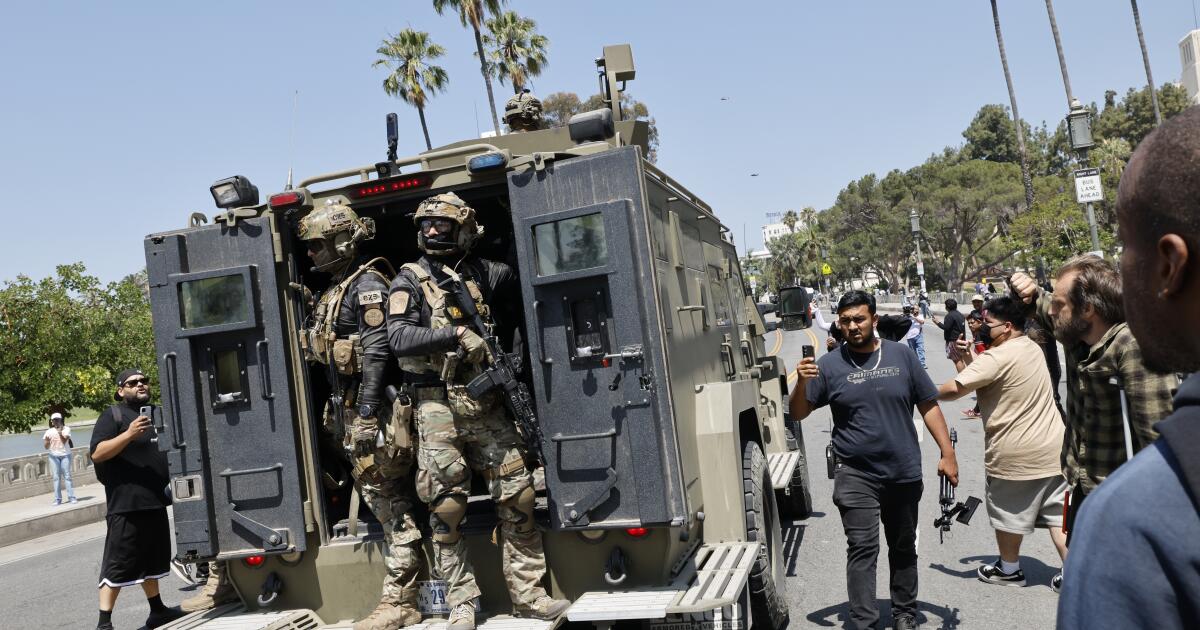
WASHINGTON — A lead attorney for the Department of Homeland Security suggested that federal agents should have “just started hitting the rioters and arresting everyone that couldn’t get away” during an anti-ICE protest in Los Angeles last June, internal emails show.
The note was in an email chain obtained by the nonprofit watchdog group American Oversight through the Freedom of Information Act and shared exclusively with The Times.
In it, attorneys for Homeland Security appear to be discussing the June 9 lawsuit filed by California Gov. Gavin Newsom over President Trump’s deployment of thousands of California National Guard troops to Los Angeles.
Under the subject line “California DOD Lawsuit,” officials coordinated legal filings defending the Trump administration and included a draft declaration by the Los Angeles field office director of Immigration and Customs Enforcement supporting the deployment of military forces.
The final email in the thread was from Joseph Mazzara, then-acting DHS general counsel, and he appears to be referring to an incident in which protesters tried to breach a protective line at a federal building.
On June 11, he wrote: “Every time I read about the battering ram incident I’m just floored at how wild that is.”
Referring to law enforcement as “they,” he continued: “They should have, when they brought the line in, just started hitting the rioters and arresting everyone that couldn’t get away from them. No one likes being hit by a stick, and people tend to run when that starts happening in earnest.”
The Department of Homeland Security didn’t respond to requests for comment.
Mazzara was later appointed deputy commissioner of U.S. Customs and Border Protection.
Politico reported that Mazzara is among 10 staffers who followed former Homeland Security Secretary Kristi Noem to the State Department after she was fired this month from DHS and given a new role as special envoy for the Shield of the Americas.
The battering ram incident Mazzara referred to is detailed in court documents for the lawsuit.
A June 19 order from a panel judges from the 9th Circuit Court of Appeals states that Trump administration attorneys presented evidence of protesters interfering with federal officers. The protesters threw objects at ICE vehicles, “pinned down” several Federal Protective Service officers and threw “concrete chunks, bottles of liquid, and other objects,” the order said.
Protesters also “used ‘large rolling commercial dumpsters as a battering ram’ in an attempt to breach the parking garage of a federal building,” the order states.
Mazzara’s comment in the email thread with other Homeland Security attorneys was given to American Oversight with a watermark showing the agency had intended to withhold it. American Oversight also received a version of the documents with that statement redacted.
Chioma Chukwu, executive director of American Oversight, said it’s no wonder the administration wanted to keep Mazzara’s comments hidden.
“They reveal a level of hostility toward protesters that is deeply at odds with the government’s obligation to protect civil liberties — and there’s no FOIA exemption that justifies hiding them,” she said.
Kerry Doyle, the former top ICE attorney during the Biden administration, said Mazzara’s comments show a shocking carelessness about the potential for harm against both the general public and the officers he was employed to protect.
The email, she said, “seems to encourage, or, at the very least, support constitutional violations by the operators that are supposed to be getting legal counsel from him to avoid violating the law.” Plus, commenting on operational strategy is outside the scope of his responsibilities, she said.
“He’s doing a disservice to the people that are on the front line, that rely on him and his colleagues to give them the parameters of what they can and can’t do,” Doyle added. “If you give them bad legal advice, you are setting them up for liability.”
Noem’s removal came amid backlash against an escalation of violence during Trump’s crackdown on immigration, including the shooting deaths of U.S. citizen protesters by immigration agents.
Doyle said part of the secretary’s job is to set the tone for the agency so the rank and file know what is expected of them. Mazzara’s comments, she said, show how that tone has permeated all facets of the agency.
After the U.S. Supreme Court cast doubt on the Trump administration’s legal theory for using troops in domestic law enforcement operations, the president in December began removing the National Guard from Los Angeles and other Democratic-led cities.
The protests last summer caused significant property damage in a small section of downtown Los Angeles. But grand juries refused to indict many demonstrators accused by federal prosecutors of attacking agents, and a Times review of alleged assaults found that most incidents resulted in no injuries.
Politics
WATCH: Senate hearing goes silent after Angel Father confronts top Dem over daughter’s death

NEWYou can now listen to Fox News articles!
A Senate hearing got tense and quiet after Illinois father Joe Abraham confronted retiring Sen. Dick Durbin, D-Ill., for not acknowledging his daughter, Katie, who was killed by an illegal immigrant drunk driver.
After Sen. Ted Cruz, R-Texas, expressed his condolences to Abraham, the grieving father thanked him and then proceeded to drill into Durbin.
“I appreciate it. I also appreciate Ranking Member Welch and Mr. Padilla for recognizing that. What I don’t understand is why my senator of Illinois, Mr. Durbin, [I] haven’t heard two words from him toward me,” he said, pointing in Durbin’s direction.
“It’s kind of amazing,” Abraham added.
ILLEGAL IMMIGRANT ACCUSED OF KILLING CHICAGO COLLEGE STUDENT TO FACE COURT AFTER TUBERCULOSIS DELAY
Sen. Dick Durbin, D-Il., (left) was confronted by Angel father Joe Abraham (right) over the killing of his daughter, Katie, by an illegal immigrant. (Demetrius Freeman/The Washington Post via Getty Images; U.S. Senate Committee on the Judiciary official website livestream)
In the suddenly quiet hearing chamber, Cruz said, “I think it is a fair question to ask.” Abraham answered, “Kind of happy he’s calling it quits.”
After the tense exchange, Abraham again called out Durbin, writing, “You had the chance to show basic humanity, to acknowledge Katie’s life and death, as other senators in your own party did. Instead, silence. Not a call, not a statement, not even basic human acknowledgment.”
Abraham stated that “silence in the face of tragedy isn’t neutrality. It’s indifference.”
“You’re retiring, but for many of us, that comes 30 years too late. And whoever you choose to endorse should be rejected just as quickly, because Illinois cannot afford more of the same,” he added, writing, “Illinois families deserve better than leaders who look away when the consequences don’t fit their narrative.”
He also criticized Durbin for supporting sanctuary policies, saying, “My daughter died in a system shaped by policies you continue to defend.”
“You chose sanctuary policies that give special privileges to those here illegally, while law-abiding Illinois citizens like my family are left unprotected,” wrote Abraham. “That’s not compassion. That’s a failure of leadership.”
COLLEGE STUDENT’S ALLEGED MURDER BY ILLEGAL WENT EXACTLY AS DEMS ‘INTENDED,’ HOUSE SPEAKER SAYS
Katie Abraham was killed by an illegal immigrant drunk driver. (Joe Abraham )
Abraham’s 20-year-old daughter, Katie Abraham, was killed by an illegal immigrant in a drunk-driving incident while standing at a stoplight in the college town of Urbana, Illinois. The federal government’s immigration crackdown in the Chicago area was launched in Katie’s honor. Dubbed “Operation Midway Blitz,” the effort resulted in more than 4,500 illegal immigrant arrests, according to DHS.
In an interview with Fox News Digital, Abraham, a lifelong Illinois resident, described his family as navigating a “dark wilderness” in the wake of Katie’s death.
“We have been in a dark wilderness, wandering, trying to find our new purpose … without Katie, who we thought would be with us the rest of our lives,” he said.
ANGEL PARENTS SLAM ILLINOIS SANCTUARY LAWS AFTER ‘PREVENTABLE’ TRAGEDY IN STUDENT’S DEATH
Joe Abraham holds a photograph of himself with his 20-year-old daughter, Katie Abraham, at his family’s home in Glenview, Illinois, on Sept. 10, 2025. (Stacey Wescott/Chicago Tribune/Tribune News Service via Getty Images)
“She was a beautiful soul,” he added, lamenting, “We thought we’d have our children the rest of our lives.”
CLICK HERE TO DOWNLOAD THE FOX NEWS APP
Addressing other Illinoisans, Abraham warned, “If anything, God forbid, happens to you, your state under this regime will turn its back on you, 100%.”
“That’s what they’ve done with us and Katie,” he said.

Video: Humpback Whale Stranded Off German Coast Is Freed by Rescuers

‘The Madison’ adds to Taylor Sheridan’s ‘Yellowstone’ legacy — ‘Marshals’ not so much

Bluetti’s Sora 500 solar panel is incredibly powerful for its size

Russian man who assaulted woman during Barron Trump FaceTime call sentenced to 4 years

Dem senators dodge crucial question on illegal alien accused of killing Chicago college student

Florida High School Football Rankings: Top 25 teams – Oct. 21

How old is Bo Nix? What to know about Oregon quarterback ahead of 2024 NFL Draft

Cleary's 21 help Le Moyne down Central Connecticut State 69-64 in OT

99th annual Pony Swim held in Virginia

Indiana Members Credit Union announced as new anchor tenant at Bottleworks District
Dem senators dodge crucial question on illegal alien accused of killing Chicago college student

EU Parliament unblocks key political hurdle in digital euro talks

Man arrested in plot to firebomb Palestinian activist’s home after undercover op

WATCH: Senate hearing goes silent after Angel Father confronts top Dem over daughter’s death

US diplomat Marco Rubio denounces settler violence, tolls in Hormuz strait
-

 Detroit, MI1 week ago
Drummer Brian Pastoria, longtime Detroit music advocate, dies at 68
-

 Movie Reviews1 week ago
‘Youth’ Twitter review: Ken Karunaas impresses audiences; Suraj Venjaramoodu adds charm; music wins praise | – The Times of India
-

 Sports7 days ago
IOC addresses execution of 19-year-old Iranian wrestler Saleh Mohammadi
-

 New Mexico5 days ago
Clovis shooting leaves one dead, four injured
-
 Business1 week ago
Disney’s new CEO says his focus is on storytelling and creativity
-

 Technology6 days ago
YouTube job scam text: How to spot it fast
-

 Tennessee4 days ago
Tennessee Police Investigating Alleged Assault Involving ‘Reacher’ Star Alan Ritchson
-

 Texas1 week ago
How to buy Houston vs. Texas A&M 2026 March Madness tickets