Politics
Rebecca Kutler wants to spin MS NOW into the post-cable future

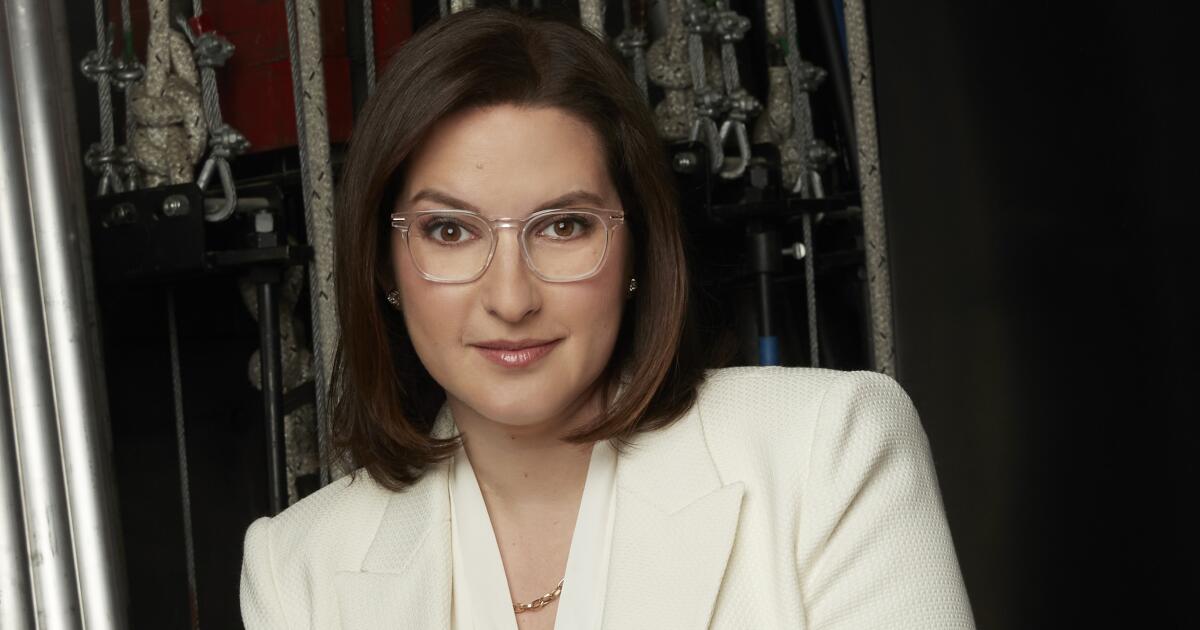
One year ago, Rebecca Kutler was promoted to president of the cable news network then known as MSNBC.
Taking the helm at a major news organization is the pinnacle of a journalist’s career. But a lot changed after Kutler landed the job.
In August, MSNBC announced it was dropping its name of nearly 30 years to become MS NOW — as its now-former owner NBCUniversal wanted a clean break from the channel, which was spun off to be part of a new media company called Versant.
The spin-off, which NBCU parent Comcast initiated because its cable networks are considered slow-dying properties that weighed down its stock price, was hardly a vote of confidence in the business. Losing the moniker that had decades of brand equity among its politically progressive viewers was not going to help.
At a recent lunch near her Washington office, Kutler acknowledged the circumstances were less than ideal. But with more than 20 years in the TV news business where she began as a production assistant at CNN, she understood the audience’s connection to her channel begins with the people on-screen, and not the logo.
“I was pretty confident the audience wouldn’t really blink because when they turn on the their television, they see Rachel Maddow, they see Jen Psaki, they see Joe Scarborough,” Kutler said. “The fact that two letters change does not change any of those audience habits.”
Still there was work to be done. Kutler no longer had the resources of NBC News at her disposal. Instead of paying $60 million annually for its newsgathering services, she chose to have MS NOW build its own newsrooms in Washington and New York. The operation was tested Tuesday as President Trump’s State of the Union address was the first major event MS NOW covered as a freestanding entity.
Kutler has some big professional challenges, but none as daunting as the one that emerged in October when she was diagnosed with breast cancer. Kutler found herself watching the newly rechristened MS NOW on a TV in a hospital room as she received chemotherapy treatments every few weeks.
“If anything it just made me appreciate and love what I do even more,” Kutler said.
As she works through her recovery, Kutler’s spirits have been buoyed by data that prove her point about MS NOW’s audience loyalty. From Nov. 15 — the date of the rebrand — through Feb. 14, MS NOW’s average daily audience has grown to 613,000, up 25% compared to the same period a year ago, according to Nielsen. Weeknight prime time is up 27% to 1.2 million viewers, still a distant second to conservative-leaning Fox News but well ahead of CNN.
There was an audience exodus from MSNBC in the months following President Trump’s election in 2024 as viewers unhappy with the results typically tune out after a presidential campaign. But anxiety over the activities of the second-term Trump White House sent them back into the familiar tent to hear Maddow, Lawrence O’Donnell, Ari Melber and others weigh in.
Lawrence O’Donnell and Rachel Maddow at an MSNBC fan festival in New York City in October 2025.
(MSNBC)
When the name change to MS NOW was announced in October, the network’s internal research showed 31% of viewers found the idea somewhat unappealing or very unappealing, a warning light for what might be ahead. Two months later, that figure dropped to 17%, while the percentage of viewers who found it very appealing or somewhat appealing jumped from 30% to 44%.
A $20-million promotional campaign that focused on the network’s personalities helped. “We made sure the audience knew that it was just a name change, not a strategy change,” Versant Chief Executive Mark Lazarus said.
Programming moves Kutler implemented ahead of the switch helped. Longtime evening host Joy Reid was replaced with an ensemble program “The Weeknight,” with Symone Sanders-Townsend, Michael Steele and Alicia Menendez, and the audience level rose by 30% in February compared to a year ago.
Kutler moved Psaki, the former press secretary to President Biden, to the 9 p.m. Eastern slot Tuesday through Friday, where viewership is up 41%.
At CNN, Kutler had a strong reputation as a producer and in talent development. She was being groomed for a top job at the network before jumping to MSNBC as an executive vice president in 2022. Agents have been impressed with her swift decision-making.
“They have exceeded expectations in an especially challenged environment,” said Bradley Singer, a partner at William Morris Endeavor whose clients include Sanders-Townsend and “The Weekend” co-host Eugene Daniels. “And I would argue that Rebecca is the right leader for this moment because she’s willing to move quickly to try new things. And the business doesn’t really have time to spare.”

Jen Psaki is the host of MS NOW’s “The Briefing.”
(MS NOW)
Psaki credits Kutler for guiding her transition into TV news. “I wasn’t hired because I spent 20 years as a local news anchor, right?” Psaki said in a recent telephone interview. “I could learn those skills, but Rebecca helped me really start the task of figuring out how to ask the questions that needed to be asked, while also sharing my unique perspective as somebody who’s worked in government and politics.”
MS NOW did have to fill a major hole when political data guru Steve Kornacki chose to stick with NBC after the spin-off. Kutler tapped Ali Velshi, the network’s versatile chief correspondent, to take over the number-crunching during election nights and other big events.
While Kutler can point to ratings increases, she is aware of the long-term doomsday scenario that faces the cable TV industry as more viewers turn to streaming. The people who still have cable like MS NOW a lot — the network has four times as many viewers today as it did 20 years ago when there were far more pay-TV subscribers. But Versant needs to become less dependent on traditional TV as subscriber numbers are sliding every year.
Wall Street will get its first look at Versant’s financial performance when the new company delivers an earnings report next week, expecting to show $6.6 billion in revenue last year. While there have been declines in revenues because of cord-cutting, the company, which includes USA Network, SYFY, CNBC, Golf Channel, E! and Oxygen, says it still delivers double-digit profit margins.

MS NOW President Rebecca Kutler at Vesant’s investor day in New York on Dec. 4.
(MS NOW)
By early fall, MS NOW will launch a direct-to-consumer subscription product aimed at people who don’t have a pay-TV package. CNN launched such a service last year, while Fox News, the perennial ratings leader in cable, is available as part of Fox One, which also offers Fox Corporation’s broadcast network and sports channels.
Kutler said MS NOW‘s direct-to-consumer service will be part of a broader digital offering that can serve as a community for progressives. She describes subscriptions as “memberships.”
“We’re trying to build a product that meets the needs of people who love news, care about democracy and want to come together in a shared space,” she said.
MS NOW already has a strong presence on YouTube. In January, the network had 339 million views of its content, second only to Fox News (466 million) among cable and broadcast TV news outlets.

Mika Brzezinski and Joe Scarborough on the set of MS NOW’s “Morning Joe.”
(MS NOW)
MS NOW also stepped up its podcast business, scoring 140 million downloads last year. The long-form interview program “The Best People with Nicolle Wallace” has been a top download onApple Podcasts, and a new entry, “Clock It” with Sanders-Townsend and Daniels, launched this month.
Kutler also is looking at outside podcast companies to supply programming. Last week, MS NOW announced a deal with Crooked Media to produce a weekly compilation of its podcasts, including “Pod Save America,” which will air Saturdays at 9 p.m. Eastern.
“If there’s content our audience is interested in, we should find a way to bring it to them,” she said.
Overall, the moves at MS NOW show a willingness to invest in growing the business, a situation that did not exist under NBCU, which has been focused on building its Peacock streaming platform. “Liberating us from that was part of the strategy of the entire spin because we now need to do all of those things in order to create a growth company,” Lazarus said.
Kutler even had the green light to enter talks with Anderson Cooper — one of the highest-paid on-air talents in TV news — about joining MS NOW before he decided to re-sign with CNN.
Kutler had her final chemo session last Friday, and doctors say her health prognosis is good. She draws inspiration from her mother, a Philadelphia-area lawyer who raised Kutler as a single parent and successfully battled the disease in her 60s.
“My hardest day would have been my mom’s easiest day,” said Kutler, who is married with three teenaged children. “I was born watching somebody power through stuff. The idea of doing a job that’s busy and demanding and loving your kids and making them a priority is the only thing I ever knew.”
It wasn’t easy to go into Lazarus’ office to break the news about her condition after just six months on the job and a massive task ahead. But Kutler said he didn’t flinch, and the new company has been “1,000%” supportive.
“She’s a tremendous leader and an example of resilience and strength,” Lazarus said.



NEWYou can now listen to Fox News articles!
President Donald Trump warned that Iran is working to build missiles that could “soon reach the United States of America,” elevating concerns about a weapons program that already places U.S. forces across the Middle East within range.
Iran does not currently possess a missile capable of striking the U.S. homeland, officials say. But its existing ballistic missile arsenal can target major American military installations in the Gulf, and U.S. officials say the issue has emerged as a key sticking point in ongoing nuclear negotiations.
Here’s what Iran can hit now — and how close it is to reaching the U.S.
What Iran can hit right now
A map shows what is within range of ballistic missiles fired from Iran. (Fox News)
Iran is widely assessed by Western defense analysts to operate the largest ballistic missile force in the Middle East. Its arsenal consists primarily of short- and medium-range ballistic missiles with ranges of up to roughly 2,000 kilometers — about 1,200 miles.
That range places a broad network of U.S. military infrastructure across the Gulf within reach.
Among the installations inside that envelope:
IRAN SIGNALS NUCLEAR PROGRESS IN GENEVA AS TRUMP CALLS FOR FULL DISMANTLEMENT
- Al Udeid Air Base in Qatar, forward headquarters for U.S. Central Command.
- Naval Support Activity Bahrain, home to the U.S. 5th Fleet.
- Camp Arifjan in Kuwait, a major Army logistics and command hub.
- Ali Al Salem Air Base in Kuwait, used by U.S. Air Force units.
- Prince Sultan Air Base in Saudi Arabia.
- Al Dhafra Air Base in the United Arab Emirates.
- Muwaffaq Salti Air Base in Jordan, which hosts U.S. aircraft.
U.S. forces have drawn down from some regional positions in recent months, including the transfer of Al Asad Air Base in Iraq back to Iraqi control earlier in 2026. But major Gulf installations remain within the range envelope of Iran’s current missile inventory.
Israel’s air defense targets Iranian missiles in the sky of Tel Aviv in Israel, June 16, 2025. (MATAN GOLAN/Middle East Images/AFP via Getty Images)
Multiple U.S. officials told Fox News that staffing at the Navy’s 5th Fleet headquarters in Bahrain has been reduced to “mission critical” levels amid heightened tensions. A separate U.S. official disputed that characterization, saying no ordered departure of personnel or dependents has been issued.
At the same time, the U.S. has surged significant naval and air assets into and around the region in recent days.
The USS Abraham Lincoln Carrier Strike Group is operating in the Arabian Sea alongside multiple destroyers, while additional destroyers are positioned in the eastern Mediterranean, Red Sea and Persian Gulf.
The USS Gerald R. Ford Carrier Strike Group is also headed toward the region. U.S. Air Force fighter aircraft — including F-15s, F-16s, F-35s and A-10s — are based across Jordan, Saudi Arabia and Bahrain, supported by aerial refueling tankers, early warning aircraft and surveillance platforms, according to a recent Fox News military briefing.
Iran has demonstrated its willingness to use ballistic missiles against U.S. targets before.
In January 2020, following the U.S. strike that killed Islamic Revolutionary Guard Corps Gen. Qassem Soleimani, Iran launched more than a dozen ballistic missiles at U.S. positions in Iraq. Dozens of American service members were later diagnosed with traumatic brain injuries.
That episode underscored the vulnerability of forward-deployed forces within reach of Iran’s missile arsenal.
Can Iran reach Europe?
Most publicly known Iranian missile systems are assessed to have maximum ranges of around 2,000 kilometers.
Depending on launch location, that could place parts of southeastern Europe — including Greece, Bulgaria and Romania — within potential reach. The U.S. has some 80,000 troops stationed across Europe, including in all three of these countries.
Iran is widely assessed by Western defense analysts to operate the largest ballistic missile force in the Middle East. (Majid Saeedi/Getty Images)
Reaching deeper into Europe would require longer-range systems than Iran has publicly demonstrated as operational.
Can Iran hit the US?
IRAN NEARS CHINA ANTI-SHIP SUPERSONIC MISSILE DEAL AS US CARRIERS MASS IN REGION: REPORT
Iran does not currently field an intercontinental ballistic missile (ICBM) capable of striking the U.S. homeland.
To reach the U.S. East Coast, a missile would need a range of roughly 10,000 kilometers — far beyond Iran’s known operational capability.
However, U.S. intelligence agencies have warned that Iran’s space launch vehicle program could provide the technological foundation for a future long-range missile.
In a recent threat overview, the Defense Intelligence Agency stated that Iran “has space launch vehicles it could use to develop a militarily-viable ICBM by 2035 should Tehran decide to pursue the capability.”
That assessment places any potential Iranian intercontinental missile capability roughly a decade away — and contingent on a political decision by Tehran.
U.S. officials and defense analysts have pointed in particular to Iran’s recent space launches, including rockets such as the Zuljanah, which use solid-fuel propulsion. Solid-fuel motors can be stored and launched more quickly than liquid-fueled rockets — a feature that is also important for military ballistic missiles.
Space launch vehicles and long-range ballistic missiles rely on similar multi-stage rocket technology. Analysts say advances in Iran’s space program could shorten the pathway to an intercontinental-range missile if Tehran chose to adapt that technology for military use.
For now, however, Iran has not deployed an operational ICBM, and the U.S. homeland remains outside the reach of its current ballistic missile arsenal.
US missile defenses — capable but finite
The U.S. relies on layered missile defense systems — including Terminal High Altitude Area Defense (THAAD), Patriot and ship-based interceptors — to protect forces and allies from ballistic missile threats across the Middle East.
These systems are technically capable, but interceptor inventories are finite.
During the June 2025 Iran-Israel missile exchange, U.S. forces reportedly fired more than 150 THAAD interceptors — roughly a quarter of the total the Pentagon had funded to date, according to defense analysts.
The economics also highlight the imbalance: open-source estimates suggest Iranian short-range ballistic missiles can cost in the low hundreds of thousands of dollars apiece, while advanced U.S. interceptors such as THAAD run roughly $12 million or more per missile.
Precise inventory levels are classified. But experts who track Pentagon procurement data warn that replenishing advanced interceptors can take years, meaning a prolonged, high-intensity missile exchange could strain stockpiles even if U.S. defenses remain effective.
Missile program complicates negotiations
The ballistic missile issue has also emerged as a key fault line in ongoing diplomatic efforts between Washington and Tehran.
Secretary of State Marco Rubio has said Iran’s refusal to negotiate limits on its ballistic missile program is “a big problem,” signaling that the administration views the arsenal as central to long-term regional security.
While current negotiations are focused primarily on Iran’s nuclear program and uranium enrichment activities, U.S. officials have argued that delivery systems — including ballistic missiles — cannot be separated from concerns about a potential nuclear weapon.
CLICK HERE TO DOWNLOAD THE FOX NEWS APP
Iranian officials, however, have insisted their missile program is defensive in nature and not subject to negotiation as part of nuclear-focused talks.
As diplomacy continues, the strategic reality remains clear: Iran cannot currently strike the U.S. homeland with a ballistic missile. But U.S. forces across the Middle East remain within range of Tehran’s existing arsenal — and future capabilities remain a subject of intelligence concern.
Related Article


At a time when so many forces seem to be dividing us as a nation, it is tragic that President Trump seeks to co-opt or destroy whatever remaining threads unite us.
I refer, of course, to the U.S. men’s Olympic hockey team winning gold: the kind of victory that normally causes Americans to forget their differences and instead focus on something wholesome, like chanting “USA” while mispronouncing the names of the European players we defeated before taking on Canada.
This should have been pure civic oxygen. Instead, we got video of Kash Patel pounding beers with the players — which is not illegal, but does make you wonder whether the head of the Federal Bureau of Investigation has a desk somewhere with neglected paperwork that might hold the answers to the D.B. Cooper mystery.
Then came the presidential phone call to the men’s team, during which Trump joked about having to invite the women’s team to the State of the Union, too, or risk impeachment — the sort of sexist humor that lands best if you’re a 79-year-old billionaire and not a 23-year-old athlete wondering whether C-SPAN is recording. (The U.S. women’s hockey team also brought home the gold this year, also after beating Canada. The White House invited the women to the State of the Union, and they declined.)
It’s hard to blame the players on the men’s team who were subjected to Trump’s joke. They didn’t invite this. They’re not Muhammad Ali taking a principled stand against Vietnam, or Tommie Smith and John Carlos raising fists for Black power at the Olympics in 1968, or even Colin Kaepernick protesting police brutality by kneeling during the national anthem. They’re just hockey bros who survived a brutal game and were suddenly confronted with two of the most powerful figures in the federal government — and a cooler full of beer.
When the FBI director wants to hang, you don’t say, “Sorry, sir, we have a team curfew.” And when the president calls, you definitely don’t say, “Can you hold? We’re trying to remain serious, bipartisan and chivalrous.” Under those circumstances, most agreeable young men would salute, smile and try to skate past it.
But symbolism matters. If the team becomes perceived as a partisan mascot, then the victory stops belonging to the country and starts belonging to a faction. That would be bad for everyone, including the team, because politics is the fastest way to turn something fun into something divisive.
And Trump’s meddling with the medal winners didn’t end after his call. It continued during Tuesday night’s State of the Union address, when Trump spent six minutes honoring the team, going so far as to announce that he would award the Presidential Medal of Freedom to goalie Connor Hellebuyck.
To be sure, presidents have always tried to bask in reflected glory. The main difference with Trump, as always, is scale. He doesn’t just associate himself with popular institutions; he absorbs them in the popular mind.
We’ve seen this dynamic play out with evangelical Christianity, law enforcement, the nation of Israel and various cultural symbols. Once something gets labeled as “Trump-adjacent,” millions of Americans are drawn to it. However, millions of other Americans recoil from it, which is not healthy for institutions that are supposed to serve everyone. (And what happens to those institutions when Trump is replaced by someone from the opposing party?)
Meanwhile, our culture keeps splitting into niche markets. Heck, this year’s Super Bowl necessitated two separate halftime shows to accommodate our divided political and cultural worldviews. In the past, this would have been deemed both unnecessary and logistically impossible.
But today, absent a common culture, entertainment companies micro-target via demographics. Many shows code either right or left — rural or urban. The success of the western drama “Yellowstone,” which spawned imitators such as “Ransom Canyon” on Netflix, demonstrates the success of appealing to MAGA-leaning viewers. Meanwhile, most “prestige” TV shows skew leftward. The same cultural divides now exist among comedians and musicians and in almost every aspect of American life.
None of this was caused by Trump — technology (cable news, the internet, the iPhone) made narrowcasting possible — but he weaponized it for politics. And whereas most modern politicians tried to build broad majorities the way broadcast TV once chased ratings — by offending as few people as possible — Trump came not to bring peace but division.
Now, unity isn’t automatically virtuous. North Korea is unified. So is a cult. Americans are supposed to disagree — it’s practically written into the Constitution. Disagreement is baked into our national identity like free speech and complaining about taxes.
But a functioning republic needs a few shared experiences that aren’t immediately sorted into red and blue bins. And when Olympic gold medals get drafted into the culture wars, that’s when you know we’re running out of common ground.
You might think conservatives — traditionally worried about social cohesion and anomie — would lament this erosion of a mainstream national identity. Instead, they keep supporting the political equivalent of a lawn mower aimed at the delicate fabric of our nation.
So here we are. The state of the union is divided. But how long can a house divided against itself stand?
We are, as they say, skating on thin ice.
Matt K. Lewis is the author of “Filthy Rich Politicians” and “Too Dumb to Fail.”

new video loaded: Hillary Clinton Denies Ever Meeting Jeffrey Epstein
transcript
transcript
Hillary Clinton Denies Ever Meeting Jeffrey Epstein
The former first lady, senator and secretary of state, Hillary Clinton, told congressional members in a closed-door deposition that she had no dealings with Jeffrey Epstein.
-
“I don’t know how many times I had to say I did not know Jeffrey Epstein. I never went to his island. I never went to his homes. I never went to his offices. So it’s on the record numerous times.” “This isn’t a partisan witch hunt. To my knowledge, the Clintons haven’t answered very many questions about everything.” “You’re sitting through an incredibly unserious clown show of a deposition, where members of Congress and the Republican Party are more concerned about getting their photo op of Secretary Clinton than actually getting to the truth and holding anyone accountable.” “What is not acceptable is Oversight Republicans breaking their own committee rules that they established with the secretary and her team.” “As we had agreed upon rules based on the fact that it was going to be a closed hearing at their demand, and one of the members violated that rule, which was very upsetting because it suggested that they might violate other of our agreements.”

By Jackeline Luna
February 26, 2026

Terrion Arnold ‘maintains complete innocence’ in kidnapping, theft case

Giants scratch Rafael Devers from lineup with tight hamstring

Downtown Dallas Inc. backs relocating aging City Hall, redevelopment of site

North Miami Beach 6-year-old who was allegedly severely abused dies: Family

Mass. reports first two measles cases of 2026, including one in Greater Boston

Florida High School Football Rankings: Top 25 teams – Oct. 21

Cleary's 21 help Le Moyne down Central Connecticut State 69-64 in OT

How old is Bo Nix? What to know about Oregon quarterback ahead of 2024 NFL Draft

99th annual Pony Swim held in Virginia

Indiana Members Credit Union announced as new anchor tenant at Bottleworks District

Where Iran’s ballistic missiles can reach — and how close they are to the US

Has India’s influence in Afghanistan grown under the Taliban?

Bill Clinton to testify before House committee investigating Epstein links

Read Judge Schiltz’s Order

Vulnerable House Dem lashes out at Trump’s ‘racist’ SOTU challenge: ‘That was uncomfortable’
-

 World2 days ago
Exclusive: DeepSeek withholds latest AI model from US chipmakers including Nvidia, sources say
-

 Massachusetts2 days ago
Mother and daughter injured in Taunton house explosion
-

 Montana1 week ago
2026 MHSA Montana Wrestling State Championship Brackets And Results – FloWrestling
-

 Oklahoma1 week ago
Wildfires rage in Oklahoma as thousands urged to evacuate a small city
-

 Louisiana5 days ago
Wildfire near Gum Swamp Road in Livingston Parish now under control; more than 200 acres burned
-

 Denver, CO2 days ago
10 acres charred, 5 injured in Thornton grass fire, evacuation orders lifted
-

 Technology6 days ago
YouTube TV billing scam emails are hitting inboxes
-

 Technology6 days ago
Stellantis is in a crisis of its own making