Politics
‘Path to 218 runs through California’: State races pivotal in fight to control the House

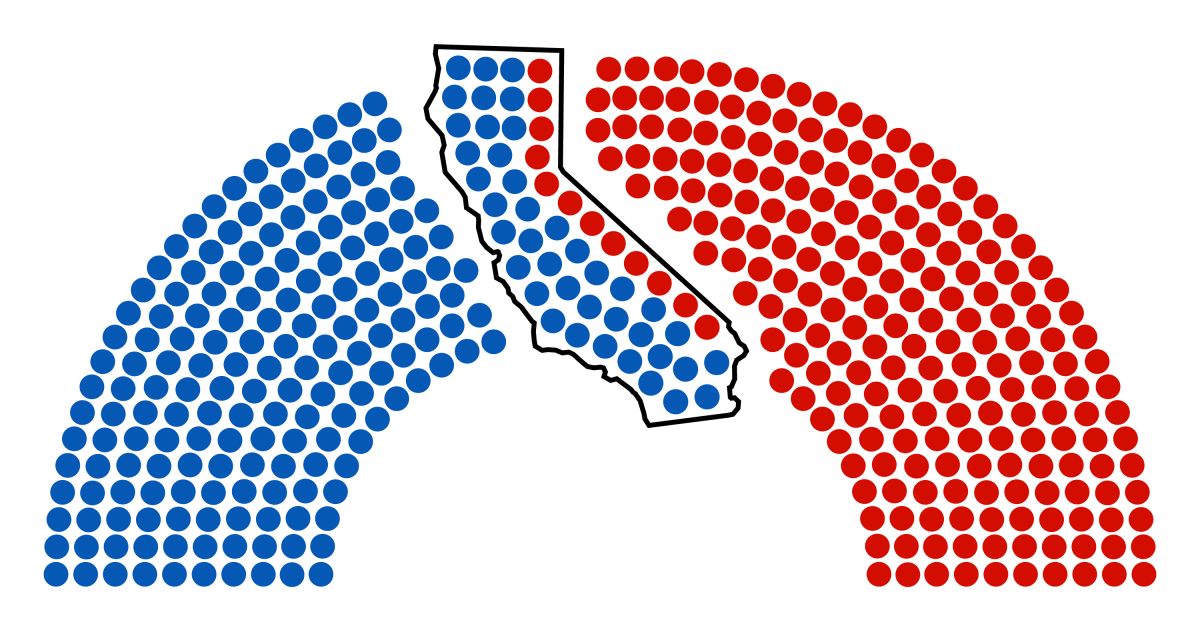
Barring divine intervention or the West Coast falling into the sea, President Biden will handily win California in the November election.
But should he — or presumptive GOP nominee Donald Trump — secure a second term in the fall, the future of either’s policy agenda rests heavily on which party controls Congress, where Republicans currently hold a wafer-thin majority in the U.S. House of Representatives.
With the Golden State home to some of the most hotly contested swing districts in the country, the House’s fate will almost certainly come down to California.
The battle for the next two years of partisan political control will be waged door-to-door, from California’s beachside suburban cul-de-sacs to the tiny farm towns in the state’s fertile Central Valley.
Those battlefields will look a lot like Bridgecreek Plaza — a sun-bleached shopping center a few hundred yards from a freeway onramp in Orange County’s Huntington Beach. The mall is home to a crystal store, several insurance brokers, a dentist and the local Republican Party headquarters.
It’s also where about two dozen GOP faithful gathered on the morning of election day, bowing their heads for a quick prayer and pledging allegiance to a portable flag before turning their attention to Jessica Millan Patterson, chair of the California Republican Party.
Patterson was in a very good mood.
When she was first elected to lead the party, in 2019, California Republicans were “essentially the third-largest party in the state,” having sunk below the share of voters registering “decline to state” under party preference.
But Patterson had presided over a massive voter registration drive over the last five years, and the party had moved back into second. People across the country liked to dismiss “blue California,” she said, but they were forgetting that California has more registered Republicans than any other state.
“California Republicans are the reasons why we have a House majority,” she added, to raucous cheering.
That majority was what they hoped to hold on to, and the group would spend the morning of the March 5 primary election canvassing for Scott Baugh, a Republican attorney and former state Assembly member vying to push Democratic Rep. Katie Porter’s soon-to-be-open congressional seat back from blue to red.
Scott Baugh is trying again to flip Orange County’s 47th District back to the red column. The seat is a chief target of state and national Republican efforts to maintain control of the House.
(Gary Coronado / Los Angeles Times)
The latest round of redistricting put more conservative enclaves such as Huntington Beach and Newport Beach into California’s 47th Congressional District, and Baugh lost to Porter only narrowly in 2022 despite being vastly outspent, making the coastal Orange County district one of the most competitive in the nation.
The charismatic Porter will be out of the House picture after a failed Senate run; her seat is one of the National Republican Congressional Committee’s three offensive targets in California and top priorities. And it’s equally prized by Democrats.
In a country where enmity and distrust separate the two major political parties on most issues, California’s utmost importance to any November House strategy is one of the few things on which Republicans and Democrats can agree.
California is home to 10 races rated as competitive by the nonpartisan Cook Political Report — five of them in districts that are represented by Republicans but that President Biden won in 2020. In the months to come, both parties will be investing significant resources in those races, as national attention inevitably turns west.
With an expected Biden-Trump rematch, voter turnout in 2024 is also likely to be supercharged compared with the 2022 midterm election. That could give an edge to Democrats, given the registration advantage that they hold in many of the competitive districts. Republicans gained one California House seat in the 2022 midterms, a nonpresidential election when turnout was substantially lower than when Biden and Trump topped the ballot two years prior.
“At the end of the day, the path to 218 runs through California,” said Democratic Congressional Campaign Committee spokesperson Dan Gottlieb, referring to the number of seats needed to garner a House majority.
Dave Min will face Baugh in November’s runoff for the 47th District seat, which Katie Porter is vacating. Min’s bruising primary battle for the crucial seat has already cost Democrats millions.
(Rich Pedroncelli / Associated Press)
Gottlieb was bullish on his party’s chances, citing the high turnout expected for the presidential election, along with strong Democratic candidates and “a bunch of dysfunctional and out-of-touch Republicans enabling the worst of their party’s chaos and dysfunction and extremism.”
But Gottlieb’s GOP counterpart was equally roseate in his outlook, with National Republican Congressional Committee spokesperson Ben Petersen reveling in the ugly and expensive primary fights that consumed Democrats in several of the state’s most crucial swing districts.
In the O.C. district where GOP volunteers fanned out for Baugh on primary morning, Democrats had sunk millions into a bruising primary battle between state Sen. Dave Min and fellow Democrat Joanna Weiss. Min ultimately emerged victorious, but only after surviving a barrage of negative advertising centered on his 2023 arrest for driving while intoxicated — arguably a gift to Republicans ahead of his fall battle with Baugh.
“Extreme Democrats are stumbling out of their vicious primary fights broke and bested by Republicans, who saw a groundswell of support for a commonsense safety and affordability agenda,” Petersen said, adding that the primary results made clear the GOP was “playing offense in California” in a way that would set the stage for victories in November.
Baugh, though, is not expected to go unscathed. In 2022, Porter’s ad campaign ripped the Republican for his antiabortion stance, as well as his work as a lobbyist and criminal charges he faced over campaign violations, for which he ultimately paid $47,000 in fines.
In the San Joaquin Valley, there were last-minute fears that a bruising primary battle would lock Democrats out of one of the races where they have the best chance of flipping a seat, but those concerns proved overblown.
Rudy Salas, backed by the Democratic establishment, vanquished fellow Democrat Melissa Hurtado to secure a spot in the fall against incumbent Rep. David Valadao (R-Hanford) in the 22nd Congressional District, but that race also put a dent in Democratic coffers.
The November race will be a rematch of the pair’s 2022 runoff, when Salas lost to Valadao by several thousand votes. And Salas and Valadao won’t be the only rematch on the November ticket.
In a heavily agricultural San Joaquin Valley district that includes all of Merced County and parts of Fresno, Madera, San Joaquin and Stanislaus counties, incumbent GOP Rep. John Duarte will once again face off against Democratic challenger Adam Gray. Duarte won the 13th Congressional District in the midterm election by fewer than 600 votes, one of the closest races in the nation.
Several hundred miles southeast, in Southern California, Democratic challenger Will Rollins will again take on GOP incumbent Rep. Ken Calvert, the longest-serving member of the California delegation. The recently redrawn 41st Congressional District stretches from the suburban Inland Empire, where Calvert has long lived, to Palm Springs, where Rollins and his partner make their home.
The district’s new boundaries — which now include one of the largest concentrations of LGBTQ+ voters in the nation and liberal pockets of Californians in the desert — are far more friendly to Democrats. They also set up Rollins, who is gay, as a potent challenger to Calvert, who voted against LGBTQ+ rights in the past, but who says his views have since evolved.
One race that will have some new blood this year, after the same pair of candidates dueled in three previous elections, is California’s 27th Congressional District in northern Los Angeles County.
Once solidly Republican, the district has been reconfigured by redistricting, and has undergone a political transition driven by younger, more diverse transplants from L.A. seeking affordable housing in Santa Clarita and the Antelope Valley. The district briefly switched from red to blue with former Rep. Katie Hill’s victory in 2018, but the young Democrat’s very public scandals and ultimate resignation helped hand the seat back to the GOP.
Now-incumbent GOP Rep. Mike Garcia beat Democrat Christy Smith in a 2019 special election to fill the seat, then twice more for full terms in 2020 and 2022. He will face off against George Whitesides, a fresh Democratic challenger, in November.
Ludovic Blain, executive director of the California Donor Table, a progressive group that pools donor funds, said his organization hopes to invest about $10 million in California House races in the fall, working with local nonprofits in key areas to turn out voters of color.
They’ll be focusing on seven key races: the three aforementioned rematches, Porter’s open seat and two other Orange County races, and the Garcia-Whitesides matchup.
One point of concern Blain raised is that Republican Steve Garvey’s place near the top of the ticket, facing off against Rep. Adam B. Schiff (D-Burbank) in the Senate race, might affect Democrats in House races.
Schiff engaged in a controversial strategy in the primary, boosting Garvey to lock out Porter and his other major Democratic challenger, Rep. Barbara Lee (D-Oakland), whom Blain’s organization supported.
It was a gambit that some in the Democratic establishment said would actually help Democrats in other tight races, since a less-competitive Senate race would siphon away far less money from the party’s coffers.
But others, like Blain, argue that Garvey’s presence could hurt down-ballot Democrats. Plus, having him on the ballot may draw in moderate Republican and independent voters who remain sour on Trump.
“Having Garvey, I think, does spike or further encourage Republican voters to turn out, and more importantly, to vote down the ticket,” Blain said.
Patterson agreed. Unlike Trump, Garvey will likely campaign across the state, providing a lift for other Republicans while he’s at it.


NEWYou can now listen to Fox News articles!
“Two down and two to go” blared the new wanted poster targeting the two remaining fugitive sons of infamous Mexican cartel kingpin Joaquin “El Chapo” Guzman-Loera, who is serving life-plus-30-years in Colorado’s federal supermax prison.
On Monday, ICE posted a new wanted poster for two members of “Los Chapitos” — Ivan Archivaldo Guzman Salazar and Jesus Alfredo Guzman Salazar, two of El Chapo’s sons with his first wife, Alejandrina Maria Salazar-Hernandez.
After El Chapo’s final capture in 2016, control of the powerful Sinaloa Cartel shifted to Ismael “El Mayo” Zambada. Following Zambada’s arrest during the Biden administration, leadership passed to Guzman’s four sons.
MEXICAN SENATOR ACCUSES SHEINBAUM OF SHIELDING ‘NARCO-POLITICIANS’ AFTER US CARTEL INDICTMENT
Both the Trump administration in the U.S. and the Sheinbaum administration in Mexico have said they are focused on cracking down on cartel’s new leadership.
“Two down and two to go with $10 million reward,” the wanted poster read, with Xs over the faces of the already captured Joaquin Guzman Lopez and Ovidio Guzman Lopez.
The two captured Chapitos are reportedly cooperating with authorities and have not yet been sentenced, but Ivan and Jesus remain “armed and dangerous,” according to ICE.
ICE NABS ACCUSED MS-13 KILLER HIDING IN NORTHERN VIRGINIA SUBURB
El Chapo Guzman arrives in the United States after his capture in Mexico. (AP File)
The two fugitives are charged with conspiracy to distribute a controlled substance and operating a continuing criminal enterprise.
Two of Guzman’s four sons have already been captured through Operation Take Back America, an initiative seeking the “total elimination of cartels and transnational criminal organizations” in order to protect U.S. communities from violent crime.
U.S. Attorney for the Northern District of Illinois Andrew Boutros said in a recent statement that efforts to capture El Chapo’s sons are the latest steps “in our efforts to bring to justice drug lords and other dangerous criminals who poison the American public with illegal and harmful drugs and who otherwise engage in violence and corruption to carry out their and their enterprises’ wide-reaching criminal activities.”
US MILITARY KILLS TWO ALLEGED NARCO-TERRORISTS IN LATEST EASTERN PACIFIC STRIKE ON DRUG-TRAFFICKING VESSEL
Joaquin “Shorty” Guzman, center, is escorted by soldiers during a presentation at the Navy’s airstrip in Mexico City. (Reuters/Edgard Garrido)
SIGN UP TO GET THE POLITICS NEWSLETTER
In his plea agreement, Guzman Lopez admitted that he and his cartel associates committed violence against law enforcement officials, rival drug traffickers and members of their own organization to protect the Sinaloa Cartel’s trafficking operations.
CLICK HERE TO DOWNLOAD THE FOX NEWS APP
Fox News Digital reached out to ICE and DHS for additional comment and information on the mission to capture the two at-large Chapitos.

WASHINGTON — President Trump said Monday that he called the president of FIFA to dispute a red card that would have barred the American striker Folarin Balogun from playing in Monday’s elimination game with Belgium, acknowledging an extraordinary intervention by a head of state in the sport’s disciplinary process.
“I asked for a review because I didn’t think it was a foul,” Trump told reporters during an event in the Oval Office. “I am good at this stuff. I didn’t think it was a foul. I thought it was two great athletes that crashed into each other and got entangled.”
FIFA subsequently rescinded Balogun’s suspension, the first time the governing body has reversed a red-card penalty during a World Cup in 64 years. Belgium has protested the decision, and a hearing is scheduled for Monday to determine whether Balogun’s reinstatement will stand.
Trump said it would be a “stain” on the World Cup to let the penalty stand, and even called the referee who issued the card “suspect” with a questionable past, though he did not provide evidence to support the accusation.
While many in the United States joined the president in celebrating the reversal, others blasted its adverse impact on the integrity of the sport.
The Belgium team has protested the penalty reversal, with the country’s soccer federation saying it was “astonished” by the ruling.
“We are not defending the national team or federation. We are defending football,” Belgian coach Rudi Garcia said.
The episode has drawn attention to Trump’s close relationship with Gianni Infantino, the president of FIFA. In December, Infantino presented Trump with the inaugural FIFA Peace Prize, an award the governing body created after Trump was passed over for the Nobel Peace Prize. That decision is now the subject of an ethics complaint, backed by members of the European Parliament, who argue it compromised FIFA’s political neutrality.
Trump appeared to downplay the significance of his call to Infantino.
“I can’t tell him what to do, and I don’t believe he made the decision,” Trump said. “I think it was a committee that made the decision, and they made the right decision, because number one, it wasn’t a foul, and you want to see a game with your best players.”
But he said it would be “very unfair” and “terrible” to not let Balogun play. He said it would be the equivalent of barring Argentina’s Lionel Messi or Portugal’s Cristiano Ronaldo — both global superstars — because they “ran” or “bumped” into someone on the field.
“We have to have our best players, and they have to have their best players. And if we win or we lose, it’s fair,” Trump said. “Let’s say we lost [Balogun] and we lose the game — it would be a terrible thing.”

Secretary Burgum condemns vandalism targeting National Mall amid new threats
Interior Secretary Doug Burgum reacts to a disturbing pattern of vandalism targeting the National Mall, including the Lincoln Memorial Reflecting Pool, which suffered significant damage. Burgum details the restoration efforts, the deployment of security and the arrest of seven individuals involved. He stresses that such acts are an attack on the country and will be prosecuted to the full extent of the law.
NEWYou can now listen to Fox News articles!
President Donald Trump and his Interior Department are declaring an America 250 victory over algae in the Lincoln Reflecting Pool.
Trump shared photos on Truth Social on Sunday showing the pool and the reflection of the Washington Monument appearing clear and blue, and made a call out with a “Wanted” poster for vandals.
“The U.S. Park Police is seeking the public’s assistance in identifying the individual in the notice below in connection with a Destruction of Government Property investigation related to the Reflecting Pool,” Trump wrote Sunday on Truth Social.
Trump also shared an Interior Department statement crediting “advanced nanobubbler technology” and National Park Service cleanup work.
FORMER US OLYMPIAN DAVID HEARN INDICTED IN ALLEGED REFLECTING POOL VANDALISM
President Donald Trump is touting the algae cleanup and the prosecution of vandals from the Lincoln Reflecting Pool, with the water proving clear and refective in this July 3 photo. (Finn Gomez/Getty Images)
“The advanced nanobubbler technology very effectively killed the algae that has plagued every Lincoln Reflecting Pool reopening — most infamously Obama’s reopening — since 1922,” Dei Gratia Minerals founder Greg Wischer, Interior’s deputy assistant secretary for land and minerals management, wrote in a letter shared with Interior Secretary Doug Burgum and Trump.
“The Reflecting Pool water is crystal clear, and our National Park Service team is now vacuuming up the dead algae resting on the bottom of some parts of the Reflecting Pool — just like the destroyed Iranian Navy resting on the bottom of the Persian Gulf.”
The photos shared by Trump show the Reflecting Pool stretching toward the Washington Monument under blue skies. One image appears to show the pool from the Lincoln Memorial end, while a second closer view shows the Washington Monument reflected in the water.
Trump also shared a U.S. Interior Press social media post hailing the technological success, quoting that Wischer memo.
YOSEMITE, GRAND CANYON LEAD NOTABLE LIST OF NATIONAL PARK CAMPGROUNDS FOR AMERICA’S 250TH
Pete Folch carries an American flag during a morning run past the Reflecting Pool as the city prepares for July 4th festivities on July 3, 2026, in Washington, D.C. (Joe Raedle/Getty Images)
“The vacuuming is the final maintenance step after refilling the pool, and it will be complete in a few days,” his memo continued. “Already, the section of the Reflecting Pool closest to the Lincoln Memorial has been vacuumed up, and the beautiful American Flag Blue coating on the bottom of the pool can be seen clearly.”
Trump’s Interior Department has praised the technology for overcoming past challenges in keeping the pool clear, including dunking on former President Barack Obama.
“Previous administrations — most notably under Obama — failed to maintain the Reflecting Pool, and after refilling the pool, the water would quickly become murky and thick with massive clumps of algae floating on the surface,” the memo concluded.
INTERNAL EMAILS EXPOSE HOW JULY 4TH BASH IS BEING DERAILED BY DEM-RUN COUNTY: ‘OFFENSIVE’
Police said the incident happened on Friday at around 3:36 p.m. at the Reflecting Pool on the grounds of the Lincoln Memorial in the nation’s capital. (U.S. Park Police)
“The photos below show how the nanobubbler technology and vacuuming have been incredibly effective, making the water crystal clear with the American Flag Blue coating shining brightly on the bottom of the pool.
“As our National Park Service team noted, the Reflecting Pool is now so ‘blue’ that the Fake News Media, which has been staked out at the Reflecting Pool for weeks, has fled!”
The 6.75 million-gallon pool has been targeted by Trump critics and leftist anti-Trump activists for attacks both verbally and physical, Burgum discussed with ABC’s “This Week” on Sunday.
“The Reflecting Pool has been a big success,” he said. “And we’ve got 340 million people in this country that are celebrating 250. We did have a few vandals, but all that’s going to be repairable, and that’ll all be fixed in the coming weeks as we go forward.”
People look out at the Reflecting Pool and Washington Monument from the steps of the Lincoln Memorial ahead of July 4 festivities on July 03, 2026, in Washington, D.C. (Joe Raedle/Getty Images)
Burgum now believes that the pool might not require a full draining after its “multiple gashes that add up to 350 feet,” he added.
“We don’t know if we need to drain the whole thing or not because, you know, the cutting happened on the edge, and, of course, it slopes from the edge,” according to Burgum.
“We may be able to partially drain it and do the repair. To be able to fix it, we may not have to drain the whole thing, but it could go very quickly.”
CLICK HERE TO DOWNLOAD THE FOX NEWS APP
While the media and Trump critics are pointing to added costs of the reflecting pool refurbishment, Burgum pointed to the vandalism causing that.
“We weren’t expecting that we were going to have a small group of people that wanted to try to destroy effectively what is part of the Lincoln Memorial,” Burgum told ABC. “There’s plenty of cameras around the Lincoln statue and around the memorial, but the Reflecting Pool had gone for, you know, decades without vandalism.”
-

 Miami, FL4 minutes ago
Tim Hardaway Jr. returns home as Miami Heat sign veteran guard:
-

 Boston, MA11 minutes ago
‘Enough is enough’: Weekend violence in Boston sparks calls for change, from more police to community investment – The Boston Globe
-

 Denver, CO11 minutes ago
Kalshi Promo Code DENVER: Trade $10, Get $10 World Cup Bonus for USA-Belgium – Denver Stiffs
-

 Seattle, WA19 minutes ago
Fans take over Seattle for USA-Belgium World Cup match
-

 San Diego, CA20 minutes ago
Elite California city set for mass illegal street vendor expansion as judge issues stunning verdict
-

 Milwaukee, WI26 minutes ago
Milwaukee police officers injured in separate holiday weekend incidents
-

 Atlanta, GA29 minutes ago
Ben’s Friends meetings help Atlanta food and beverage workers struggling with addiction
-

 Minneapolis, MN34 minutes ago
Overnight shooting outside Minneapolis recording studio leaves teen injured, 3 men hurt

