Politics
Opinion: Why is the 'pro-family' GOP blocking legislation that would help lift many kids out of poverty?

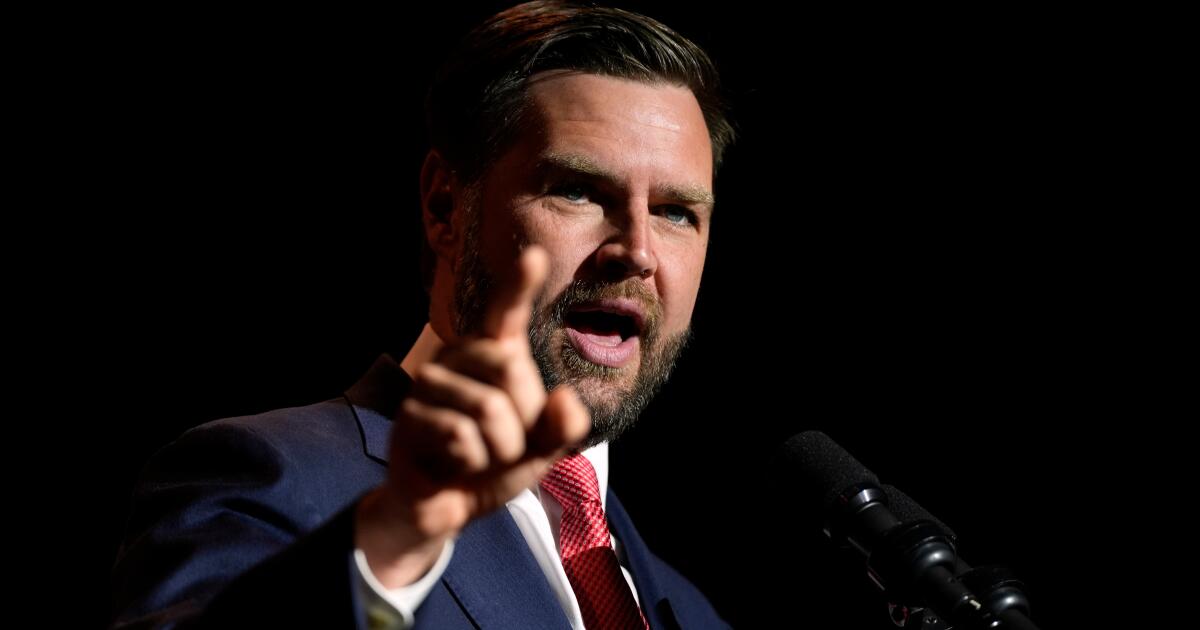
Republican vice presidential nominee JD Vance told Megyn Kelly last month that Democrats are calling for an end to the Child Tax Credit because they are “anti-family and anti-kid.” Vance, who has courted controversy for calling Democrats the party of “childless cat ladies,” then declared, “We should send the signal to the culture that we are the pro-family party, and we’re gonna back it up with real policy. We’re the party of parents, we’re the party of kids.”
Republicans are using Vance’s kids and families rhetoric to convince voters to choose them in November, but they are failing when it comes to backing it up. In fact, they’re actively opposing important legislation to help children and parents.
On Thursday, Senate Republicans blocked a bill that would expand the Child Tax Credit — the very policy that Vance has championed and just accused Kamala Harris of opposing. Vance didn’t show up for the vote. Killing the proposal was a loss to roughly 16 million children in low-income working families, who would have benefited from about $700 in tax relief this year. Estimates from the Center on Budget and Policy Priorities show that the proposal would have lifted at least 500,000 children above the poverty line and raised the family incomes for at least 5 million more poor children.
The Child Tax Credit isn’t just the most effective policy tool for pulling children out of poverty — it’s also one of the most popular legislative proposals in the country right now. The current bill had bipartisan support when it passed the House in a 357-70 vote in January. Polling showed that 69% of Americans supported the proposal, including 80% of Democrats, 59% of Republicans and 63% of independents. The legislation even included tax cuts for some businesses’ research and development efforts as well as investments that Republicans have long sought.
Influential business groups made it clear that they wanted the bill to pass. But Republican leadership was able to keep it from getting to a vote, even with a majority of the Senate in favor, because 60 votes are needed to break the filibuster.
The big reason that Republicans killed the Child Tax Credit measure appears to have little to do with policy. Iowa Sen. Charles E. Grassley said the quiet part out loud in January when he noted that it might “make Biden look good.”
Republicans also fought the bigger, temporary expansion of the Child Tax Credit that passed in 2021. That legislation was historic, and poverty among children was reduced by 44% to its lowest level on record while it was in effect. But during the last three years, the party demonstrated that it’s still committed to an economic program that puts tax cuts for large corporations above the well-being of children and families.
At the same time, the GOP has blocked legislation to build a universal pre-K system, enact paid family and medical leave, expand subsidies for child care and improve home care for older people and people with disabilities.
Republicans want to have it both ways, touting their pro-family agenda while blocking pro-family legislation.
Democrats shouldn’t just mock Vance’s “childless cat lady” comments or rely on legal cases, even felony convictions, to make their case in the closing months of this election campaign. The party‘s candidates need to make it clear who is standing up for children and parents.
Increasingly, Republicans are framing the parenting issue as an existential question. Focusing on policy for children and families, they argue, demonstrates a commitment to the future.
This is a debate Democrats should welcome — and one they can handily win.
Justin Talbot Zorn is a senior advisor at the Center for Economic and Policy Research. Mark Weisbrot is co-director.







new video loaded: U.S. ‘Accelerating’ Military Assault in Iran, Hegseth Says
By Christina Kelso
March 4, 2026

NEWYou can now listen to Fox News articles!
A U.S. submarine sank a prized Iranian warship by torpedo, the first such sinking of an enemy ship since World War II, Secretary of War Pete Hegseth said Wednesday morning.
Hegseth joined Chairman of the Joint Chiefs of Staff Gen. Dan Caine at the Pentagon to provide an update to reporters on “Operation Epic Fury” in Iran.
“An American submarine sunk an Iranian warship that thought it was safe in international waters,” Hegseth said. “Instead, it was sunk by a torpedo. Quiet death. The first sinking of an enemy ship by a torpedo since World War Two. Like in that war, back when we were still the War Department. We are fighting to win.”
Caine said that an Iranian vessel was “effectively neutralized” in a Navy “fast attack” using a single Mark 48 torpedo. He added that the U.S. Navy achieved “immediate effect, sending the warship to the bottom of the sea.”
WATCH HEGSETH’S ANNOUNCEMENT:
Hegseth said that the U.S. Navy sank the Iranian warship, the Soleimani. The flagship was named for Qasem Soleimani, an Iranian military officer who served in the Islamic Revolutionary Guard Corps who the U.S. killed in a January 2020 drone strike during President Donald Trump’s first term.
“The Iranian Navy rests at the bottom of the Persian Gulf. Combat ineffective, decimated, destroyed, defeated. Pick your adjective,” Hegseth said. “In fact, last night we sunk their prize ship, the Soleimani. Looks like POTUS got him twice. Their navy, not a factor. Pick your adjective. It is no more.”
This map shows U.S. and Israeli strikes against Iranian naval forces as of March 1. (Fox News)
Hegseth also told reporters at the briefing that the U.S. and Israel will soon achieve “complete control” over Iranian airspace after Iran’s missile capabilities were drastically diminished in the four days of fighting.
US ‘WINNING DECISIVELY’ AGAINST IRAN, WILL ACHIEVE ‘COMPLETE CONTROL’ OF AIRSPACE WITHIN DAYS, HEGSETH SAYS
“More bombers and more fighters are arriving just today and now, with complete control of the skies, we will be using 500 pound, one thousand pound and 2,000 pound laser-guided precision gravity bombs, of which we have a nearly unlimited stockpile,” he said.
The war has killed more than 1,000 people in Iran and dozens in Lebanon, while U.S. officials said six American troops were killed in a fatal drone strike in Kuwait.
Thousands of travelers have been left stranded across the Middle East.
This map shows security and travel updates for Americans regarding countries in the Middle East region. (Fox News)
CLICK HERE TO DOWNLOAD THE FOX NEWS APP
Caine told reporters that the U.S. military is helping thousands of Americans stranded in the Middle East after the U.S. State Department urged citizens to leave more than a dozen countries.
Fox News Digital’s Ashley Carnahan contributed to this report.
Related Article


Sen. Alex Padilla (D-Calif.) is preparing for President Trump to declare a national emergency in order to seize control of this year’s midterm elections from the states, including by bracing his Senate colleagues for a vote in which they would be forced to either co-sign on the power grab or resist it.
In the wake of reporting last week that conservative activists with connections to the White House were circulating such an order, Padilla sent a letter to his Senate colleagues Friday stating that any such order would be “wildly illegal and unconstitutional,” and would no doubt face “extremely strict scrutiny” in the courts.
“Nevertheless, if the President does escalate his unprecedented assault on our democracy by declaring an election-related emergency, I will swiftly introduce a privileged resolution [and] force a vote in the Senate to terminate the fake emergency,” wrote Padilla, the ranking Democrat on the Senate Committee on Rules and Administration.
Padilla wrote that such an order — which could possibly “include banning mail-in voting, eliminating major voting registration methods, voter purges, and/or new document barriers for registering to vote and voting” — would clearly go beyond Trump’s authority.
“Put simply, no President has the power under the Constitution or any law to take over elections, and no declaration or order can create one out of thin air,” Padilla wrote.
The same day Padilla sent his letter, Trump was asked whether he was considering declaring a national emergency around the midterms. “Who told you that?” he asked — before saying he was not considering such an order.
The White House referred The Times to that exchange when asked Tuesday for comment on Padilla’s letter.
If Trump did declare such an emergency, a “privileged resolution,” as Padilla proposed, would require the full Senate to vote on the record on whether or not to terminate it — forcing any Senate allies of the president to own the policy politically, along with him.
Experts say there is no evidence that U.S. elections are significantly affected or swung by widespread fraud or foreign interference, despite robust efforts by Trump and his allies for years to find it.
Nonetheless, Trump has been emphatic that such fraud is occurring, particularly in blue states such as California that allow for mail-in ballots and do not have strict voter ID laws. He and others in his administration have asserted, again without evidence, that large numbers of noncitizen residents are casting votes and that others are “harvesting” ballots out of the mail and filling them out in bulk.
Soon after taking office, Trump issued an executive order purporting to require voters to show proof of U.S. citizenship before registering and barring the counting of mail-in ballots received after election day, but it was largely blocked by the courts.
Trump’s loyalist Justice Department sued red and blue states across the country for their full voter rolls, but those efforts also have largely been blocked, including in California. The FBI also raided an elections office in Georgia that has been the focus of Trump’s baseless claims that the 2020 presidential election was stolen from him.
Trump is also pushing for the passage of the SAVE Act, a voter ID bill passed by the House, but it has stalled in the Senate.
In recent weeks, Trump has expressed frustration that his demands around voting security have not translated into changes in blue state policies ahead of the upcoming midterm elections, where his shrinking approval could translate into major gains for Democrats.
Last month, Trump wrote on his Truth Social platform, “I have searched the depths of Legal Arguments not yet articulated or vetted on this subject, and will be presenting an irrefutable one in the very near future. There will be Voter I.D. for the Midterm Elections, whether approved by Congress or not!”
Then, last week, the Washington Post reported that a draft executive order being circulated by activists with ties to Trump suggests that unproven claims of Chinese interference in the 2020 election could be used as a pretext to declare an elections emergency granting Trump sweeping authority to unilaterally institute the changes he wants to see in state-run elections.
Election experts said the Constitution is clear that states control and run elections, not with the executive branch.
Democrats have widely denounced any federal takeover of elections by Trump. And some Republicans have expressed similar concerns, including Sen. Mitch McConnell (R-Ky.), who chairs the Senate rules committee.
In the Wall Street Journal last year, McConnell warned against Trump or any Republican president asserting sweeping authority to control elections, in part because Democrats would then be empowered to claim similar authority if and when they retake power.
McConnell’s office referred The Times to that Journal opinion piece when asked about the circulating emergency order and Padilla’s resolution.
Padilla’s office said his resolution would be introduced in response to an emergency declaration by Trump, but hoped it wouldn’t be necessary.
“Instead of trying to evade accountability at the ballot box,” Padilla wrote, “the President should focus on the needs of Americans struggling to pay for groceries, health care, housing and other everyday needs and put these illegal and unconstitutional election orders in the trash can where they belong.”

Stephen A. Smith called Zion Williamson a ‘food addict,’ is now feuding with the Pelicans on social

Sánchez defies Trump in political gamble as Madrid say no to war

Satellite images show Iran school strike hit more buildings than earlier reported

Young mother swept away to her death while hiking in California, officials say

Gun rights expert says Minnesota Dems tried to block her testimony on firearm bills to ‘avoid’ policy debate

Florida High School Football Rankings: Top 25 teams – Oct. 21

Cleary's 21 help Le Moyne down Central Connecticut State 69-64 in OT

How old is Bo Nix? What to know about Oregon quarterback ahead of 2024 NFL Draft

99th annual Pony Swim held in Virginia

Indiana Members Credit Union announced as new anchor tenant at Bottleworks District
Sánchez defies Trump in political gamble as Madrid say no to war
Satellite images show Iran school strike hit more buildings than earlier reported

US submarine sinks Iranian warship by torpedo in a first since World War II

Which oil and gas facilities in the Gulf have been attacked?

Mojtaba Khamenei, son of former supreme leader, tipped to become Iran’s next head of state
-

 World7 days ago
Exclusive: DeepSeek withholds latest AI model from US chipmakers including Nvidia, sources say
-

 Massachusetts1 week ago
Mother and daughter injured in Taunton house explosion
-

 Wisconsin3 days ago
Setting sail on iceboats across a frozen lake in Wisconsin
-

 Denver, CO1 week ago
10 acres charred, 5 injured in Thornton grass fire, evacuation orders lifted
-

 Maryland4 days ago
AM showers Sunday in Maryland
-

 Louisiana1 week ago
Wildfire near Gum Swamp Road in Livingston Parish now under control; more than 200 acres burned
-

 Florida4 days ago
Florida man rescued after being stuck in shoulder-deep mud for days
-

 Oregon5 days ago
2026 OSAA Oregon Wrestling State Championship Results And Brackets – FloWrestling