Politics
Opinion: On homelessness, liberal California and the ultraconservative Supreme Court largely agree

What does a small, solidly Republican city in Oregon have in common with California’s largest liberal enclaves? All breathed a sigh of relief this year thanks to the far-right U.S. Supreme Court.
The court’s conservative bloc ruled in favor of the city of Grants Pass, Ore., in June, overturning a key lower court ruling on homelessness and clearing the way for local governments to crack down on sleeping in public spaces regardless of the availability of housing or shelter. California’s response to the ruling has become a vivid reminder of not just the intractability of the homelessness epidemic but also the tension between national liberal politics and local policy in Democratic-dominated states and cities.
Some 186,000 people across California lack consistent shelter. Roughly 84% of the state’s voters believe homelessness is a “very serious” problem, a Quinnipiac University poll found, and Democrats and Republicans were in similarly broad agreement on that assessment, at 81% and 85%, respectively. In that light, it’s not surprising that California officials have wasted no time since Grants Pass in implementing their preferred “solution” to the homelessness problem.
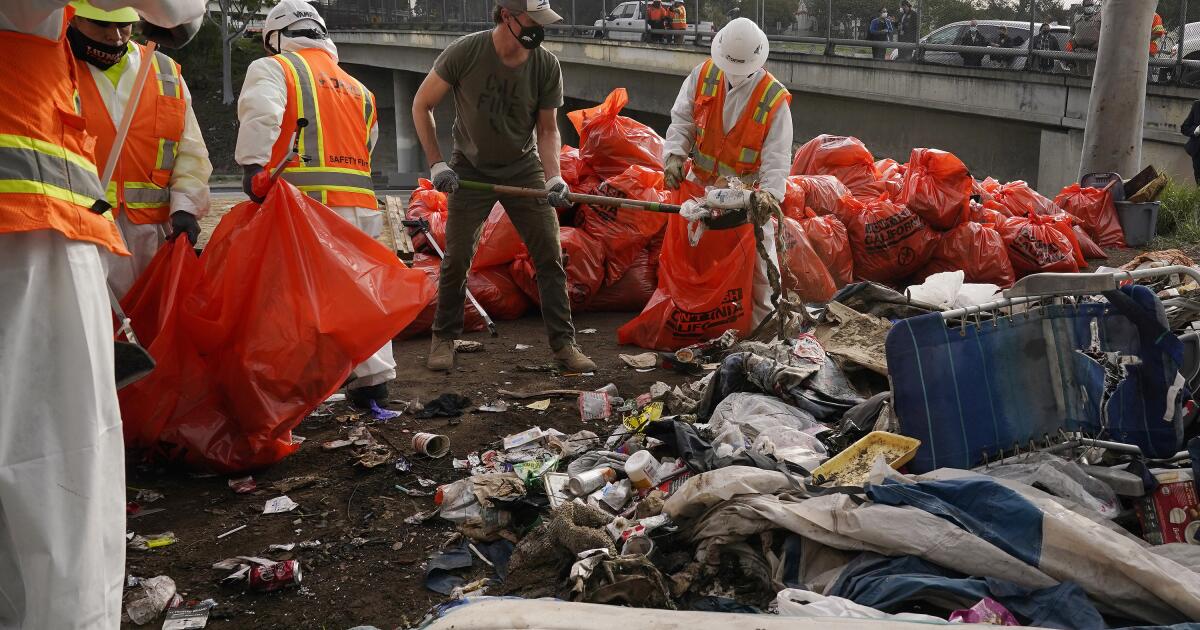
From San Diego to San Francisco, state and local workers began disassembling makeshift shelters and camps and displacing the homeless people living in them. Within days, entire blocks were remade across the state. Residents rallied to social media platforms such as Reddit and Nextdoor to exchange strategies for getting homeless encampments removed from their own neighborhoods.
Other California residents have taken the Supreme Court’s ruling and Democratic officials’ exuberant co-sign as further evidence of the nation’s growing disdain for society’s most marginalized. Reports spread of homeless people being ejected from campsites with little or no warning, their pets taken away and medications lost, among other indignities.
The American Civil Liberties Union and other advocacy groups have condemned the Grants Pass ruling. The chief executive of the National Alliance to End Homelessness said it set a “dangerous precedent.” But the precedent set by California Democrats has arguably been far more dangerous.
During the initial waves of the Golden State’s housing crisis, in the late 1970s, Democratic politicians were reluctant to be seen as overtly antagonistic to the state’s homeless people, many of them veterans of the nation’s wars in Vietnam and Korea. But as the homeless population has grown and diversified, officials have faced deepening NIMBY sentiment not just in California’s well-heeled liberal cities but also in Democratic-leaning working-class communities that increasingly experience the highest rates of homelessness and related problems such as loitering and blight. As a result, anti-homeless policies have become more politically appealing despite being painfully at odds with inclusivity and other virtues Democrats signal on the national stage.
Addressing the housing crisis has been a quintessential and enduring social justice cause for Democrats, encompassing themes that tend to unify the party, including health, economic and racial equity. According to one survey, 82% of homeless adults in California reported having experienced a serious mental health condition, and 65% had used illicit drugs at some point. The state’s Black people are disproportionately affected by homelessness: Despite making up only about 5% of California’s total population, they represent roughly 25% of its homeless people. Such statistics helped liberals frame homelessness as a product of Republican policies weakening social services and promoting unchecked capitalism.
But that view has lost support as homelessness has become more dramatic and visible over the last decade. In some of California’s liberal enclaves, homeless encampments have become full-blown tent cities. Scenes of squalor, drug use and petty crime have spawned a subculture of gonzo-style documentary videos racking up hundreds of thousands of views on YouTube. San Francisco and Los Angeles have the most prominent crises, inviting scrutiny of the latter city’s readiness to host the 2028 Olympics.
Democrats’ conundrum is whether authorities should roust, fine and imprison people residing in public spaces in the interest of answering the broader community’s quality-of-life concerns. Critics have argued that such criminalization is a cruel distraction and that more affordable housing is the only way to meaningfully address the crisis.
Gov. Gavin Newsom and his predecessor, Jerry Brown, devoted billions of dollars to homelessness prevention and affordable housing even as the homeless population generally continued to grow. Newsom was quick to seize on the conservative Supreme Court’s permission to put punishment ahead of housing, warning cities that if they don’t remove encampments, they risk losing state funding. San Francisco Mayor London Breed, who just lost a reelection bid partly because of concerns about homelessness, likewise promised to be “very aggressive” in removing encampments. Never mind that those displaced by the state’s homeless sweeps often end up occupying another nearby space and returning at a later date.
So how did we get here? California’s ruling Democrats have tried to have it all ways, largely cultivating and tolerating deeply bureaucratic housing development standards while amplifying a booming tech industry populated by employees willing to pay top dollar for homes, dramatically boosting prices. And although Newsom and others have heralded emergency housing and other measures to answer the crisis, the total capacity is far short of the unhoused population. That’s partly because new facilities are often rebuffed by cities such as the L.A. suburb of Norwalk, which recently enacted a moratorium on homeless shelters.
Reducing and preventing homelessness, whatever the underlying motivations, is one of the few civic concerns that bind the political parties together in an age of stark polarization. Beyond the obvious moral merits of the cause, it could provide a road map to arrive at bipartisan solutions for other challenges facing the state and country. Unfortunately, the consensus on homelessness is coalescing around a prescription with little chance of long-term success.
Jerel Ezell is an assistant professor of community health sciences at UC Berkeley.


NEWYou can now listen to Fox News articles!
Sen. Lindsey Graham, R-S.C., died Saturday evening following a “brief and sudden” illness, according to a statement from his office.
“On the evening of Saturday, July 11, U.S. Senator Lindsey Graham passed away from a brief and sudden illness,” his office said.
“Senator Graham’s family appreciates prayers at this time and asks for privacy during this incredibly difficult period,” it continued.
CLICK HERE TO DOWNLOAD THE FOX NEWS APP
Sen. Lindsey Graham, R-S.C., speaks with reporters about aid to Ukraine, on Capitol Hill, Wednesday, March 10, 2022, in Washington. (AP Photo/Alex Brandon)
This is a breaking story; check back for updates.

The Trump administration finalized a rollback of the Endangered Species Act on Friday, paving the way for drilling, mining and other human development across protected wildlife habitats.
The move redefines “harm” under the Endangered Species Act, the landmark conservation law that protects threatened and endangered plants and animals. For years, “harm” meant actions that injure or kill wildlife, as well as actions that destroy protected habitats.
Under the new rule, destroying those habitats is no longer illegal.
The decision aligns with the Trump administration’s ongoing effort to slash regulations in the name of economic growth. Interior Secretary Doug Burgum, whose department finalized the move, said the prior definition of harm “interfered with private property rights” and “turned routine activity into a regulatory trap.”
Environmental groups called the decision a disaster, saying it puts protected species on a path to extinction.
The move seems especially poised to hit California, the most biodiverse state in the country, where more than 6,700 species are spread across mountains, forests, deserts and oceans. Of the roughly 2,300 species protected by the Endangered Species Act, nearly 300 are found in California.
These species include amphibians such as tiger salamanders and Yosemite toads; birds such as California condors and northern spotted owls; fish such as Little Kern golden trout and Santa Ana suckers; insects such as Franklin’s bumble bees and Mission blue butterflies; mammals such as gray wolves and Santa Catalina Island foxes; and reptiles such as desert tortoises and green sea turtles.
The Endangered Species Act is widely credited with saving the California condor, which almost went extinct in the 1980s due to several factors, including habitat destruction. Thanks to a recovery program under the act, the condor population has since soared to several hundred. But under the new law, the logging and human development that led to their near demise is now allowed.
A handful of California species recoveries have been championed as success stories under the Endangered Species Act, including southern sea otters, peregrine falcons, humpback whales, bald eagles and green sea turtles.
According to a report from the Center for Biological Diversity, the El Segundo blue butterfly lost 90% of its oceanside habitat due to the construction of LAX and beachfront housing developments. The population dwindled to about 1,000 butterflies in the 1970s, when it was named an endangered species. Now, the population has climbed above 120,000.
In California, the rollback could pave the way for more farming, mining, logging and drilling in areas that were once forbidden due to the potential for wildlife habitat destruction. A report from Earthjustice estimates that expanded oil drilling in California could threaten five marine species including humpback whales, sea otters, leatherback sea turtles, marbled murrelets and wild salmon.
Several environmental groups are planning legal challenges to the ruling.
“For the first time ever, a presidential administration now claims that species protected by the Endangered Species Act shouldn’t be safe from habitat modification that destroys where they live, raise their young, or search for food,” Kristen Boyles, attorney for the environmental nonprofit Earthjustice, said in a statement. “Let’s be clear: there is no support for the Trump administration’s rule — no scientific support, no legal support, no public support. We will see the Trump administration in court.”
Ben Greuel, wildlife campaign manager at the Sierra Club, called the decision “an unlawful attempt to open the door for corporate polluters to degrade vitally important habitats.”
“For more than four decades, the definition of ‘harm’ recognized a simple truth: if you destroy the places wildlife need to survive, you are putting species on a path to extinction,” Greuel said in a statement.
It’s not the first time Trump has taken aim at California environmental regulation.
Earlier this year, Gov. Gavin Newsom, along with the governors of Washington and Oregon, submitted a formal opposition to the Trump administration’s plans to expand drilling off the Pacific Coast, with Newsom saying it leads to “dead wildlife.” In June, the Trump administration ordered a review of the California Coastal Commission, claiming the state’s “environmental extremism” obstructs spaceport development and offshore oil production.
A day before the Endangered Species Act decision, the Trump administration signed off on a controversial plan to use an old oil pipeline to pump water from the Mojave Desert into cities. Environmental groups said the plan threatens springs and local wildlife, since six pumps would need to be built in desert tortoise habitats.
Politics
Trump-aligned House holdouts accused of holding ‘life-saving’ veterans bill ‘hostage’ over SAVE America Act

NEWYou can now listen to Fox News articles!
A sweeping veterans package supporters describe as the largest expansion of veterans’ health care and benefits in more than a decade is expected to return to the House floor when lawmakers come back from the July recess, but backers warn the legislation could once again become collateral damage in the Republican standoff over the SAVE America Act.
The Take Care of America’s Veterans Act rolls roughly 60 veterans bills into a package that would dramatically expand veterans’ health care and benefits. At its core, the legislation would cement veterans’ access to community care outside the VA while increasing benefits for combat-wounded veterans, caregivers and Gold Star families, expanding mental health services and enacting dozens of additional reforms.
House Veterans’ Affairs Committee Chairman Mike Bost, R-Ill., told Fox News Digital he intends to bring the Take Care of America’s Veterans Act back for a vote as soon as the House reconvenes next week.
WASHINGTON, D.C. – MARCH 17: Eugene Simpson, 29, from Dale City, Virginia goes through physical therapy at the Veterans Affairs Medical Center in Washington, D.C. with Michael Minor, a kinesiotherapist with the United States Department of Veterans Affairs on March 17, 2006 in Washington, D.C., USA. (Photo by Jeff Hutchens/Getty Images) (Jeff Hutchens/Getty Images)
HOUSE CONSERVATIVES DERAIL GOP AGENDA IN SAVE AMERICA ACT SHOWDOWN
The legislation was held up last month after a group of House Republicans joined Democrats to defeat a procedural vote, stopping the House from taking up the bill.
“I’m feeling good as long as my members stay with us on the rule,” Bost said. “Right now, there’s some politics being played, not about this bill, but just in general.”
The bill became entangled in a broader House Republican fight over the SAVE America Act, legislation championed by President Donald Trump that would require proof of U.S. citizenship to register to vote in federal elections.
On June 30, the House voted on H. Res. 1398, the procedural rule governing floor consideration of several bills, including the National Defense Authorization Act and the Take Care of America’s Veterans Act. The rule failed after 14 Republicans joined Democrats in opposition, preventing the House from taking up the veterans package and bringing floor business to a standstill. Rep. Anna Paulina Luna, R-Fla., claimed to have voted against the rules vote in protest against House leadership’s handling of the SAVE America Act. As a result, Speaker of the House Mike Johnson sent the members home early.
Bost accused the holdouts of effectively putting veterans legislation on hold.
The US Department of Veterans Affairs building is seen in Washington, DC, on July 22, 2019. (Photo by Alastair Pike / AFP) (Photo credit should read ALASTAIR PIKE/AFP via Getty Images) (Photo credit should read ALASTAIR PIKE/AFP via Getty Image)
‘IT’S A MESS’: GOP TURNS ON HOUSE CONSERVATIVES AS VOTER ID BLOCKADE STALLS TRUMP’S AGENDA
“They’re holding all bills hostage,” Bost said. “They’re not voting for any rule. Any bill that has to pass a rule before it comes to the floor—which this bill does because of its size—can’t move.”
Although Bost said he supports the SAVE America Act and has voted for it three times, he argued the Senate’s failure to act should not stop the House from advancing unrelated legislation.
“I agree with that bill,” Bost said. “But the Senate still has to do their work. We don’t stop our work because the Senate isn’t doing it.”
With 23 legislative days left in the Congressional session, Concerned Veterans for America Strategic Director John Byrnes, a supporter of the bill, said time is of the essence.
“There are lots and lots of things that have to get done,” Byrnes told Fox News Digital. “There’s also the National Defense Authorization Act, which is a must pass every year, so these things eat up time. There’s requirements to have debate on these, which eat up session time.”
Byrnes argued that every procedural delay pushes other legislation further down the calendar.
“This bill will save lives in 2027,” Byrnes said. “If we lose veterans because they could have had faster, better access to health care, we’re never going to get those veterans back.”
Rep. Mike Bost, R-Ill. ( )
TRUMP’S SAVE AMERICA ACT SHOWS SIGNS OF LIFE IN THE SENATE DESPITE REPUBLICAN REVOLT
But Rep. Chip Roy, R-Texas, who also voted no on the procedural vote, told Fox News Digital that he has concerns about how the bill is financed.
“I appreciate what the chairman’s trying to do in some respects, but there’s a few issues,” Roy said.
Among them, Roy pointed to provisions offsetting new spending through changes affecting other veterans.
“You’re taxing certain veterans to provide some sort of benefits and changes to other veterans,” Roy said. “There are concerns about some of the pay-fors.”
Veterans of Foreign Wars has also taken issue with Section 108 of the bill, warning that it would codify changes to future disability ratings for tinnitus and sleep apnea to help finance other veterans priorities.
But Bost said this is inaccurate.
“No veteran is going to have their benefits reduced,” Bost said. “If you’re receiving a benefit right now, that’s not going to be reduced at all.”
Roy, who previously served two years on the House Veterans’ Affairs Committee, said he supported a lot of what the bill was seeking to accomplish; but said other pieces of legislation are priorities, too.
CLICK HERE TO DOWNLOAD THE FOX NEWS APP
“There is a block of us for whom border security, the SAVE Act and demonstrating our leadership on major issues is critical,” Roy said. “Some of these other bills may or may not get hung up based on a desire of many in the conference to see movement on other things.”
Fox News Digital reached out to Luna’s office and the White House for comment.
-

 Movie Reviews8 minutes ago
Movie Review: EVIL DEAD BURN – Assignment X
-

 World16 minutes ago
Family demands answers in death of young Black man in Mississippi
-
 Lifestyle56 minutes ago
Love Island and Pre-Teen Punks with Jason Narducy : Wait Wait… Don’t Tell Me!
-

 Technology1 hour ago
Oregon’s Attorney General withdraws effort to delay Paramount and Warner Bros. merger
-

 World1 hour ago
Gunfire shatters Toronto Latin street festival, leaving at least 2 dead and multiple wounded
-

 Politics1 hour ago
Sen. Lindsey Graham dead at 71 after ‘brief and sudden’ illness, office says
-

 Health1 hour ago
Last American to use an iron lung dies at 78 years old after childhood polio diagnosis
-

 Sports1 hour ago
Conor McGregor’s long-awaited Octagon return cut short by apparent knee injury seconds into UFC 329

