Politics
Newsom leaves the Vatican with pope's praise for refusing to impose the death penalty

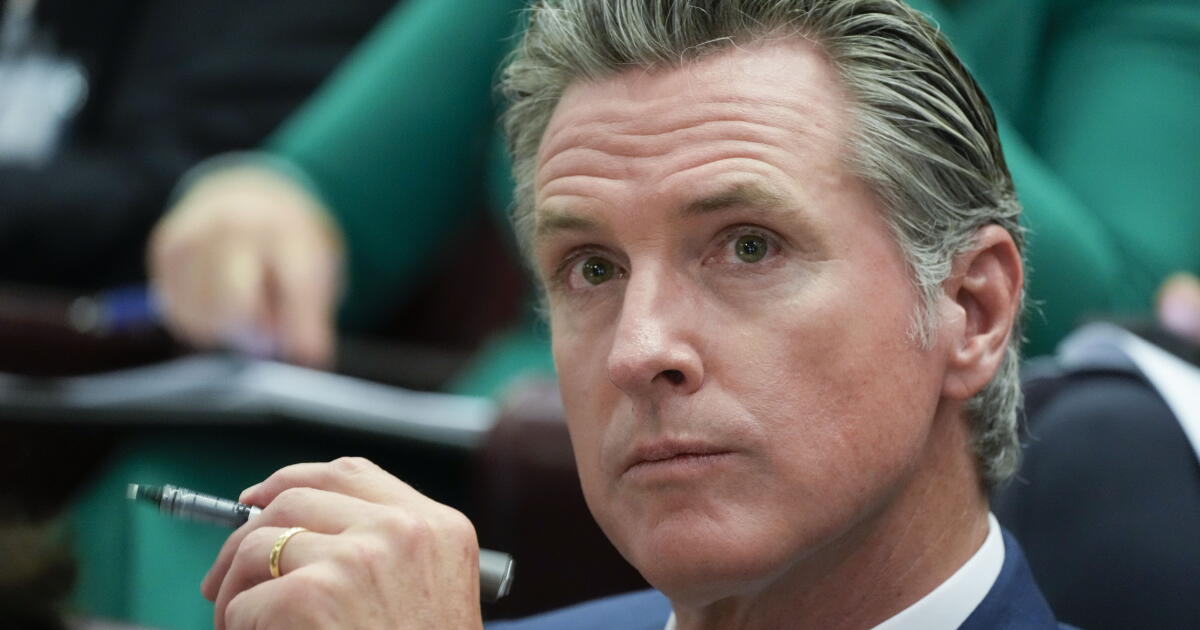
In an opulent hall in the Apostolic Palace framed in marble and adorned with Renaissance murals, Gov. Gavin Newsom waited in a line of governors, mayors and scientists for an opportunity to greet Pope Francis.
The queue wasn’t the ideal setup envisioned by the governor’s advisors. Newsom traveled more than 6,000 miles from California to the Vatican to give a speech before — and hopefully talk with — the pope about climate change.
Pope Francis, however, had other topics on his mind besides the warming planet.
“I was struck by how he immediately brought up the issue of the death penalty and how proud he was of the work we’re doing in California,” Newsom said afterward. “I was struck by that because I wasn’t anticipating that, especially in the context of this convening.”
The talk was brief and informal. But the politically astute head of the Roman Catholic Church still took advantage of the moment to support one of Newsom’s most controversial actions as governor.
Through executive order two months after his inauguration, Newsom issued a temporary moratorium on the death penalty and ordered the dismantling of the state’s execution chambers at San Quentin State Prison. Families of murder victims criticized the decision, and legal scholars called it an abuse of power.
Newsom’s refusal to impose the death penalty could hurt him politically if he runs for president.
As a Catholic, however, the governor’s decree is in line with the church and the pope’s teachings.
In an interview with The Times after he left the Vatican, Newsom said he has yet to propose a statewide ballot measure to abolish the death penalty because he doesn’t have confidence that it would pass. California voters rejected measures to ban executions in 2012 and 2016.
Newsom said recent polls conducted by his political advisors show soft support for a ban.
“We constantly put it in our surveys that I do,” Newsom said in an interview with The Times. “It’s in the margin. But I’m thinking a lot about this beyond that because we’re reimagining death row. I’m thinking about when I’m leaving; I mean, I’ve been pretty honest about that. I’m trying to figure out what more can I do in this space.”
There were more than 730 inmates on death row when Newsom took office. Death row at San Quentin was the largest of any prison in the Western Hemisphere. Under his plan to reform the prison to emphasize rehabilitation, Newsom said California is just weeks from emptying death row entirely.
The governor said he was outspoken about his opposition to capital punishment when he campaigned in 2018. He endorsed the 2012 and 2016 ballot measures to abolish the death penalty.
“I campaigned very openly as lieutenant governor, as governor. I went out of my way to say, ‘If you elect me, this is what I’m going to do,’” Newsom said. “And also I have the legal authority. So I wasn’t challenging that.”
Currently, 21 of the 50 states impose the death penalty. The remaining 29 either have no death penalty or paused executions due to executive action — including California, according to the Death Penalty Information Center.
Newsom’s moratorium might not play well with voters in some swing states in a potential presidential campaign, adding to perceptions that leftist California and the Democratic governor are soft on crime and misaligned with the rest of the nation. The governor has repeatedly dismissed speculation that he’s eyeing the White House, and he has actively campaigned for President Biden’s reelection.
Kevin Eckery, a political consultant who has worked with the Catholic Church in California, said the death penalty isn’t going to be a deciding factor in an election.
“Nationally, the death penalty has been carried out so infrequently for the last 50 years that I don’t see people voting based on your position on [the] death penalty,” Eckery said. “They are going to vote on pocketbook issues. They are going to vote on other things, but not that issue.”
The Catholic Church has long said the death penalty could be justified only in rare situations. Francis updated church doctrine in 2018 to say “the death penalty is inadmissible because it is an attack on the inviolability and dignity of the person.”
Newsom lunched in an arched courtyard covered in jasmine at the American Academy in Rome after he, in a speech at the Vatican, accused former President Trump of “open corruption” by soliciting campaign donations from oil executives.
Sitting in a weathered wood chair under the shade of a tree, the governor explained how his Catholic background and the inequities in the criminal justice system influenced his refusal to sign off on executions as governor.
His paternal grandparents were devout Catholics, and his late father, William Newsom, who served as a state appellate court justice, went to church every day growing up, he said.
Later in life, Newsom’s father considered himself “a Catholic of the distance,” the governor said, and “kind of pushed away” because of the politics of the church.
Newsom said Jesuit teachings at Santa Clara University, where he attended college, spoke a language he appreciated “of faith and works.” His own religious beliefs, he said, have always been exercised “around a civic frame.”
“The Bible teaches many parts, one body,” Newsom said, mentioning a quote he often references. “One part suffers, we all suffer, and this notion of communitarianism.
“You can’t get out of Santa Clara University without the requisite studies and sort of a religious baseline: God and common thought type frames,” he said.
As a Catholic and San Francisco native, Newsom said his beliefs follow “the Spirit of St. Francis” and the idea of being good to others, but not necessarily a strict religious doctrine.
The governor said he attended the private Catholic school École Notre Dame des Victoires in San Francisco for a short time during early elementary school. He said his family often attended Glide Memorial, a nondenominational church in San Francisco. The governor said he attended church on Easter with his family.
Newsom mentioned religion at other points during his trip, telling reporters outside the hall where he spoke at the Vatican about the importance of the bridge between science and the pope’s moral authority on climate change.
“As we know from church, it’s faith and works,” Newsom said. “So, as we pray, we move our feet. It’s that action with our passion.”
Daniel Philpott, a professor of political science at the University of Notre Dame, said it’s smart for politicians in either party to talk about faith.
“We’ve learned over the last 30 years that presidential candidates in general benefit when they can be shown to be religious, or practicing their religious faith,” Philpott said.
Newsom said he didn’t want to overplay the influence of religion on his position on the death penalty, which his father also opposed.
His father and grandfather were involved in the case of Pete Pianezzi, a friend who was wrongfully convicted of first-degree murder in the shooting and killing a gambler and busboy in Los Angeles in 1937.
Pianezzi escaped the death penalty by a single vote and served 13 years in prison. He was later exonerated.
Even if it were possible to limit inequity and wrongful convictions in the criminal justice system, Newsom said he would still be against the death penalty.
Receiving the pope’s support made Newsom reflect on the way he agonized over the decision before he issued the moratorium a few years ago, he said. The governor met with families of victims and sought guidance from others prior to his announcement.
“It just never made sense to me, the basic paradigm, that we were going to kill people to communicate to the general public that killing is wrong,” he said. “I could never understand that. I could never sanction that.”

Politics
Georgia Republicans head to runoff in secretary of state race defined by 2020 election claims

NEWYou can now listen to Fox News articles!
Vernon Jones and Tim Fleming are heading to a runoff after neither claimed at least 50% of the vote in Georgia’s Republican primary for secretary of state on Tuesday.
The Republican field included Jones, Fleming, Gabriel Sterling, Kelvin King and Ted Metz, while Democrats Cam Ashling, Dana Barrett, Adrian Consonery Jr. and Penny Brown Reynolds competed for their party’s nomination for Georgia’s top election officer.
The race underscored how disputes stemming from the 2020 presidential election, including claims from President Donald Trump that the contest was stolen, continue to shape debates over voting laws and election security years later.
2026 MIDTERMS: PRIMARIES, KEY RACES AND ELECTION RESULTS
The winner of the runoff on June 16 will advance to the general election in November, where control of the office overseeing voter registration, election certification and ballot administration is expected to remain a closely watched issue in one of the nation’s most competitive battleground states.
Sterling, Georgia’s former chief operating officer in the secretary of state’s office, entered the race with statewide name recognition after publicly defending Georgia’s handling of the 2020 election.
Jones, a former Democratic state lawmaker turned Trump ally, campaigned as a staunch supporter of the president and emerged as a fierce critic of the state’s election system.
REPORTER’S NOTEBOOK: DEMOCRATS SAY THEY CAN STILL FLIP THE HOUSE DESPITE GOP REDISTRICTING GAINS IN THE SOUTH
Vernon Jones, a former Democratic state lawmaker turned Republican ally of President Donald Trump, ran in Georgia’s GOP primary for secretary of state. (Elijah Nouvelage/Bloomberg/Getty Images)
King is a general contractor who previously ran for U.S. Senate and is married to State Election Board member and conservative commentator Janelle King.
Fleming previously worked in the secretary of state’s office when current Republican Gov. Brian Kemp held the position. The former chairman of the Georgia Republican Party pitched himself as a conservative focused on tightening election procedures.
CLICK HERE TO DOWNLOAD THE FOX NEWS APP
Candidates in Georgia’s secretary of state race are competing to oversee elections in one of the nation’s most closely watched battleground states. (Dustin Chambers/Bloomberg/Getty Images)
Metz, the Libertarian Party’s 2022 gubernatorial nominee, also joined the GOP primary field.
Georgia Secretary of State Brad Raffensperger, a Republican who drew national attention after rejecting efforts to overturn the state’s 2020 presidential election results, is running for governor.
This is a developing story. Check back for the latest election results and updates.
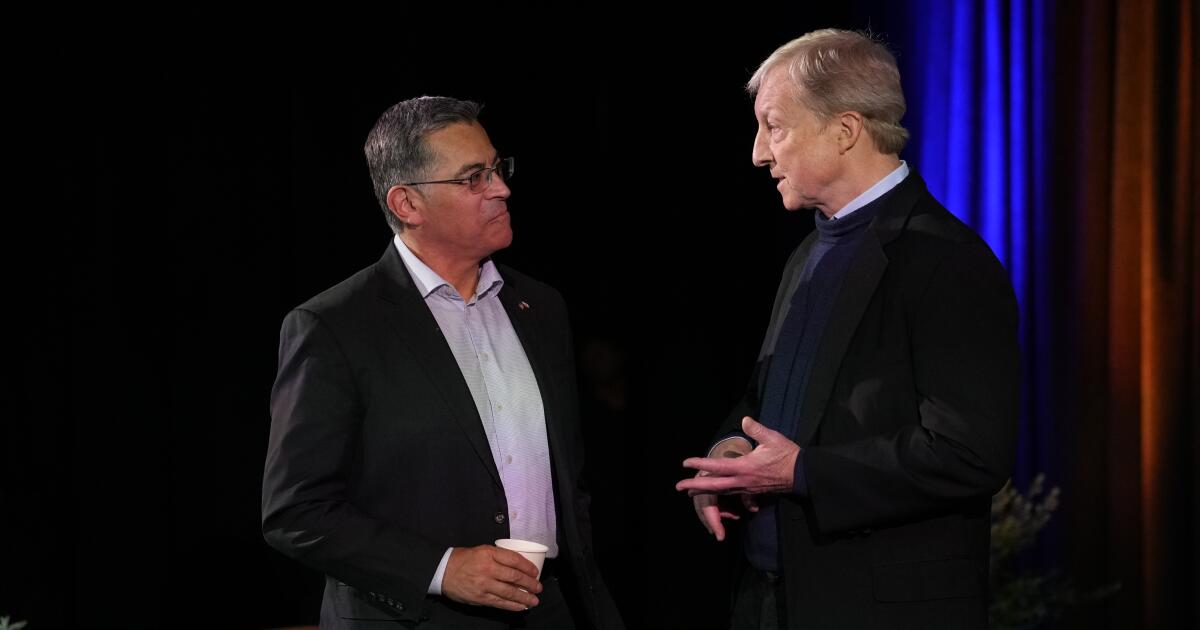
WASHINGTON — In the latest escalation of a fight over the use of paid social media creators, Tom Steyer’s campaign for governor filed a complaint Tuesday accusing influencers who posted content supportive of Xavier Becerra’s campaign of failing to disclose that they had been paid, which is required by California law.
One of the two influencers accused, however, said she had not been paid by the Becerra campaign to create posts supporting his candidacy.
The complaint, filed with California’s Fair Political Practices Commission, accuses Jay Gonzalez of producing at least 14 pro-Becerra posts on Instagram and Facebook in late April and early May, after he was hired by the campaign, and only belatedly editing the posts to acknowledge they had been sponsored by the campaign.
The complaint also said that a social media creator named Maggie Reed, who posts under the username mermaidmamamaggie, created four pro-Becerra posts on Instagram and had previously offered to create paid posts for another gubernatorial campaign.
The complaint alleges that Becerra’s campaign failed to disclose payments to both influencers in its campaign filings.
But Reed said she had not been paid by the Becerra campaign for her posts.
“I have never accepted, nor have I been offered, money from Xavier Becerra’s campaign. I endorsed Becerra because of his policies and proven track record,” Reed said in a statement.
The Becerra campaign maintained that it has not paid influencers who have created posts in support of the campaign.
“All of the content you see online is entirely and purely organic,” said Becerra spokesman Jonathan Underland.
Becerra and Steyer have been the top two Democratic candidates in recent polling for the governor’s race, with Becerra consistently maintaining a slight edge in those polls.
The complaint by Steyer’s campaign comes after two influencers who support Becerra filed a complaint last week accusing social media creators hired by the Steyer campaign of failing to disclose that they had been paid to produce their posts.
The campaign of the billionaire candidate for governor had previously disclosed payments to some influencers with large audiences, including one creator with the user name zayydante, who has 1.8 million followers on TikTok, and another with the user name littleyeg, who has nearly 350,000 followers on TikTok. The complaint filed last week said that both of these influencers failed to disclose that they had been paid by the campaign to produce content.
The complaint also highlighted several accounts created by user who don’t appear to live in California who created posts promoting Steyer and, in at least one case, posted elsewhere that they had been paid by the campaign.
The influencers who filed the original complaint said they saw the newly filed complaint as an attempt by Steyer’s campaign to deflect criticism.
“All he’s done is attack his opponent instead of taking accountability for violating the law,” said Kaitlyn Hennessy, one of the two influencers who filed the complaint against Steyer’s campaign. Hennessy and the other influencer who filed the complaint both said they have not been paid by the Becerra campaign.
In a post on Substack, Steyer defended his campaign’s use of paid social media influencers and said that it had been transparent about their use.
“Every creator we compensate has been and will be publicly disclosed as required by law,” he wrote.
Under a California law passed in 2023, social media creators who create paid content on behalf of a political campaign are required to disclose in their post that the material was sponsored and who paid for it.
The onus is on creators to provide the disclosure, but campaigns are required to notify influencers they hire of the requirement.
Violation of the rules doesn’t trigger criminal, civil or administrative penalties but the FPPC can take alleged offenders to court and ask a judge to force compliance with the law.
Politics
JD Vance says Trump is ‘locked and loaded’ to restart military campaign against Iran if nuclear talks fail

NEWYou can now listen to Fox News articles!
Vice President JD Vance said Tuesday that President Donald Trump is still pursuing a diplomatic deal with Iran but remains “locked and loaded” to restart the military campaign if nuclear talks collapse.
“It takes two to tango,” Vance told reporters at a White House press briefing. “We are not going to have a deal that allows the Iranians to have a nuclear weapon.
“So as the president just told me, we’re locked and loaded,” Vance added. “We don’t want to go down that pathway. But the president is willing and able to go down that pathway if we have to.”
The administration sees two paths forward, according to Vance: a negotiated agreement that permanently blocks Iran from obtaining a nuclear weapon, or renewed U.S. military action.
VANCE WARNS IRAN THAT ‘ANOTHER OPTION ON THE TABLE’ IF NUCLEAR DEAL NOT REACHED
Vice President JD Vance spoke during a news conference on anti-fraud initiatives in the Indian Treaty Room of the Eisenhower Executive Office Building on May 13, 2026, in Washington, D.C. The Trump administration warned states they could lose Medicaid funding if they fail to comply with federal anti-fraud statutes. (Daniel Heuer/Bloomberg via Getty Images)
“We think the Iranians want to make a deal,” Vance said. “The president of the United States has asked us to negotiate in good faith. And that’s exactly what we’ve done.”
But Vance warned that diplomacy will not come at the cost of Trump’s core demand that Tehran never obtain a nuclear weapon.
“There’s an option B, and the option B is that we could restart the military campaign to continue to prosecute the case, to continue to try to achieve America’s objectives,” Vance said. “But that’s not what the president wants. And I don’t think it’s what the Iranians want either.”
TRUMP WARNS IRAN’S ‘CLOCK IS TICKING’: MOVE ‘FAST’ OR ‘THERE WON’T BE ANYTHING LEFT’
U.S. President Donald Trump speaks to members of the media after returning to the White House on May 15, 2026 in Washington, DC. President Trump is returning to Washington from his trip to China, where he and President Xi addressed ways to enhance bilateral economic cooperation and investment, and agreed that Iran should not be allowed to have a nuclear weapon. ( (Kevin Dietsch/Getty Images)
The exchange came after Trump said he was just an hour away from ordering fresh attacks on Iran on Monday night.
“We were getting ready to do a very major attack [Tuesday], and I put it off for a little while — hopefully maybe forever,” Trump said, “because we’ve had very big discussions with Iran, and we’ll see what they amount to.”
“There seems to be a very good chance that they can work something out,” Trump told reporters at the White House. “If we can do that without bombing the hell out of them, I’d be very happy.”
The announcement marked the latest shift in Trump’s handling of the fragile ceasefire reached in mid-April. For weeks, the president has warned Iran that fighting could resume if it did not accept a deal, while repeatedly setting deadlines and then backing away from them.
Ships are anchored in the Strait of Hormuz off Bandar Abbas in southern Iran on May 4. A report on May 15 said a ship was seized off the coast of the United Arab Emirates and is being brought toward Iranian waters. (Amirhossein Khorgooei/ISNA/AFP via Getty Images)
CLICK HERE TO DOWNLOAD THE FOX NEWS APP
Over the weekend, Trump warned that “the Clock is Ticking” and said Iran needed to move “FAST, or there won’t be anything left of them.”
Trump first disclosed the pause in a social media post Monday, saying he had ordered the U.S. military to be ready “to go forward with a full, large scale assault of Iran, on a moment’s notice” if an acceptable deal is not reached.
-

 Los Angeles, Ca32 minutes ago
Sandy Fire forces evacuation of nearly 44,000 Simi Valley residents
-

 Detroit, MI56 minutes ago
Hart of Detroit Summer fest set for Juneteenth with Kash Doll and more
-

 San Francisco, CA1 hour ago
Headlines, May 20 – Streetsblog San Francisco
-

 Dallas, TX1 hour ago
One Surprise Dallas Cowboys Cut to Expect After OTAs
-

 Miami, FL1 hour ago
United States expected to indict Raúl Castro today. Here’s how to watch.
-

 Boston, MA1 hour ago
LinkedIn releases top 10 best employers for career growth in Boston
-

 Denver, CO2 hours ago
Battle Pussy Wants You to Know They Are Not Cute — The Denver VOICE
-

 Seattle, WA2 hours ago
New Exhibition Explores Seattle Black Panther Legacy Through Art And History

